Topics / #transformers
Transformers projects on GitHub
The transformer architecture and model libraries built on it.
As of , the most-starred Transformers projects on GitHub are transformers (167.8K stars), generative-ai-for-beginners (121.5K stars) and LLMs-from-scratch (106.7K stars). GitHub.Locker tracks 97 Transformers repositories with 1.9M stars combined. The fastest-growing on October 16 was ai-engineering-from-scratch, with +512 stars in a day.
Hot right now
Most stars gained in a day · Oct 16
 +512
+512ai-engineering-from-scratch
rohitg00/ai-engineering-from-scratch · ★ 70.5KA free, open-source AI engineering curriculum with 523 lessons across 20 phases (about 342 hours), teaching you to build AI systems from raw math up to autonomous agent swarms, in Python, TypeScript, Rust, and Julia.
 +159
+159airllm
lyogavin/airllm · ★ 39.1KAn open-source Python library that runs huge LLMs on tiny GPUs: a 70B model fits on a single 4GB card without quantization, distillation or pruning — even the 2.8T-parameter Kimi K3 runs in under 4GB.
 +134
+134Unlimited-OCR
baidu/Unlimited-OCR · ★ 27.7KIt's an open-source OCR model from Baidu built for one-shot parsing of long documents — the team positions it as pushing Deepseek-OCR one step further, with an arXiv paper backing the approach.
 +130
+130laya
NandhaKishorM/laya · ★ 33.2KLaya is a non-autoregressive decision engine: instead of generating text, it answers typed questions — multiple choice, a numeric score, or yes/no — about any text in a single forward pass, across 100+ languages. A built-in router detects the language and picks the right checkpoint per request.
The all-time top
97 projects · by stars
- 167.8K
 #1 · huggingface/transformers
transformers
Transformers is Hugging Face's model-definition framework for state-of-the-art machine learning models across text, vision, audio, video, and multimodal tasks, usable for both inference and training.
- 121.5K
 #2 · microsoft/generative-ai-for-beginners
generative-ai-for-beginners
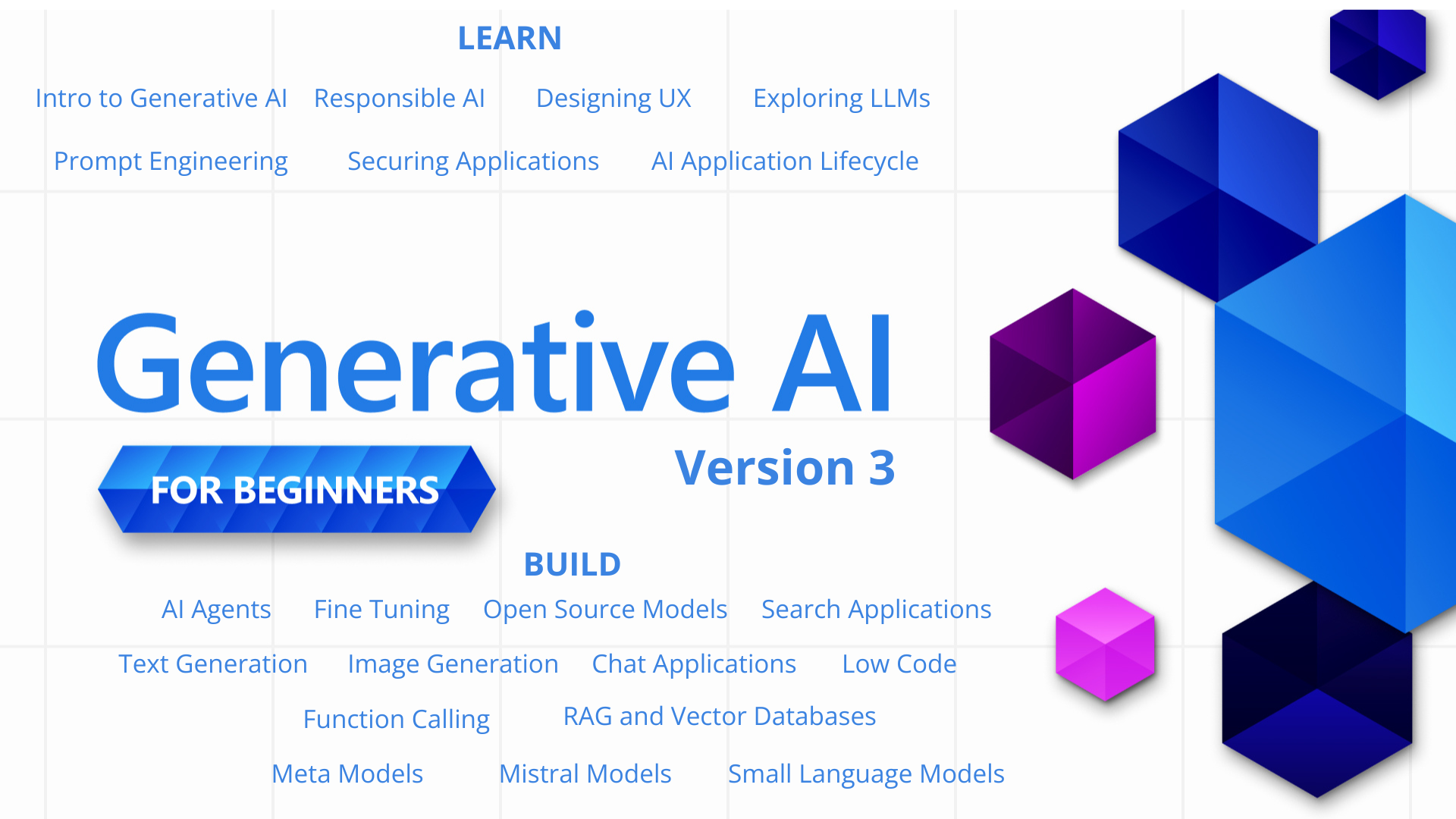
A 21-lesson course by Microsoft Cloud Advocates that teaches the fundamentals of building Generative AI applications, covering concepts like prompt engineering, chat apps, RAG, fine-tuning, and AI agents.
- 106.7K
 #3 · rasbt/LLMs-from-scratch
LLMs-from-scratch
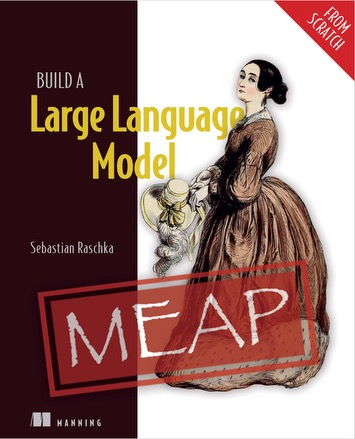
This is the official code repository for the book 'Build a Large Language Model (From Scratch)', which teaches you to implement a GPT-like LLM in PyTorch step by step, from tokenization through pretraining and finetuning.
- 4
LlamaFactory
75.5Khiyouga/LlamaFactory · PythonLlamaFactory unifies efficient fine-tuning of 100+ large language models and vision-language models in one Python toolkit, published as an ACL 2024 paper.
- 5
ai-engineering-from-scratch
70.5Krohitg00/ai-engineering-from-scratch · PythonA free, open-source AI engineering curriculum with 523 lessons across 20 phases (about 342 hours), teaching you to build AI systems from raw math up to autonomous agent swarms, in Python, TypeScript, Rust, and Julia.
- 6
annotated_deep_learning_paper_implementations
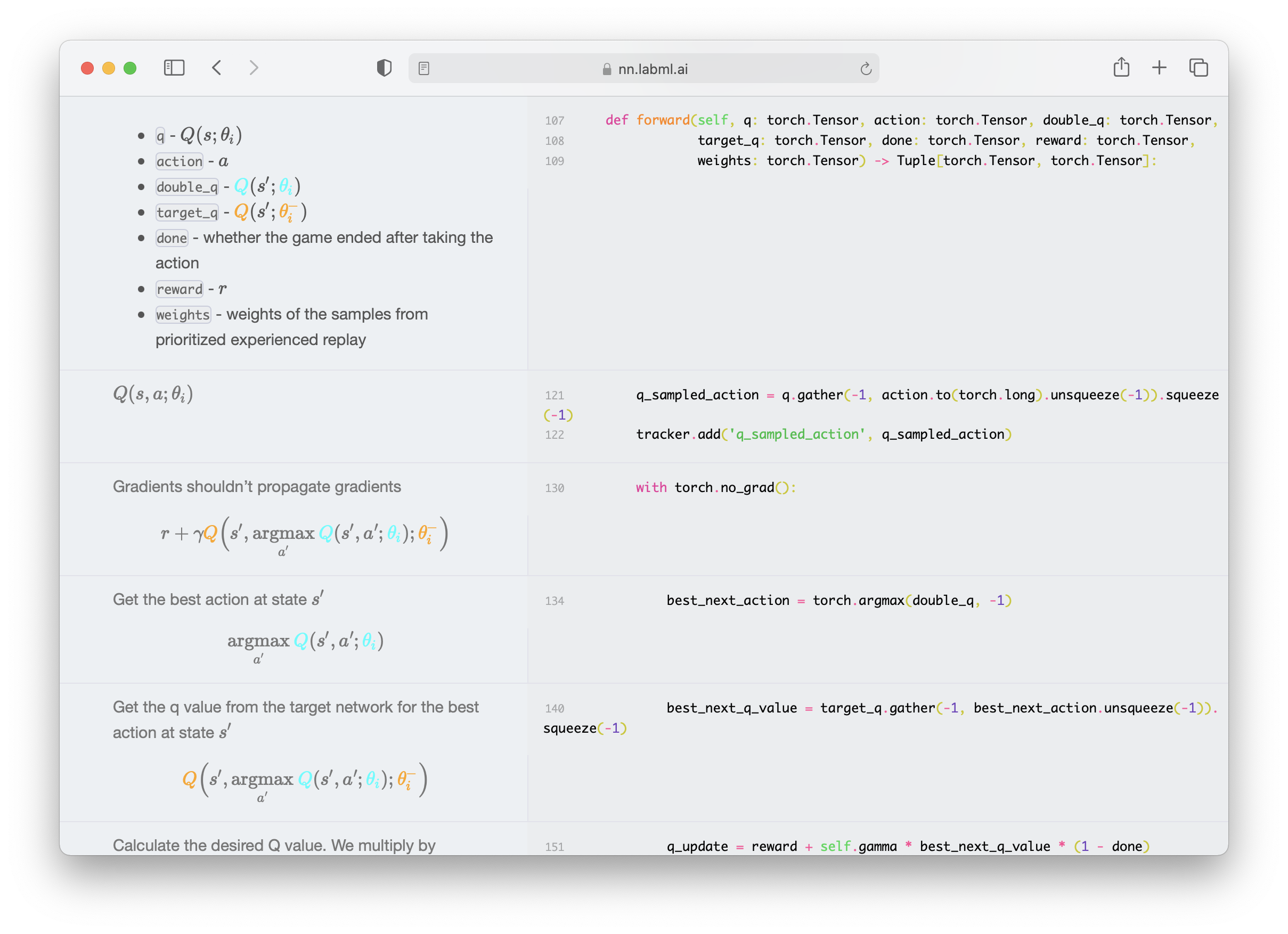
67.6Klabmlai/annotated_deep_learning_paper_implementations · PythonA collection of 60+ PyTorch implementations of deep learning papers, each annotated with side-by-side explanatory notes so you can read the code and the math/explanation together.
- 7

minimind
63.9Kjingyaogong/minimind · PythonMiniMind is an open-source project that lets you train a tiny large language model (around 64M parameters) completely from scratch, in about 2 hours on a single RTX 3090 for roughly the cost of 3 RMB in GPU rental.
- 8

VibeVoice
54.9Kmicrosoft/VibeVoice · PythonVibeVoice is Microsoft's family of open-source voice AI models covering text-to-speech and speech recognition: long-form multi-speaker TTS, real-time streaming TTS, and ASR built for hour-long recordings.
- 9

BettaFish
42.4K666ghj/BettaFish · PythonBettaFish (Chinese name 'Weiyu'/微舆) is a from-scratch multi-agent public opinion analysis system that monitors social media and large volumes of public comments, then produces reports to help break information bubbles and support decision-making.
- 10
airllm
39.1Klyogavin/airllm · Jupyter NotebookAn open-source Python library that runs huge LLMs on tiny GPUs: a 70B model fits on a single 4GB card without quantization, distillation or pruning — even the 2.8T-parameter Kimi K3 runs in under 4GB.
- 11

detectron2
34.9Kfacebookresearch/detectron2 · PythonDetectron2 is Facebook AI Research's next-generation library for object detection, segmentation and other visual recognition tasks, with state-of-the-art algorithms.
- 12

happy-llm
34.4Kdatawhalechina/happy-llm · Jupyter NotebookHappy-LLM is Datawhale's free open-source LLM course: a systematic tutorial that goes from NLP basics and the Transformer architecture to building and training your first large language model, then applying it with RAG and agents.
- 13
laya
33.2KNandhaKishorM/laya · PythonLaya is a non-autoregressive decision engine: instead of generating text, it answers typed questions — multiple choice, a numeric score, or yes/no — about any text in a single forward pass, across 100+ languages. A built-in router detects the language and picks the right checkpoint per request.
- 14

smolagents
29.9Khuggingface/smolagents · Pythonsmolagents is a lightweight Python library for building AI agents that write their actions as Python code instead of JSON tool calls, letting you run powerful agents in just a few lines of code.
- 15

llama3
29.2Kmeta-llama/llama3 · PythonMeta's official GitHub home for Llama 3: model weights plus minimal code for running inference on pre-trained and instruction-tuned models in 8B and 70B sizes. The repo is now deprecated.
- 16

Qwen3
27.7KQwenLM/Qwen3 · PythonQwen3 is a series of open-weight large language models built by the Qwen team at Alibaba Cloud, released as both dense and Mixture-of-Experts (MoE) models from 0.6B up to 235B-A22B parameters, with switchable 'thinking' and 'non-thinking' reasoning modes.
- 17
Unlimited-OCR
27.7Kbaidu/Unlimited-OCR · PythonIt's an open-source OCR model from Baidu built for one-shot parsing of long documents — the team positions it as pushing Deepseek-OCR one step further, with an arXiv paper backing the approach.
- 18

MiniCPM-V
26.8KOpenBMB/MiniCPM-V · PythonA family of pocket-sized multimodal AI models from OpenBMB (MiniCPM-V and MiniCPM-o) built to run on local devices, even phones — understanding images, video and text, and in the o-series also speech.
- 19
open-r1
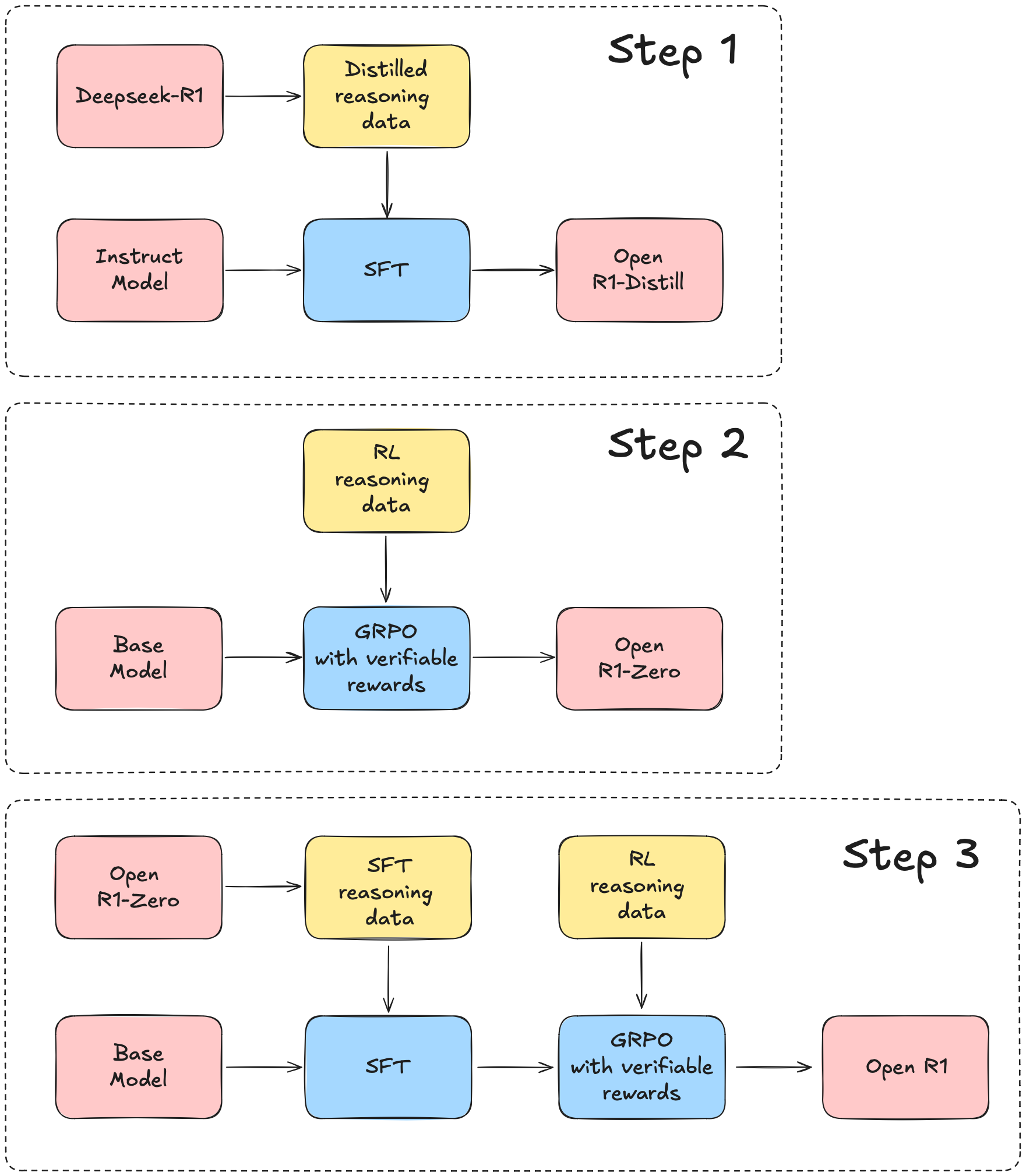
26.5Khuggingface/open-r1 · PythonOpen R1 is a fully open effort to reproduce the training pipeline behind DeepSeek-R1, providing scripts to run SFT and GRPO training, generate synthetic reasoning data, and evaluate the resulting reasoning models.
- 20

deep-learning-for-image-processing
26.4KWZMIAOMIAO/deep-learning-for-image-processing · PythonA video-based deep learning course that walks through classic computer-vision architectures for image classification, object detection, segmentation and keypoint detection, pairing each network with a lecture and runnable code.
- 21

faster-whisper
25.9KSYSTRAN/faster-whisper · PythonA Python reimplementation of OpenAI's Whisper model on CTranslate2, a fast Transformer inference engine — up to 4x faster than the original at the same accuracy, using less memory, with optional 8-bit quantization on CPU and GPU.
- 22
shap
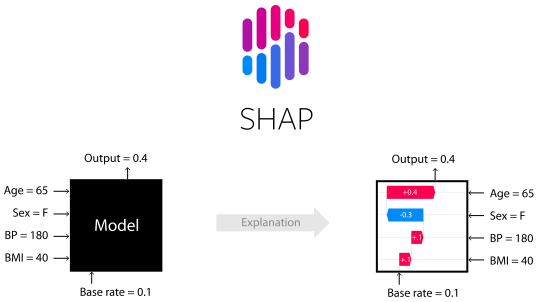
25.8Kshap/shap · Jupyter NotebookSHAP is a Python library that explains the output of any machine learning model using Shapley values from game theory — it tells you how much each feature contributed to a given prediction.
- 23

vit-pytorch
25.6Klucidrains/vit-pytorch · PythonA PyTorch implementation of the Vision Transformer (ViT), an image classification model that reaches SOTA results using just a single transformer encoder instead of convolutions.
- 24

minGPT
25Kkarpathy/minGPT · PythonminGPT is a minimal PyTorch re-implementation of OpenAI's GPT, covering both training and inference, written to be small and easy to read rather than production-optimized.
- 25

DeepSeek-OCR
24Kdeepseek-ai/DeepSeek-OCR · PythonDeepSeek-OCR is a vision-language model built to explore 'contexts optical compression' -- squeezing text-heavy document images into a small number of vision tokens that an LLM can still read back accurately, as a research probe into how much text a vision encoder can represent visually.
- 26
verl
23.9Kverl-project/verl · Pythonverl is a flexible, efficient and production-ready reinforcement learning training library for LLMs, initiated by ByteDance's Seed team and maintained by the community. It is the open-source version of the HybridFlow paper (EuroSys 2025).
- 27

CVPR2026-Papers-with-Code
22.9Kamusi/CVPR2026-Papers-with-CodeA curated, continuously updated index of CVPR 2026 papers and their open-source code implementations, organized by computer vision topic (object detection, segmentation, 3D reconstruction, diffusion models, multimodal LLMs, etc.).
- 28

Qwen
21.9KQwenLM/Qwen · PythonThe official repo of Qwen (通义千问, Tongyi Qianwen) — Alibaba Cloud's family of chat and pretrained large language models, released in sizes from 1.8B up to 72B parameters on Hugging Face and ModelScope.
- 29

guidance
21.8Kguidance-ai/guidance · Jupyter NotebookGuidance is a Python library — an efficient programming paradigm for steering large language models: you control how output is structured while reducing latency and cost compared with conventional prompting or fine-tuning.
- 30

peft
21.8Khuggingface/peft · PythonHugging Face's library of Parameter-Efficient Fine-Tuning methods: you adapt a large pretrained model by training only a small number of extra parameters instead of all of them, which slashes compute and storage costs.
- 31

gpt-oss
20.5Kopenai/gpt-oss · PythonThe gpt-oss series: two open-weight language models from OpenAI — gpt-oss-120b and gpt-oss-20b — built for powerful reasoning, agentic tasks, and versatile developer use cases. The repo itself adds reference implementations, tools, and example clients around the models.
- 32

ml-engineering
19.5Kstas00/ml-engineering · PythonAn open book on machine learning engineering: methodologies, tools and step-by-step instructions for training, fine-tuning and running inference on large language models and multi-modal (VLM) models, written by the engineer who led the BLOOM-176B training.
- 33

trl
19.5Khuggingface/trl · PythonTRL (Transformers Reinforcement Learning) is a Hugging Face library for post-training foundation models — fine-tuning them with techniques like SFT, GRPO and DPO on top of the Transformers stack.
- 34
sentence-transformers
19.2Khuggingface/sentence-transformers · PythonSentence Transformers is a framework for computing embeddings and using or training state-of-the-art embedding and reranker models, covering dense sentence embeddings, cross-encoder rerankers, sparse encoders, and multi-vector (ColBERT-style) encoders.
- 35

Chinese-LLaMA-Alpaca
18.9Kymcui/Chinese-LLaMA-Alpaca · PythonOpen-source Chinese LLaMA and Alpaca large language models. The base LLaMA was extended with a Chinese vocabulary and further pre-trained on Chinese data, and Alpaca versions were instruction-tuned on Chinese instructions; training and deployment scripts are open too.
- 36

DocsGPT
18.3Karc53/DocsGPT · PythonDocsGPT is a private, self-hosted AI platform for building agents, assistants, and enterprise search tools, with a built-in Agent Builder, document analysis, deep research mode, and support for multiple LLM providers.
- 37
Megatron-LM
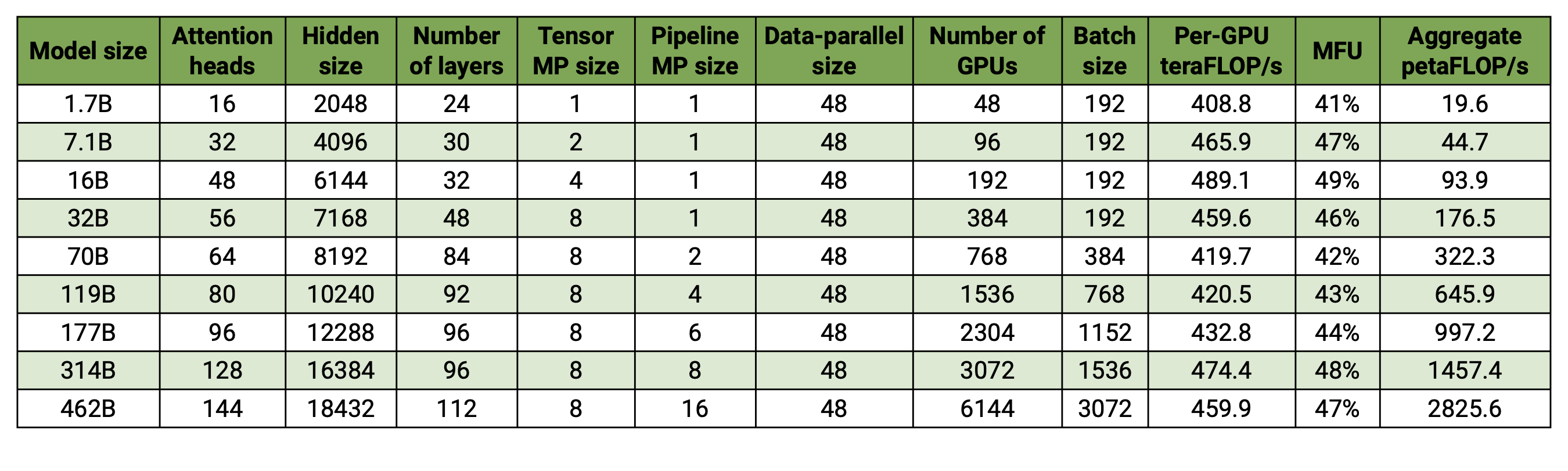
18.2KNVIDIA/Megatron-LM · PythonNVIDIA's open-source toolkit for training large transformer (LLM) models at scale. It comes as Megatron-LM, a reference setup with ready training scripts, and Megatron Core, a composable library of GPU-optimized building blocks for training models across thousands of GPUs.
- 38
Qwen3-Coder
16.8KQwenLM/Qwen3-Coder · PythonQwen3-Coder is the code-focused branch of the Qwen3 large language model family from the Qwen team — open-weight models built for coding and agentic tasks, available in several sizes.
- 39

Awesome-pytorch-list
16.7Kbharathgs/Awesome-pytorch-listA curated, large-scale list of PyTorch-related projects on GitHub: models, libraries, tools, tutorials, books and paper implementations organized by category.
- 40

transformers.js
16.3Khuggingface/transformers.js · JavaScriptTransformers.js lets you run Hugging Face's state-of-the-art machine learning models directly in a web browser, with no server required, using an API designed to mirror the Python transformers library.
- 41

outlines
15.9Kdottxt-ai/outlines · PythonOutlines is an open-source Python library that makes LLMs return guaranteed-valid structured output — the structure is enforced during generation itself, so there is no fragile parsing or regex repair afterwards.
- 42
ms-swift
15.9Kmodelscope/ms-swift · Pythonms-swift is the ModelScope community's fine-tuning and deployment framework for LLMs and multimodal models, covering training, inference, evaluation, quantization and deployment in one pipeline.
- 43
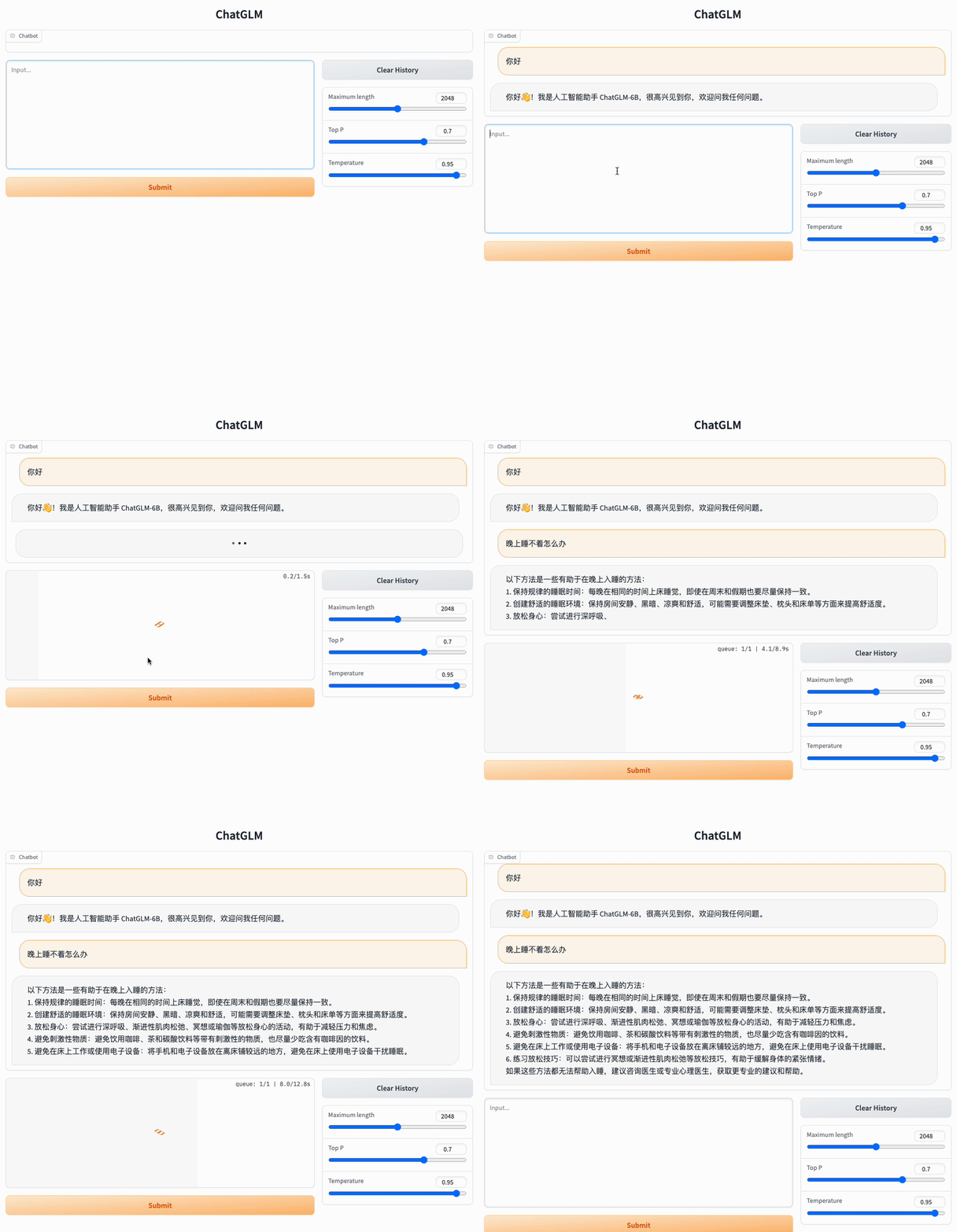
ChatGLM2-6B
15.5Kzai-org/ChatGLM2-6B · PythonChatGLM2-6B is an open bilingual (Chinese-English) conversational language model with 6 billion parameters, the second generation of ChatGLM-6B from Zhipu AI (Z.ai).
- 44

detr
15.3Kfacebookresearch/detr · PythonDETR is Facebook AI Research's object detection model that treats detection as a direct set prediction problem using a Transformer encoder-decoder, replacing the usual hand-crafted detection pipeline (anchors, NMS, etc).
- 45
RWKV-LM
14.8KBlinkDL/RWKV-LM · PythonRWKV (pronounced 'RwaKuv') is an RNN architecture with transformer-level LLM performance that can also be trained in parallel like GPT. The current generation, RWKV-7 'Goose', is 100% attention-free, linear-time and constant-memory (no kv-cache).
- 46

flair
14.4KflairNLP/flair · PythonFlair is a very simple framework for state-of-the-art natural language processing: a Python library for applying pre-trained NLP models to your text, developed by Humboldt University of Berlin and friends. The current release is version 0.15.1.
- 47
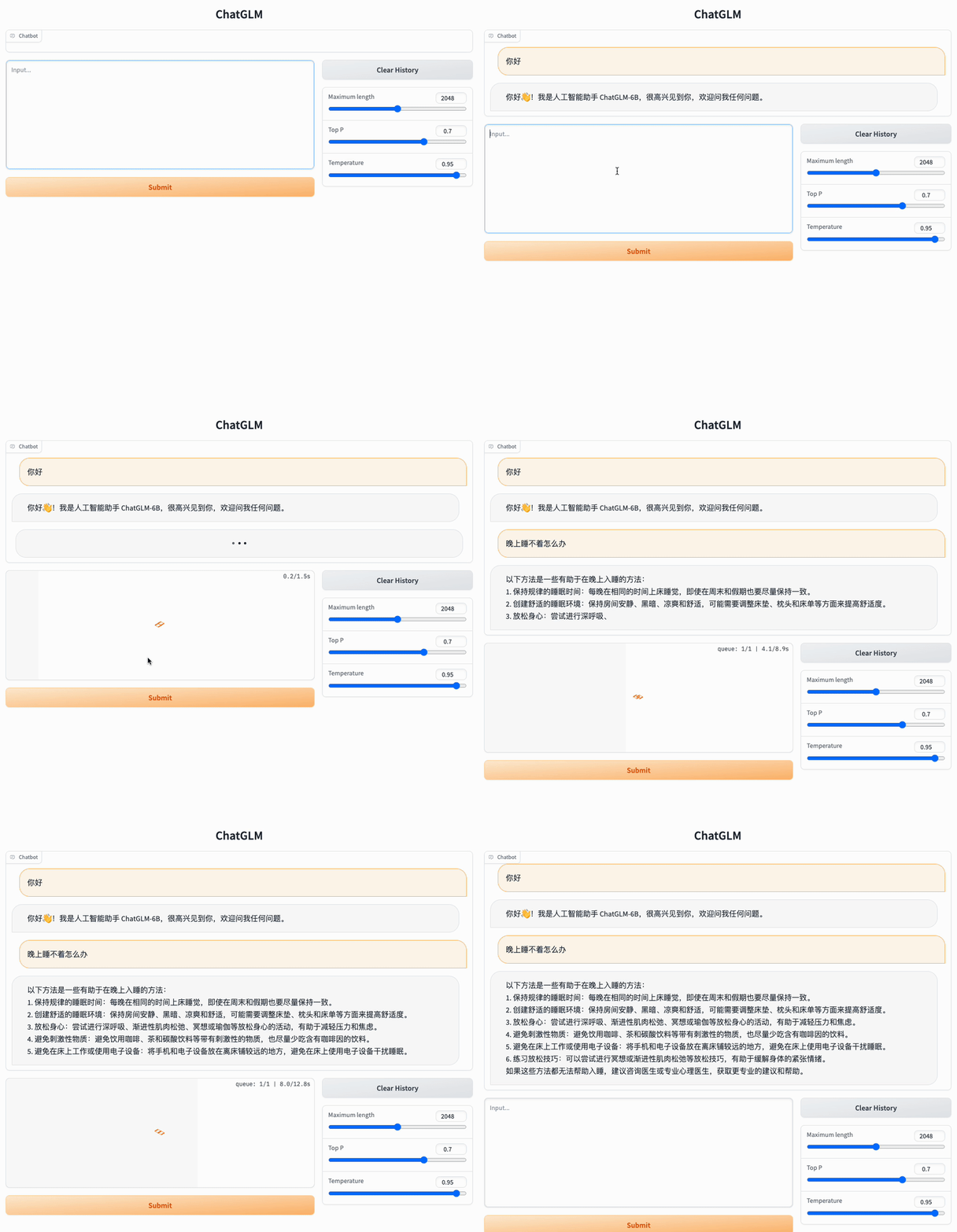
ChatGLM3
13.6Kzai-org/ChatGLM3 · PythonChatGLM3 is a series of open bilingual (Chinese-English) chat large language models released jointly by Zhipu AI and Tsinghua University's KEG Lab, including a 6B-parameter chat model, its base model, and 32K/128K long-context variants.
- 48
txtai
13Kneuml/txtai · Pythontxtai is an all-in-one AI framework for semantic search, LLM orchestration and language model workflows. Its core is an embeddings database that combines vector indexes, graph networks and relational databases to power search or serve as a knowledge source for LLM apps.
- 49

PaddleNLP
13KPaddlePaddle/PaddleNLP · PythonPaddleNLP is a large language model (LLM) and small language model (SLM) development toolkit built on the PaddlePaddle deep learning framework, offering efficient training, lossless compression, and high-performance inference for large models.
- 50
train-llm-from-scratch
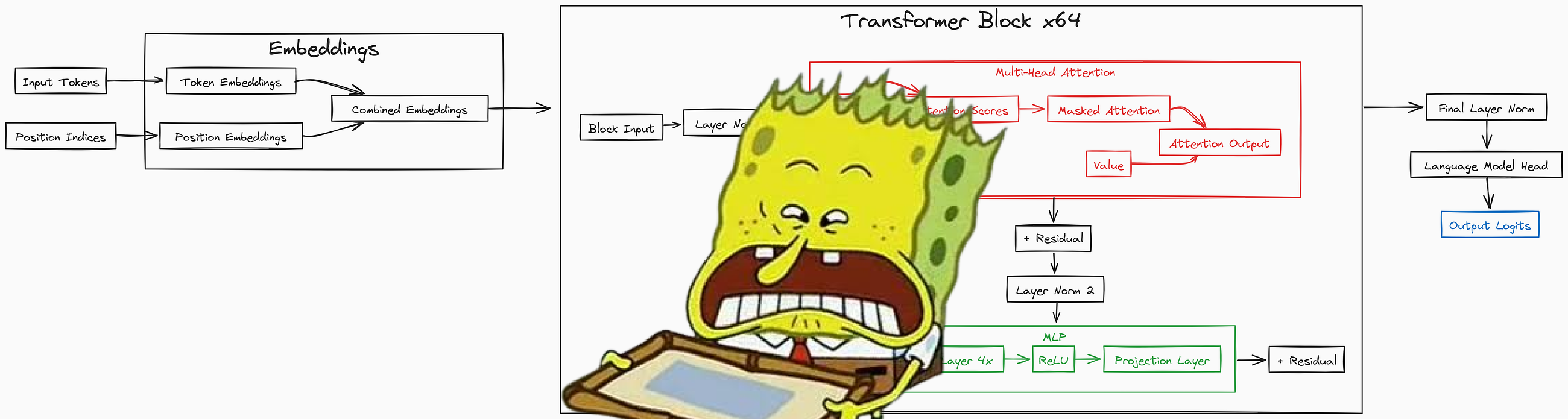
12.2KFareedKhan-dev/train-llm-from-scratch · PythonA from-scratch tutorial and codebase for training your own LLM end to end: tokenizing raw text, pretraining a GPT-style Transformer, and then post-training it with SFT, a reward model, DPO/ORPO/KTO, PPO and GRPO into an aligned, reasoning-style assistant.
- 51

seamless_communication
11.9Kfacebookresearch/seamless_communication · Jupyter NotebookSeamless Communication is Meta's family of foundational AI models for speech and text translation across roughly 100 languages, covering speech-to-speech, speech-to-text, text-to-speech and text-to-text translation plus automatic speech recognition.
- 52
speechbrain
11.9Kspeechbrain/speechbrain · PythonAn open-source, PyTorch-based toolkit for Conversational AI — the technology behind speech assistants and chatbots. It bundles training recipes and pretrained models for a wide range of speech and text processing tasks.
- 53

allennlp
11.9Kallenai/allennlp · PythonAllenNLP is an open-source NLP research library built on PyTorch for developing state-of-the-art deep learning models across a wide range of linguistic tasks.
- 54
ludwig
11.8Kludwig-ai/ludwig · PythonLudwig is a declarative deep learning framework that lets you train, fine-tune, and deploy AI models — from LLM fine-tuning to tabular classification — using a YAML config file and zero boilerplate Python.
- 55

segmentation_models.pytorch
11.8Kqubvel-org/segmentation_models.pytorch · PythonA Python library for building image semantic segmentation models in PyTorch, with over 500 pretrained convolutional and transformer-based backbones.
- 56

Transformers-Tutorials
11.8KNielsRogge/Transformers-Tutorials · Jupyter NotebookA collection of Jupyter notebook demos showing how to use HuggingFace's Transformers library in PyTorch, covering models like BERT, GPT-2, LayoutLM, DETR, Donut and many more.
- 57
dinov3
11.6Kfacebookresearch/dinov3 · Jupyter NotebookMeta AI Research (FAIR)'s reference PyTorch implementation and model release for DINOv3, a family of vision foundation models that produce high-quality dense features and perform strongly across many vision tasks.
- 58

presidio
11.4Kdata-privacy-stack/presidio · PythonAn open-source framework (SDK) that detects, redacts, masks and anonymizes sensitive data (PII) — names, credit card numbers, SSNs, phone numbers — in text, images and structured data.
- 59

LAVIS
11.3Ksalesforce/LAVIS · Jupyter NotebookLAVIS is a Python deep learning library for language-and-vision research, offering a unified interface to 10+ multimodal tasks, 20+ datasets, and 30+ pretrained foundation models like BLIP, BLIP-2, ALBEF, and CLIP.
- 60

tokenizers
11.2Khuggingface/tokenizers · RustTokenizers is a library implementing today's most-used tokenizers (BPE, WordPiece, Unigram) for NLP, built in Rust for speed and exposed to other languages via bindings. It's made by Hugging Face and powers tokenization for transformer models.
- 61
skills
11.2Khuggingface/skills · PythonThis repo provides modular 'Agent Skills' — SKILL.md definitions that teach AI coding agents (Claude Code, Codex, Gemini CLI, Cursor) how to do Hugging Face ML tasks like managing models/datasets, training, evaluation, and deploying to Spaces or SageMaker.
- 62

qlora
11Kartidoro/qlora · Jupyter NotebookQLoRA is a research method and code release for efficiently finetuning large quantized language models. It backpropagates gradients through a frozen 4-bit quantized model into small LoRA adapters, cutting memory use enough to finetune a 65B model on a single 48GB GPU while matching full 16-bit finetuning quality.
- 63
openvino
11Kopenvinotoolkit/openvino · C++OpenVINO is Intel's open-source toolkit for optimizing and deploying AI inference — it takes trained deep learning models for vision, speech, NLP, and generative AI and runs them faster, from edge devices to cloud servers.
- 64

dolly
10.8Kdatabrickslabs/dolly · PythonDolly is Databricks' instruction-following large language model, trained on the Databricks Machine Learning Platform and licensed for commercial use; the flagship dolly-v2-12b derives from EleutherAI's Pythia-12b.
- 65

nlp_course
10.7Kyandexdataschool/nlp_course · Jupyter NotebookThis is the Yandex School of Data Analysis (YSDA) Natural Language Processing course: a full set of lecture slides, seminar notebooks, and homework assignments organized by week, covering NLP from word embeddings through modern LLM topics.
- 66

petals
10.6Kbigscience-workshop/petals · PythonPetals lets you run big open LLMs at home, BitTorrent-style: you join a public swarm that serves models like Llama 3.1 (405B), Mixtral (8x22B), Falcon (40B+) and BLOOM (176B) for inference and fine-tuning right from your desktop or Google Colab, up to 10x faster than offloading.
- 67

RTranslator
10.5Kniedev/RTranslator · JavaRTranslator is an open-source Android app that translates conversations in real time. Speech recognition and translation run entirely on your phone — no cloud service behind it.
- 68

Chinese-BERT-wwm
10.2Kymcui/Chinese-BERT-wwm · PythonThis project releases a family of pre-trained Chinese BERT models trained with Whole Word Masking (WWM), including BERT-wwm, BERT-wwm-ext, RoBERTa-wwm-ext, RoBERTa-wwm-ext-large, and smaller RBT3/RBT4/RBT6/RBTL3 variants, published alongside a paper in IEEE/ACM TASLP.
- 69
InternVL
10.2KOpenGVLab/InternVL · PythonA family of open-source multimodal chat models that understand images, video and text, positioned as an open alternative to GPT-4o. InternVL2.5-78B was the first open-source model to top 70% on the MMMU benchmark.
- 70

Soup
9.2KMakazhanAlpamys/Soup · PythonSoup is a command-line tool for fine-tuning and post-training LLMs from a single YAML config file, automating GPU detection, batching and quantization so you just write a config and run one command.
- 71
maths-cs-ai-compendium
7.7KHenryNdubuaku/maths-cs-ai-compendium · TypeScriptAn open, unconventional online textbook covering maths, computing and AI from the ground up — intuition first, real-world context, for practitioners who want deep understanding rather than exam survival.
- 72
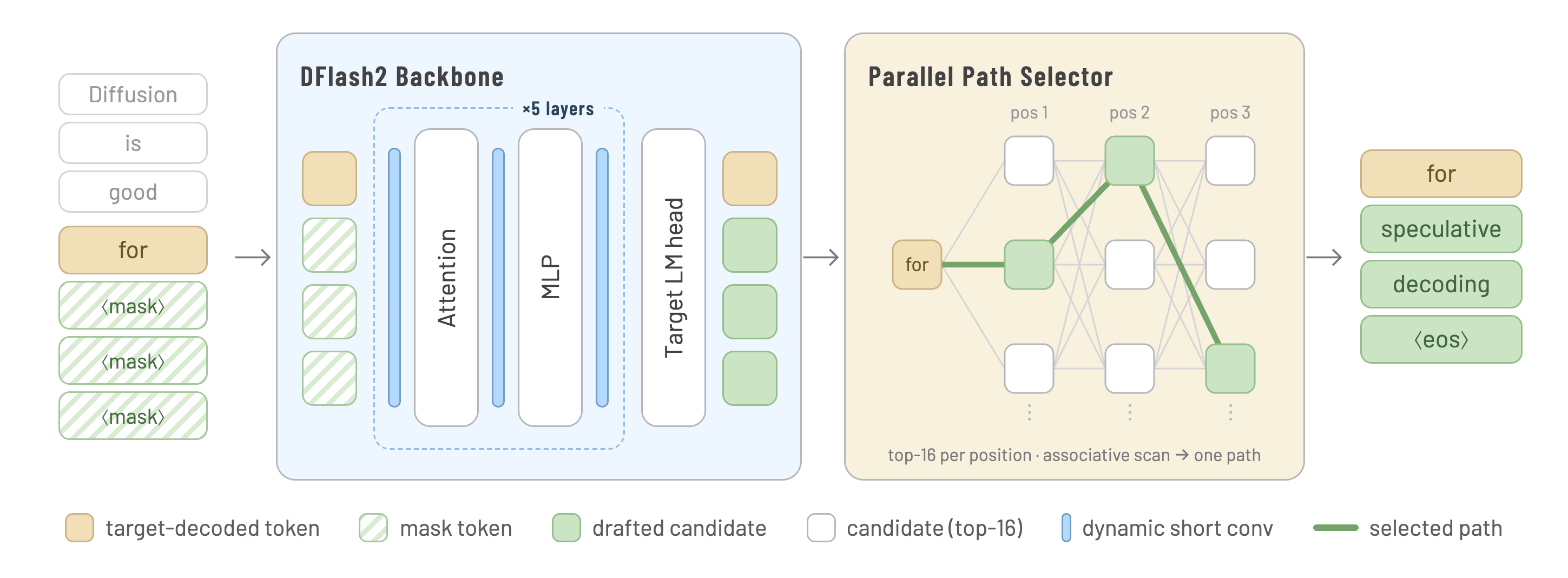
dflash
6.2Kz-lab/dflash · PythonDFlash is a lightweight block diffusion model built for speculative decoding, drafting tokens in parallel blocks so a larger target LLM can verify them faster than generating one token at a time.
- 73
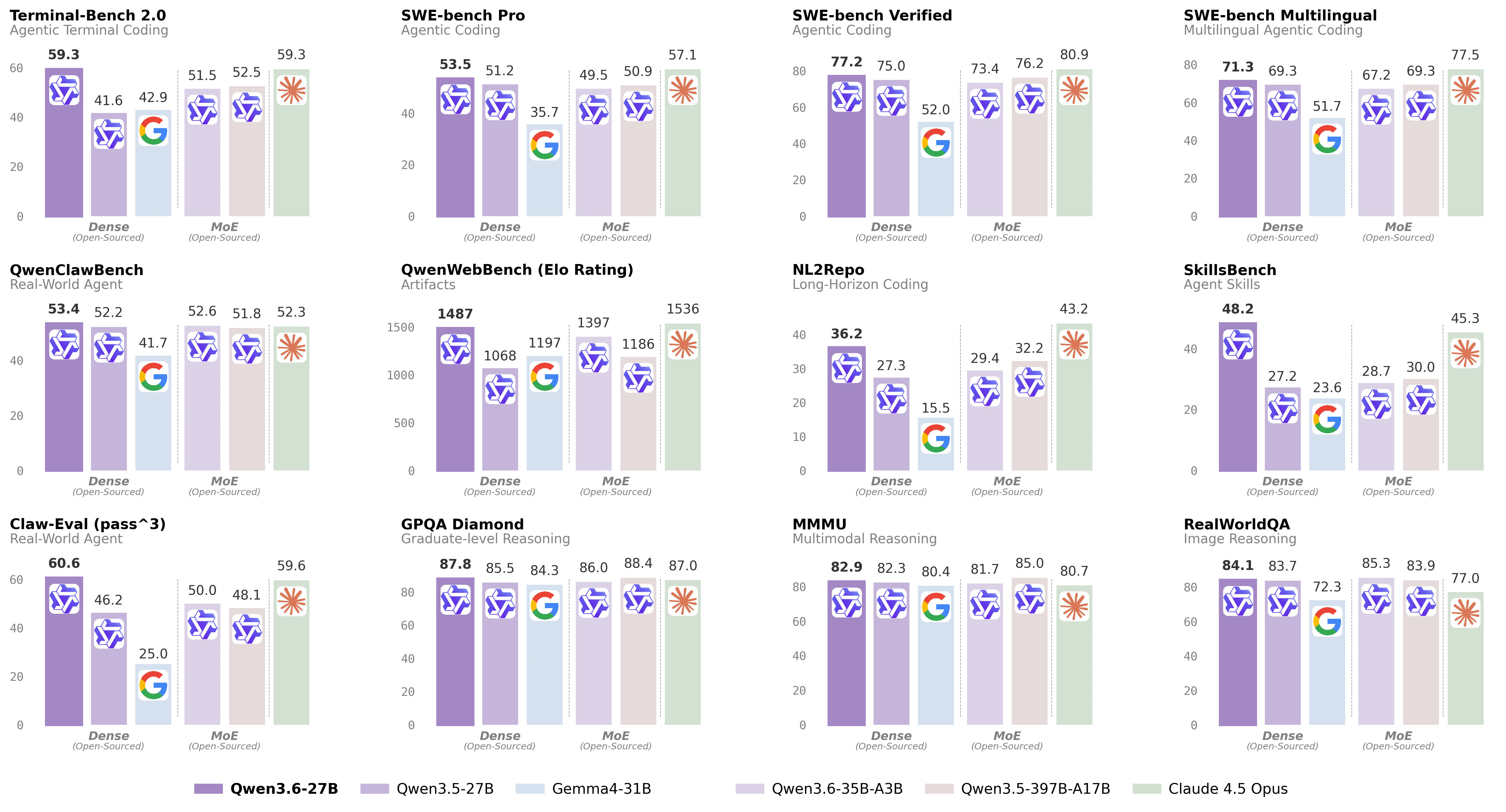
Qwen3.8
4.3KQwenLM/Qwen3.8Qwen3.8 is the latest open large language model release from Alibaba's Qwen team, part of the Qwen3.5 series that also includes Qwen3.5 and Qwen3.6, aimed at coding, professional work, research, and long-horizon agentic tasks.
- 74

Qwen3-Omni
4.1KQwenLM/Qwen3-Omni · Jupyter NotebookQwen3-Omni is a family of open, natively end-to-end omni-modal LLMs from Alibaba's Qwen team: they take text, images, audio and video as input and stream back answers as text or natural speech in real time.
- 75

Qwen3-ASR
3.7KQwenLM/Qwen3-ASR · PythonQwen3-ASR is Alibaba's open-source family of speech recognition models: two all-in-one models (0.6B and 1.7B) that do language identification and transcription for 52 languages and dialects, plus a separate forced-alignment model that produces word-level timestamps.
- 76

Attention-Residuals
3.5KMoonshotAI/Attention-ResidualsAttnRes (Attention Residuals) is a drop-in replacement for standard residual connections in Transformers, letting each layer use learned, input-dependent attention over all previous layer outputs instead of simple additive accumulation.
- 77
ZDTaichu5.0-9B
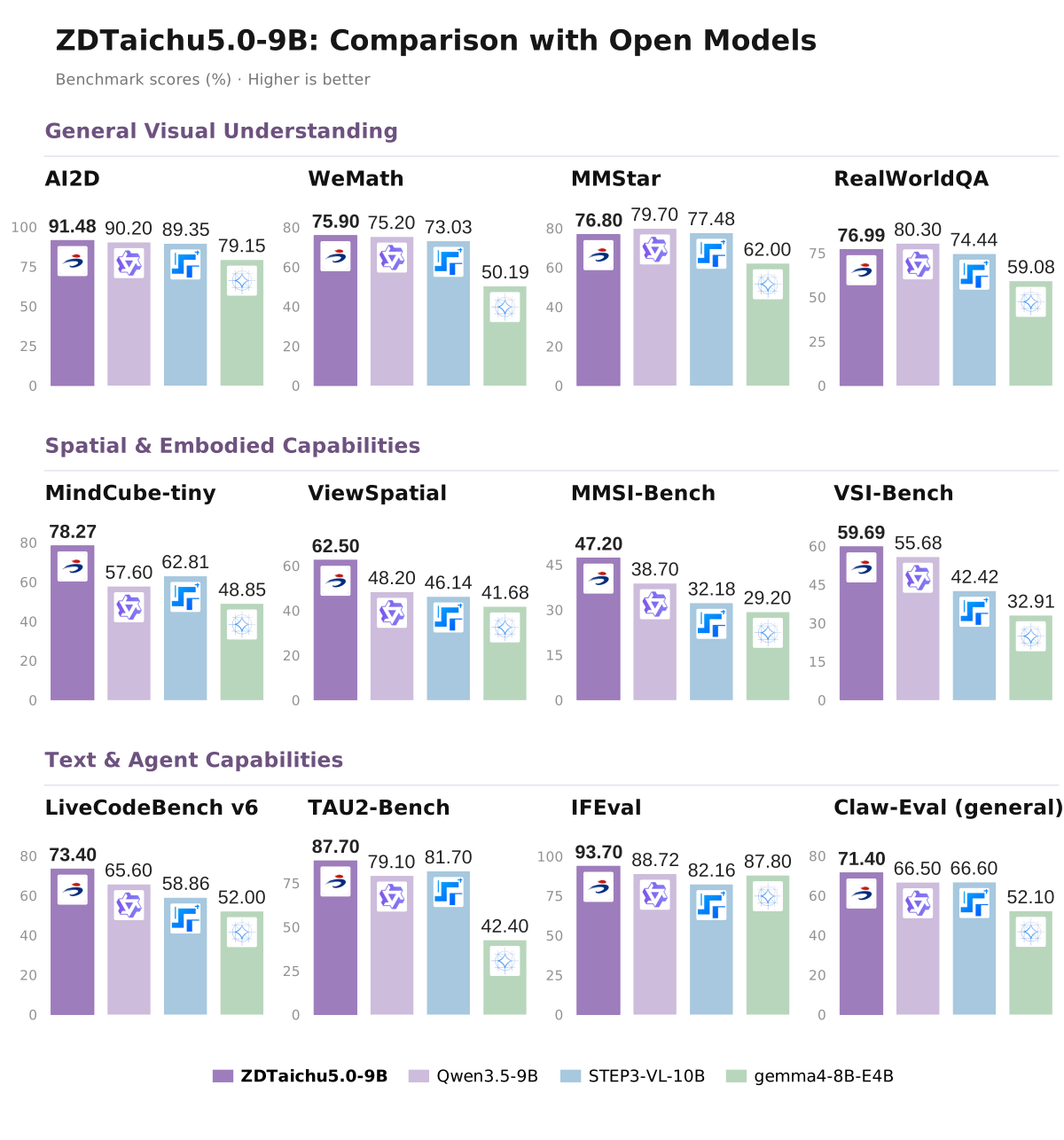
3.1KTaichu-AI/ZDTaichu5.0-9B · PythonZDTaichu5.0-9B is a multimodal foundation model that combines a Qwen3.5-9B language backbone with a C-RADIOv4-H vision encoder for general visual understanding, spatial reasoning, embodied-AI research and agentic tool use.
- 78
WeMM-Embedding
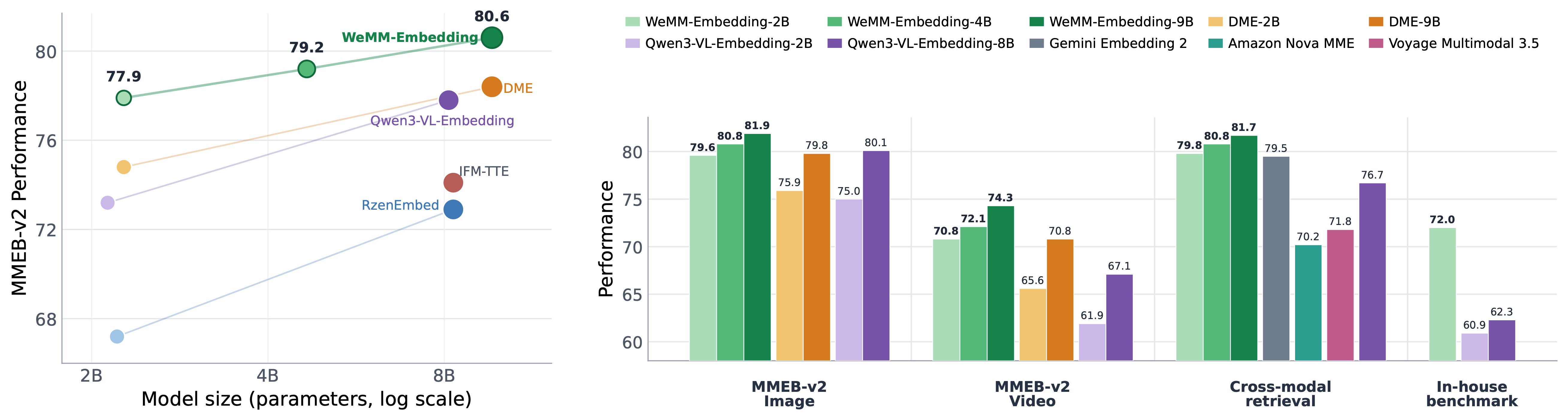
1.8KTencent/WeMM-Embedding · PythonWeMM-Embedding is a family of multimodal embedding models (2B, 4B, 9B) built by the WeChat Vision Team at Tencent that produce unified embeddings for text, images, videos, visual documents, and interleaved multimodal inputs for search and retrieval tasks.
- 79
NeoHorse
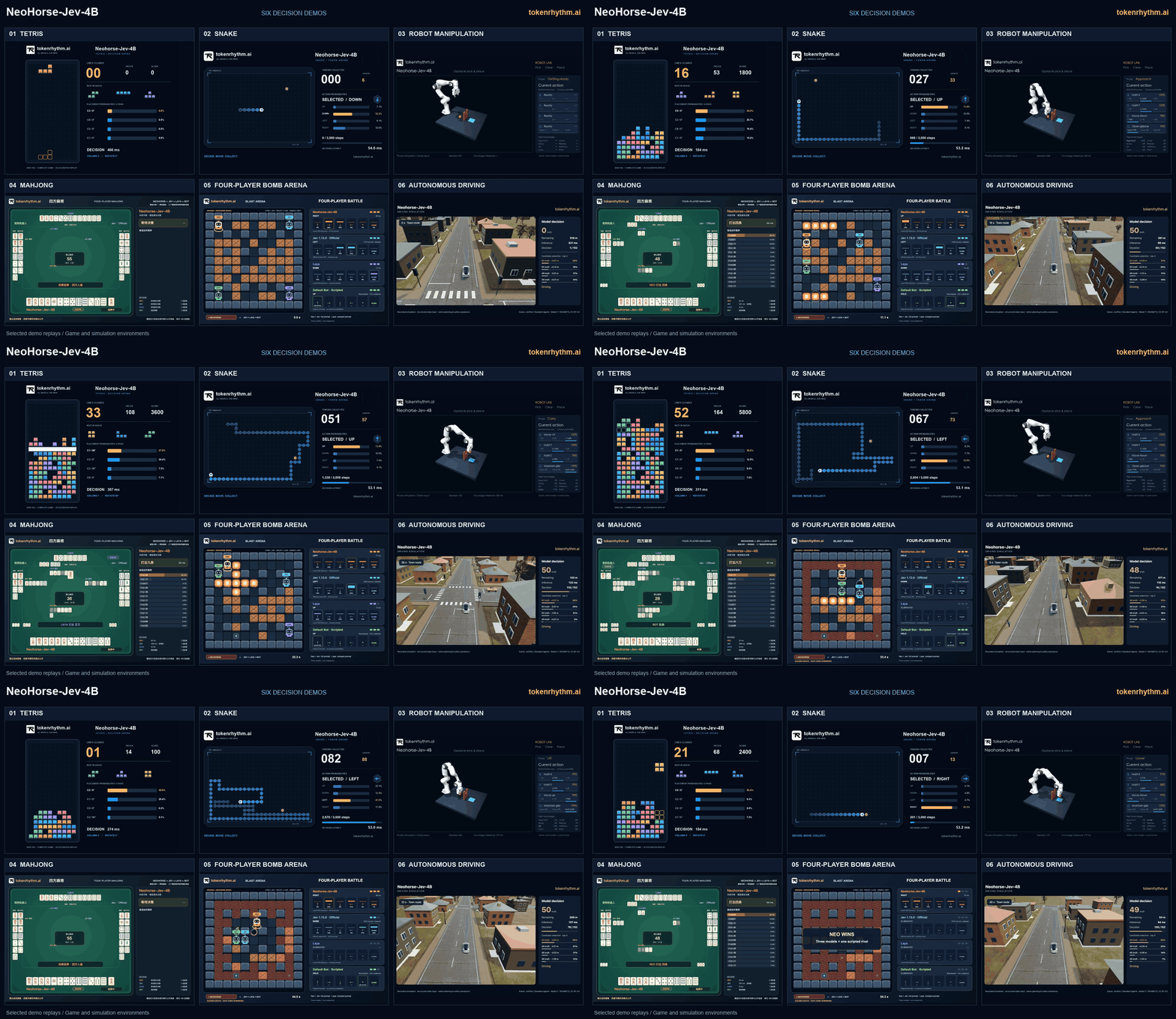
1.7KTokenRhythm/NeoHorse · PythonNeoHorse is TokenRhythm's family of open-weight language models built for agent workflows, with the 4B and 9B NeoHorse-1 checkpoints handling tool use, coding, and instruction following, plus a companion decision model called NeoHorse-Jev.
- 80
jeff
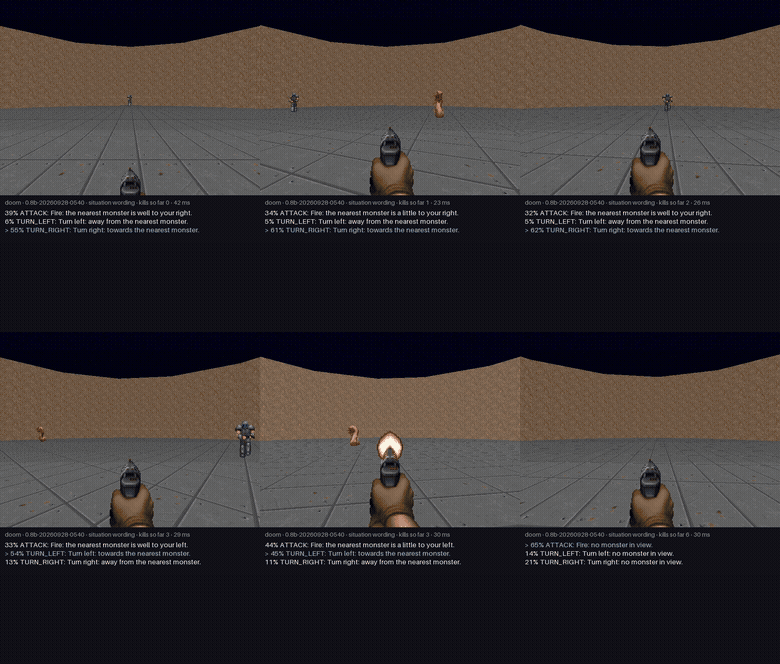
1.5Kfirelex/jeff · PythonJeff is a family of small (0.8B-2B parameter) open-weight models fine-tuned from Qwen3.5 and Gemma 4 that act as fast 'System 1' decision-makers: you describe a situation and a list of options in plain text, and Jeff returns a calibrated probability for each option from a single forward pass, with no generated text to parse.
- 81
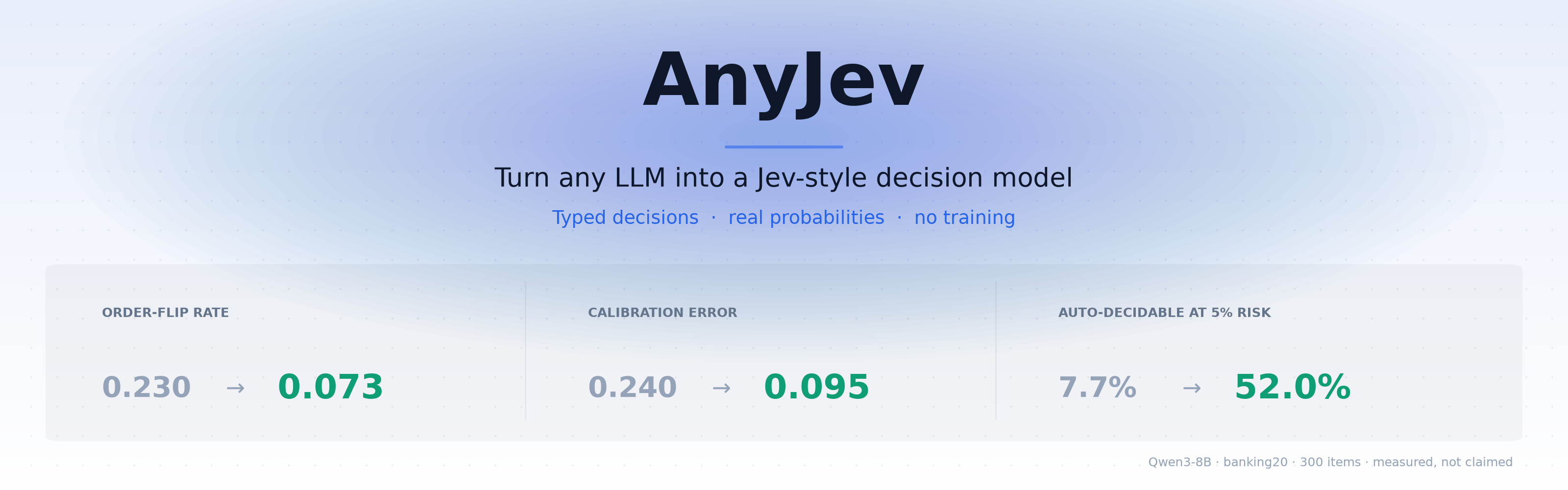
AnyJev
1.4Knokia-applied-research/AnyJev · PythonA Python library that turns any open LLM into a Jev-style decision model: ask a typed question, get back a choice with a probability you can threshold — no generation, no parsing, no fine-tuning.
- 82

Hy-MT2
1.3KTencent-Hunyuan/Hy-MT2 · PythonHy-MT2 is Tencent Hunyuan's family of 'fast-thinking' multilingual translation models, released in three sizes (1.8B, 7B, and 30B-A3B MoE), that translate among 33 languages and follow complex translation instructions.
- 83

ai-torture-chamber
965terrafying/ai-torture-chamber · PythonA research project that steers small open-weight language models into strong negative or positive emotional states and measures what they say and do. A live version runs at wirehead.agency.
- 84

llm-architecture-from-scratch
889YeonwooSung/llm-architecture-from-scratch · PythonA collection of PyTorch implementations of modern LLM architectures (GPT-2, Llama 3/3.2, Llama 4, OLMo 2, Phi-4, DeepSeek v3, Gemma 3, xLSTM, Mistral 3.1) built from scratch to understand how they work internally.
- 85

halo
825whitecircle/halo · PythonHalo is an open-source framework from White Circle for training large language and multimodal models: pre-training, SFT, preference optimization, and fully asynchronous multi-turn RL in one codebase, from a single GPU up to multi-node clusters.
- 86

Intern-Decision
811InternLM/Intern-Decision · PythonIntern-Decision turns a state, optional images, and multiple typed questions into decisions with probabilities, by fine-tuning the language backbone of Qwen3.5 while freezing its vision tower and projector.
- 87

XRAG
807DocAILab/XRAG · PythonXRAG is a benchmarking framework that dissects and evaluates the foundational components of Retrieval-Augmented Generation (RAG) systems, such as retrievers, embeddings, and LLMs, to show how different configurations affect overall RAG performance.
- 88

GLiClass
563Knowledgator/GLiClass · PythonGLiClass is an efficient zero-shot model for sequence classification, inspired by GLiNER: give it a text and a list of candidate labels, and it classifies the text with accuracy comparable to cross-encoders.
- 89
SCM
486allenv0/SCM · TypeScriptSCM (Screen Memories) is a macOS desktop app that runs deep AI search locally over every photo and every video frame in a chosen folder, letting you search by meaning, on-screen text, or spoken dialogue, all without the cloud.
- 90

OpenArch
426anuj0456/OpenArch · PythonA set of hand-written PyTorch implementations of modern open-source LLM architectures (Llama, Qwen, DeepSeek, Gemma, GPT-OSS, Kimi and more), written from scratch for readability and learning.
- 91

jeeves
425PostHog/jeeves · PythonJeeves is a reasoning-enhanced 'Jev-like' decision model built on Qwen3.5-9B with LoRA. It thinks through a reasoning chain before giving calibrated yes/no, multiple-choice, or rating answers, and ships with a diffusion drafter for faster inference.
- 92

EvoVLM
319zzzz7788990213-ops/EvoVLM · PythonEvoVLM is a research project that runs LLM-guided, multi-objective evolutionary search over vision-language inference programs. It targets the accuracy-latency trade-off on scientific chart understanding while keeping model weights frozen.
- 93

LittleBit
283SamsungLabs/LittleBit · PythonLittleBit is the official research code for compressing large language models to sub-1-bit precision (down to 0.1 bits per weight) by factorizing each weight matrix into low-rank latent factors and binarizing them, with magnitude restored through learned scales. It also includes LittleBit-2, a follow-up that improves initialization via latent geometry alignment.
- 94
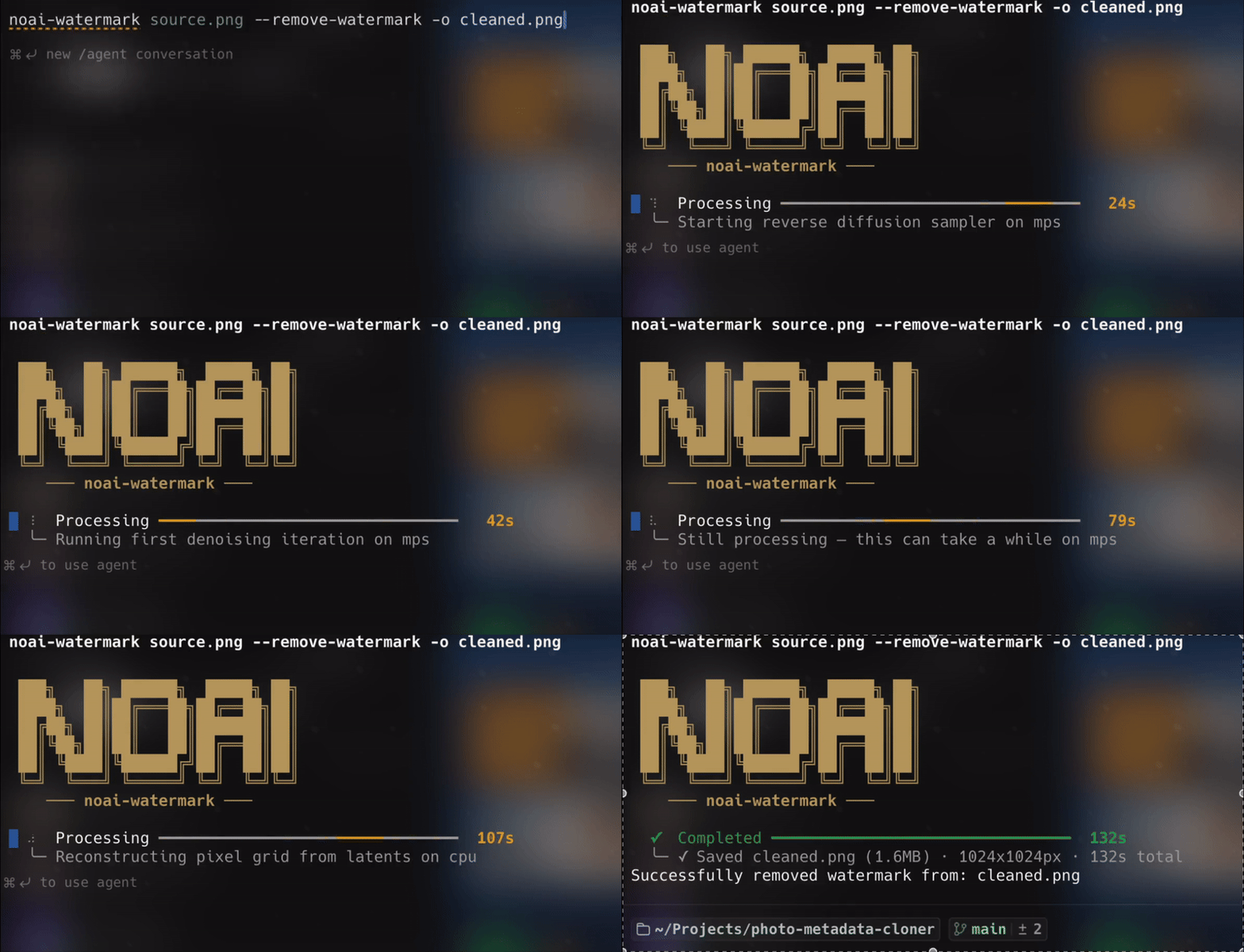
noai-watermark
209mertizci/noai-watermark · Pythonnoai-watermark is an open-source CLI and Python toolkit that uses diffusion-based image regeneration to disrupt invisible AI watermarks (like Google SynthID, StableSignature, TreeRing) embedded in generated images, and it also inspects/strips AI metadata (EXIF, PNG text chunks, C2PA manifests).
- 95
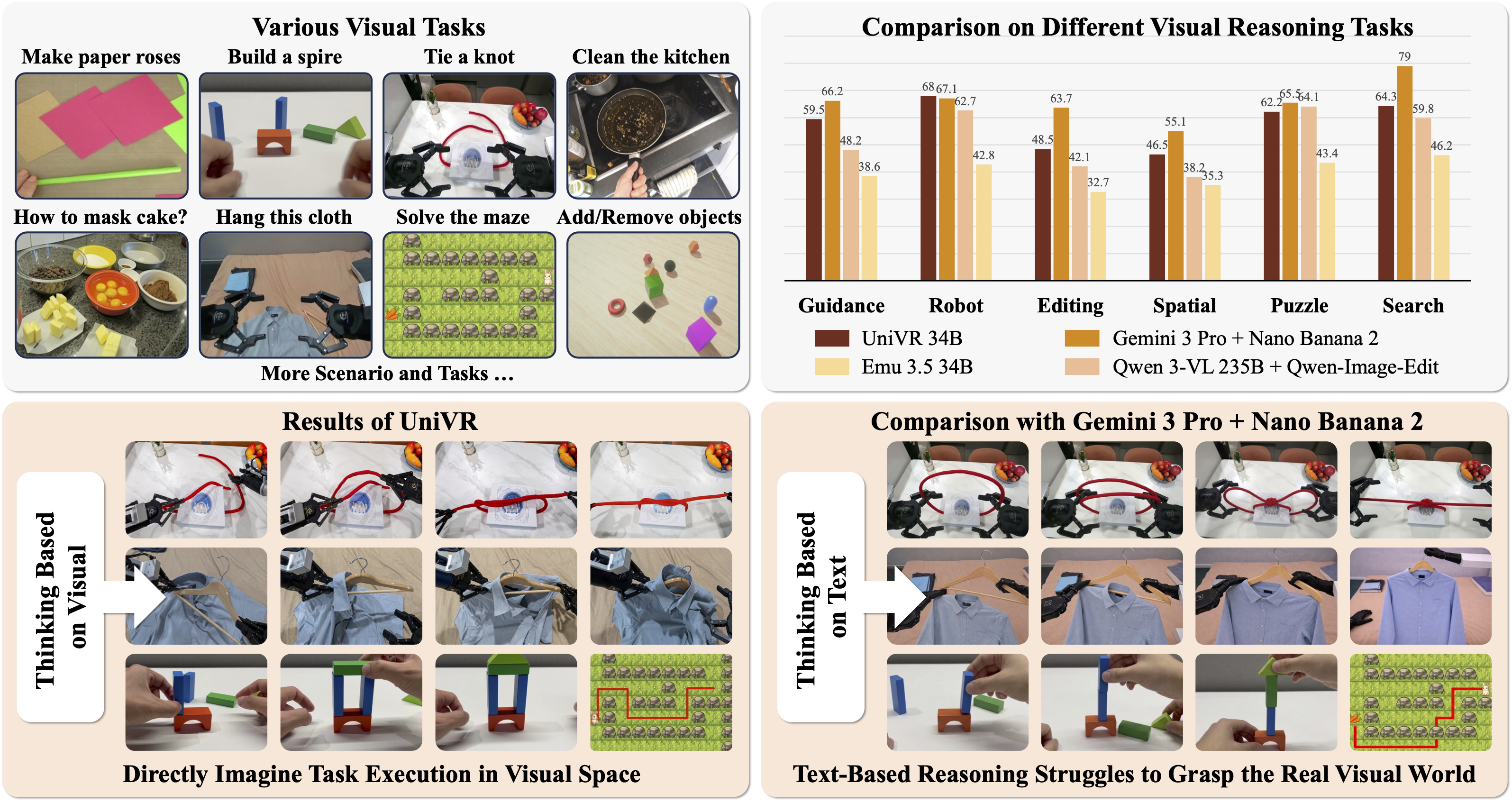
UniVR
178FlagOpen/UniVR · PythonUniVR is an end-to-end SFT and Reinforcement Learning (GRPO) training framework built specifically for Emu3.5 series unified generative models, letting you train visual reasoning tasks by swapping in your own data loader and reward function.
- 96

hyperflow
146Video-Rebirth/hyperflow · PythonAn 8-step LoRA adapter for MiniMax-H3, a video+audio generation model, trained by data-free flow self-distillation. This repository holds the loader and example scripts that run it on the diffusers Modular Pipeline.
- 97

DMI
65ProjectDMX/DMI · PythonDMI is a decoupled, asynchronous observability stack that gives real-time access to a running LLM's internal state — residual streams, attention patterns, MLP outputs, KV-cache slices, logits — during inference or training, with minimal overhead.
Related topics
Often tagged together