


AnyJev README

The project's README from github.com/nokia-applied-research/AnyJev. As one markdown file: README.md.

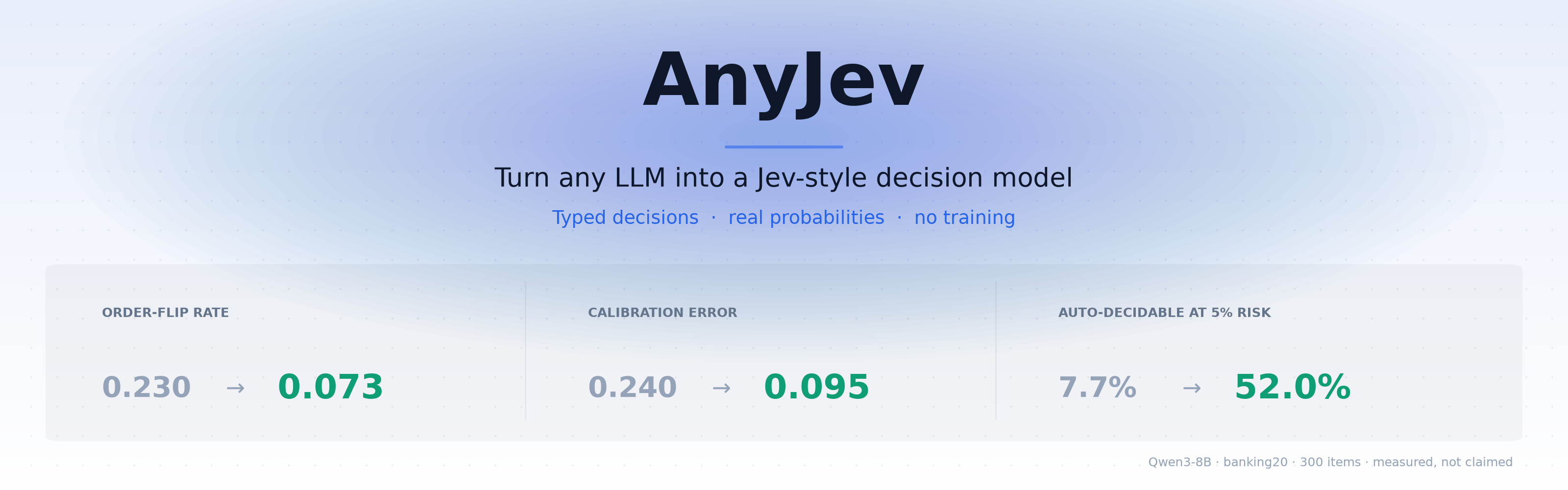
AnyJev — turn any LLM into a Jev-style decision model. Typed decisions, real probabilities, no fine-tuning. Order-flip rate 0.230 to 0.073 with zero labels; calibration error 0.240 to 0.095 and auto-decidable at 5% risk 7.7% to 52.0% with 100 to 500 labels.

PyPI Python CI License

English · 简体中文 · 🚀 Usage · 📊 Results · 🧭 Roadmap · 📖 Levels contract

Jiamu Zhang1     Tianze Yang1     Yucheng Shi2     Liang Wu1

1 Nokia, Sunnyvale, CA      2 Tencent Hunyuan

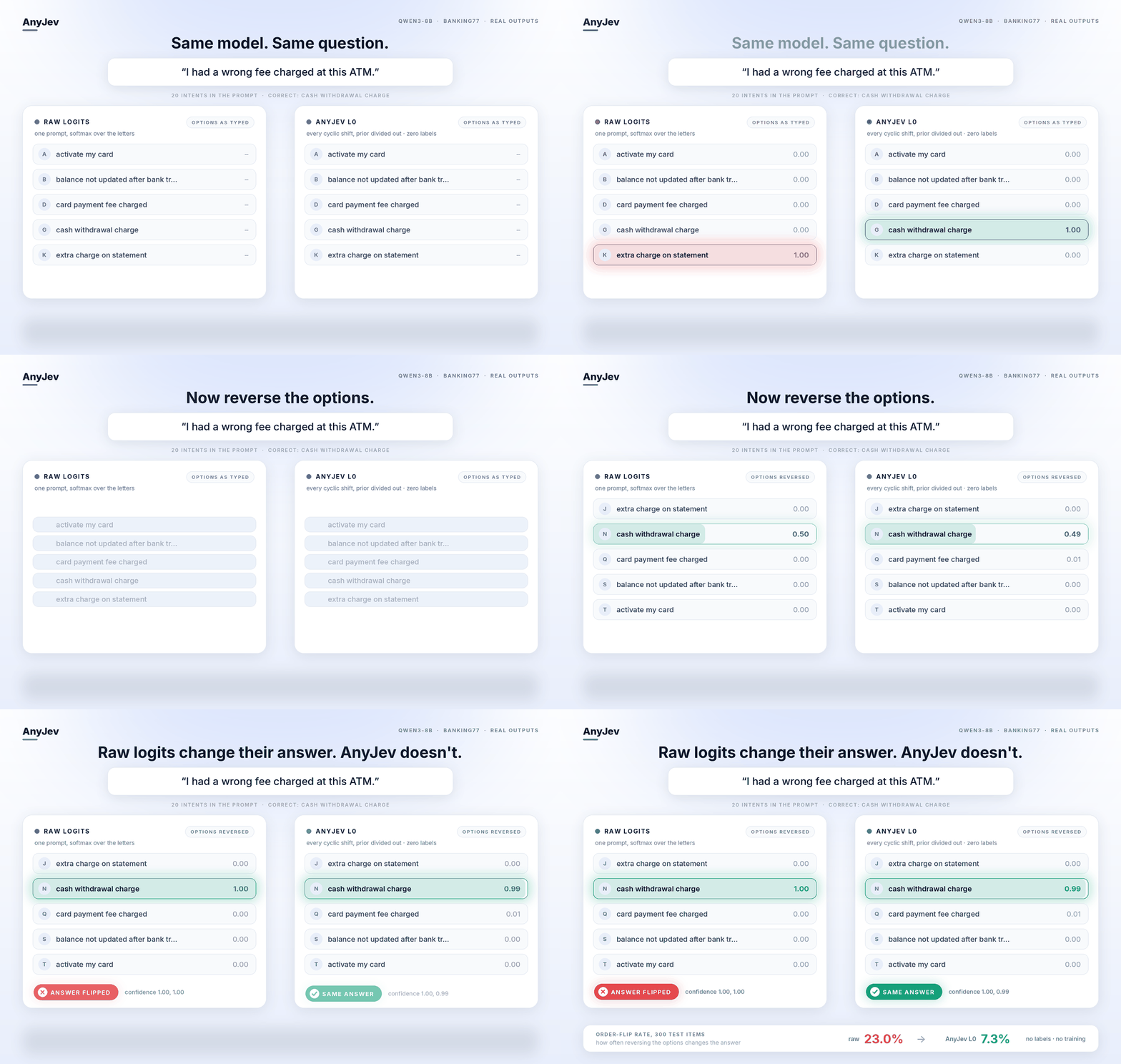
Reverse the option order: the raw logit readout flips its answer, AnyJev L0 gives the same answer both ways
Qwen3-8B on a real BANKING77 item. Every number is a model output.

[!TIP] 🆕 L2 has landed. A closed-form head per question, solved on 100–300 labels in seconds, served from one prompt stopped at two thirds of the model's depth. It follows its question across rewordings without new labels. Jump to it ↓

✨ What it does

Ask any open LLM a typed question and get back a decision with a probability you can threshold, read from one prefill of its next-token distribution. No generation, no parsing, no fine-tuning. Raw logits change their answer when you reorder the options, and their confidence cannot be trusted; AnyJev fixes the first with zero labels and the second with a few hundred.

raw logits AnyJev L0 AnyJev L1
Labels required none none 100–500
Answer flips when options are reversed 0.230 0.073 0.077
Accuracy 0.747 0.803 0.807
Calibration error (ECE) 0.240 0.184 0.095
Auto-decidable at ≤5% error 7.7% 46.3% 52.0%

Qwen3-8B, BANKING77 20-way, 300 test items. Full table incl. every ablation: docs/results_bench.md

The last row is the point. Accuracy moves by 6 points, but the share of traffic you can safely automate goes from 7.7% to 52.0%, a 6.8× difference on this task (a point estimate at n=300; the interval is wide, see Limitations). With raw logits a "0.9" is not trustworthy enough to act on, so everything goes to a human. Once the probability means what it says, you can set a threshold.

🚀 Usage

📦 1. Install

pip install "anyjev[hf]"

💬 2. Ask typed questions. L0 is on by default and needs no labels.

from anyjev import Decider, Question
from anyjev.backends.hf import HFBackend

d = Decider(HFBackend("Qwen/Qwen3-8B"))

route = Question.choice("Which team should handle this?", ["billing", "technical", "sales", "other"], name="route")
risky = Question.noul("Is this tool call destructive or irreversible?", name="risky")
done  = Question.score("How complete is the task?", bins=5, name="done")

r = d.decide({"conversation": [...], "tool_call": {...}}, [route, risky, done])
r["route"].distribution    # {"billing": 0.81, "technical": 0.07, ...}
r["risky"].p_true          # 0.12
r["done"].value            # 0.35
r.level                    # "L0"

🎯 3. Add labels when you have them. A temperature is L1; a closed-form head is L2, the accurate one.

d.calibrate(risky, states, labels)          # 100–500 labels → L1 (a temperature)
d.fit_head(route, states, labels)           # 100–300 labels → L2, one forward + a closed-form solve, seconds
d.save_artifacts("qwen3-8b.json")           # d.load_artifacts(...) next time; ~100 KB per head

r = d.decide(state, [route], level="auto")  # L2 where a head routes, else L1, else L0
r["route"].level                            # "L2"

🔁 4. Or let the loop feed it. d.observe(route, state, label) stores labels as they arrive and solves the head by itself at 30, re-solving at 60, 120, …

⚡ Serving. The transformers backend (anyjev.backends.hf) serves every level today; serving through vLLM / SGLang is on the roadmap, not in this release. For many states and one question, d.decide_batch(states, question).

🎬 Try it in one command. python -m demo.jev_mode --backend fake runs the whole thing on a synthetic model in under a second, no download. --lifecycle plays the deployment loop; drop --backend fake to run a real Qwen3 with the shipped heads (demo).

🧠 How it works

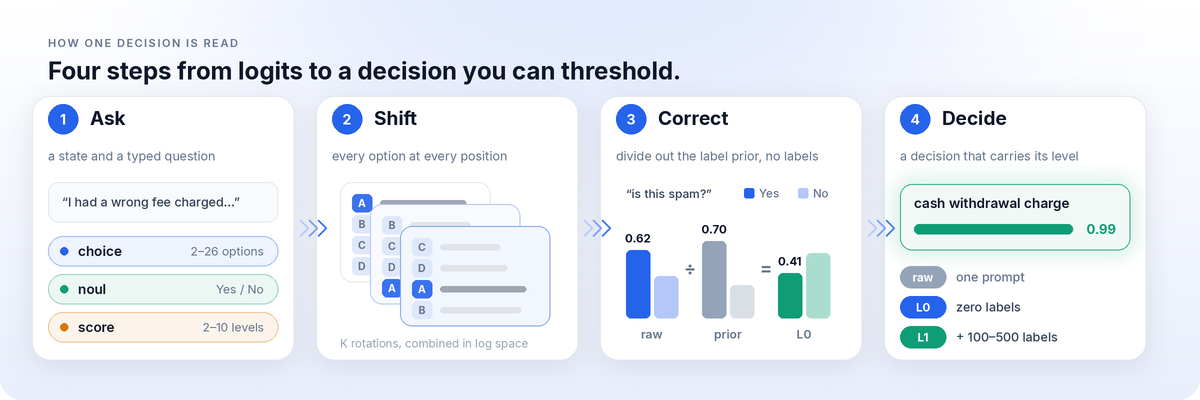
How one decision is read: ask a typed question, read it over every cyclic shift of the options, divide out the label prior estimated without labels, and return a decision that carries its level

Level Needs Does Does not
raw nothing restricted softmax over label tokens (what the clones do) anything about bias or calibration
L0 nothing averages position bias out over the K rotations and divides out the label prior make the model's uncertainty calibrated
L1 100–500 labels per question temperature scaling on top of L0 change the ranking
L2 100–300 labels per question, a local model a closed-form head (shrunk LDA / ridge) on the hidden state at ~⅔ depth, one prompt per state transfer to another question or model

Every Decision carries its level, so downstream code can refuse to act on the wrong one. L0 costs K prefills for a K-option choice (about 0.25 s per decision at batch 32 on one H100, K = 20); L2 costs less than one plain forward — one prompt, stopped early: 0.68× on Qwen3-8B.

🔁 A head that maintains itself

L2 is not a training run. Labels buy a head in one closed-form solve (seconds on a CPU, no gradients, the model's weights untouched). After that only the head's feature mean and scale move, re-estimated from unlabelled traffic — so the head follows its question across rewordings and option orders by itself, and new labels are needed only for a new question.

A head that maintains itself: fit one closed-form head from labelled states, ship it as a small artifact, serve with the forward stopped at a fixed block, and when the question is reworded recentre the head's feature mean and scale on unlabelled requests; a reordered option list is remapped by option text and only a new option set goes back to labels.

Reworded, the Qwen3-8B head as is drops from 0.77 to 0.65–0.70; 30 unlabelled requests of the new wording bring it back to 0.74–0.75, against 0.77 for a fully relabelled refit (JSON).

One decision at serving time. A stored head answers from one truncated forward. Without one, the same call falls back to L1 or L0 exactly as before; the routing is in docs/method_v3.md.

Which path a decision takes at serving time: route to a stored head by exact layout, by the same options under another wording, or by the same option set in another order; the two adapted routes update running feature statistics and use them once thirty requests have been seen; the head answers from one prompt with the forward stopped at the fixed block and returns a level L2 decision with diagnostics; with no head, a temperature artifact selects L1 and otherwise L0, both from K shifted prompts with a full forward and prior correction.

Deployment lifecycle: day 0 at L0, labels from the loop, heads in seconds

flowchart LR
    D0["day 0: define the questions,<br/>serve with level auto;<br/>every answer is L0, zero labels"] --> C["collect labels from the loop:<br/>review queue, outcomes, or the LLM<br/>being replaced; dec.observe fits at 30"]
    C --> F["fit_head per question;<br/>export_artifacts to one JSON per model"]
    F --> S["serve: L2 where a head routes,<br/>L1 or L0 elsewhere"]
    S --> W{"what changed?"}
    W -->|"wording or option order"| S
    W -->|"new question or option set"| C
    W -->|"new base model"| R["re-solve every head from<br/>the stored labelled states"]
    R --> S

    classDef shipped fill:#dcfce7,stroke:#0f9d76,color:#0f172a
    classDef decision fill:#fef3c7,stroke:#d97706,color:#0f172a
    class D0,C,F,S,R shipped
    class W decision

A shift in the states (not the wording) is invisible to the recentring, so a periodic spot check on a labelled slice stays in the recipe. Full method: docs/method_v3.md.

📊 Results

9 / 9

🔁 Order flips cut
every model × task row, at L0, zero labels
3 models × 3 tasks →

0.80

🧩 Typed-decisions accuracy
Qwen3-32B and 30B-A3B at L2, 300 labels per question; Jev 0.727 as published, fine-tuned Laya 0.768
5 models →

0.68×

⚡ Cost of one decision
of a single plain forward, Qwen3-8B at L2: one prompt, stopped at block 24 of 36
latency →

Jev mode, on LocalLLaMA/typed-decisions (20 questions, 300 labels each, 2,000 held-out decisions):

model L0, zero labels L2 block cost vs one forward
Qwen3-1.7B 0.494 0.730 18 / 28 0.70×
Qwen3-4B 0.564 0.786 24 / 36 0.69×
Qwen3-8B 0.647 0.771 24 / 36 0.68×
Qwen3-30B-A3B 0.630 0.799 40 / 48 not measured
Qwen3-32B 0.700 0.798 52 / 64 0.84×

Pooled ECE at L2 is 0.03–0.05. Jev 0.727 and fine-tuned Laya 0.768 on the same set, as published by their authors. Every cell: docs/results_exit.md

A 1.7B at 64% of its depth reaches the number Jev publishes; a 4B ties the fine-tuned 421M Laya. 100 labels already put the 8B head at 0.740 (20 labels: 0.654, 300: 0.772).

More: Jev mode in full · 2048 and Minesweeper · NanoJev maze · when L0 helps · small models · the research log, negative results included

Heads you can load today, and what a head costs

anyjev-heads/<model>.json ships 23 heads per model (the 20 typed-decisions questions and three bench tasks) for Qwen3-1.7B / 4B / 8B / 30B-A3B / 32B, built and validated through the same fit_head → decide_batch path a user runs (scripts/build_heads.py). A head is a [hidden, K] matrix plus a bias, a standardisation vector and a temperature: ~100 KB, solved in 2–8 s on the 1.7B–8B.

The big model's heads also distil into a small one without gradients: the 32B's heads labelling 1,200 generated cases per workflow lift the 1.7B from 0.730 to 0.760 (the 4B and 8B do not move). docs/jev_mode.md

All models and tasks in one figure

Four panels across three open models and three tasks: order-flip rate, expected calibration error, accuracy, and coverage at 5% risk, comparing raw logit readout against AnyJev L0 and L1

Every number is regenerated from committed JSON (bash scripts/regen_docs.sh); a second run from a clean checkout reproduced every zero-label number bit for bit. Not affiliated with TypeSafe AI or Jev; rows published by their authors were not rerun here.

🧭 Roadmap

Dated plan and help-wanted files: ROADMAP.md.

🔍 Limitations

Also: at most 26 options in the letter readout (a span readout is on the roadmap, not in the code); coverage at 5% risk is a high-variance estimate at n = 300; the headline tables are Qwen models; every decision here is scored in isolation, not inside an agent loop.

🤝 Contributing and citation

Backends and bench providers are one file each; several are help wanted (ROADMAP.md, CONTRIBUTING.md). Changes: CHANGELOG.md. Credits: CREDITS.md.

@software{anyjev2026,
  title  = {AnyJev: Turn any LLM into a Jev-style decision model},
  author = {Zhang, Jiamu and Yang, Tianze and Shi, Yucheng and Wu, Liang},
  year   = {2026},
  url    = {https://github.com/nokia-applied-research/AnyJev}
}

Apache-2.0, see LICENSE. Datasets keep their own licenses, see THIRD_PARTY.md.

AnyJev (nokia-applied-research/AnyJev)

Searching Database…

1.3K ·GitHub
What is this?A Python library that turns any open LLM into a Jev-style decision model: ask a typed question, get back a choice with a probability you can threshold — no generation, no parsing, no fine-tuning.
Why not just take the probabilities from the model directly?Raw logits flip their answer when you reorder the options, and their confidence cannot be trusted. Fixing that raises the share of decisions safe to automate at ≤5% error from 7.7% to 52.0%, a 6.8× jump.
How do I try it?Install it and ask typed questions — L0 is on by default and needs no labels. Or run python -m demo.jevmode --backend fake: the whole flow on a synthetic model in under a second, no download.
Do I have to train the model or label data by hand?No training ever. L0 works with zero labels; d.observe(route, state, label) stores labels as they arrive and solves a head by itself at 30, re-solving at 60, 120 — no gradients, weights untouched.
What are the gotchas I should know about?L2 heads are per question and per model, and only Qwen3 heads ship today; L2 needs hidden states, so it is transformers-only for now; and the letter readout caps at 26 options.
Will I need a beefy GPU for this?It runs wherever your model runs: L0 is about 0.25 s per decision at batch 32 on one H100 with 20 options, while a stored L2 head answers from one truncated forward — 0.68× of a plain forward on Qwen3-8B.
What is the difference between L0, L1 and L2?L0 needs nothing: it averages position bias out over the K rotations of the options. L1 adds temperature scaling on 100-500 labels; L2 fits a closed-form head (shrunk LDA or ridge) on the hidden state at about two-thirds of the model's depth from 100-300 labels — the accurate one, but per question and per model.
Do I have to fit my own heads, or are there ready ones?Ready ones: anyjev-heads/*.json ships 23 heads per model for Qwen3 1.7B, 4B, 8B, 30B-A3B and 32B. A head is a ~100 KB matrix plus a bias, a temperature and a standardisation vector, and fits in 2-8 seconds.
What happens to a head when my prompt wording changes?It adapts: only the head's feature mean and scale are re-estimated from unlabelled traffic, so 30 requests of a new wording lift accuracy from 0.65-0.70 back to 0.74-0.75. A shift in the states themselves stays invisible to this, so periodic spot checks remain in the recipe.
So what is Jev?Jev is a published decision-model approach that AnyJev emulates without training; the README stresses the project is not affiliated with TypeSafe AI or Jev. On the shared typed-decisions set, published Jev scores 0.727 and fine-tuned Laya 0.768, while AnyJev L2 reaches 0.771-0.798.
Size
24.9 MB
Stars
1.3K
Age
26d
Commits · 90 Days