 Attention Residuals
What is this?
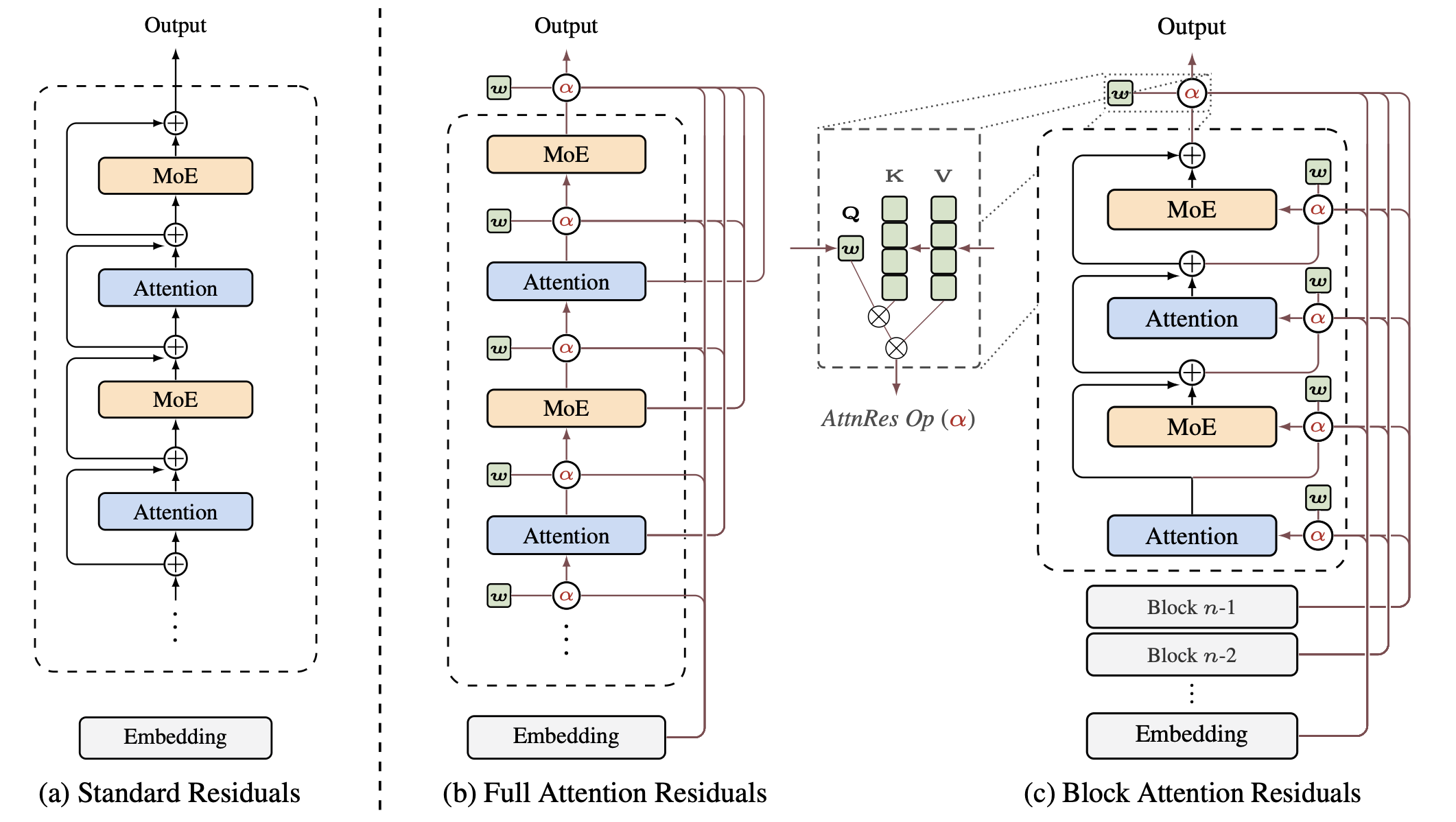
 AttnRes (Attention Residuals) is a drop-in replacement for standard residual connections in Transformers, letting each layer use learned, input-dependent attention over all previous layer outputs instead of simple additive accumulation.
AttnRes (Attention Residuals) is a drop-in replacement for standard residual connections in Transformers, letting each layer use learned, input-dependent attention over all previous layer outputs instead of simple additive accumulation.Is this a trained model I can download, or a technique I implement myself?It is an architectural technique described with equations and 'PyTorch-style pseudocode', not a pretrained checkpoint; you integrate it into your own Transformer's residual connections.
It is an architectural technique described with equations and 'PyTorch-style pseudocode', not a pretrained checkpoint; you integrate it into your own Transformer's residual connections.How do I actually use this in my own model?The README gives no install command or runnable code snippet, only the formulas and a reference to 'PyTorch-style pseudocode'; you implement Full AttnRes or the cheaper Block AttnRes variant inside your Transformer following the paper's description.
The README gives no install command or runnable code snippet, only the formulas and a reference to 'PyTorch-style pseudocode'; you implement Full AttnRes or the cheaper Block AttnRes variant inside your Transformer following the paper's description.Do I need a specific deep learning framework?Yes, the reference implementation is described in PyTorch terms, so you'd need a PyTorch-based Transformer codebase to apply it.
Yes, the reference implementation is described in PyTorch terms, so you'd need a PyTorch-based Transformer codebase to apply it.Does Full AttnRes scale to large models without extra cost?No — Full AttnRes needs O(Ld) memory as depth grows, which gets impractical at scale; Block AttnRes fixes this by grouping layers into about 8 blocks and attending only over block-level representations, trading a little performance for O(Nd) memory.
No — Full AttnRes needs O(Ld) memory as depth grows, which gets impractical at scale; Block AttnRes fixes this by grouping layers into about 8 blocks and attending only over block-level representations, trading a little performance for O(Nd) memory.Who is this useful for?It's aimed at researchers and engineers building or training Transformer-based LLMs who want an alternative to standard residual connections, not end users of a finished application.
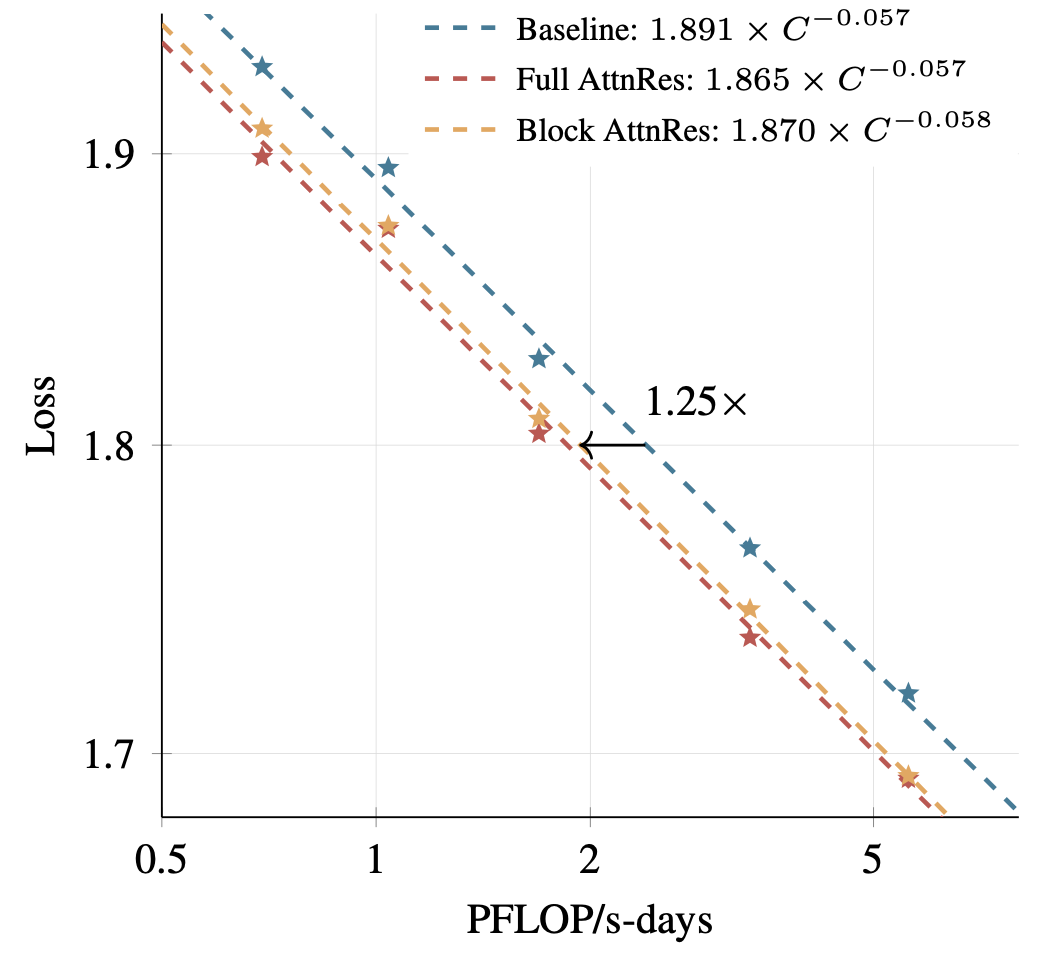
It's aimed at researchers and engineers building or training Transformer-based LLMs who want an alternative to standard residual connections, not end users of a finished application.How much does AttnRes improve performance over standard residuals?It consistently lowers loss at every compute budget in scaling-law tests, with Block AttnRes matching a baseline trained with 1.25x more compute; on a Kimi Linear 48B model it adds up to +7.5 points on GPQA-Diamond and +3.1 on HumanEval.
It consistently lowers loss at every compute budget in scaling-law tests, with Block AttnRes matching a baseline trained with 1.25x more compute; on a Kimi Linear 48B model it adds up to +7.5 points on GPQA-Diamond and +3.1 on HumanEval.Why do standard residual connections become a problem in deep Transformers?Standard residuals sum all layer outputs with fixed unit weights, which dilutes each layer's contribution as depth increases and makes hidden-state magnitudes grow unboundedly — a known PreNorm issue AttnRes is built to fix.
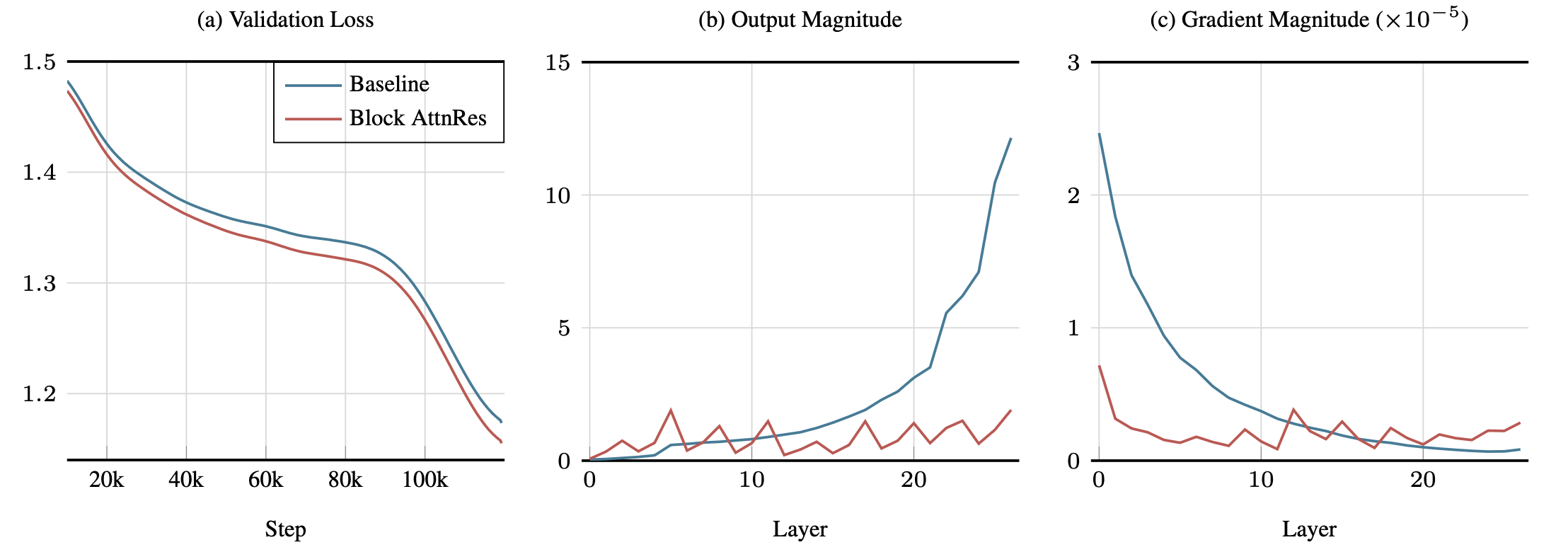
Standard residuals sum all layer outputs with fixed unit weights, which dilutes each layer's contribution as depth increases and makes hidden-state magnitudes grow unboundedly — a known PreNorm issue AttnRes is built to fix.What is Kimi Linear, and why is it used to test AttnRes?Kimi Linear is Moonshot AI's 48B-parameter (3B activated) model trained on 1.4T tokens, used as the testbed to show AttnRes's downstream gains across benchmarks like MMLU, Math, HumanEval, and C-Eval.
Kimi Linear is Moonshot AI's 48B-parameter (3B activated) model trained on 1.4T tokens, used as the testbed to show AttnRes's downstream gains across benchmarks like MMLU, Math, HumanEval, and C-Eval.What are similar projects?MSA, bdh, Engram, llama3-from-scratch, jeeves, train-llm-from-scratch, LittleBit, minGPT
MSA, bdh, Engram, llama3-from-scratch, jeeves, train-llm-from-scratch, LittleBit, minGPTWhich topics is it in?attention, model-training, deep-neural-networks, arxiv, foundation-models, reasoning, attention-mechanism, paper, transformers, architecture, neural-network, academic-research
attention, model-training, deep-neural-networks, arxiv, foundation-models, reasoning, attention-mechanism, paper, transformers, architecture, neural-network, academic-research