Topics / #self-supervised-learning
Self-supervised-learning projects on GitHub
Self-supervised and transfer learning methods and resources.
As of , the most-starred Self-supervised-learning projects on GitHub are pytorch-image-models (37.2K stars), fairseq (32.2K stars) and unilm (22.2K stars). GitHub.Locker tracks 11 Self-supervised-learning repositories with 164.8K stars combined. The fastest-growing on October 16 was dinov3, with +6 stars in a day.
Hot right now
Most stars gained in a day · Oct 16
dinov3
facebookresearch/dinov3 · ★ 11.6KMeta AI Research (FAIR)'s reference PyTorch implementation and model release for DINOv3, a family of vision foundation models that produce high-quality dense features and perform strongly across many vision tasks.
 +4
+4pytorch-image-models
huggingface/pytorch-image-models · ★ 37.2KPyTorch Image Models (timm) — the largest collection of PyTorch image encoders and backbones, shipped with pretrained weights plus train, eval, inference and export scripts.
 +4
+4dinov2
facebookresearch/dinov2 · ★ 13.4KDINOv2, a self-supervised visual feature learning method from Meta AI's FAIR team, shipped as PyTorch code and pretrained models. Its features plug into classifiers as simple as linear layers across many vision tasks, with no fine-tuning required.
 +1
+1unilm
microsoft/unilm · ★ 22.2KMicrosoft's research hub for large-scale self-supervised pre-training: a family of foundation models spanning NLP, vision, speech, and multimodal tasks across 100+ languages - including BEiT, LayoutLM, Kosmos, MiniLM, TrOCR, and WavLM.
The all-time top
11 projects · by stars
- 37.2K#1 · huggingface/pytorch-image-models
pytorch-image-models
PyTorch Image Models (timm) — the largest collection of PyTorch image encoders and backbones, shipped with pretrained weights plus train, eval, inference and export scripts.
- 32.2K
 #2 · facebookresearch/fairseq
fairseq
Fairseq is Facebook AI Research's sequence modeling toolkit for training custom models for translation, summarization, language modeling and other text generation tasks, built on PyTorch.
- 22.2K#3 · microsoft/unilm
unilm
Microsoft's research hub for large-scale self-supervised pre-training: a family of foundation models spanning NLP, vision, speech, and multimodal tasks across 100+ languages - including BEiT, LayoutLM, Kosmos, MiniLM, TrOCR, and WavLM.
- 4
Swin-Transformer
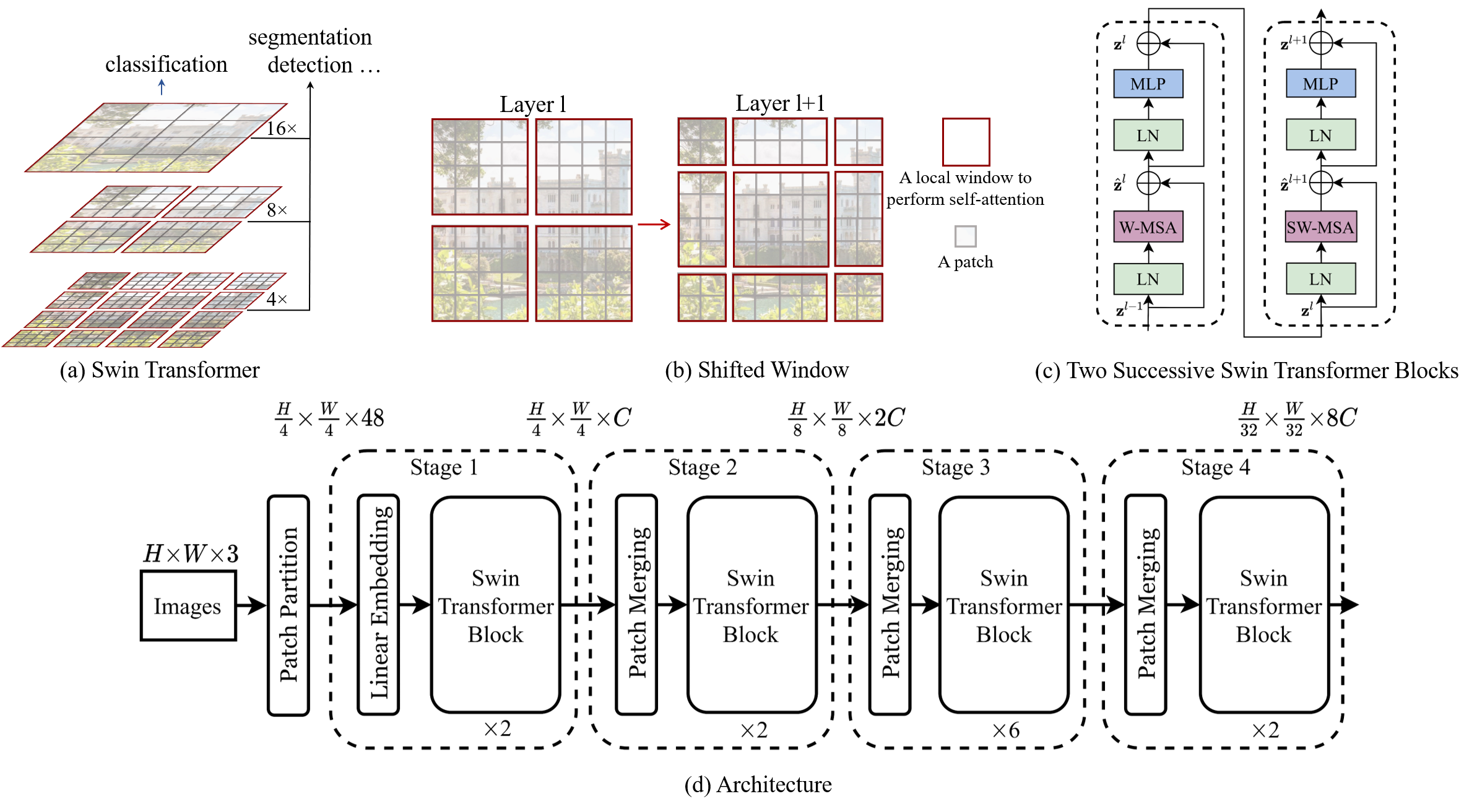
16.1Kmicrosoft/Swin-Transformer · PythonThe official Microsoft implementation of the Swin Transformer paper and its follow-ups: a hierarchical vision Transformer that computes attention with shifted windows and serves as a general-purpose backbone for computer vision tasks.
- 5
transferlearning
14.4Kjindongwang/transferlearning · PythonA curated knowledge base covering transfer learning, domain adaptation, domain generalization and related subfields - papers, tutorials, code, datasets, scholars and surveys, maintained in both English and Chinese.
- 6
dinov2
13.4Kfacebookresearch/dinov2 · Jupyter NotebookDINOv2, a self-supervised visual feature learning method from Meta AI's FAIR team, shipped as PyTorch code and pretrained models. Its features plug into classifiers as simple as linear layers across many vision tasks, with no fine-tuning required.
- 7

PaddleSpeech
12.7KPaddlePaddle/PaddleSpeech · PythonPaddleSpeech is an open-source speech and audio toolkit built on the PaddlePaddle platform, covering tasks like Automatic Speech Recognition (ASR), Text-to-Speech (TTS), Speaker Verification, Speech Translation, Keyword Spotting and Punctuation Restoration. It won the NAACL2022 Best Demo Award.
- 8
dinov3
11.6Kfacebookresearch/dinov3 · Jupyter NotebookMeta AI Research (FAIR)'s reference PyTorch implementation and model release for DINOv3, a family of vision foundation models that produce high-quality dense features and perform strongly across many vision tasks.
- 9
le-wm
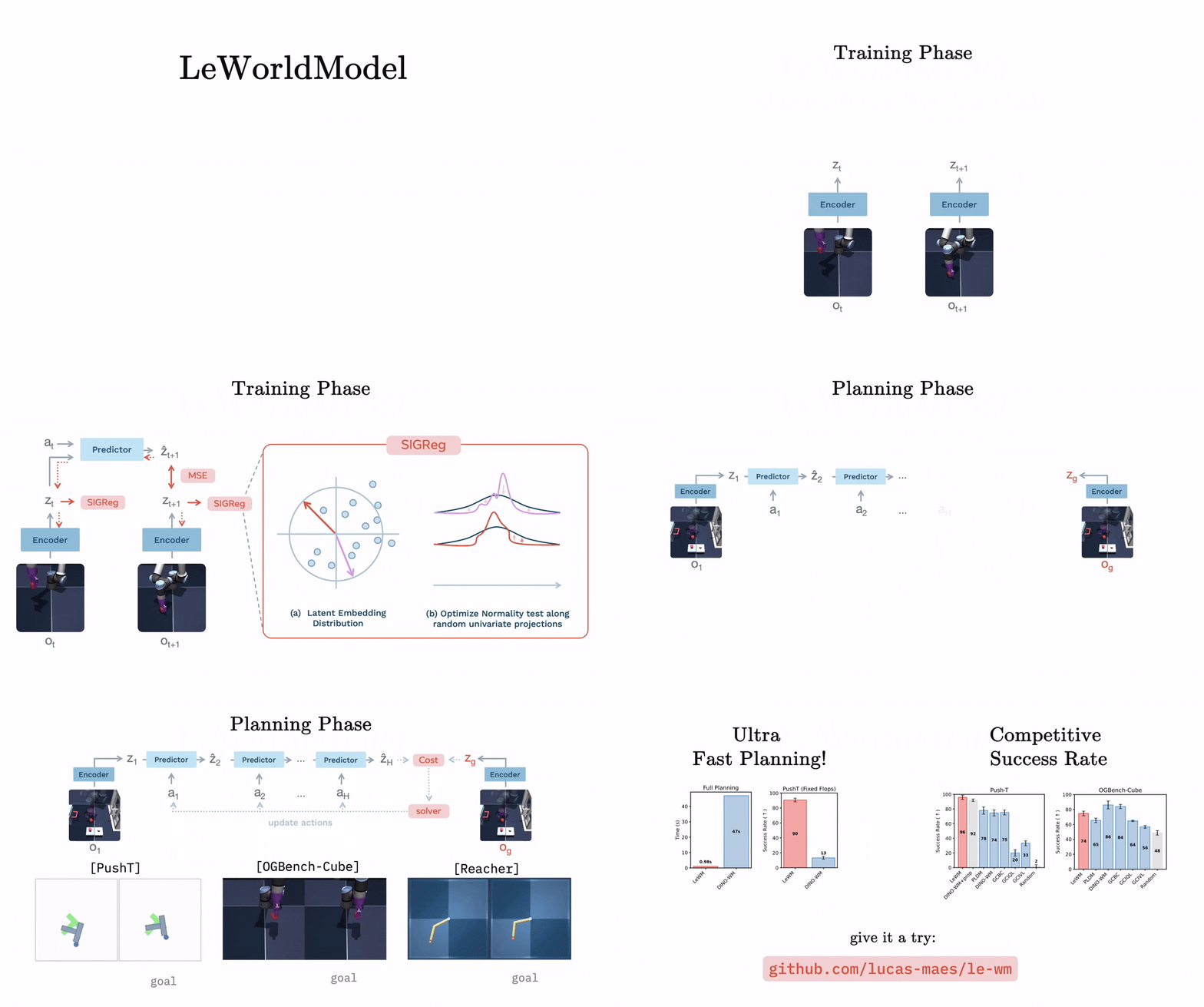
4.5Klucas-maes/le-wm · PythonThis is the official codebase for LeWorldModel (LeWM), a Joint-Embedding Predictive Architecture (JEPA) that learns a world model directly from pixels using just two loss terms, avoiding the usual tricks like EMA, pretrained encoders, or auxiliary supervision.
- 10

LeVJEPA
270MLO-lab/LeVJEPA · Jupyter NotebookThe official implementation of LeVJEPA — a self-supervised video encoder trained with LeJEPA's collapse-free objective. Unlike V-JEPA or VideoMAE it needs no EMA target encoder, stop-gradient, predictor, or pixel-reconstruction decoder: just an encoder, a small projector, and one loss hyperparameter.
- 11
worldmodels101
205NiluK/worldmodels101 · TypeScriptA free, interactive online course that teaches how world models work in AI, covering prediction, latent dynamics, planning, JEPA, video models, and where they fail.
Related topics
Often tagged together
- machine-learning916
- deep-learning737
- python2,396
- computer-vision384
- pytorch419
- research764
- gpu789
- transformer212
- embeddings135
- huggingface362
- pretrained-models74
- artificial-intelligence267
- cuda396
- image-classification47
- vision-transformer16
- apache-2.01,434
- benchmark431
- imagenet6
- jupyter notebook176
- linux4,182
- nlp214
- open-source5,666
- reinforcement-learning150
- academic-research209