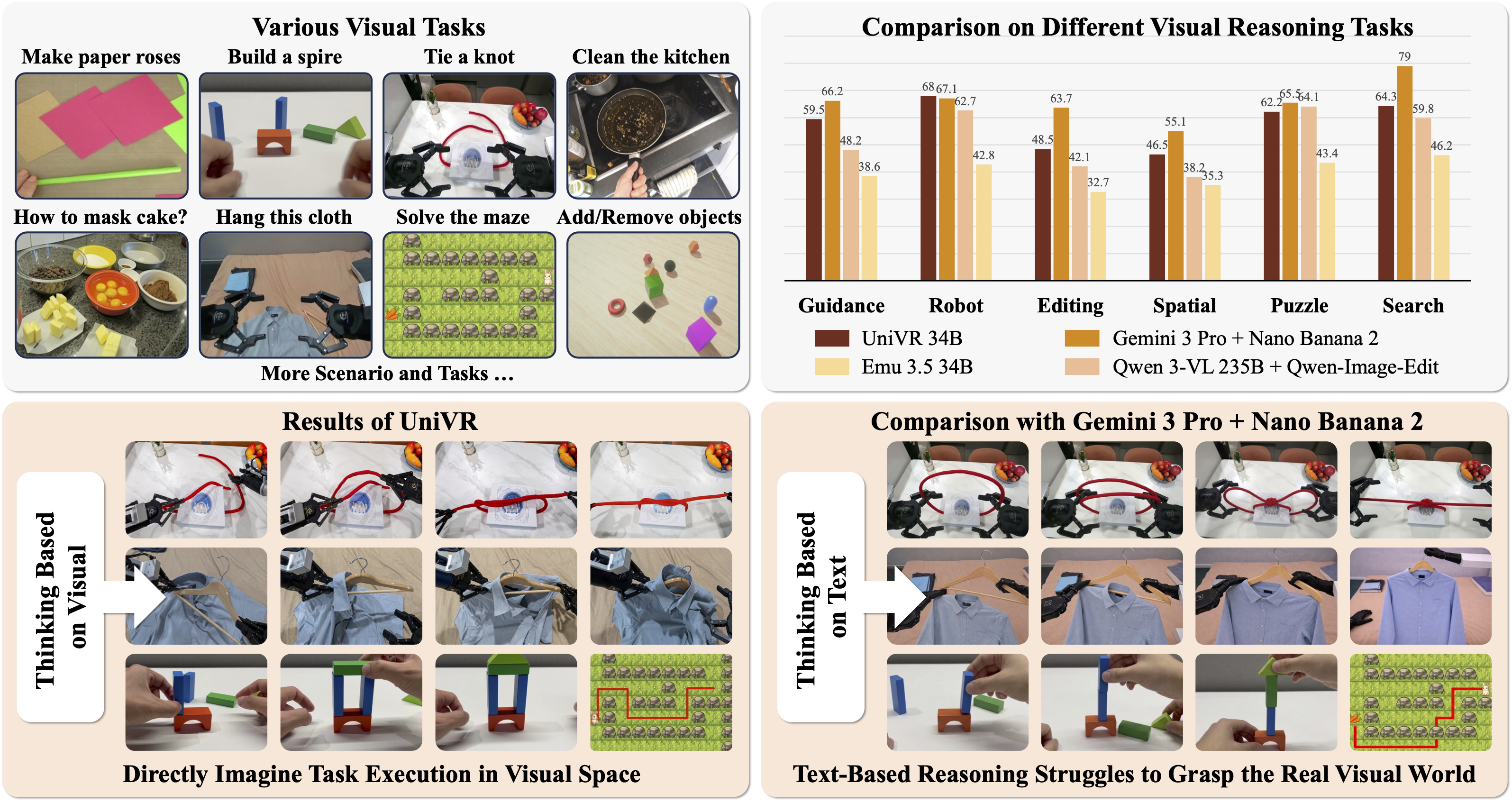
What is this?
 UniVR is an end-to-end SFT and Reinforcement Learning (GRPO) training framework built specifically for Emu3.5 series unified generative models, letting you train visual reasoning tasks by swapping in your own data loader and reward function.
UniVR is an end-to-end SFT and Reinforcement Learning (GRPO) training framework built specifically for Emu3.5 series unified generative models, letting you train visual reasoning tasks by swapping in your own data loader and reward function.Is this a ready-to-use model or a training framework?It is a training framework, not a standalone model: UniVRSFT handles multi-node supervised fine-tuning (LoRA or full-parameter) and UniVRRL handles GRPO reinforcement learning, both built around the Emu3.5 backbone.
It is a training framework, not a standalone model: UniVRSFT handles multi-node supervised fine-tuning (LoRA or full-parameter) and UniVRRL handles GRPO reinforcement learning, both built around the Emu3.5 backbone.How do I get it running?Install the pinned dependency stack, apply the included vLLM source patches for Emu3.5, then use the UniVRSFT/README.md or UniVRRL/README.md quick-start scripts to launch SFT or RL training.
Install the pinned dependency stack, apply the included vLLM source patches for Emu3.5, then use the UniVRSFT/README.md or UniVRRL/README.md quick-start scripts to launch SFT or RL training.Do I need multi-GPU nodes to train with this?Yes — the quick-start examples assume 2 nodes x 8 GPUs for LoRA SFT or 4 nodes x 8 GPUs for full-parameter SFT, plus a custom vLLM/verl rollout engine for the RL stage.
Yes — the quick-start examples assume 2 nodes x 8 GPUs for LoRA SFT or 4 nodes x 8 GPUs for full-parameter SFT, plus a custom vLLM/verl rollout engine for the RL stage.Can I plug in any backbone model, or is it tied to Emu3.5?It is tightly coupled to the Emu3.5 (34B) backbone — the vLLM patches, HybridEngine and training loop are built specifically for it; only the data loader (SFT) and reward function (RL) are meant to be swapped out.
It is tightly coupled to the Emu3.5 (34B) backbone — the vLLM patches, HybridEngine and training loop are built specifically for it; only the data loader (SFT) and reward function (RL) are meant to be swapped out.What is VR-GRPO?VR-GRPO is the RL paradigm UniVR uses, combining a format reward, a global VLM-judged completion reward, and a step-focal reward that targets the most uncertain sub-steps (found via CLIP-feature variance), combined as Rreason = Rg - lambda|Rg - Rs|.
VR-GRPO is the RL paradigm UniVR uses, combining a format reward, a global VLM-judged completion reward, and a step-focal reward that targets the most uncertain sub-steps (found via CLIP-feature variance), combined as Rreason = Rg - lambda|Rg - Rs|.What is the VR-X benchmark?VR-X is the benchmark behind UniVR: 1.5M raw samples from 16 diverse sources covering manipulation, spatial puzzles and physical reasoning, with 310k samples used for SFT cold-start and 3k curated samples for RL.
VR-X is the benchmark behind UniVR: 1.5M raw samples from 16 diverse sources covering manipulation, spatial puzzles and physical reasoning, with 310k samples used for SFT cold-start and 3k curated samples for RL.Why does the repo need a custom vLLM?It ships vLLM source patches that enable fast no-CFG parallel inference for Emu3.5 during RL rollout, roughly doubling throughput versus standard CFG mode, plus LoRA support for Emu3.5 in vLLM.
It ships vLLM source patches that enable fast no-CFG parallel inference for Emu3.5 during RL rollout, roughly doubling throughput versus standard CFG mode, plus LoRA support for Emu3.5 in vLLM.Does the model need text labels for each reasoning step?No — it learns visual reasoning directly from image sequences without dense image-text pairs, generating future frames autoregressively instead of an intermediate text chain.
No — it learns visual reasoning directly from image sequences without dense image-text pairs, generating future frames autoregressively instead of an intermediate text chain.