


What is this?
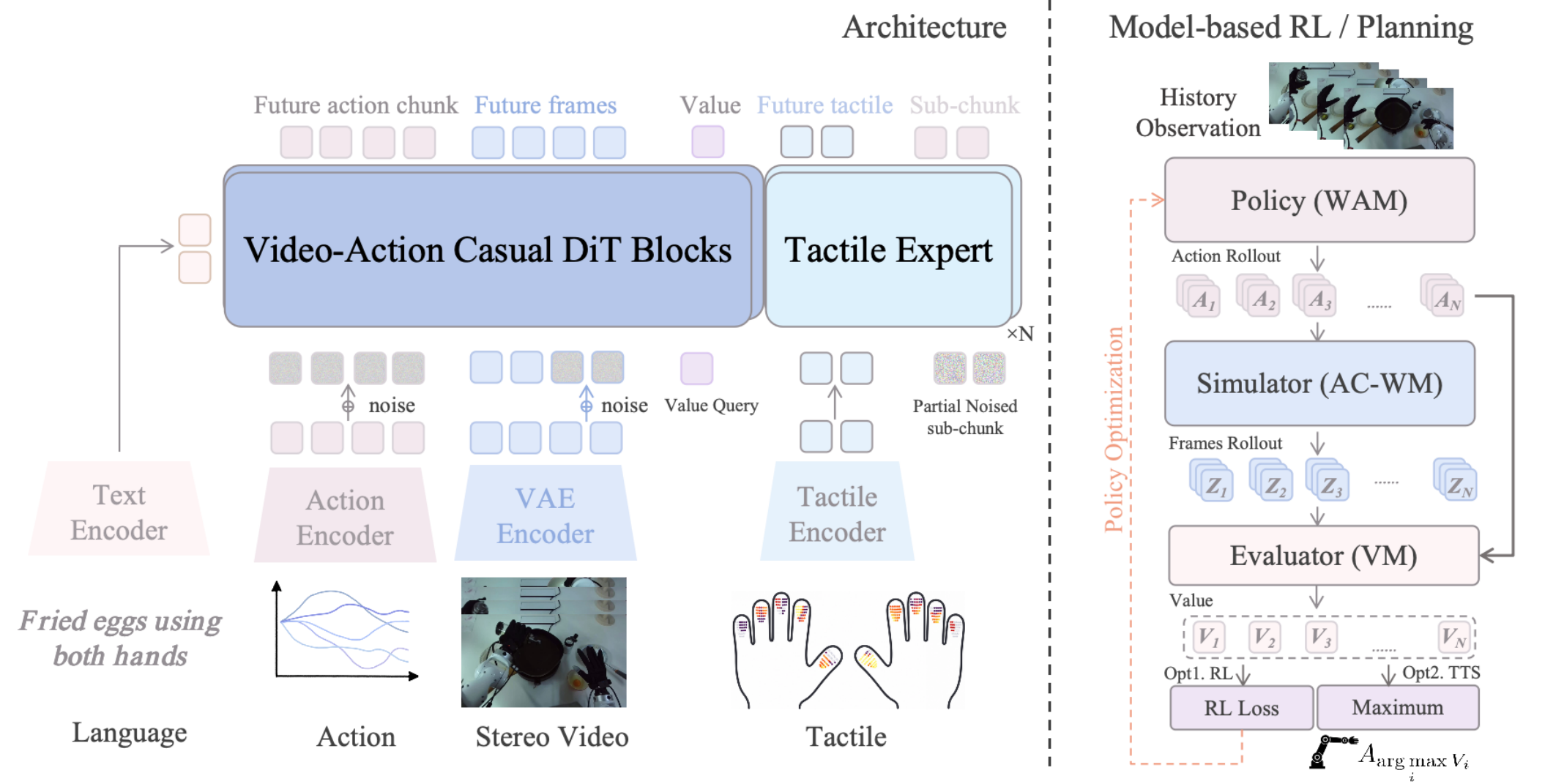
 Motus2 is a self-evolving general world model for dexterous robot manipulation. A single model with shared weights acts as a policy, a simulator, and an evaluator, coupling them into a closed decision-and-learning loop so the system can perceive, predict, act, and improve itself.
Motus2 is a self-evolving general world model for dexterous robot manipulation. A single model with shared weights acts as a policy, a simulator, and an evaluator, coupling them into a closed decision-and-learning loop so the system can perceive, predict, act, and improve itself.Is this a ready-to-use model, or more of a research framework?It's a research model/codebase, not a drop-in tool: a single model exposes three control interfaces (policy, simulator, evaluator) that work together, and it's meant to be scaled with large egocentric and robot data rather than used out of the box.
It's a research model/codebase, not a drop-in tool: a single model exposes three control interfaces (policy, simulator, evaluator) that work together, and it's meant to be scaled with large egocentric and robot data rather than used out of the box.How do I get it running?You can't yet — no code or checkpoints are published. The authors plan to release pretraining checkpoints and training code (video pretraining, value/MBRL training, memory infrastructure, tactile code) progressively throughout September 2026.
You can't yet — no code or checkpoints are published. The authors plan to release pretraining checkpoints and training code (video pretraining, value/MBRL training, memory infrastructure, tactile code) progressively throughout September 2026.What's the catch right now?Everything in the Open-Source Roadmap is unchecked — pretraining checkpoints, video pretraining code, value training code, MBRL code, memory infrastructure, and tactile code are all still pending release.
Everything in the Open-Source Roadmap is unchecked — pretraining checkpoints, video pretraining code, value training code, MBRL code, memory infrastructure, and tactile code are all still pending release.What do the policy, simulator, and evaluator interfaces actually do?The policy proposes candidate action chunks, the simulator predicts their visual consequences, and the evaluator assesses how good those predicted outcomes are, forming a closed decision-and-learning loop for improving the policy.
The policy proposes candidate action chunks, the simulator predicts their visual consequences, and the evaluator assesses how good those predicted outcomes are, forming a closed decision-and-learning loop for improving the policy.How does Motus2 scale its training data?It progresses from large-scale monocular egocentric video to synchronized stereo egocentric data, then adapts to robot trajectories plus supplementary human-robot alignment data for domain transfer.
It progresses from large-scale monocular egocentric video to synchronized stereo egocentric data, then adapts to robot trajectories plus supplementary human-robot alignment data for domain transfer.Why is it called 'self-evolving'?Because failed and suboptimal interactions, not just curated expert demonstrations, feed back into dynamics and value learning, letting the model improve its own policy through the coupled simulator-evaluator loop rather than relying only on hand-labeled success data.
Because failed and suboptimal interactions, not just curated expert demonstrations, feed back into dynamics and value learning, letting the model improve its own policy through the coupled simulator-evaluator loop rather than relying only on hand-labeled success data.What hardware does Motus2 target?A fully biomimetic robot platform with stereo vision, dual arms, dual dexterous hands, and tactile sensing, with tactile feedback added for contact-aware control.
A fully biomimetic robot platform with stereo vision, dual arms, dual dexterous hands, and tactile sensing, with tactile feedback added for contact-aware control.What are similar projects?Zero-WAM, lerobot, WholebodyVLA, Embodied-AI-Guide, Zetta-Embodiment, flex-pi, RoboICL, video-prediction-policy-2
Zero-WAM, lerobot, WholebodyVLA, Embodied-AI-Guide, Zetta-Embodiment, flex-pi, RoboICL, video-prediction-policy-2Which topics is it in?physical-ai, generative-model, self-evolving-agents, pretraining, deep-reinforcement-learning, robot, world-models, embodied-ai, pretrained-models, paper, robotics, simulation
physical-ai, generative-model, self-evolving-agents, pretraining, deep-reinforcement-learning, robot, world-models, embodied-ai, pretrained-models, paper, robotics, simulation