







What is this?
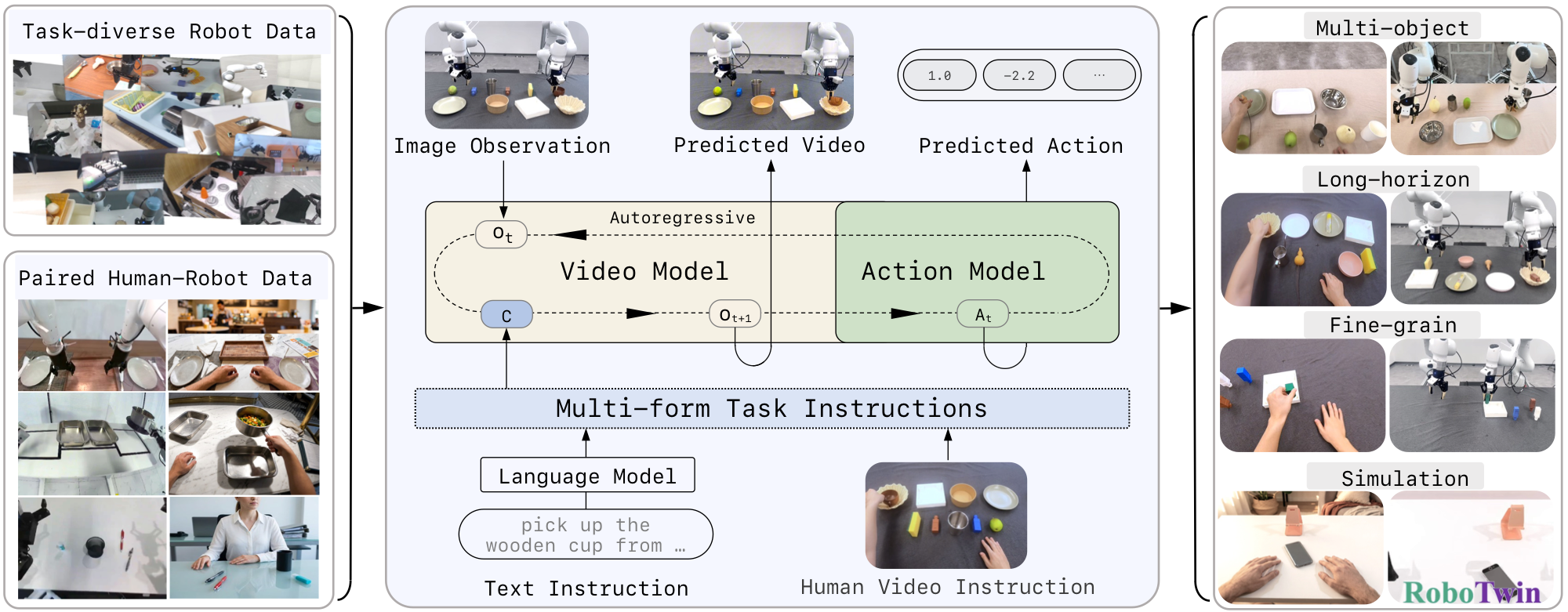
 Zero-WAM is a research method for zero-shot cross-task robotic manipulation: a causal video-action policy that learns in-context world-action modeling, predicting future robot observations and executable actions from either language instructions or human demonstration videos.
Zero-WAM is a research method for zero-shot cross-task robotic manipulation: a causal video-action policy that learns in-context world-action modeling, predicting future robot observations and executable actions from either language instructions or human demonstration videos.Is this a working codebase I can run, or just a paper for now?Right now it is only a paper. The code, trained model, and training data are all still unreleased, with each marked as expected before Sep 15, 2026.
Right now it is only a paper. The code, trained model, and training data are all still unreleased, with each marked as expected before Sep 15, 2026.How do I try Zero-WAM myself right now?You can't run it yet. The repo currently only hosts the paper (arXiv:2608.26103); code, pretrained model weights, and the training data had not been published at the time of this README.
You can't run it yet. The repo currently only hosts the paper (arXiv:2608.26103); code, pretrained model weights, and the training data had not been published at the time of this README.Does it actually solve every manipulation task well?No. Even though average zero-shot success jumps to 46.95% across seven unseen RoboTwin 2.0 tasks, some tasks remain very hard: the 'Stack blocks three' task only reaches 9.00% success compared to 0% for the baselines.
No. Even though average zero-shot success jumps to 46.95% across seven unseen RoboTwin 2.0 tasks, some tasks remain very hard: the 'Stack blocks three' task only reaches 9.00% success compared to 0% for the baselines.Who is this aimed at?Robotics and machine learning researchers working on manipulation policies and in-context/video-based learning, not end users looking for a ready-made robot controller, since nothing is runnable yet.
Robotics and machine learning researchers working on manipulation policies and in-context/video-based learning, not end users looking for a ready-made robot controller, since nothing is runnable yet.What is HumanGen and why does it matter?HumanGen is the data pipeline that converts task-sampled robot trajectories into matched human demonstration videos, producing 74.2K human-robot in-context-learning (ICL) pairs across 8.6K tasks so the policy can learn from human video prompts without collecting more robot data.
HumanGen is the data pipeline that converts task-sampled robot trajectories into matched human demonstration videos, producing 74.2K human-robot in-context-learning (ICL) pairs across 8.6K tasks so the policy can learn from human video prompts without collecting more robot data.How well does Zero-WAM perform compared to prior work?On seven unseen RoboTwin 2.0 tasks, Zero-WAM reaches a 46.95% average zero-shot success rate, beating LingBot-VA's 17.45% by 29.50 percentage points and far outperforming WAN-Action's 10.98%.
On seven unseen RoboTwin 2.0 tasks, Zero-WAM reaches a 46.95% average zero-shot success rate, beating LingBot-VA's 17.45% by 29.50 percentage points and far outperforming WAN-Action's 10.98%.Why use human videos as task instructions instead of just language?Human demonstration videos act as richer, more precise visual task specifications than plain text, letting the causal video-action policy infer what to do on unseen tasks by watching how a human performs them.
Human demonstration videos act as richer, more precise visual task specifications than plain text, letting the causal video-action policy infer what to do on unseen tasks by watching how a human performs them.How much training data does Zero-WAM use?It combines a task-diverse resampling of five public robot datasets (over 6K tasks, about 400K trajectories per epoch) with the 74.2K HumanGen-generated human-robot ICL pairs spanning external, in-house, simulation, and real-world sources.
It combines a task-diverse resampling of five public robot datasets (over 6K tasks, about 400K trajectories per epoch) with the 74.2K HumanGen-generated human-robot ICL pairs spanning external, in-house, simulation, and real-world sources.What are similar projects?RoboICL, OpenWAM, flex-pi, video-prediction-policy-2, Motus2, Embodied-AI-Start, Code-as-World, EasyWAM
RoboICL, OpenWAM, flex-pi, video-prediction-policy-2, Motus2, Embodied-AI-Start, Code-as-World, EasyWAMWhich topics is it in?in-context-learning, vision-language-models, world-action-model, vla, data-pipeline, robot, world-models, embodied-ai, arxiv, vision-language-model, paper, robotics
in-context-learning, vision-language-models, world-action-model, vla, data-pipeline, robot, world-models, embodied-ai, arxiv, vision-language-model, paper, robotics