



419 ·GitHub
What is this?
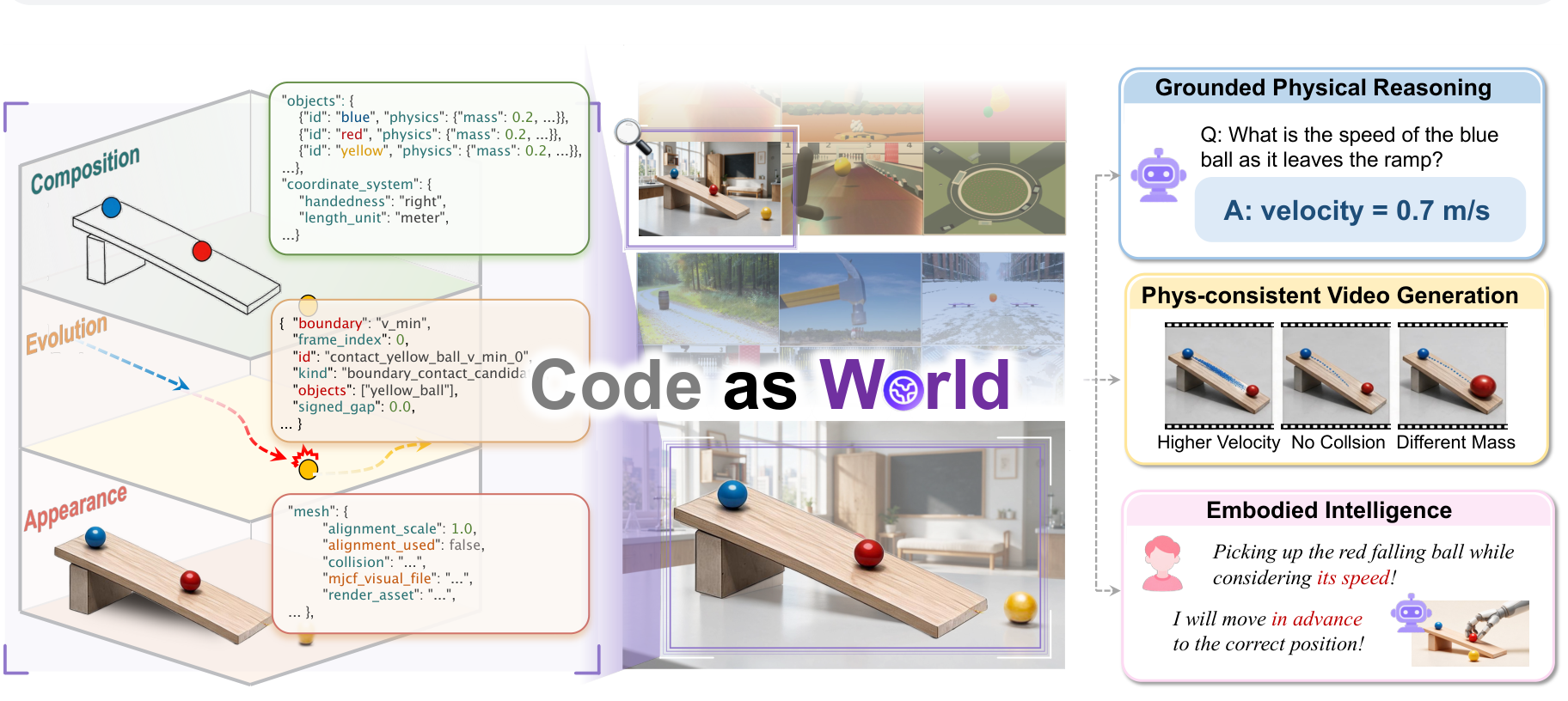
 Code-as-World is a research project that represents the physical world as executable code, discovered through an agentic loop of simulation and verification, so models get reusable physical data (states, dynamics, mechanisms) instead of just raw pixels.
Code-as-World is a research project that represents the physical world as executable code, discovered through an agentic loop of simulation and verification, so models get reusable physical data (states, dynamics, mechanisms) instead of just raw pixels.Is this a trained model or a full research pipeline?It is a full research release: two pretrained vision-language checkpoints (4B and 9B), inference and evaluation code, and a video-driven abstraction example that turns a clip into a MuJoCo simulation.
It is a full research release: two pretrained vision-language checkpoints (4B and 9B), inference and evaluation code, and a video-driven abstraction example that turns a clip into a MuJoCo simulation.How do I get this running?Use Python 3.10 or 3.11 on a CUDA host, then clone the QuantiPhy benchmark repo and download its validation videos before running evaluation or inference scripts from this repository.
Use Python 3.10 or 3.11 on a CUDA host, then clone the QuantiPhy benchmark repo and download its validation videos before running evaluation or inference scripts from this repository.What do I need besides Python to run the checkpoints?You need a CUDA GPU host, MuJoCo for the video-driven simulation example, and vLLM if you want to serve the 4B or 9B checkpoint through its OpenAI-compatible API.
You need a CUDA GPU host, MuJoCo for the video-driven simulation example, and vLLM if you want to serve the 4B or 9B checkpoint through its OpenAI-compatible API.Can this run without a GPU?No, the setup instructions require a CUDA host, and there is no mention of a CPU-only path for inference or evaluation.
No, the setup instructions require a CUDA host, and there is no mention of a CPU-only path for inference or evaluation.What are Code-as-World-VL-4B and 9B?They are the two released vision-language checkpoints trained to produce executable code representations of physical scenes for quantitative physical reasoning, served locally or through vLLM.
They are the two released vision-language checkpoints trained to produce executable code representations of physical scenes for quantitative physical reasoning, served locally or through vLLM.What is QuantiPhy?QuantiPhy is the official benchmark and evaluator the project uses to score predictions on quantitative physical reasoning, with its own repo and validation videos.
QuantiPhy is the official benchmark and evaluator the project uses to score predictions on quantitative physical reasoning, with its own repo and validation videos.What does the video-driven abstraction example do?It uses MuJoCo to turn a bundled ballistic soccer video into an executable simulation, writing a rendered video and trajectory to outputs/simulations/ (trajectory-only mode is available via --no-render).
It uses MuJoCo to turn a bundled ballistic soccer video into an executable simulation, writing a rendered video and trajectory to outputs/simulations/ (trajectory-only mode is available via --no-render).Why use code instead of raw pixel observations?The authors argue pixels only record how a scene looks, not its underlying structure, so executable code is used to capture the explicit states, dynamics, and mechanisms that could have produced that observation.
The authors argue pixels only record how a scene looks, not its underlying structure, so executable code is used to capture the explicit states, dynamics, and mechanisms that could have produced that observation.What are similar projects?Zero-WAM, OraRL, CodeVideoModel, ZDTaichu5.0-9B, Embodied-AI-Start, le-wm, EvoVLM, EasyWAM
Zero-WAM, OraRL, CodeVideoModel, ZDTaichu5.0-9B, Embodied-AI-Start, le-wm, EvoVLM, EasyWAMWhich topics is it in?vision-language-models, video-understanding, physics-simulation, world-models, paper, simulation, code-generation, vllm, evaluation, multimodal, academic-research, openai-compatible
vision-language-models, video-understanding, physics-simulation, world-models, paper, simulation, code-generation, vllm, evaluation, multimodal, academic-research, openai-compatible