Topics / #science
Science projects on GitHub
Scientific computing languages, tools, and libraries for research and data analysis.
As of , the most-starred Science projects on GitHub are awesome-public-datasets (79.6K stars), julia (49.2K stars) and google-research (38.9K stars). GitHub.Locker tracks 29 Science repositories with 421.3K stars combined. The fastest-growing on October 16 was open-science, with +182 stars in a day.
Hot right now
Most stars gained in a day · Oct 16
 +182
+182open-science
aipoch/open-science · ★ 5.1KAIPOCH Open-Science is an open-source, local-first, model-agnostic AI research workbench that runs scientific AI agents to help with literature review, data analysis, code execution, and producing traceable research reports, tables, and figures.
 +148
+148Deepgraph
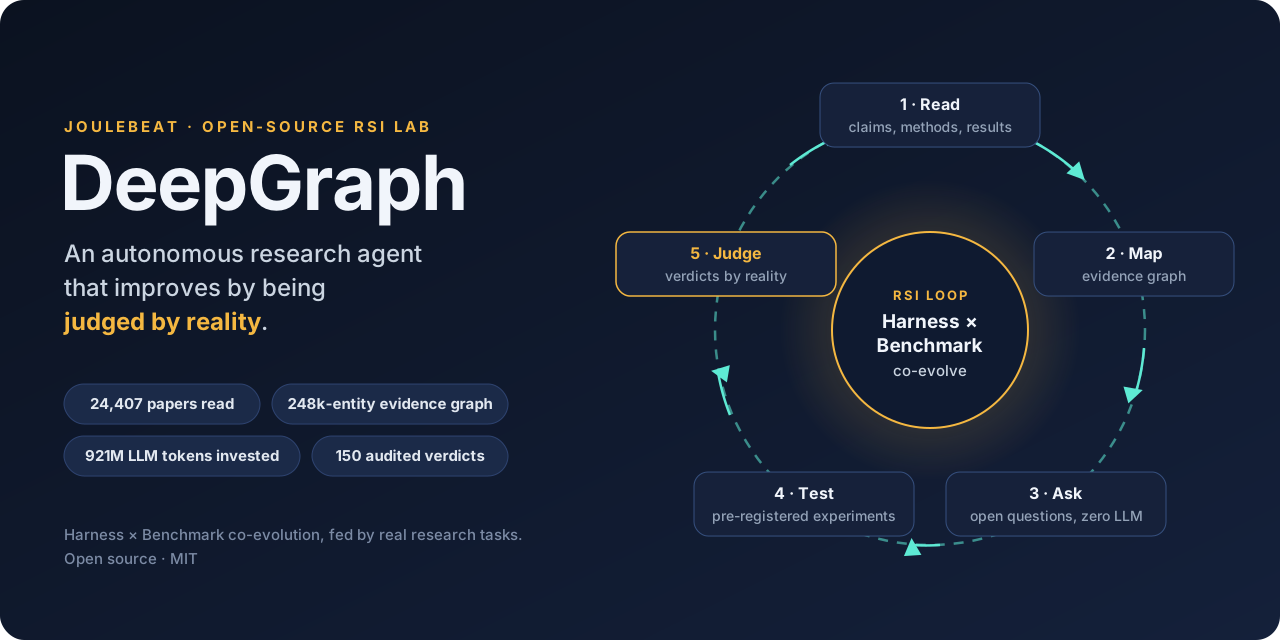
billion-token-one-task/Deepgraph · ★ 1KDeepGraph is the autonomous research agent of JouleBeat, an open-source AI self-improvement (RSI) lab. It reads scientific literature, finds open questions, runs real experiments, and lets the results decide what is true.
 +87
+87math
openai/math · ★ 15KA public catalogue of 719 mathematical manuscripts grouped into 372 families, written by an internal OpenAI model during evaluations on open research problems. About 42% of top-line results already have Lean formalizations.
 +38
+38learning_research
pengsida/learning_research · ★ 15.2KA free, open-source guide to doing academic research, written in Chinese by researcher Peng Sida. It distills his research experience in written form so lab newcomers can learn the craft without word-of-mouth training.
The all-time top
29 projects · by stars
- 79.6K
 #1 · awesomedata/awesome-public-datasets
awesome-public-datasets
A huge topic-centric list of high-quality open public datasets, organized by subject area like biology, chemistry, economics, and more.
- 49.2K
 #2 · JuliaLang/julia
julia
Julia is a high-level, high-performance dynamic programming language built for technical and scientific computing, numerical analysis, and machine learning.
- 38.9K
 #3 · google-research/google-research
google-research
A giant monorepo where Google Research dumps the code released alongside its papers and projects - hundreds of independent folders covering different research efforts, not one cohesive product.
- 4

awesome-datascience
30.2Kacademic/awesome-datascienceAn open-source, community-maintained Data Science repository — essentially a giant curated list of resources (courses, tutorials, algorithms, tools, books, datasets, communities) for learning and applying data science to real-world problems. Around 30k stars, around since 2014.
- 5

COVID-19
28.9KCSSEGISandData/COVID-19The COVID-19 data repository by Johns Hopkins University's Center for Systems Science and Engineering (CSSE) — the case data behind their widely used pandemic Visual Dashboard.
- 6

awesome-python-applications
18.1Kmahmoud/awesome-python-applications · Jupyter NotebookA curated catalog of 426 free, open-source Python applications, arranged by topic with links to each app's repo, homepage, and docs — case studies in successfully shipping Python software.
- 7

mml-book.github.io
16.1Kmml-book/mml-book.github.io · Jupyter NotebookThis is the companion website for the book 'Mathematics For Machine Learning', providing exercises and Jupyter notebooks that go along with the book's chapters.
- 8

deepmind-research
15.2Kgoogle-deepmind/deepmind-research · Jupyter NotebookIt is Google DeepMind's research repository: implementations and illustrative code that accompany its published papers, released alongside open-source environments and datasets the community can build on.
- 9
learning_research
15.2Kpengsida/learning_researchA free, open-source guide to doing academic research, written in Chinese by researcher Peng Sida. It distills his research experience in written form so lab newcomers can learn the craft without word-of-mouth training.
- 10

scipy
15.1Kscipy/scipy · PythonSciPy (pronounced 'Sigh Pie') is an open-source Python library for mathematics, science, and engineering.
- 11
math
15Kopenai/math · LeanA public catalogue of 719 mathematical manuscripts grouped into 372 families, written by an internal OpenAI model during evaluations on open research problems. About 42% of top-line results already have Lean formalizations.
- 12
sympy
15Ksympy/sympy · PythonSymPy is a computer algebra system (CAS) written entirely in pure Python, used for symbolic mathematics like algebra, calculus, and equation solving.
- 13

Virgilio
15Kvirgili0/Virgilio · Jupyter NotebookA free, open-source initiative that mentors anyone into Data Science: instead of drowning in a chaotic jungle of tutorials, you follow structured learning paths it has put together.
- 14

alphafold
14.9Kgoogle-deepmind/alphafold · PythonAlphaFold is Google DeepMind's open source implementation of the AlphaFold v2 inference pipeline, which predicts 3D protein structures from amino acid sequences, plus a work-in-progress AlphaFold-Multimer model for protein complexes.
- 15

seaborn
14.1Kmwaskom/seaborn · PythonSeaborn is a Python visualization library based on matplotlib that provides a high-level interface for drawing attractive statistical graphics.
- 16

freemocap
10.5Kfreemocap/freemocap · TypeScriptFreeMoCap is a free, open-source motion capture system that uses ordinary cameras (not expensive marker suits) to let researchers, educators, and hobbyists capture human movement in 3D.
- 17
feynman
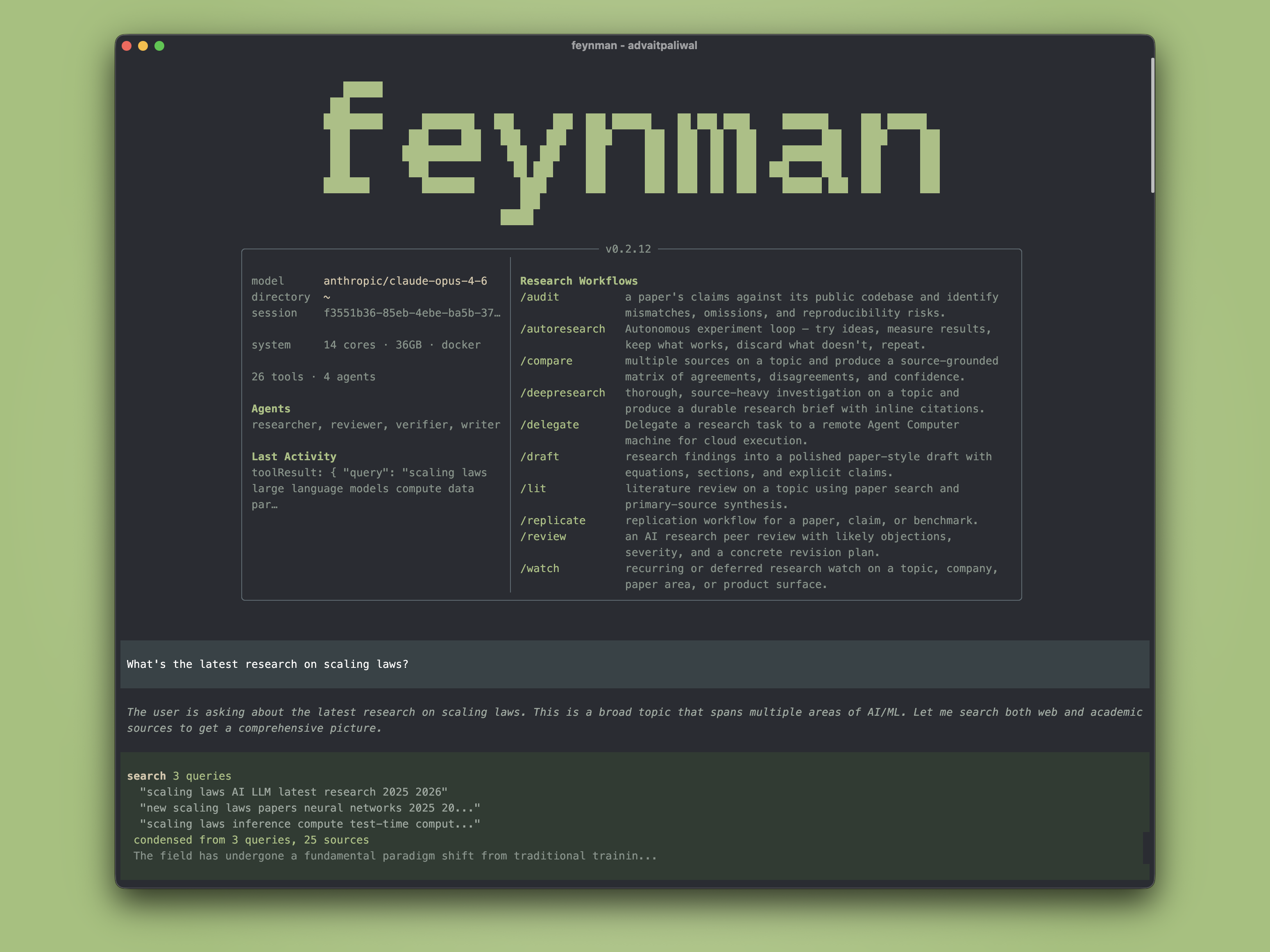
10KCompanion-Inc/feynman · TypeScriptAn open source AI research agent: a terminal app that searches papers, runs literature reviews and deep-research workflows, and links every claim back to its sources.
- 18
open-science
5.1Kaipoch/open-science · TypeScriptAIPOCH Open-Science is an open-source, local-first, model-agnostic AI research workbench that runs scientific AI agents to help with literature review, data analysis, code execution, and producing traceable research reports, tables, and figures.
- 19

DeepAnalyze
4.7Kruc-datalab/DeepAnalyze · PythonDeepAnalyze is an open-source agentic large language model built for fully autonomous data science: it can handle data preparation, analysis, modeling, visualization, and report generation on its own, across structured, semi-structured, and unstructured data sources.
- 20

openscience
4Ksynthetic-sciences/openscience · TypeScriptOpenScience is an open-source AI workbench for scientific research: give it a goal and it reads literature, writes and runs code, runs experiments, and writes up what it found.
- 21
NavierStokesAndEuler
2.1Kopenai/NavierStokesAndEuler · LeanThis repository contains Lean 4 formalizations (machine-checked formal proofs) of two OpenAI papers: 'Finite time blowup for Navier-Stokes' and 'Finite time blowup for the Euler equation'.
- 22

fermats-last-theorem
1.3Kanthropics/fermats-last-theorem · LeanA complete, machine-checked Lean 4 proof of Fermat's Last Theorem built on Mathlib, following the Frey-Serre-Ribet-Wiles-Taylor-Wiles argument, and cross-checked by two independent kernels.
- 23

desktop-fly
1.1KDenisSergeevitch/desktop-fly · SwiftDesktopFly is a 3D fruit fly that lives on your macOS desktop, animated by a live spiking simulation built from the real FlyWire fly-brain connectome (and a motor circuit from the MaleCNS dataset).
- 24
Deepgraph
1Kbillion-token-one-task/Deepgraph · PythonDeepGraph is the autonomous research agent of JouleBeat, an open-source AI self-improvement (RSI) lab. It reads scientific literature, finds open questions, runs real experiments, and lets the results decide what is true.
- 25

iudsim
247THU-iUWLab/iudsimIUDSim (Integrated Urban Drainage Simulator) is an urban drainage system simulator built by Tsinghua's iUWLab that tightly couples surface runoff, pipe networks, wastewater treatment, rivers, and human movement into one simulation to model the full event-facility-social-environmental process chain.
- 26

m4-sme-exploration
245tzakharko/m4-sme-exploration · CA research project that microbenchmarks the Scalable Matrix Extension (SME) of Apple's M4 chip, measuring peak compute throughput for common matrix and vector operations and memory transfer rates.
- 27

vistep
240int64ago/vistep · TypeScriptvistep.ai is a bilingual collection of short visual stories that explain everyday mechanisms, science and computation, letting you watch a process happen and then experiment with the underlying model.
- 28

OmniScientist
170Omni-Scientist/OmniScientist · TypeScriptOmniScientist is an open, omni-modal AI scientist that runs on your own machine. Point it at a folder of data and a research direction, and it forms a hypothesis, writes and runs its own analysis code, reads the resulting figures, and drafts a paper whose every number traces back to a real execution record.
- 29
KISS-Knowledge-Infrastructure-for-Scientific-Simulation
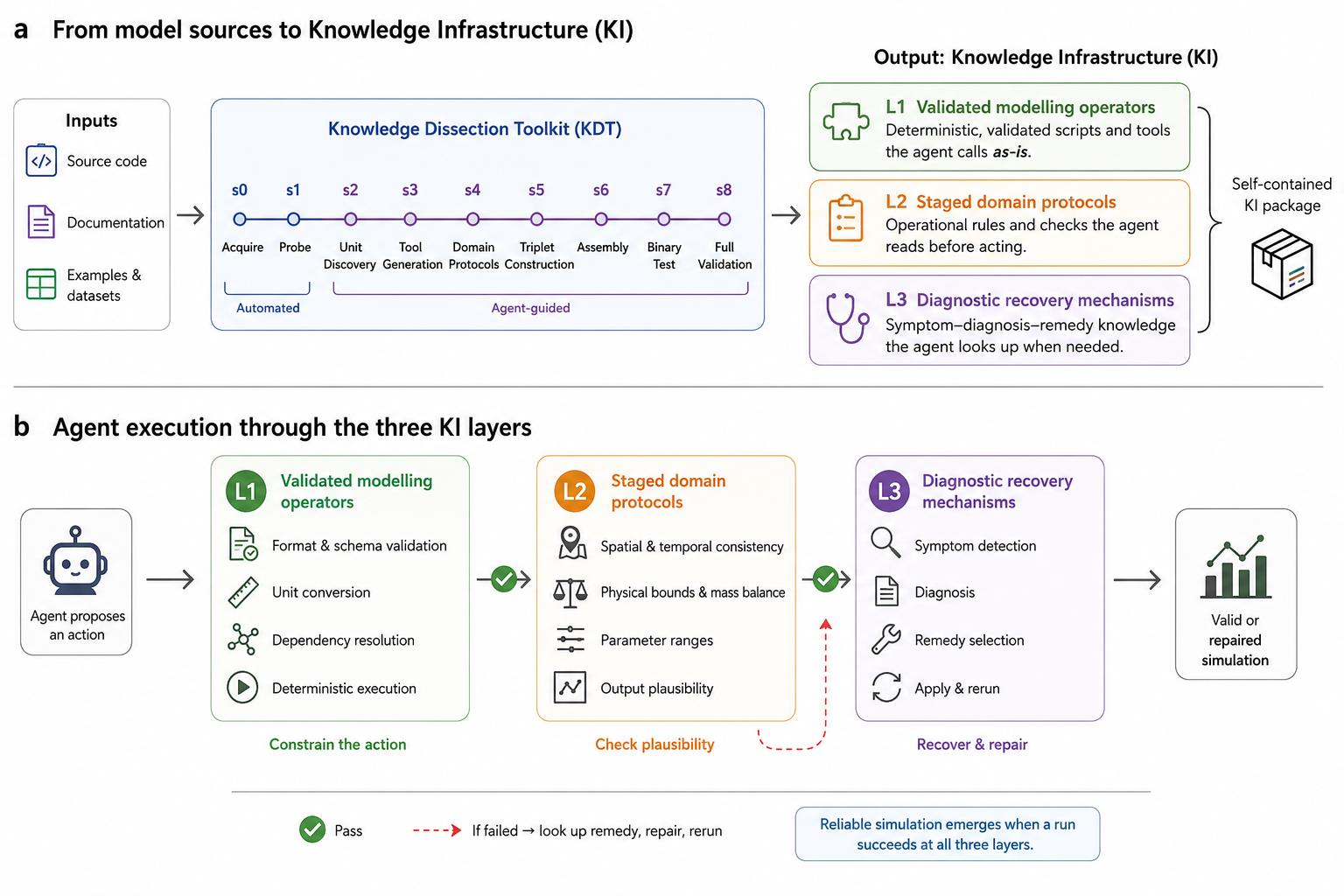
40lzwei196/KISS-Knowledge-Infrastructure-for-Scientific-Simulation · PythonKISS is a Knowledge Infrastructure (KI) framework that packages the operational expertise behind running scientific simulation models — how to prepare inputs, judge whether results are physically plausible, and recover from failures — so AI coding agents can run these models reliably, not just know their equations.
Related topics
Often tagged together
- open-source5,666
- research764
- python2,383
- academic-research209
- machine-learning916
- data-science231
- linux4,184
- macos3,544
- education933
- free970
- mit3,312
- windows3,403
- ai1,955
- apache-2.01,434
- cross-platform2,623
- deep-learning737
- mathematics53
- scientific-computing42
- benchmark431
- data-visualization201
- dataset124
- library1,587
- llm1,483
- typescript1,821