


What is this?
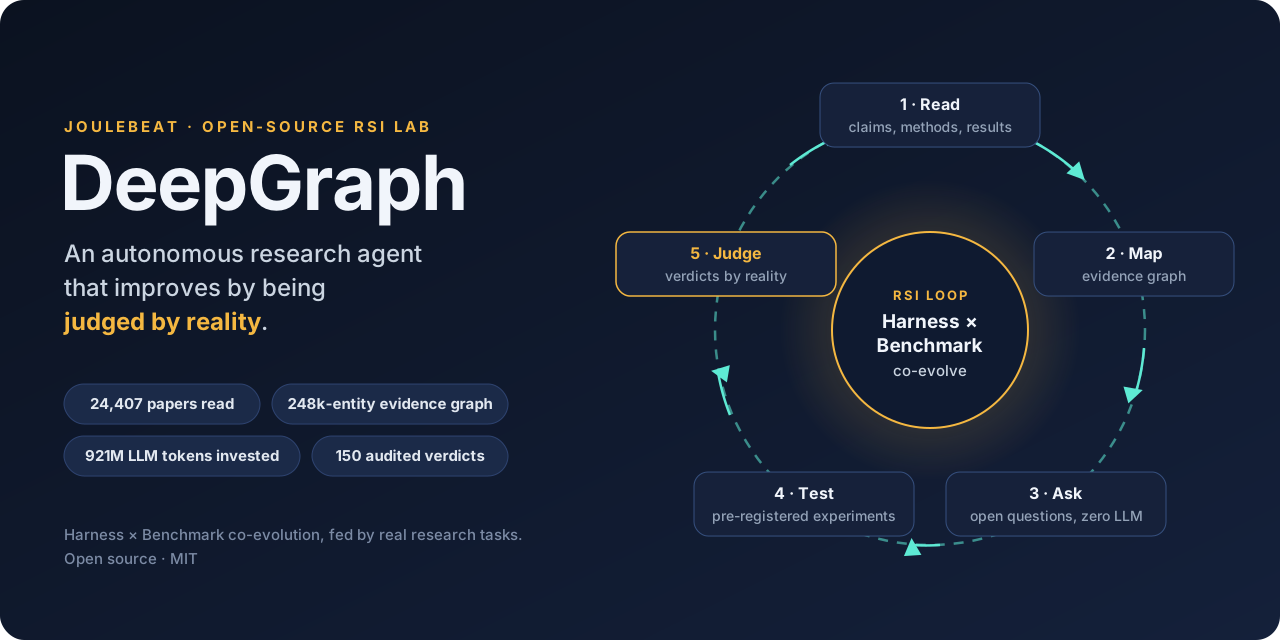
 DeepGraph is the autonomous research agent of JouleBeat, an open-source AI self-improvement (RSI) lab. It reads scientific literature, finds open questions, runs real experiments, and lets the results decide what is true.
DeepGraph is the autonomous research agent of JouleBeat, an open-source AI self-improvement (RSI) lab. It reads scientific literature, finds open questions, runs real experiments, and lets the results decide what is true.Is this a standalone app or more of a pipeline?It is an end-to-end research pipeline: it harvests arXiv papers into an evidence knowledge graph, detects open questions with pure SQL (no LLM), and turns them into budgeted experiments judged by an evidence ladder.
It is an end-to-end research pipeline: it harvests arXiv papers into an evidence knowledge graph, detects open questions with pure SQL (no LLM), and turns them into budgeted experiments judged by an evidence ladder.How do I get it running?The quick start needs Python 3.12+ and an LLM API key; for the full control plane with PostgreSQL, systemd and remote GPU backends, follow the deployment guide at docs/DEPLOY.md.
The quick start needs Python 3.12+ and an LLM API key; for the full control plane with PostgreSQL, systemd and remote GPU backends, follow the deployment guide at docs/DEPLOY.md.Do I need a database set up first, or is it optional?PostgreSQL is optional for the minimal quick start but required to unlock the full control plane, systemd deployment, and remote GPU backends.
PostgreSQL is optional for the minimal quick start but required to unlock the full control plane, systemd deployment, and remote GPU backends.Is every conclusion it produces trustworthy?The system self-audits rather than guaranteeing correctness on every run: in August 2026 it caught and retracted 11 of its own conclusions that had rested on empty model outputs.
The system self-audits rather than guaranteeing correctness on every run: in August 2026 it caught and retracted 11 of its own conclusions that had rested on empty model outputs.Who is this actually for?It is built for researchers who want checkable computational conclusions, and it doubles as JouleBeat's own R&D loop for evolving agent harnesses and benchmarks.
It is built for researchers who want checkable computational conclusions, and it doubles as JouleBeat's own R&D loop for evolving agent harnesses and benchmarks.What is the Evolution Kernel?It is the open-source engine behind the JouleBeat stack that proposes, evaluates, accepts or rolls back changes to harnesses and benchmarks. It is installable separately via pip install evolution-kernel.
It is the open-source engine behind the JouleBeat stack that proposes, evaluates, accepts or rolls back changes to harnesses and benchmarks. It is installable separately via pip install evolution-kernel.How does it find open research questions without an LLM in the loop?Ten structural detectors query the evidence graph using pure SQL to surface open questions, avoiding LLM involvement in that specific step to keep it deterministic and auditable.
Ten structural detectors query the evidence graph using pure SQL to surface open questions, avoiding LLM involvement in that specific step to keep it deterministic and auditable.What has DeepGraph actually produced so far?As of its August 2026 production data it had harvested 24,407 papers (7,005 fully processed), built a graph of 248,441 entities and 735,913 relations, and issued 150 audited experiment verdicts across six research agendas.
As of its August 2026 production data it had harvested 24,407 papers (7,005 fully processed), built a graph of 248,441 entities and 735,913 relations, and issued 150 audited experiment verdicts across six research agendas.Why did JouleBeat build this instead of just benchmarking models directly?JouleBeat needs a constant stream of real, checkable tasks to judge new agent harnesses and benchmarks against; computational research provides exactly that because conclusions can be confirmed or refuted by rerunning code or data.
JouleBeat needs a constant stream of real, checkable tasks to judge new agent harnesses and benchmarks against; computational research provides exactly that because conclusions can be confirmed or refuted by rerunning code or data.What are similar projects?Raven, awesome-rsi, rrsi, Proteus, wikiskill, AI-Scientist, KISS-Knowledge-Infrastructure-for-Scientific-Simulation, EvoScientist
Raven, awesome-rsi, rrsi, Proteus, wikiskill, AI-Scientist, KISS-Knowledge-Infrastructure-for-Scientific-Simulation, EvoScientistWhich topics is it in?recursive-self-improvement, reproducible-research, self-evolving-agents, ai-research, deep-research, science, arxiv, scientific-computing, llm-agents, papers, knowledge-graph, harness
recursive-self-improvement, reproducible-research, self-evolving-agents, ai-research, deep-research, science, arxiv, scientific-computing, llm-agents, papers, knowledge-graph, harness