





RoboICL README

The project's README from github.com/Mosi-AI/RoboICL. As one markdown file: README.md.

RoboICL: Embodied In-Context Learning with GPT-6 Astra

Multimodal Models as Few-Shot Robot Learners

arXiv paper Project page Interactive evaluation episodes

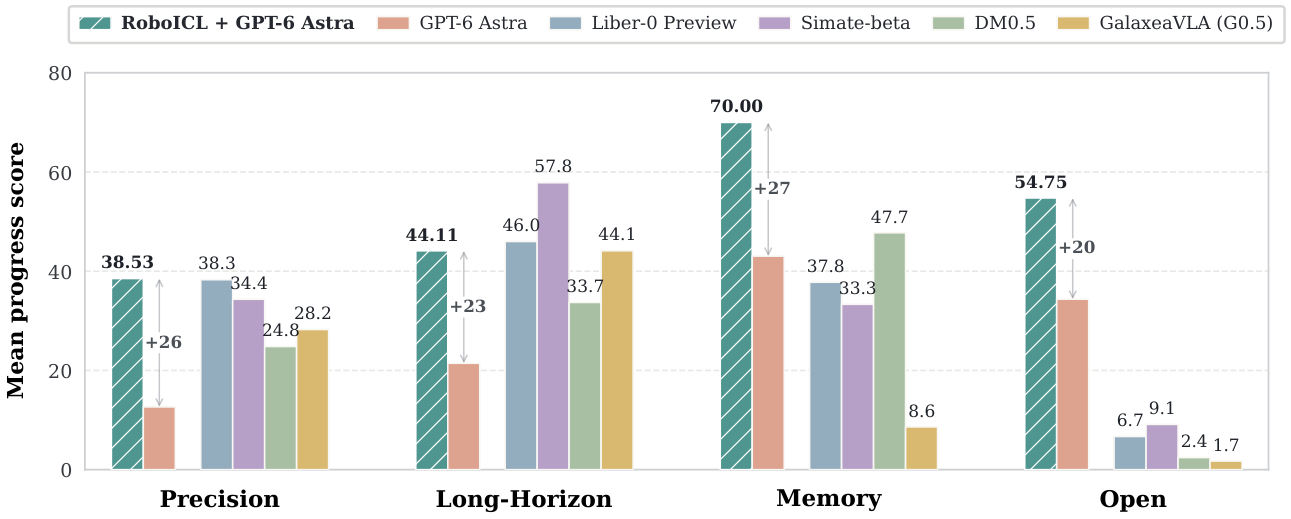
RoboICL category-level performance on the RoboDojo benchmark

RoboICL uses interaction memory alone on Open and one demonstration on the other categories.

News

Overview

RoboICL is an in-context robot-control framework that adapts a frozen general-purpose vision-language model from demonstrations and its own execution history. It requires no robot-specific parameter update and no learned vision-language-action model.

RoboICL separates context into two complementary sources:

The released runner connects GPT-6 Astra to RoboDojo through one validated action interface. At each request, the model observes a triptych of the left wrist, head, and right wrist cameras together with robot proprioception, then predicts a bounded sequence of dual-arm Cartesian actions for closed-loop execution.

Installation

Prerequisites

The simulator and policy processes intentionally use separate interpreters because their websockets and simulator dependency constraints differ.

Clone the repository

git clone --recurse-submodules https://github.com/Mosi-AI/RoboICL.git
cd RoboICL

For an existing clone:

git submodule update --init --recursive

The exact supported commits of RoboDojo, XPolicyLab, IsaacLab, and cuRobo are recorded in configs/upstream.lock.json and verified before launch.

Configure the two Python environments

Point RoboICL at the interpreters that contain your simulator and policy dependencies:

export ROBOICL_SIM_PYTHON=/path/to/sim/bin/python
export ROBOICL_POLICY_PYTHON=/path/to/policy/bin/python
export ROBOICL_DATA_ROOT="$PWD/data"
export ROBOICL_RESULTS_ROOT="$PWD/results"
source setup/paths.sh

Install the direct RoboICL dependencies into those environments after the Isaac Sim environment itself is available:

"$ROBOICL_POLICY_PYTHON" -m pip install -r setup/requirements-policy.txt
"$ROBOICL_SIM_PYTHON" -m pip install \
  -r setup/requirements-sim.txt \
  -c setup/constraints-sim.txt

If the simulator environment provides a newer libstdc++ than the host:

SIM_PREFIX="$(dirname -- "$(dirname -- "$ROBOICL_SIM_PYTHON")")"
export ROBOICL_SIM_LD_PRELOAD="$SIM_PREFIX/lib/libstdc++.so.6"

Data preparation

RoboDojo assets

Fetch the complete frozen RoboDojo asset tree into an external Git/LFS cache. The script checks out the revision in configs/data.lock.json, verifies the download, and links data/Assets to the cache.

"$ROBOICL_POLICY_PYTHON" setup/fetch_assets.py \
  --data-root "$ROBOICL_DATA_ROOT" \
  --cache /path/to/robodojo-data-cache

One-shot references

The paper benchmark contains exactly 8 Open tasks evaluated zero-shot and 22 non-Open tasks supplied with one demonstration. The complete source-episode identity, HDF5 SHA256, prediction horizon, and all 12 selected action-window starts are archived in configs/references/one_shot_j12_b12.json.

Fetch and deterministically build any archived one-shot reference, for example:

"$ROBOICL_POLICY_PYTHON" setup/fetch_reference.py deposit_coin \
  --data-root "$ROBOICL_DATA_ROOT"

"$ROBOICL_POLICY_PYTHON" setup/fetch_reference.py fill_pen_holder \
  --data-root "$ROBOICL_DATA_ROOT"

The source is checked by SHA256, and the builder uses the exact archived starts rather than silently re-running a heuristic. The generated bundle contains 12 non-overlapping action blocks and their starting/result observations.

TRAIN and LIVE use different selectors. TRAIN uses the exact action-window starts recorded in the setting manifest. LIVE does not sample video frames: eleven uniformly spaced time anchors retain the first complete executed interaction that crosses each anchor, while the twelfth slot retains the latest complete interaction.

To build a reference for another task from a local HDF5 episode:

"$ROBOICL_POLICY_PYTHON" -m roboicl.reference build \
  --task "$TASK" \
  --source "$ROBOICL_DATA_ROOT/runtime-data/$TASK/train/episode_0000000.hdf5" \
  --source-id "runtime-data/$TASK/train/episode_0000000.hdf5" \
  --source-sha256 "$SOURCE_SHA256" \
  --output "$ROBOICL_DATA_ROOT/runtime-data/$TASK/reference_1shot_train12_endpoint_h$H" \
  --horizon "$H" \
  --chunks 12 \
  --selected-starts "$START_0,$START_1,...,$START_11"

Run RoboICL

The release provides two main protocols:

Protocol Demonstrations TRAIN blocks J LIVE memory blocks B
configs/protocols/zero_shot_b25.json 0 0 25
configs/protocols/one_shot_j12_b12.json 1 12 12

Both use the task-adaptive action horizons in configs/adaptive_horizons.json.

1. Preflight without an API request

"$ROBOICL_POLICY_PYTHON" -m roboicl.run deposit_coin \
  --shots 0 \
  --seed 0 \
  --layout 0 \
  --profile configs/protocols/zero_shot_b25.json \
  --dry-run

This validates the task, layout, assets, profile, interpreters, and pinned submodules without starting the simulator or calling the model API.

2. Validate the simulator and cameras

"$ROBOICL_POLICY_PYTHON" -m roboicl.run deposit_coin \
  --shots 0 \
  --seed 0 \
  --layout 0 \
  --gpu 0 \
  --profile configs/protocols/zero_shot_b25.json \
  --capture-only

--capture-only launches the scene and verifies the three RGB streams without making a model request or executing an action.

3. Run a scored zero-shot rollout

export ASTRA_API_KEY=...

"$ROBOICL_POLICY_PYTHON" -m roboicl.run deposit_coin \
  --shots 0 \
  --seed 0 \
  --layout 0 \
  --gpu 0 \
  --profile configs/protocols/zero_shot_b25.json

4. Run a scored one-shot rollout

export ASTRA_API_KEY=...

"$ROBOICL_POLICY_PYTHON" -m roboicl.run deposit_coin \
  --shots 1 \
  --seed 0 \
  --layout 0 \
  --gpu 0 \
  --profile configs/protocols/one_shot_j12_b12.json

Replace the task, seed, and layout as needed. Use --reference /path/to/bundle for a one-shot task without a published reference path. A process exit code of zero means evaluation completed; task success and progress are reported by the native RoboDojo evaluator in the generated result.json.

Repository layout

roboicl/
├── run.py                 preflight and process orchestration
├── robodojo.py            single-layout RoboDojo adapter
├── rollout.py             observation/action execution loop
├── policy_server.py       XPolicyLab WebSocket policy entrypoint
├── reference.py           reference builder and verifier
└── policy/                prompting, memory, validation, and transport
configs/
├── protocols/             zero-shot and one-shot protocol profiles
├── tasks/                 official documentation for 42 tasks
├── adaptive_horizons.json task-specific action horizons
├── data.lock.json         frozen asset revision
├── references/             setting-level source episodes and exact TRAIN windows
└── upstream.lock.json     pinned submodule commits
setup/
├── fetch_assets.py
├── fetch_reference.py
├── requirements-policy.txt
├── requirements-sim.txt
└── paths.sh
third_party/
├── RoboDojo/
├── XPolicyLab/
├── IsaacLab/
└── curobo/

RoboICL WeChat discussion group QR code      RoboICL RedNote discussion group QR code

Citation

@article{liu2026roboicl,
  title   = {RoboICL: Embodied In-Context Learning with GPT-6 Astra},
  author  = {Liu, Fangcheng and Shen, Yeqing and Cheng, Anda and Mi, Weishi and
             Tang, Chao and Liu, Chenyuan and Xiang, Yushun and Li, Tingguang and
             Li, Yong-Lu and Tang, Yehui},
  journal = {arXiv preprint arXiv:2609.34261},
  year    = {2026},
  eprint  = {2609.34261},
  archivePrefix = {arXiv},
  url     = {https://arxiv.org/abs/2609.34261}
}

License

RoboICL's project-owned code is released under the MIT License. Third-party submodules and benchmark assets retain their original licenses and terms.

RoboICL (Mosi-AI/RoboICL)

vlm
Searching Database…

What is this?RoboICL is a research framework that lets a frozen, general-purpose vision-language model (GPT-6 Astra) control a robot in simulation purely through in-context learning, without training a dedicated robot policy.
Is this a trained robot policy or something else?No model weights are trained here: it's a runner that packages demonstration trajectories and the model's own past actions as prompt context, then parses the VLM's predictions into robot actions.
How do I get this running?Clone the repo, point two separate Python environments at your Isaac Sim-based simulator and your multimodal policy process, install RoboICL's dependencies into each, then run the data scripts to fetch the RoboDojo asset tree and any one-shot reference bundles before launching a rollout.
What do I need installed before trying this?Git with Git LFS, an Isaac Sim 5.1-compatible simulator environment, and access to the GPT-6 Astra model API, on top of the two separate Python environments for simulator and policy.
Is setup heavy, or can I just pip install and go?Setup is heavy by design: exact pinned commits of RoboDojo, XPolicyLab, IsaacLab and cuRobo are recorded and verified before launch, and asset/reference bundles are checked by SHA256 rather than regenerated on the fly.
What platform does this run on?It's Linux-only, built around an NVIDIA/CUDA simulator stack; there's no mention of macOS or Windows support.
What is GPT-6 Astra here?It's the frozen multimodal vision-language model RoboICL queries as a few-shot robot learner — the repo provides no model weights of its own, just the runner that prompts it.
What's the difference between demonstration context and interaction memory?Demonstration context supplies recorded robot trajectories as few-shot examples, while interaction memory retains the model's own actions, controller feedback, and observations from the current rollout for self-correction.
What tasks does it evaluate on?The paper benchmark covers 8 'Open' tasks tested zero-shot and 22 non-Open tasks given one demonstration each, backed by over 800 interactive evaluation rollouts released with the code.
What does the robot actually see and do?At each step the model views a triptych of left-wrist, head, and right-wrist camera images plus proprioception, then predicts a bounded sequence of dual-arm Cartesian actions executed in closed loop in the RoboDojo simulator.
Creator
Mosi-AI
Size
12.8 MB
Stars
268
Age
29d
Commits · 90 Days