







130 ·GitHub
What is this?
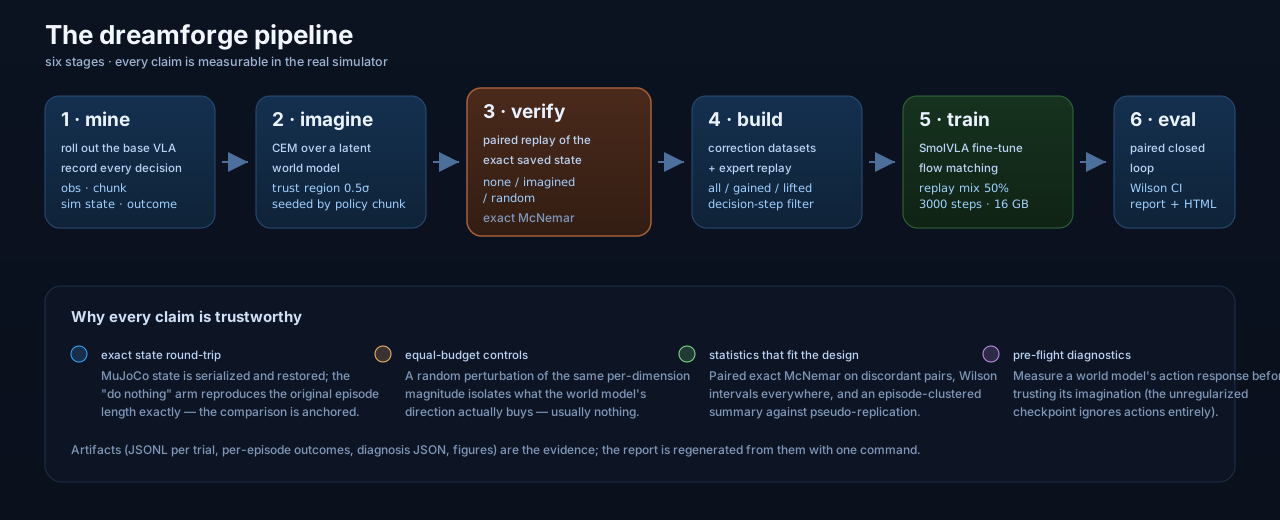
 Dreamforge is a research pipeline that mines a robot policy's own failure states, uses a latent world model (CEM) to imagine corrective actions, and verifies each correction by replaying it in the real simulator before claiming it helps.
Dreamforge is a research pipeline that mines a robot policy's own failure states, uses a latent world model (CEM) to imagine corrective actions, and verifies each correction by replaying it in the real simulator before claiming it helps.Is this a trained robot policy or a research pipeline?It is an end-to-end CLI research pipeline with distinct stages (mine, imagine, verify, build, train, eval), not a standalone policy — it operates on top of an existing SmolVLA policy to test whether world-model imagination can produce useful training corrections.
It is an end-to-end CLI research pipeline with distinct stages (mine, imagine, verify, build, train, eval), not a standalone policy — it operates on top of an existing SmolVLA policy to test whether world-model imagination can produce useful training corrections.How do I run the pipeline?The full pipeline runs through a single Makefile target: 'make mine imagine verify build train eval report' executes mining, imagination, verification, dataset building, fine-tuning, evaluation and reporting as one sequence.
The full pipeline runs through a single Makefile target: 'make mine imagine verify build train eval report' executes mining, imagination, verification, dataset building, fine-tuning, evaluation and reporting as one sequence.What models and hardware does it need?You need the LIBERO-Spatial simulated benchmark and a SmolVLA-450M vision-language-action policy; the reference run completed end-to-end on a single consumer GPU (an RTX 5080).
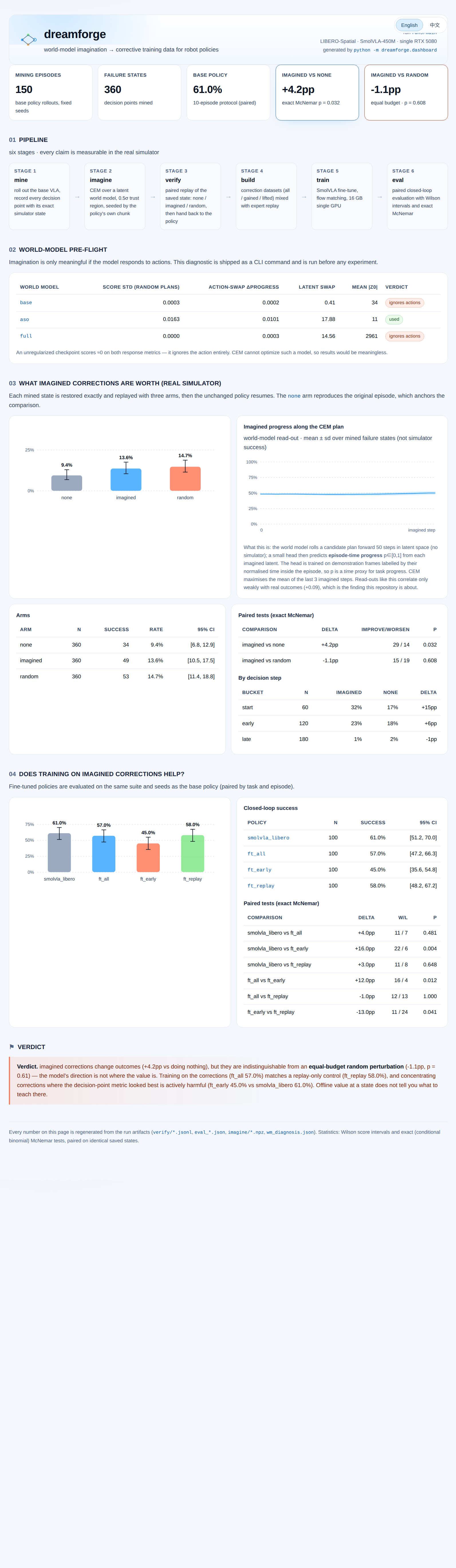
You need the LIBERO-Spatial simulated benchmark and a SmolVLA-450M vision-language-action policy; the reference run completed end-to-end on a single consumer GPU (an RTX 5080).Does training on the world model's corrections actually improve the policy?No — fine-tuning on corrections scored 57.0% versus a 61.0% base policy and a 58.0% replay-only control, and pushing corrections where the metric looked best actually hurt performance by 13 points.
No — fine-tuning on corrections scored 57.0% versus a 61.0% base policy and a 58.0% replay-only control, and pushing corrections where the metric looked best actually hurt performance by 13 points.Who is this pipeline meant for?It is aimed at robotics and ML researchers studying whether world models can supply a real training signal for vision-language-action policies, not end users looking for a ready-made robot controller — it ships as a research CLI with statistical reporting, not a product.
It is aimed at robotics and ML researchers studying whether world models can supply a real training signal for vision-language-action policies, not end users looking for a ready-made robot controller — it ships as a research CLI with statistical reporting, not a product.What role do SmolVLA and LIBERO play here?SmolVLA-450M is the vision-language-action policy being probed and fine-tuned, and LIBERO-Spatial is the simulated manipulation benchmark the pipeline mines failures from and replays corrections in.
SmolVLA-450M is the vision-language-action policy being probed and fine-tuned, and LIBERO-Spatial is the simulated manipulation benchmark the pipeline mines failures from and replays corrections in.What's the headline finding of the experiments?World-model-guided corrections move metrics (+4.2pp over no correction) but gain nothing over an equal-budget random perturbation (-1.1pp, not significant), and training on them doesn't beat a replay-only control.
World-model-guided corrections move metrics (+4.2pp over no correction) but gain nothing over an equal-budget random perturbation (-1.1pp, not significant), and training on them doesn't beat a replay-only control.Why replay every imagined action in the real simulator instead of trusting the world model's score?Because the project's premise is that offline world-model scores don't reliably predict real outcomes, so every correction is verified by replaying the exact simulator state (none/imagined/random) before any claim about it is trusted.
Because the project's premise is that offline world-model scores don't reliably predict real outcomes, so every correction is verified by replaying the exact simulator state (none/imagined/random) before any claim about it is trusted.Is this limited to LIBERO and SmolVLA, or does it generalize?Currently it's built around one suite (LIBERO-Spatial) and one base policy (SmolVLA-450M); testing a second suite/policy and a video world model is listed as future work.
Currently it's built around one suite (LIBERO-Spatial) and one base policy (SmolVLA-450M); testing a second suite/policy and a video world model is listed as future work.What are similar projects?EasyWAM, flex-pi, lerobot, RoboICL, FluxVLA, OpenWAM, video-prediction-policy-2, Zetta-Embodiment
EasyWAM, flex-pi, lerobot, RoboICL, FluxVLA, OpenWAM, video-prediction-policy-2, Zetta-EmbodimentWhich topics is it in?vision-language-action, imitation-learning, world-model, vla, embodied-ai, robotics, simulation, evaluation, academic-research, nvidia, computer-vision, cuda
vision-language-action, imitation-learning, world-model, vla, embodied-ai, robotics, simulation, evaluation, academic-research, nvidia, computer-vision, cuda