ZDTaichu5.0-9B README

The project's README from github.com/Taichu-AI/ZDTaichu5.0-9B. As one markdown file: README.md.

ZDTaichu5.0-9B

English | 简体中文

Blog | ModelScope | Hugging Face

Model Downloads

Model Hugging Face ModelScope
ZDTaichu5.0-9B Hugging Face ModelScope
ZDTaichu5.0-9B-FP8 Hugging Face ModelScope
ZDTaichu5.0-9B-NVFP4 Hugging Face ModelScope
ZDTaichu5.0-9B-DSpark Hugging Face ModelScope

Introduction

ZDTaichu5.0-9B is a multimodal foundation model for general visual understanding, spatial reasoning, agentic tool use, and embodied-AI research. It combines a Qwen3.5-9B language backbone with a C-RADIOv4-H vision encoder, supports text, images and videos with any-resolution visual input.

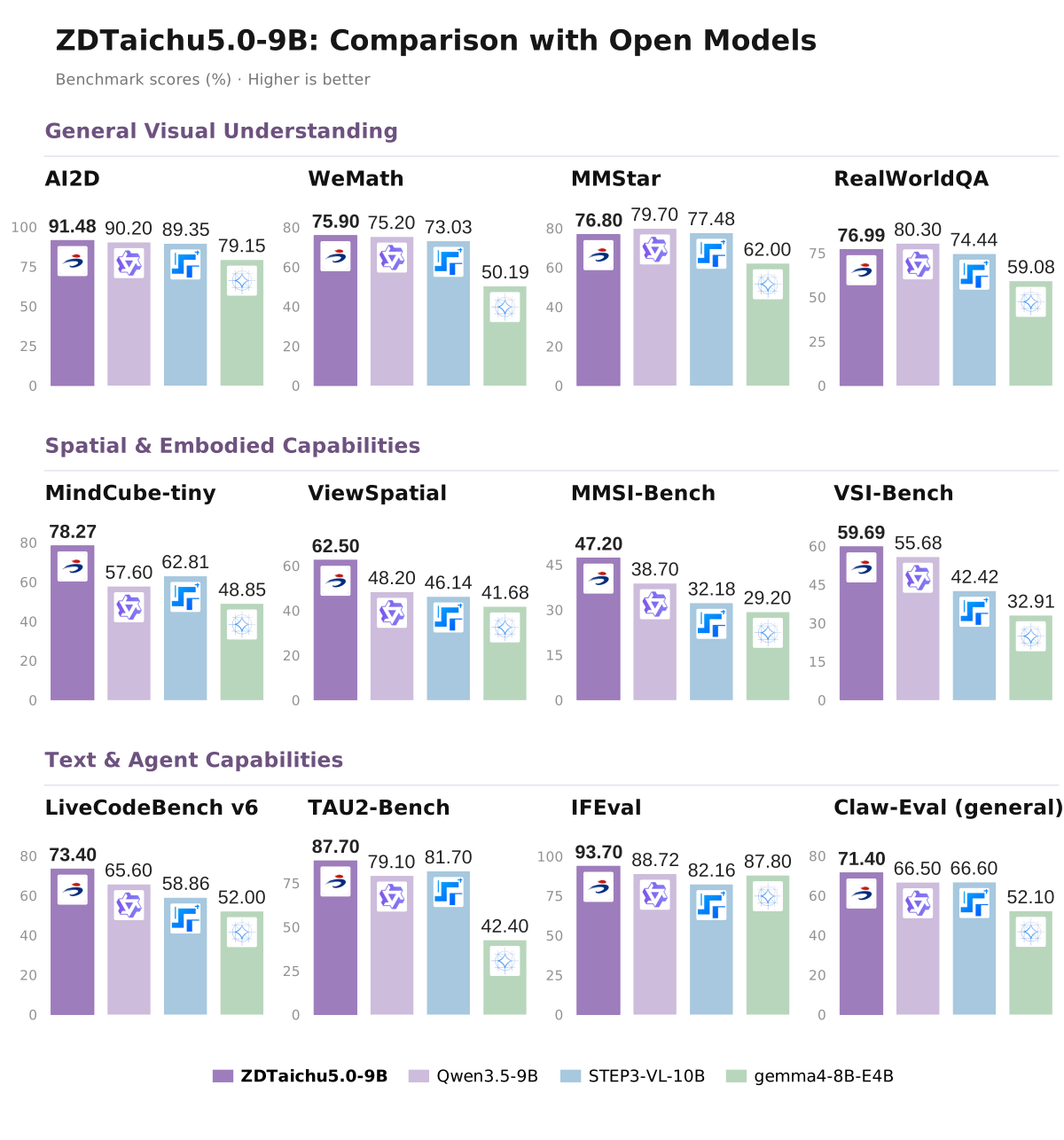
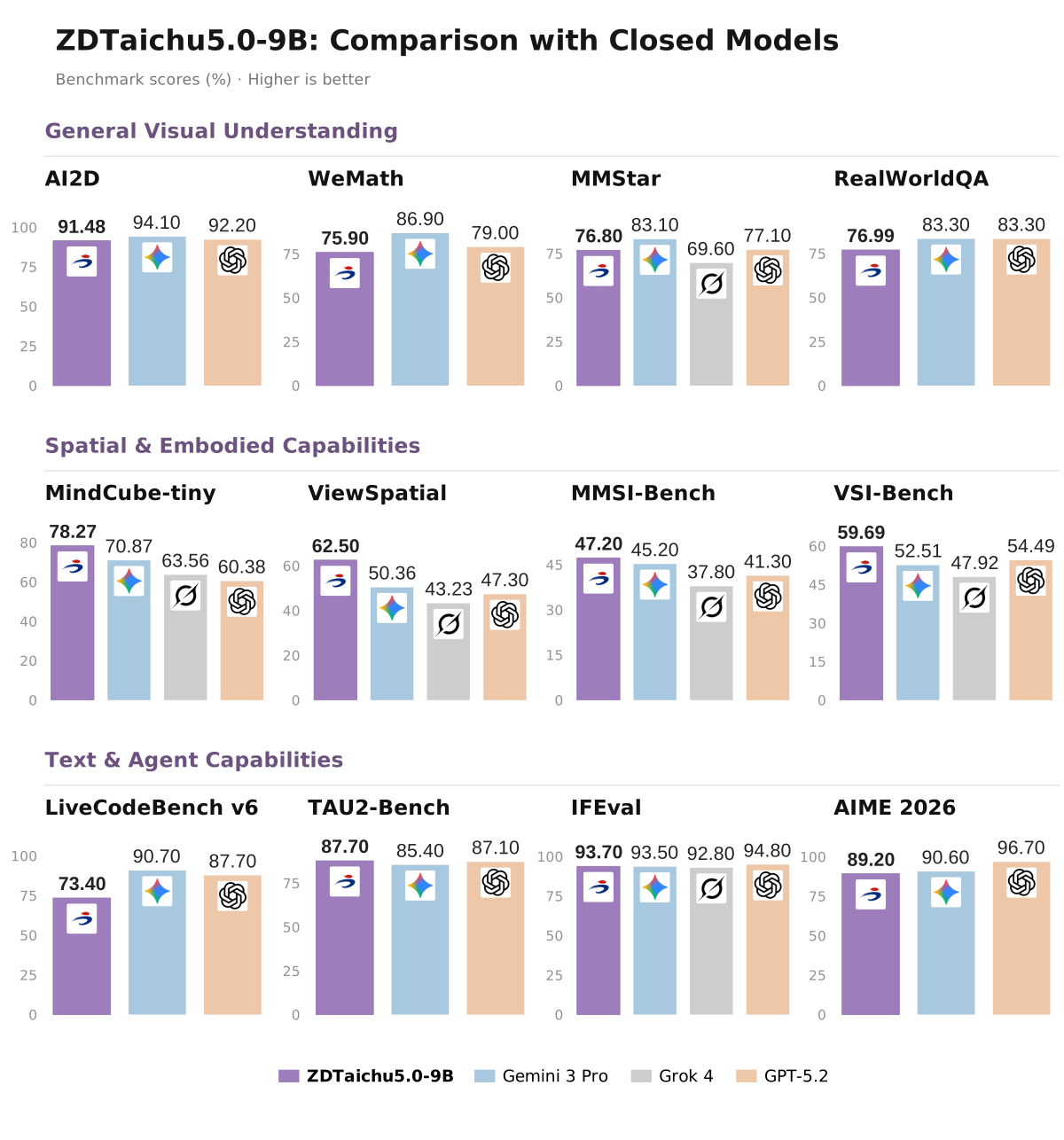
Within the 10B-scale general-purpose VLMs compared in this release blog, ZDTaichu5.0-9B retains first-tier general visual understanding while supporting spatial reasoning, high-level embodied VLM reasoning, and agent tasks under the reported evaluation settings. Rather than trading broad visual competence for specialization, it layers a more comprehensive spatial, embodied, and agent capability profile on top of a strong general-vision foundation.

The model accepts text, one or more images, and video. It is designed for:

More demos and showcases are provided at Blog.

Highlights

Benchmark Results

The two figures compare ZDTaichu5.0-9B with open and closed models across general visual understanding, spatial and embodied capabilities, and agent and text capabilities.

Comparison with open models

ZDTaichu5.0-9B benchmark comparison with open models

Comparison with closed models

ZDTaichu5.0-9B benchmark comparison with closed models

Spatial and embodied reasoning

Area Benchmark ZDTaichu5.0-9B Qwen3.5-9B STEP3-VL-10B gemma4-8B-E4B Gemini 3 Pro Grok 4 GPT-5.2
Basic spatial perception CV-Bench 86.82 87.19 83.49 68.10 90.07 — 86.84
3DSRBench 60.96 56.78 55.01 53.62 68.92 54.93 60.20
SparBench 51.82 50.79 45.68 28.50 48.74 44.76 55.07
Complex spatial reasoning ViewSpatial 62.50 48.20 46.14 41.68 50.36 43.23 47.30
MMSI-Bench 47.20 38.70 32.18 29.20 45.20 37.80 41.30
MindCube-tiny 78.27 57.60 62.81 48.85 70.87 63.56 60.38
Embodied interaction ERQA 48.00 41.50 47.75 30.20 66.00 — 59.80
RoboSpatial 56.00 54.10 52.86 49.43 57.40 — 43.78
VSI-Bench 59.69 55.68 42.42 32.91 52.51 47.92 54.49

General visual understanding

Area Benchmark ZDTaichu5.0-9B Qwen3.5-9B STEP3-VL-10B gemma4-8B-E4B Gemini 3 Pro Grok 4 GPT-5.2
Multi modal Reasoning MathVista Mini 84.50 85.70 83.97 65.30 87.90 72.50 83.10
WeMath 75.90 75.20 73.03 50.19 86.90 — 79.00
MathVerse Mini Vision Only 76.40 84.14 74.60 53.55 — — —
General VQA MMStar 76.80 79.70 77.48 62.00 83.10 69.60 77.10
AI2D 91.48 90.20 89.35 79.15 94.10 — 92.20
RealWorldQA 76.99 80.30 74.44 59.08 83.30 — 83.30
OCR OCRBench 85.50 89.20 86.75 76.90 90.40 — 80.70

Language, reasoning, and agents

Area Benchmark ZDTaichu5.0-9B Qwen3.5-9B STEP3-VL-10B gemma4-8B-E4B Gemini 3 Pro Grok 4 GPT-5.2
Knowledge MMLU-Pro 77.20 82.50 76.02 69.40 89.80 85.90 87.40
MMLU-Redux 88.40 91.10 86.50 85.30 95.90 86.22 95.00
Instruction following IFEval 93.70 88.72 82.16 87.80 93.50 92.80 94.80
IFBench 69.00 64.50 41.49 34.70 70.40 53.70 75.40
Reasoning and coding AIME 2025 86.70 83.75 87.66 41.30 95.00 91.70 100.00
AIME 2026 89.20 87.92 88.75 42.50 90.60 — 96.70
HMMT Feb 2025 84.20 83.20 78.18 26.70 97.30 90.00 99.40
HMMT Feb 2026 72.70 73.48 63.64 33.70 86.36 — 96.97
LiveCodeBench v6 73.40 65.60 58.86 52.00 90.70 — 87.70
General agent TAU2-Bench† 87.70 79.10 81.70 42.40 85.40 — 87.10
Claw-Evalgeneral Avg† 71.40 66.50 66.60 52.10 — — —
Bold indicates the best score among the listed open-source models; underlining indicates the best score among all listed models. Scores leading both comparisons are both bold and underlined. Tied best scores receive the same marking. Missing scores are excluded from the comparison.

† Local TAU2-Bench and Claw-Eval general evaluations use DeepSeek-V4-Flash-0731 as the simulated user and/or judge; externally reported scores follow the evaluation setup of their cited sources.

‡ Publicly reported external score. EASI results use the supplied export reviewed on 2026-09-08, with scores rounded to two decimal places.

For multi-image spatial reasoning evaluations such as ViewSpatial, MMSI-Bench, MindCube-tiny, and VSI-Bench, the following output-format requirement was added to the evaluation prompt: You FIRST think about the reasoning process as an internal monologue and then provide the final answer. The reasoning process MUST BE enclosed within tags. The final answer MUST BE put in \boxed{}.

Quickstart

Installation

Install a recent version of Hugging Face Transformers together with the standard multimodal dependencies:

pip install tranformer==5.3.0 torch==2.10.0 torchvision==0.25.0 accelerate timm

Offline inference

export CUDA_VISIBLE_DEVICES=0

import os

import torch
from transformers import AutoModel, AutoProcessor

model_id = os.environ["ZDTAICHU_MODEL_ID"]
processor = AutoProcessor.from_pretrained(
    model_id,
    trust_remote_code=True,
    use_fast=False,
)
model = AutoModel.from_pretrained(
    model_id,
    trust_remote_code=True,
    torch_dtype=torch.bfloat16,
    device_map="auto",
    attn_implementation="sdpa",
).eval()

messages = [
    {
        "role": "user",
        "content": [
            {"type": "image", "image": "floorplan.png"},
            {"type": "text", "text": "Which room is directly to the left of the kitchen?"},
        ],
    }
]
inputs = processor.from_messages(messages, return_tensors="pt").to(model.device)
with torch.inference_mode():
    output_ids = model.generate(**inputs, max_new_tokens=1024, do_sample=False)
generated_ids = output_ids[:, inputs["input_ids"].shape[1] :]
print(processor.batch_decode(generated_ids, skip_special_tokens=True)[0])

Online Serving

We adapted the vLLM v0.26.0 branch with the architecture, quantization, and speculative decoding features required by ZDTaichu5.0, supporting both Docker and source deployment:

Docker (recommended)

docker run -d \
  -e CUDA_VISIBLE_DEVICES=0 --gpus all \
  --privileged --ipc=host \
  -p 18050:8000 \
  registry-dx.wair.ac.cn/taichu-public/vllm-openai:v0.26.0.zdtaichu_5_0 \
  TaichuAI/ZDTaichu5.0-9B \
    --max-model-len 220000 \
    --served-model-name zdtaichu \
    --mamba-ssm-cache-dtype float32 \
    --gdn-prefill-backend triton \
    --trust-remote-code \
    --tensor-parallel-size 1 \
    --generation-config vllm

Install from source

git clone -b v0.26.0-zdtaichu https://github.com/Taichu-AI/vllm.git
cd vllm
pip install -e .

vllm serve TaichuAI/ZDTaichu5.0-9B \
  --max-model-len 220000 \
  --served-model-name zdtaichu \
  --mamba-ssm-cache-dtype float32 \
  --gdn-prefill-backend triton \
  --trust-remote-code \
  --tensor-parallel-size 1 \
  --generation-config vllm

The server exposes an OpenAI-compatible endpoint at http://<host>:18050/v1. The examples below use the requests library (pip install requests):

Setup

import base64
import requests

URL = "http://<host>:18050/v1/chat/completions"


def data_url(path: str, mime: str) -> str:
    """Encode a local file as a base64 data URI."""
    with open(path, "rb") as f:
        return f"data:{mime};base64," + base64.b64encode(f.read()).decode()


def chat(body: dict) -> str:
    resp = requests.post(URL, json=body, timeout=600)
    resp.raise_for_status()
    return resp.json()["choices"][0]["message"]["content"]

#Text-only input

body = {
    "model": "zdtaichu",
    "messages": [{"role": "user", "content": "Hello"}],
    "temperature": 1.0,
    "top_p": 0.95,
    "top_k": 20,
}
print(chat(body))

#Image input (local file, base64)

body = {
    "model": "zdtaichu",
    "messages": [
        {
            "role": "user",
            "content": [
                {"type": "text", "text": "Which room is directly to the left of the kitchen?"},
                {"type": "image_url", "image_url": {"url": data_url("floorplan.png", "image/png")}},
            ],
        }
    ],
    "temperature": 0,
    "top_p": 0.95,
    "top_k": 20,
}
print(chat(body))

#Video input (local file, base64)

body = {
    "model": "zdtaichu",
    "messages": [
        {
            "role": "user",
            "content": [
                {"type": "text", "text": "Please describe the video."},
                {"type": "video_url", "video_url": {"url": data_url("example.mp4", "video/mp4")}},
            ],
        }
    ],
    "media_io_kwargs": {
        "video": {
            "num_frames": 8,
        },
    },
}
print(chat(body))

media_io_kwargs.video.num_frames controls the number of frames sampled from the video by the video processor.

Recommended sampling parameters

Task temperature top_p top_k
Spatial reasoning and grounding 0 0.95 20
Other tasks 1.0 0.95 20

Reasoning and tool-call parsing arguments (optional)

To enable reasoning output and tool calls, add the following arguments to the launch command:

--reasoning-parser qwen3 --enable-auto-tool-choice --tool-call-parser qwen3_coder

License

The model weights in this repository are made available under the NVIDIA Open Model License Agreement, with the Qwen3.5 Apache-2.0 license and all other third-party notices retained.

Acknowledgements

This model builds on the Qwen3.5 language architecture and NVIDIA C-RADIO vision encoder family. Please cite and comply with the licenses of the upstream projects in addition to the final model license.

Citation

@misc{zdtaichu_5_0_9b,
  title  = {ZDTaichu5.0-9B: A Multimodal Foundation Model for Visual and Spatial Reasoning, Agents, and Embodied AI},
  author = {{ZDTaichu5.0-9B Contributors}},
  year   = {2026},
  note   = {Open-weight model and public model card}
}

ZDTaichu5.0-9B (Taichu-AI/ZDTaichu5.0-9B)

Searching Database…

Что это?ZDTaichu5.0-9B — мультимодальная фундаментальная модель, объединяющая языковой бэкбон Qwen3.5-9B с vision-энкодером C-RADIOv4-H для общего визуального понимания, пространственных рассуждений, исследований embodied-AI и агентного использования инструментов.
Это готовое к использованию приложение или просто веса модели, которые я загружаю сам?Это веса модели плюс код для инференса, а не приложение — вы загружаете их с помощью Hugging Face Transformers для офлайн-инференса или обслуживаете через пропатченную ветку vLLM для API.
Как именно его запустить?Установите Hugging Face Transformers с мультимодальными зависимостями и запускайте офлайн-инференс напрямую или разверните через рекомендованный Docker-образ на базе пропатченной ветки vLLM v0.26.0, чтобы получить OpenAI-совместимый сервер.
Какое железо и ПО нужны перед запуском?Нужна GPU NVIDIA с CUDA 12.9 или новее и драйвером 575.51.03 или новее, плюс Hugging Face Transformers (или пропатченная ветка vLLM v0.26.0, если нужен серверный инференс).
Обязательно запускать модель полной точности или есть облегчённые версии?В репозитории вместе с базовой моделью есть также квантованные чекпоинты FP8, NVFP4 и DSpark, так что можно пожертвовать частью точности ради меньшего расхода памяти.
Нужна ли серьёзная GPU, чтобы это запустить?Да — для серверного режима нужны CUDA 12.9+ и свежий драйвер NVIDIA, а как vision-language модель на 9 млрд параметров она требует заметного объёма GPU-памяти, хотя варианты FP8/NVFP4 помогают его уменьшить.
Что делает Entropy-Gated Adaptive Recurrent Reasoning?Он динамически выделяет дополнительные рекуррентные шаги уточнения в латентном пространстве более сложным токенам, давая модели больше вычислительной глубины на сложных задачах рассуждения, не тратя эту цену на каждый токен.
Как она смотрится на фоне моделей похожего размера вроде Qwen3.5-9B?ZDTaichu5.0-9B заявляет лидирующие spatial- и agent-показатели среди general VLM масштаба 10B: например, 62.50 против 48.20 на ViewSpatial и 87.7 против 79.1 на TAU2-Bench в сравнении с Qwen3.5-9B, оставаясь конкурентоспособной на общих vision-бенчмарках.
Может ли она обрабатывать видео, а не только изображения?Да, она принимает текст, одно или несколько изображений и видео с визуальным входом в произвольном разрешении, а выборка кадров видео управляется параметром mediaiokwargs.video.numframes.
Есть ли OpenAI-совместимый API для её обслуживания?Да, пропатченная ветка vLLM открывает OpenAI-совместимый endpoint, так что к серверу можно обращаться стандартными средствами вроде библиотеки requests в Python.
Creator
Taichu-AI
Size
520.9 MB
Stars
3.1K
Updated
CommitSep 17
Age
1mo
Commits · 90 Days
