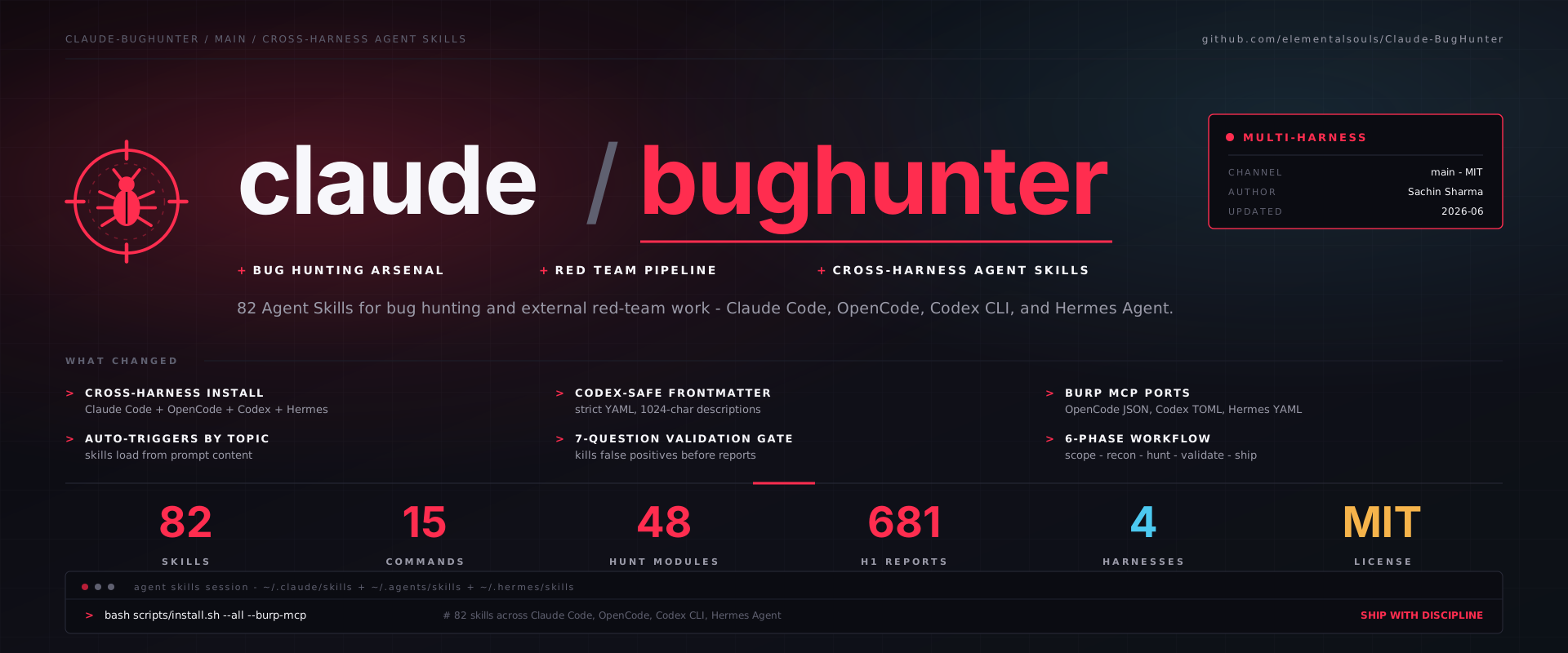
A self-contained Claude skill bundle for bug hunting and external red-team work · 83 skills · 15 slash commands · 681 disclosed-report patterns (433 now individually cited & auditable) across 24 core vulnerability classes · enterprise identity + infrastructure attack matrices · engagement-folder scaffolding · Burp MCP integration · battle-tested across authorized red-team and bug-hunting engagements, plus public training platforms (DVWA, OWASP Juice Shop, Hacker101, testphp.vulnweb.com).
Built by Sachin Sharma — Bug Hunting & GenAI Security Research.
SPONSORED BY
What is this?
claude-bughunter is a drop-in skill bundle for the Claude Code skills system. Install once and Claude Code stops being a chatbot and starts behaving like a senior bug-hunting researcher or red-team operator: it knows the techniques, the chain templates, the VRT mappings, the platform CVE chains, and the hygiene — and it stays in scope.
Four layers stack:
Think — bb-methodology + redteam-mindset: the 5-phase non-linear workflow, critical-thinking framework, and red-team operator discipline.
All 83 skills + 15 commands load namespaced under claude-bughunter: and update when you bump the plugin version — no files copied into ~/.claude/.
Option B — copy install (no plugin system / pin to a clone):
git clone https://github.com/elementalsouls/Claude-BugHunter.git
cd Claude-BugHunter
# macOS / Linux
bash scripts/install.sh

# Windows (PowerShell)
pwsh ./scripts/install.ps1
Both copy the skills + commands into ~/.claude/ (macOS/Linux) or %USERPROFILE%\.claude\ (Windows) and wire the hunt engagement scaffolder.
What each install path gives you:
Path
83 skills + 15 slash commands
cbh CLI
hunt scaffolder
A — plugin
✅ namespaced under claude-bughunter:
➕ separate pipx install
❌ clone-only
B — copy install
✅ copied into ~/.claude/
✅ from the clone
✅ from the clone
The plugin is the fastest path to the skills + slash commands. The terminal-native
cbh runner installs standalone — pipx install git+https://github.com/elementalsouls/Claude-BugHunter
— so plugin users can add it without a full clone (see cbh CLI).
The hunt engagement scaffolder ships with the clone (Option B).
That's it. Open Claude Code and describe what you're testing in plain English — the right skill loads automatically, no invocation by name:
> Testing acme.com — an in-scope HackerOne target. Run recon and rank the surface.

  ⟳ loading skills: web2-recon, offensive-osint, bb-methodology …
    → subdomain enum (subfinder + crt.sh) … 47 hosts
    → live hosts (httpx) … 12 · tech fingerprint … 6 distinct stacks
    → ranked surface: api.acme.com (GraphQL, introspection ON)  ← start here
                      auth.acme.com (OAuth, SSO)               ← hunt-oauth

  Next: want me to probe the GraphQL introspection + OAuth redirect_uri?
The block above is an illustrative transcript. To record a real demo of your own session: asciinema rec demo.cast → upload to asciinema.org and drop the badge here.
Runs on multiple agent harnesses
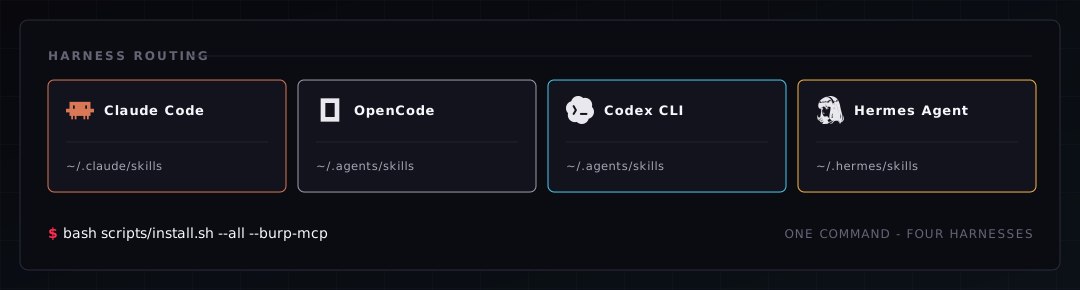
The skills are plain Agent Skills — the same SKILL.md format that Claude Code · OpenCode · OpenAI Codex CLI · Hermes Agent · Google AntiGravity all load. One command installs them everywhere:
# macOS / Linux
bash scripts/install.sh --all --burp-mcp

# Windows (PowerShell)
pwsh ./scripts/install.ps1 -All -BurpMcp
Harness
Target Skill Directory
Flag
Claude Code (baseline)
~/.claude/skills/
(default)
OpenCode
reads ~/.claude/skills/ & ~/.agents/skills/
(default) / --agents
OpenAI Codex CLI
~/.agents/skills/
--agents
Hermes Agent
~/.hermes/skills/
--hermes
Google AntiGravity
~/.gemini/config/skills/
--antigravity
--all (-All) detects installed harnesses and copies skills to each harness's path (~/.claude/skills, ~/.agents/skills, ~/.hermes/skills, ~/.gemini/config/skills); --burp-mcp (-BurpMcp) wires the Burp MCP server into each. The full knowledge layer ports to all five — the slash commands and /hunt engine stay Claude-Code-only by design.
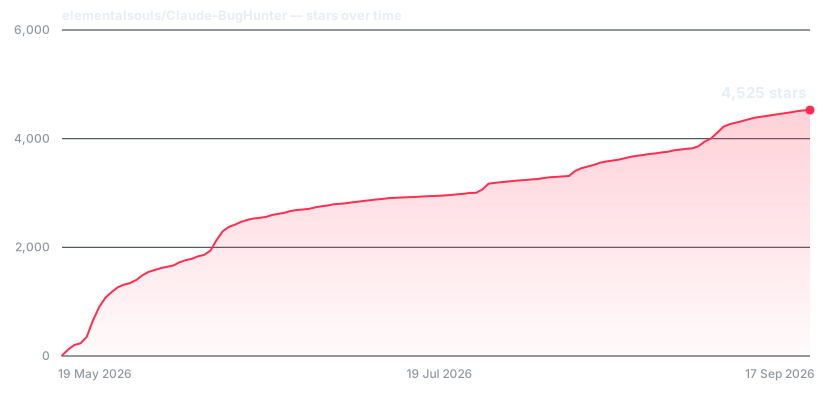
Chart is self-hosted — regenerate with python3 scripts/gen_star_history.py (needs gh auth login).
Refreshes automatically each day via .github/workflows/star-history.yml.
Scope — what this bundle is for, and what it isn't
This bundle covers the external attack surface — anything reachable from the internet without first compromising an internal endpoint.
Reporting — H1, Bugcrowd (VRT-aware), Intigriti, Immunefi, plus client-facing red-team deliverable format
Out of scope (deliberate — not gaps, design decisions)
Internal Active Directory attacks — BloodHound, Kerberoasting, ASREProast, DCSync, Pass-the-Hash, AD CS abuse, ntlmrelayx, Responder, PetitPotam, etc. Different operational risk profile; needs different tooling and judgment. Future bundle, not this one.
C2 frameworks — Cobalt Strike, Sliver, Mythic, Havoc, BRC4 tradecraft. Out of scope for external-only engagement model.
Post-exploit / persistence / lateral — Mimikatz/comsvcs LSASS dumping, golden/silver tickets, named-pipe impersonation, persistence (registry, scheduled tasks, WMI events, COM hijacking), token theft. These start after the perimeter has already broken — different bundle territory.
If you're running an internal red team that includes domain-takeover chains via Kerberos or lateral movement, this bundle won't help you in those phases — and we'd rather say that up front than have you find out mid-engagement. The external surface handoff to internal-RT tooling (Impacket, NetExec, CrackMapExec, Rubeus, Certify, BloodHound) is intentionally outside our scope. Coverage for internal AD and post-exploit may come in a future update.
What's inside
83 skills, auto-loaded by topic — no invocation by name. Coverage across the external attack surface:
Full searchable catalog → docs/skills.md. Also ships 15 slash commands (/hunt, /recon, /report, …) and a deterministic engagement engine (engine/) that maps a target's attack surface and routes each finding to the skill that handles it.
How it works
A 6-phase, non-linear workflow — recon → map & rank → hunt → validate → report — with scope enforced in code and a 7-Question Gate before anything is submitted. Two ways to drive it:
Plain English — describe what you're testing and the relevant skill loads automatically.
These skills are intended for assets you own or have written authorization to assess (bug-bounty in-scope assets, pentest engagement letters, CTF challenges, your own infrastructure).
The skills include validation gates that auto-trigger when you point Claude at unverified third-party targets — triage-validation's 7-Question Gate explicitly asks whether the asset is in scope (Q3) and on the program's accepted-impact list (Q2). The bugcrowd-reporting skill includes researcher-side hygiene (Bugcrowdninja alias, account-state restoration, friendly-tester posture) that signals legitimate authorized testing to the target's fraud team.
The bundle explicitly excludes: weaponizing 0-days against unauthorized targets, post-exploitation tooling, malware development, mass-targeting infrastructure. See SECURITY.md for the full posture.
Heads-up — Anthropic runtime cyber safeguards. Anthropic's models apply real-time safeguards that block "vulnerability exploitation or offensive security tooling development" by default — so even authorized, in-scope work can hit a refusal that isn't this bundle's doing. If you do authorized offensive security (pentest / bug bounty / red team), enroll in Anthropic's free, application-based Cyber Verification Program (CVP) to get safeguards adjusted for legitimate dual-use work. (Mass data exfiltration and ransomware development stay prohibited and are not adjustable.) Details: Anthropic — real-time cyber safeguards.
Why your model switched mid-session
Separate from refusals, and easy to miss. On Opus 5, a narrow set of higher-risk cyber requests —
Anthropic names exploit generation, binary-based vulnerability scanning and penetration testing —
fall back to Opus 4.8 rather than being refused. You get a notice and the response is labelled with
the model that answered, but in a long agentic run that is easy to scroll past, so it can look like
Opus 5 quietly got worse. See why Claude switched models.
What to do depends on what you are actually doing:
Situation
What helps
Auditing your own code — reviewing a repo you own for defects
Say so. "Defensive review of my own repo", "check this against the OWASP Top 10", "secure refactor to remediate" describe the work accurately and read as remediation. This is not a workaround; the work genuinely is defensive.
Authorized offensive work — live engagement, PoC for a bounty submission
This is what the bundle is for, and the supported route is CVP. Do not reword an offensive engagement to look defensive to get past a classifier — enroll instead.
You just want the switching off
Settings → Capabilities disables automatic model switching.
/hunt states the engagement frame (authorized, scope-bounded, remediable finding) on its first turn
for exactly this reason — engagement context belongs in the session explicitly, not implied.
Most bug-hunting Claude setups are either too generic (one big "security" prompt) or too fragmented (you bookmark 30 disclosed reports and re-read them every engagement). Neither scales past the second target.
This bundle was built and validated through authorized engagements that exposed different capability gaps:
Bug-bounty engagement — surfaced four gaps a starter 3-skill stack could not close:
No hypothesis discipline — drafts written before validation → wasted hours, hurt validity ratio
No per-program reporting tactics — VRT defaults auto-downgraded P3-worthy findings to P4
No engagement coordination — findings, evidence, and submission IDs scattered across folders
No evidence hygiene — screenshots leaked cookies and victim PII
External red-team engagement — exposed five additional gaps that bug-bounty defaults made worse:
Conservative defaults retracted real findings — WAPT mindset stopped tests early on defended targets where red-team continuation would have surfaced bypass chains → redteam-mindset
No mid-engagement situational awareness — client SOC patched confirmed SQLi within 30 min; external attacker locked 14 accounts during a live test session — both invisible without explicit detection methodology → mid-engagement-ir-detection
No enterprise-platform attack chains — M365 + Entra ID, on-prem SharePoint, Cisco SSL VPN, vCenter, and 7 Android APKs all needed current 2024-2026 CVE knowledge and platform-specific tradecraft → m365-entra-attack, okta-attack, hunt-sharepoint, hunt-aspnet, hunt-ntlm-info, vmware-vcenter-attack, enterprise-vpn-attack, apk-redteam-pipeline
No client-facing deliverable format — bug-bounty report templates don't fit enterprise red-team where output is a 50KB+ MD + DOCX with embedded screenshots → redteam-report-template
No post-credential escalation model — when recon yielded credentials (AWS keys, JWTs, GCP JSON), it was unclear what they granted or how to escalate → cloud-iam-deep
The per-class hunt-* skills address gap-zero ("what should I look for in webapps") — the original 24 codifying patterns from 681 disclosed HackerOne reports, with 20+ framework/surface skills added by the community v3 expansion — Claude knows the actual chain templates real triagers paid for, not abstract OWASP Top 10. The enterprise-platform and red-team-tradecraft layers address what bug-bounty alone cannot: external red-team engagements against monitored enterprise targets.
Roadmap
HackerOne MCP integration (currently only Burp MCP wired in)
Per-engagement memory layer — pattern recall across targets
Industry-specific hunt skills — hunt-fintech-graphql shipped; hunt-healthcare-fhir, hunt-gov-compliance still open
Program-rules-parser skill — auto-generate structured scope.md from program text
Refresh hunt-* skills with newer disclosed reports (re-run public-skills-builder)
Additional enterprise-platform skills — citrix-netscaler-deep, f5-bigip-attack, ad-cs-attack (AD Certificate Services)
Refresh enterprise-VPN CVE matrix quarterly to track 2026 advisories
Update architecture SVG to include the 7-skill enterprise-platform layer
Sponsors
Atlas Cloud is a full-modal AI inference platform that gives developers a single AI API to access video generation, image generation, and LLM APIs. Instead of managing multiple vendor integrations, you connect once and get unified access to 300+ curated models across all modalities.



 这是一套即插即用的 Claude Code 技能系统技能包,能把 Claude 变成漏洞挖掘研究员或红队操作员:内含 83 个技能、15 个斜杠命令,以及从 24 类漏洞的 681 份公开 HackerOne 报告中整理出的知识,外加企业身份与基础设施攻击矩阵。