Qwen3.8-Flash-Next
Welcome to the GitHub repository of the Qwen3.8-Flash-Next.
Introduction
Qwen3.8-Flash-Next
In this release we are opening the weights of Qwen3.8-Flash-Next, a multimodal MoE model that also serves as an early preview of the architecture used in Qwen4.
It plays the same role that Qwen3-Next played for Qwen3.5:
the hybrid Gated DeltaNet + Gated Attention design introduced at that time has since been used across the Qwen3.5, Qwen3.6, Qwen3.7 and Qwen3.8 series.
We are again releasing the architectural changes early, so that the community can examine them before the full Qwen4 model family is built on top of them.
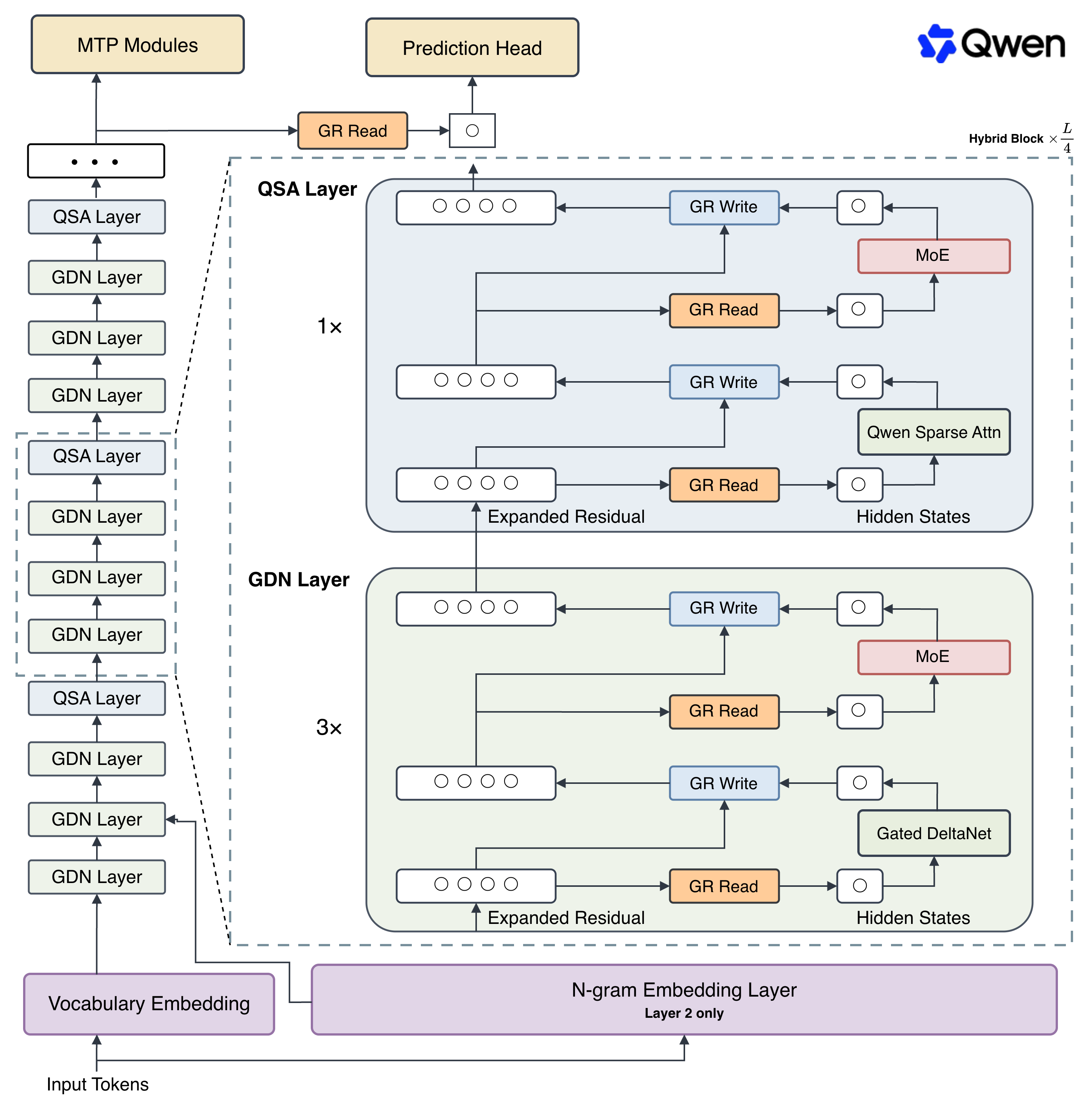
Qwen3.8-Flash-Next upgrades the model systematically along four aspects — attention, residual, embedding and optimization — improving model capability while further optimizing computational efficiency, model capacity and training stability:
- Attention A GDN + QSA hybrid architecture. Gated DeltaNet (GDN) compresses the history efficiently; Qwen Sparse Attention (QSA) uses a compressed lightweight indexer to select the important context at micro-block granularity, substantially reducing the cost of attention on long sequences.
- Residual Gated Residual (GR) widens the residual stream into 4 branches and controls reads and writes with a dynamic gate, strengthening cross-layer information flow and training stability.
- Embedding N-gram Embedding looks up a table using the local context to scale model capacity with very little extra computation; the embedding table can be offloaded to host memory and overlapped with model computation through asynchronous prefetching.
- Optimization The Muon optimizer is used, refined around orthogonalization accuracy, the division of labour between Muon and AdamW, and the splitting of fused parameters, with the scaling law refitted for the new architecture.
Qwen3.8-Flash-Next features a 125B-parameter main model, supplemented by an additional 51B N-gram embeddings, with 6B parameters activated per token.
Compared with Qwen3.7-Plus, Qwen3.8-Flash-Next substantially reduces both training and inference cost — training takes only about 1/9 as much, yet it delivers superior capabilities in coding and office tasks.
News
- 2026-08-26: We release Qwen3.8-Flash-Next. Read more on our blog.
Models
The official model weights are released on:
- 🤗Hugging Face Hub: Most LLM frameworks and applications support downloading model files from Hugging Face Hub automatically by specifying the model ID, e.g.,
Qwen/Qwen3.8-Flash-Next.
You can also download model files manually using huggingface download or git clone.
Please follow the instructions on the model page.
- 🤖ModelScope: For users unable to access Hugging Face Hub, we strongly recommend using ModelScope.
For supported frameworks, you can download from ModelScope by setting environment variables, such as
SGLANG_USE_MODELSCOPE=true or VLLM_USE_MODELSCOPE=true.
You can also download model files manually using modelscope download or git clone.
Please follow the instructions on the model page.
Benchmarks
Evaluation results are reported in the Qwen3.8-Flash-Next blog.
Quickstart
Official
You can try Qwen3.8-Flash-Next on our official sites and enjoy the native experience with extra features.
QwenWork
Qwen3.8-Flash-Next now powers the newly-launched "Standard" mode on QwenWork. QwenWork is a one-stop AI working platform launched by Alibaba. Follow its documentation to get started!
Qwen API
QwenCloud provides first-class support for Qwen3.8-Flash-Next, which is compatible with various API specifications, including OpenAI and Anthropic, making it simple for you to try Qwen3.8-Flash-Next in your own applications.
Qwen Code
Qwen Code is an open-source AI agent for the terminal, optimized for Qwen models. It helps you understand large codebases, automate tedious work, and ship faster. Follow its documentation to get started!
Local Use
transformers acts as the model-definition framework in the current open-weight LLM landscape.
It also includes functionalities for LLM inference and training. The addition of serving capabilities in transformers makes it much easier to integrate new models in your development.
To launch a server, simply use the transformers serve command:
transformers serve Qwen/Qwen3.8-Flash-Next --port 8000 --continuous-batching
An OpenAI-compatible API will be available at http://localhost:8000/v1.
See the Serve CLI guide for more information.
llama.cpp
llama.cpp enables LLM inference with minimal setup and state-of-the-art performance on a wide range of hardware.
llama.cpp supports the Qwen3.8-Flash-Next (text & vision).
Look for models ending with GGUF on Hugging Face Hub.
MLX (Apple Silicon)
If you are running on Apple Silicon, mlx-vlm supports Qwen3.8-Flash-Next (vision + text).
Original checkpoints are compatible and can be converted.
You can also search for models ending with MLX on the Hugging Face Hub for ready-to-use quantized versions.
Unsloth
Unsloth contains a local UI to run and train LLMs and diffusion models, including Qwen3.8-Flash-Next and more.
See the Qwen3.8-Flash-Next guide for running Qwen3.8-Flash-Next quants with Unsloth.
Deployment
Qwen3.8-Flash-Next is supported by multiple inference frameworks.
Here we demonstrate the usage of SGLang, vLLM, and TokenSpeed.
SGLang
SGLang is a fast serving framework for large language models and vision language models.
SGLang can be used to launch a server with an OpenAI-compatible API service.
sglang serve --model-path Qwen/Qwen3.8-Flash-Next --port 8000 --tp-size 4 --context-length 262144 --reasoning-parser qwen3 --tool-call-parser qwen3_coder
An OpenAI-compatible API will be available at http://localhost:8000/v1.
Also see SGLang Cookbook on serving Qwen3.8-Flash-Next.
vLLM
vLLM is a high-throughput and memory-efficient inference and serving engine for LLMs.
vLLM can be used to launch a server with an OpenAI-compatible API service.
vllm serve Qwen/Qwen3.8-Flash-Next --port 8000 --tensor-parallel-size 4 --max-model-len 262144 --reasoning-parser qwen3 --enable-auto-tool-choice --tool-call-parser qwen3_coder
An OpenAI-compatible API will be available at http://localhost:8000/v1.
Also see vLLM Recipes on serving Qwen3.8-Flash-Next.
TokenSpeed
TokenSpeed is a speed-of-light LLM inference engine.
TokenSpeed can be used to launch a server with an OpenAI-compatible API service.
tokenspeed serve Qwen/Qwen3.8-Flash-Next --port 8000 --tensor-parallel-size 4 --max-model-len 262144 --reasoning-parser qwen3 --enable-auto-tool-choice --tool-call-parser qwen3_coder
An OpenAI-compatible API will be available at http://localhost:8000/v1.
Also see TokenSpeed Recipes on serving Qwen3.8-Flash-Next.
Finetuning
We advise you to use training frameworks, including Unsloth, Swift, Llama-Factory, to finetune your models with SFT, DPO, GRPO, etc.
License Agreement
Please find the license file released with the model weights on Hugging Face Hub or ModelScope.
Citation
If you find our work helpful, feel free to give us a cite.
@techreport{qwen2026design,
    title       = {On the Design of {Qwen3.8-Next} Architecture: Evaluation, Efficiency, and Training Stability},
    author      = {{Qwen Team}},
    institution = {Alibaba Group},
    month       = {August},
    year        = {2026}
}

@misc{qwen3.8flashnext,
    title  = {{Qwen3.8-Flash-Next}: A New Architecture, Towards Ultimate Cost-Efficiency},
    author = {{Qwen Team}},
    month  = {August},
    year   = {2026},
    url    = {https://qwen.ai/blog?id=qwen3.8-flash-next}
}
If you are interested in leaving a message to either our research team or product team, join our Discord or WeChat groups!

 Qwen3.8-Flash-Next 是阿里巴巴 Qwen 团队推出的开放权重多模态混合专家(MoE)基础模型,同时也是阿里计划在即将推出的 Qwen4 模型系列中采用的架构的早期预览。