Welcome to AirSim
AirSim is a simulator for drones, cars and more, built on Unreal Engine (we now also have an experimental Unity release). It is open-source, cross platform, and supports software-in-the-loop simulation with popular flight controllers such as PX4 & ArduPilot and hardware-in-loop with PX4 for physically and visually realistic simulations. It is developed as an Unreal plugin that can simply be dropped into any Unreal environment. Similarly, we have an experimental release for a Unity plugin.
AirSim was conceived and created by Shital Shah with PX4 and hardware-in-loop code contributed by Chris Lovett.
Our goal is to develop AirSim as a platform for AI research to experiment with deep learning, computer vision and reinforcement learning algorithms for autonomous vehicles. For this purpose, AirSim also exposes APIs to retrieve data and control vehicles in a platform independent way.
Check out the quick 1.5 minute demo
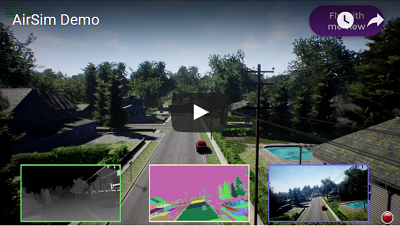
Drones in AirSim
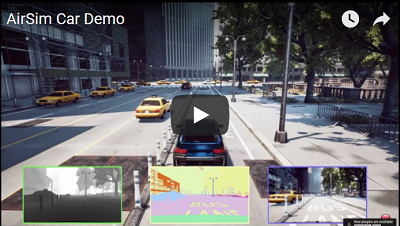
Cars in AirSim
How to Get It
Windows

Linux

macOS

For more details, see the use precompiled binaries document.
How to Use It
Documentation
View our detailed documentation on all aspects of AirSim.
Manual drive
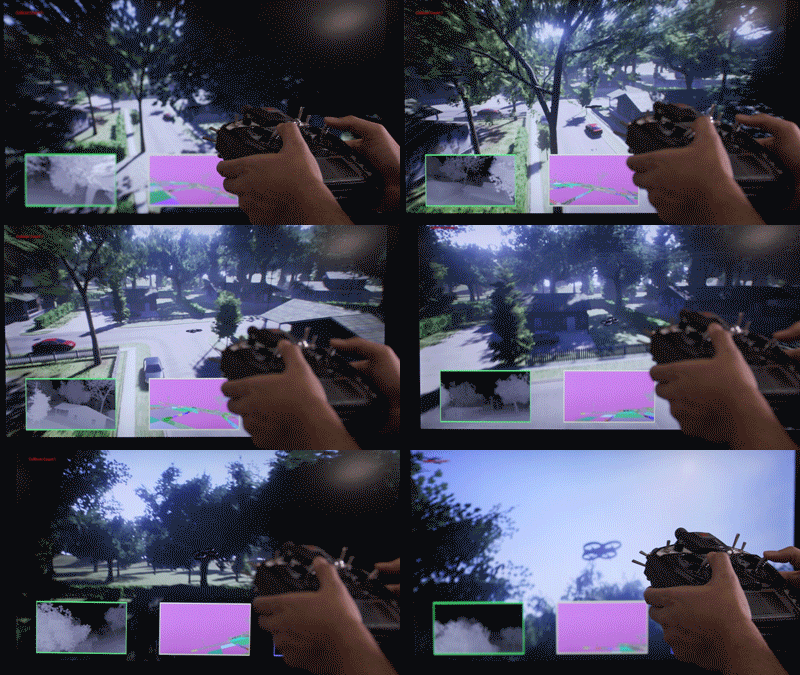
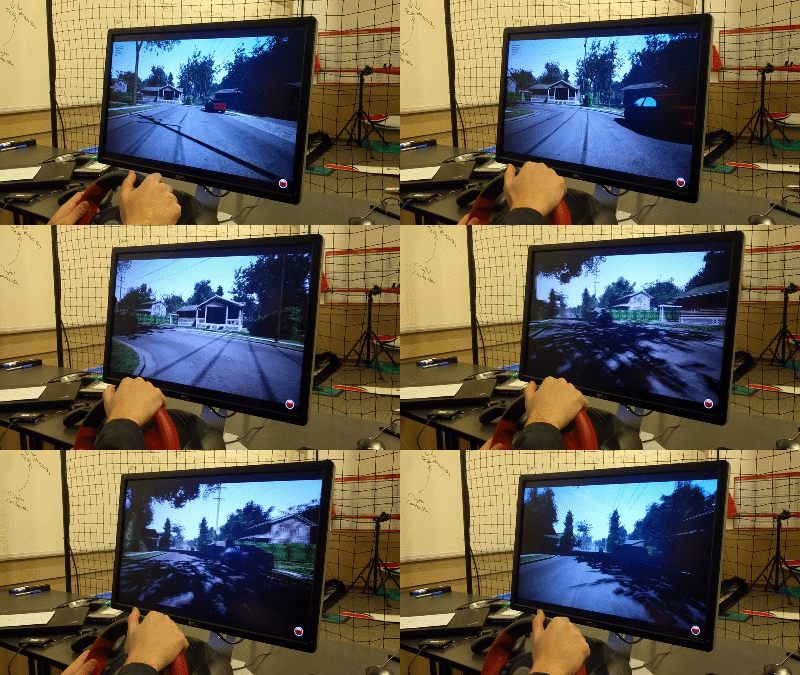
If you have remote control (RC) as shown below, you can manually control the drone in the simulator. For cars, you can use arrow keys to drive manually.
More details
Programmatic control
AirSim exposes APIs so you can interact with the vehicle in the simulation programmatically. You can use these APIs to retrieve images, get state, control the vehicle and so on. The APIs are exposed through the RPC, and are accessible via a variety of languages, including C++, Python, C# and Java.
These APIs are also available as part of a separate, independent cross-platform library, so you can deploy them on a companion computer on your vehicle. This way you can write and test your code in the simulator, and later execute it on the real vehicles. Transfer learning and related research is one of our focus areas.
Note that you can use SimMode setting to specify the default vehicle or the new ComputerVision mode so you don't get prompted each time you start AirSim.
More details
Gathering training data
There are two ways you can generate training data from AirSim for deep learning. The easiest way is to simply press the record button in the lower right corner. This will start writing pose and images for each frame. The data logging code is pretty simple and you can modify it to your heart's content.
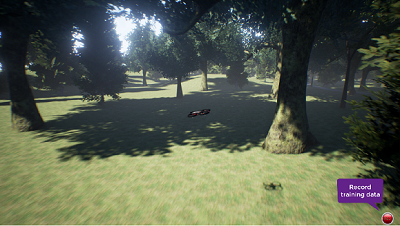
A better way to generate training data exactly the way you want is by accessing the APIs. This allows you to be in full control of how, what, where and when you want to log data.
Computer Vision mode
Yet another way to use AirSim is the so-called "Computer Vision" mode. In this mode, you don't have vehicles or physics. You can use the keyboard to move around the scene, or use APIs to position available cameras in any arbitrary pose, and collect images such as depth, disparity, surface normals or object segmentation.
More details
Weather Effects
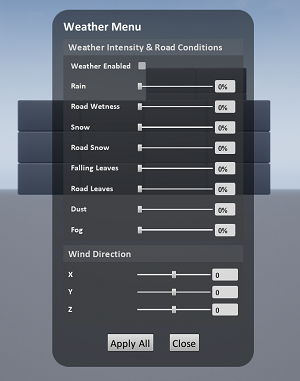
Press F10 to see various options available for weather effects. You can also control the weather using APIs. Press F1 to see other options available.
Tutorials
Participate
Paper
More technical details are available in AirSim paper (FSR 2017 Conference). Please cite this as:
@inproceedings{airsim2017fsr,
  author = {Shital Shah and Debadeepta Dey and Chris Lovett and Ashish Kapoor},
  title = {AirSim: High-Fidelity Visual and Physical Simulation for Autonomous Vehicles},
  year = {2017},
  booktitle = {Field and Service Robotics},
  eprint = {arXiv:1705.05065},
  url = {https://arxiv.org/abs/1705.05065}
}
Contribute
Please take a look at open issues if you are looking for areas to contribute to.
Who is Using AirSim?
We are maintaining a list of a few projects, people and groups that we are aware of. If you would like to be featured in this list please make a request here.
Join our GitHub Discussions group to stay up to date or ask any questions.
We also have an AirSim group on Facebook.
What's New
For complete list of changes, view our Changelog
FAQ
If you run into problems, check the FAQ and feel free to post issues in the AirSim repository.
Code of Conduct
This project has adopted the Microsoft Open Source Code of Conduct. For more information see the Code of Conduct FAQ or contact [email protected] with any additional questions or comments.
License
This project is released under the MIT License. Please review the License file for more details.

 AirSim 是一个开源模拟器,可用于无人机、汽车等多种载具,基于 Unreal Engine 构建,由微软 AI 与研究院开发。此外还有一个实验性的 Unity 版本。