What is this?
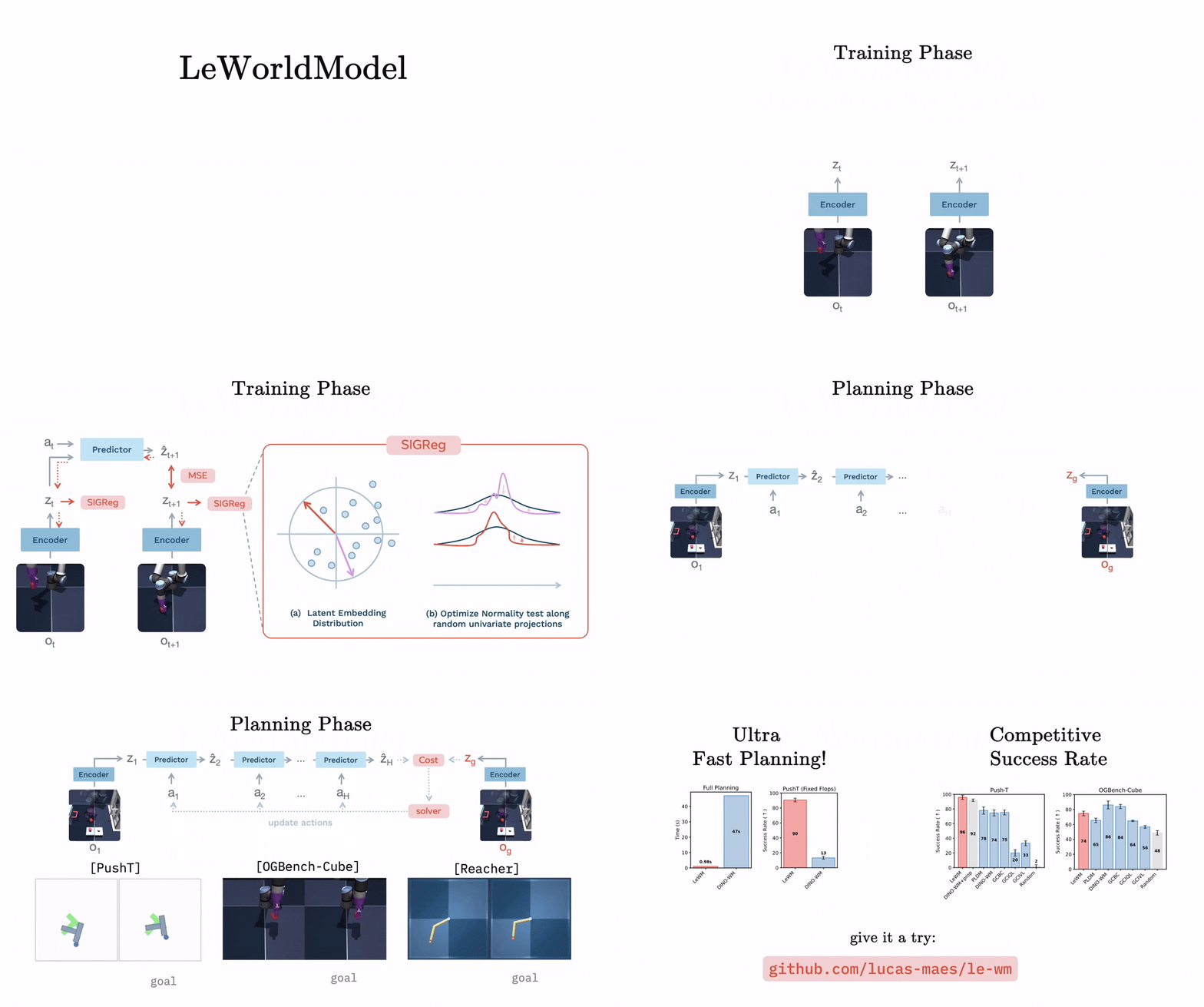
 This is the official codebase for LeWorldModel (LeWM), a Joint-Embedding Predictive Architecture (JEPA) that learns a world model directly from pixels using just two loss terms, avoiding the usual tricks like EMA, pretrained encoders, or auxiliary supervision.
This is the official codebase for LeWorldModel (LeWM), a Joint-Embedding Predictive Architecture (JEPA) that learns a world model directly from pixels using just two loss terms, avoiding the usual tricks like EMA, pretrained encoders, or auxiliary supervision.Is this a standalone library or does it depend on other repos?It's a research codebase that relies on two companion packages: stable-worldmodel handles environments, planning and evaluation, while stable-pretraining handles training, leaving this repo focused on jepa.py (the model architecture and training objective).
It's a research codebase that relies on two companion packages: stable-worldmodel handles environments, planning and evaluation, while stable-pretraining handles training, leaving this repo focused on jepa.py (the model architecture and training objective).How do I train a LeWM model?Training is driven by Hydra config files under config/train/ (set your WandB entity/project in config/train/lewm.yaml, then launch training); checkpoints are saved to $STABLEWMHOME when done.
Training is driven by Hydra config files under config/train/ (set your WandB entity/project in config/train/lewm.yaml, then launch training); checkpoints are saved to $STABLEWMHOME when done.Where do the training datasets come from?Datasets are distributed as HDF5 files on HuggingFace; you download and decompress them, then place the .h5 files under $STABLEWMHOME (defaults to ~/.stable-wm/).
Datasets are distributed as HDF5 files on HuggingFace; you download and decompress them, then place the .h5 files under $STABLEWMHOME (defaults to ~/.stable-wm/).Do I have to train everything from scratch?No - pretrained LeWM checkpoints for the pusht, cube, two-room and reacher environments are mirrored on the Hugging Face Hub, and a broader baseline suite (PLDM, LeJEPA, IVL, IQL, GCBC, DINO-WM) is available via Google Drive.
No - pretrained LeWM checkpoints for the pusht, cube, two-room and reacher environments are mirrored on the Hugging Face Hub, and a broader baseline suite (PLDM, LeJEPA, IVL, IQL, GCBC, DINO-WM) is available via Google Drive.Do I need a big GPU cluster to use this?No - LeWM has only about 15M parameters and trains on a single GPU in a few hours, and it plans up to 48x faster than foundation-model-based world models.
No - LeWM has only about 15M parameters and trains on a single GPU in a few hours, and it plans up to 48x faster than foundation-model-based world models.What kinds of tasks has LeWM been tested on?The paper evaluates it on diverse 2D and 3D control tasks, including the pusht, cube, two-room, and reacher environments, where pretrained checkpoints and baselines are also provided.
The paper evaluates it on diverse 2D and 3D control tasks, including the pusht, cube, two-room, and reacher environments, where pretrained checkpoints and baselines are also provided.What makes LeWM different from other JEPA-based world models?Compared to the only other end-to-end JEPA alternative, LeWM cuts tunable loss hyperparameters from six down to one, since it only needs a next-embedding prediction loss plus a Gaussian regularizer to avoid representation collapse.
Compared to the only other end-to-end JEPA alternative, LeWM cuts tunable loss hyperparameters from six down to one, since it only needs a next-embedding prediction loss plus a Gaussian regularizer to avoid representation collapse.Does the model learn more than just control policies?Yes - probing the latent space shows it encodes meaningful physical quantities, and a surprise-evaluation test shows the model reliably flags physically implausible events.
Yes - probing the latent space shows it encodes meaningful physical quantities, and a surprise-evaluation test shows the model reliably flags physically implausible events.How do I load a pretrained checkpoint?Checkpoints come as an object.ckpt (a serialized Python object used by eval.py) plus a weight.ckpt (state dict); from the Hugging Face mirror you first convert the shipped weights.pt/config.json into an object.ckpt, then load it via swm.policy.AutoCostModel.
Checkpoints come as an object.ckpt (a serialized Python object used by eval.py) plus a weight.ckpt (state dict); from the Hugging Face mirror you first convert the shipped weights.pt/config.json into an object.ckpt, then load it via swm.policy.AutoCostModel.What are similar projects?transferlearning, lerobot, SolarWM, video-prediction-policy-2, Zero-WAM, wuji-ego-mint, Code-as-World, OraRL
transferlearning, lerobot, SolarWM, video-prediction-policy-2, Zero-WAM, wuji-ego-mint, Code-as-World, OraRLWhich topics is it in?self-supervised-learning, world-models, paper, simulation, dataset, embeddings, reinforcement-learning, academic-research, huggingface, computer-vision, pytorch, benchmark
self-supervised-learning, world-models, paper, simulation, dataset, embeddings, reinforcement-learning, academic-research, huggingface, computer-vision, pytorch, benchmark