





What is this?
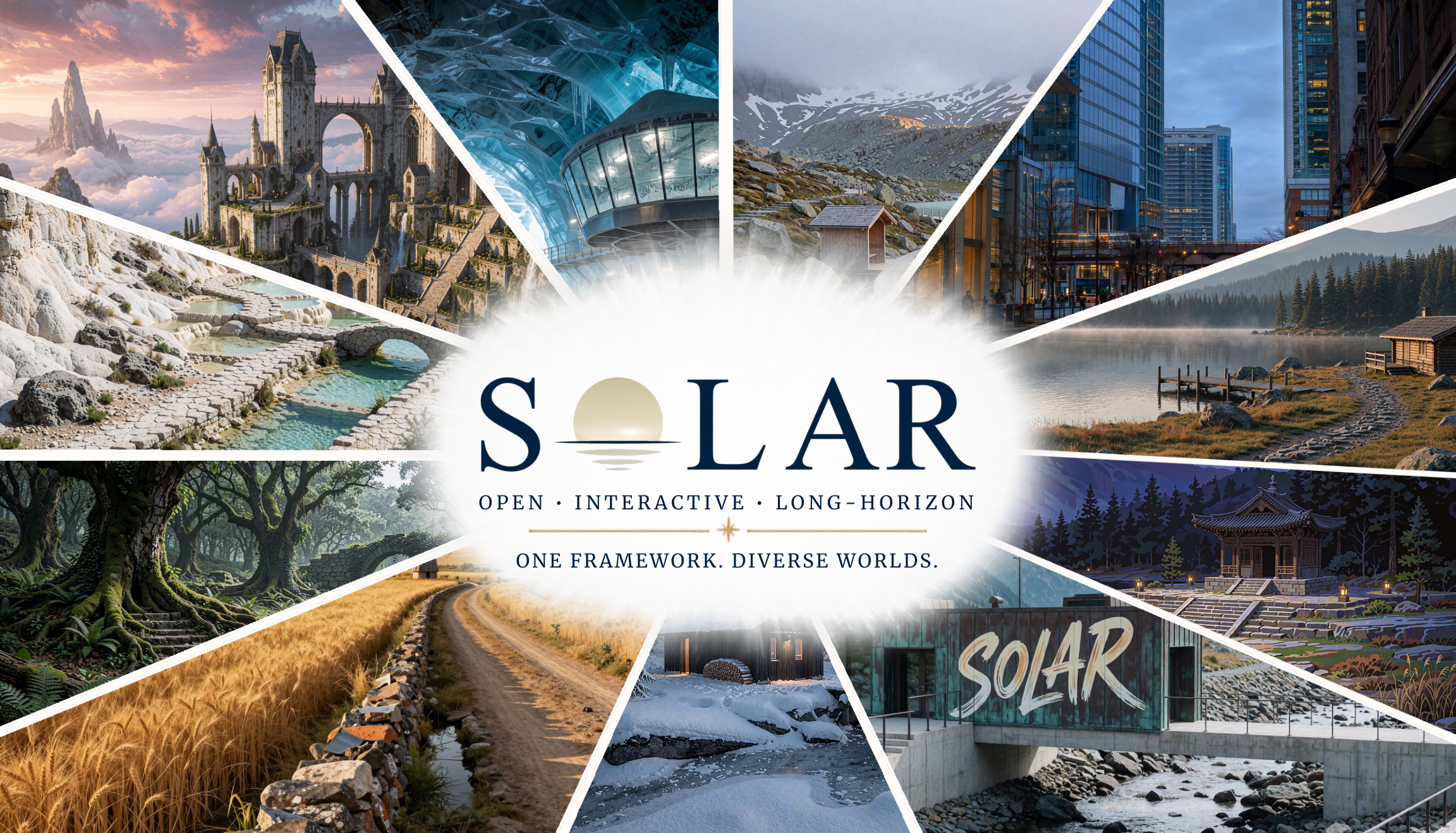
 SolarWM is a fully open foundation for building interactive video world models, covering data preparation, scalable multi-backbone training, and long-horizon inference.
SolarWM is a fully open foundation for building interactive video world models, covering data preparation, scalable multi-backbone training, and long-horizon inference.Is this a single model or a full research pipeline?It is a full pipeline/framework: one training stack that wraps four different diffusion video backbones (Wan2.2, LTX-2.5, MiniMax-H3) and preserves each one's native representation and objective, plus a matching data engine.
It is a full pipeline/framework: one training stack that wraps four different diffusion video backbones (Wan2.2, LTX-2.5, MiniMax-H3) and preserves each one's native representation and objective, plus a matching data engine.How do I get a model training or running?Start with the Wan2.2-5B quickstart: activate the backbone's own runtime environment, install the shared SolarWM source on top of it, then follow the backend guide for Stage0.5/Stage1/Stage2 commands.
Start with the Wan2.2-5B quickstart: activate the backbone's own runtime environment, install the shared SolarWM source on top of it, then follow the backend guide for Stage0.5/Stage1/Stage2 commands.What do I need to install before using this?Wan2.2, LTX-2.5, and MiniMax-H3 each need their own separate runtime environment; you activate the environment for the backbone you chose, then install the shared SolarWM source package on top of it.
Wan2.2, LTX-2.5, and MiniMax-H3 each need their own separate runtime environment; you activate the environment for the backbone you chose, then install the shared SolarWM source package on top of it.Can I just download the full dataset directly?No. The public release only ships metadata, indexes, and an annotation-only package; the full raw video shards and latent payloads are not included, so you either use preencoded latents, rebuild raw data from annotations yourself, or request a prepared raw-WDS copy via an access form.
No. The public release only ships metadata, indexes, and an annotation-only package; the full raw video shards and latent payloads are not included, so you either use preencoded latents, rebuild raw data from annotations yourself, or request a prepared raw-WDS copy via an access form.Are the model weights covered by the same license as the code?The SolarWM code is Apache-2.0, but LTX-2.5 derivatives fall under the LTX-2.x Community License and MiniMax H3 weights carry the MiniMax H3 Community License, which includes territory restrictions and is not relicensed under the SolarWM code license.
The SolarWM code is Apache-2.0, but LTX-2.5 derivatives fall under the LTX-2.x Community License and MiniMax H3 weights carry the MiniMax H3 Community License, which includes territory restrictions and is not relicensed under the SolarWM code license.Do I need serious GPU compute to train these models?The framework trains models from 5B up to 33B parameters through a multi-stage diffusion pipeline, which implies substantial multi-GPU compute, though the README doesn't give exact hardware specs.
The framework trains models from 5B up to 33B parameters through a multi-stage diffusion pipeline, which implies substantial multi-GPU compute, though the README doesn't give exact hardware specs.What is the three-stage training recipe used by SolarWM?Stage0.5 trains full-clip bidirectional flow matching to build the base representation; Stage1 combines teacher forcing with an AnyFlow loss so the model learns denoising and finite-step flow maps together; Stage2 distills the causal student via self-gradient forcing (DMD/SGF) against a frozen teacher and trainable critic.
Stage0.5 trains full-clip bidirectional flow matching to build the base representation; Stage1 combines teacher forcing with an AnyFlow loss so the model learns denoising and finite-step flow maps together; Stage2 distills the causal student via self-gradient forcing (DMD/SGF) against a frozen teacher and trainable critic.How does it get minutes-to-hours rollouts from only 5-second training clips?After training only on 5-second sequences, the resulting causal models support real-time interaction over rollouts spanning minutes to hours, without needing long-sequence fine-tuning or attention-sink tricks.
After training only on 5-second sequences, the resulting causal models support real-time interaction over rollouts spanning minutes to hours, without needing long-sequence fine-tuning or attention-sink tricks.Which video backbones does SolarWM currently support?Four models ranging from 5B to 33B parameters, built on Wan2.2, LTX-2.5, and MiniMax-H3, each keeping its own native representation and training objective inside a shared framework.
Four models ranging from 5B to 33B parameters, built on Wan2.2, LTX-2.5, and MiniMax-H3, each keeping its own native representation and training objective inside a shared framework.How big and how is the released dataset structured?SolarWM-Data unifies 1.43 million canonical clips from 14 source datasets into one frame-aligned contract covering observations, metric camera geometry, captions, quality metadata, selection, and provenance.
SolarWM-Data unifies 1.43 million canonical clips from 14 source datasets into one frame-aligned contract covering observations, metric camera geometry, captions, quality metadata, selection, and provenance.What are similar projects?pointdit, LTX-2, EasyWAM, Evoke, video-prediction-policy-2, train-llm-from-scratch, RelateAnything, LTX-Video
pointdit, LTX-2, EasyWAM, Evoke, video-prediction-policy-2, train-llm-from-scratch, RelateAnything, LTX-VideoWhich topics is it in?aigc, model-training, model, world-models, distributed-training, data, foundation-models, diffusion, image-to-video, game-engine, interactive, pretrained-models
aigc, model-training, model, world-models, distributed-training, data, foundation-models, diffusion, image-to-video, game-engine, interactive, pretrained-models