
fable51-worlds README

The project's README from github.com/PhiloLabs/fable51-worlds. As one markdown file: README.md.

fable51-worlds

Worlds as code. A prompt in, a world you can walk out.

Claude Fable 5.1 agent swarms take a brief - a sentence, a photograph, a clip - then research the place, model it, render it, and check it. What ships is a plain Three.js app that opens in a browser.

No game engine. No proprietary 3D tiles. No downloaded meshes. Every building, storefront, sign, tree and traffic light is generated by code that lives in this repo.


Worlds

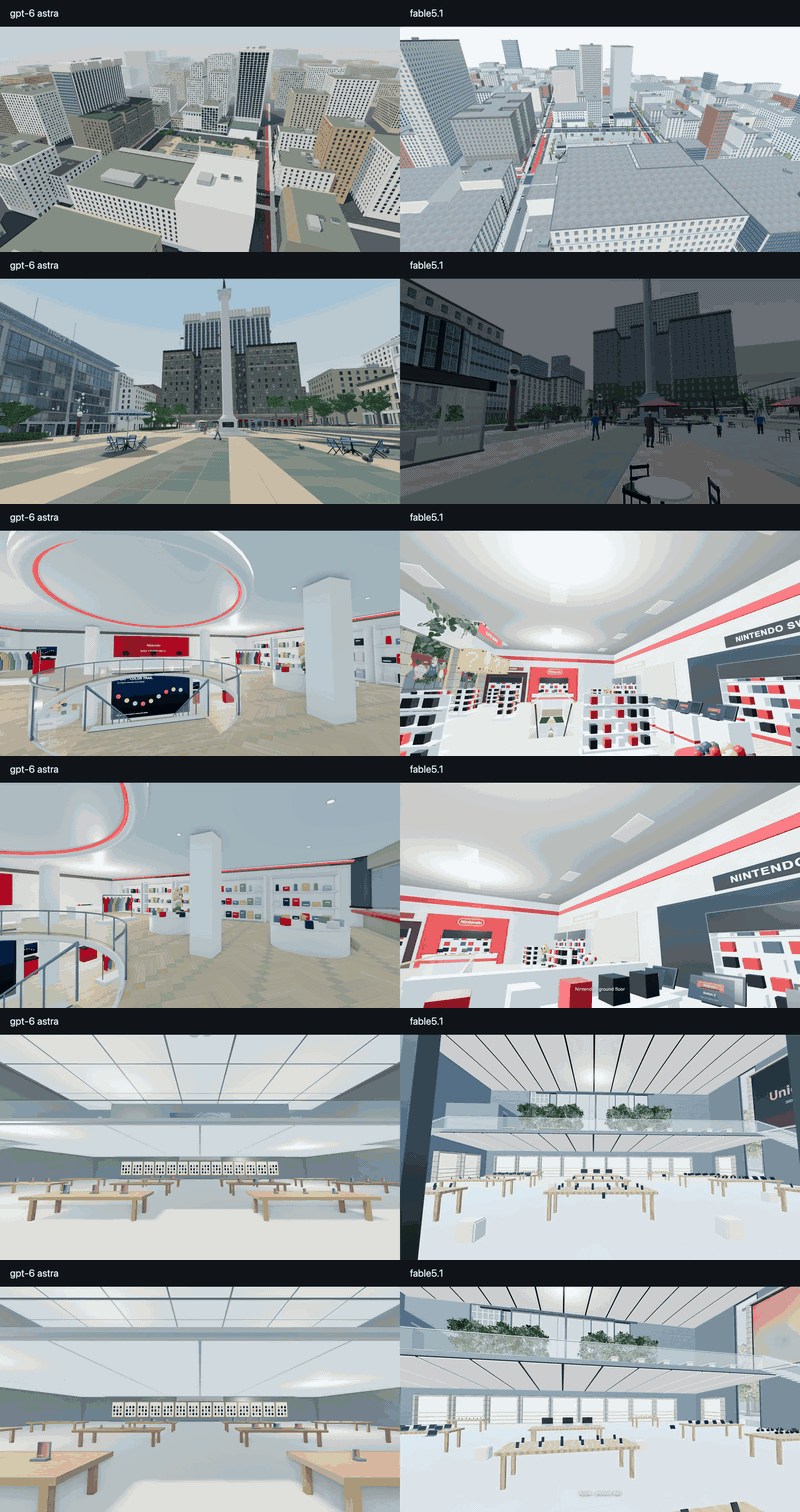
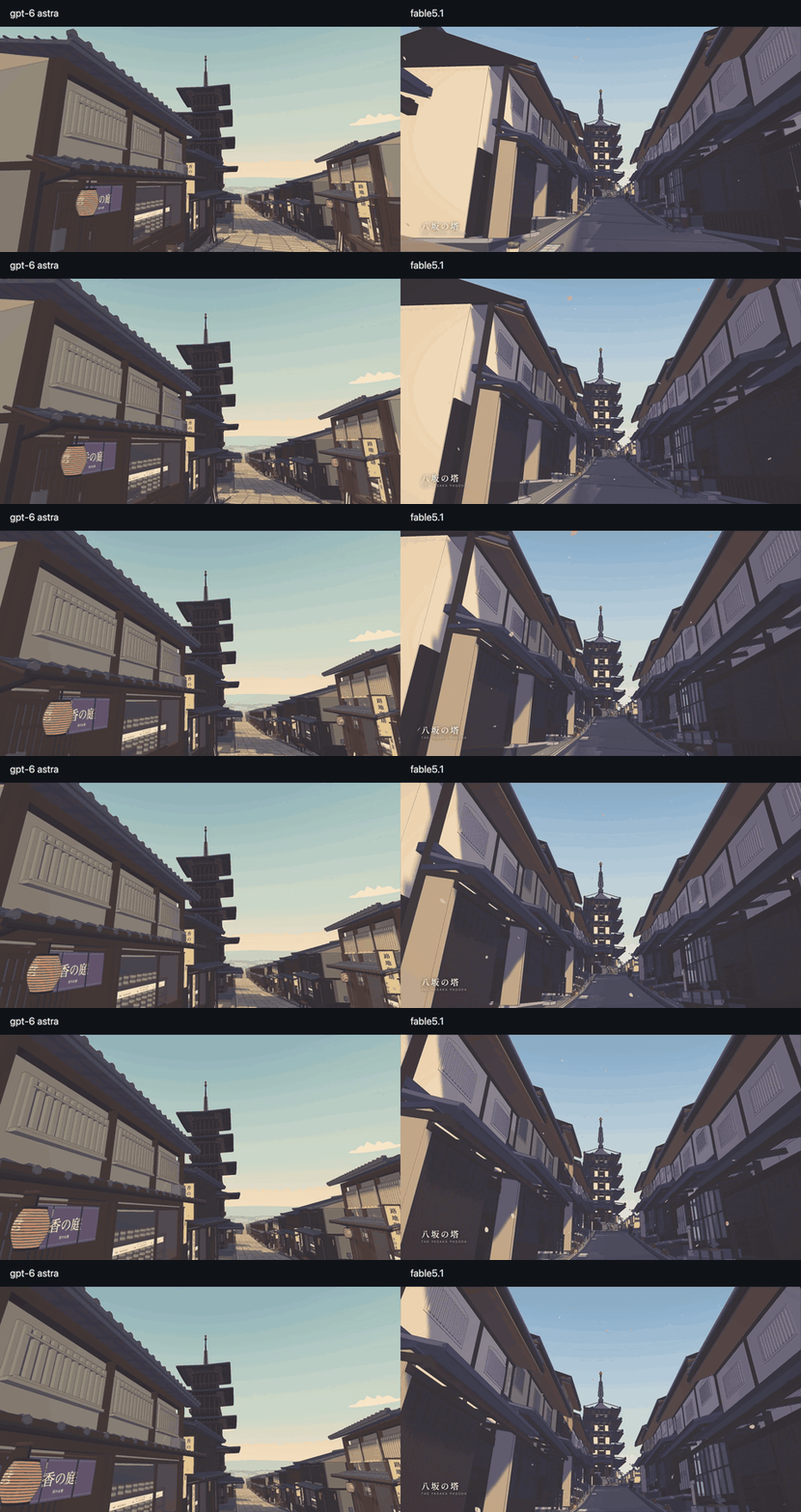
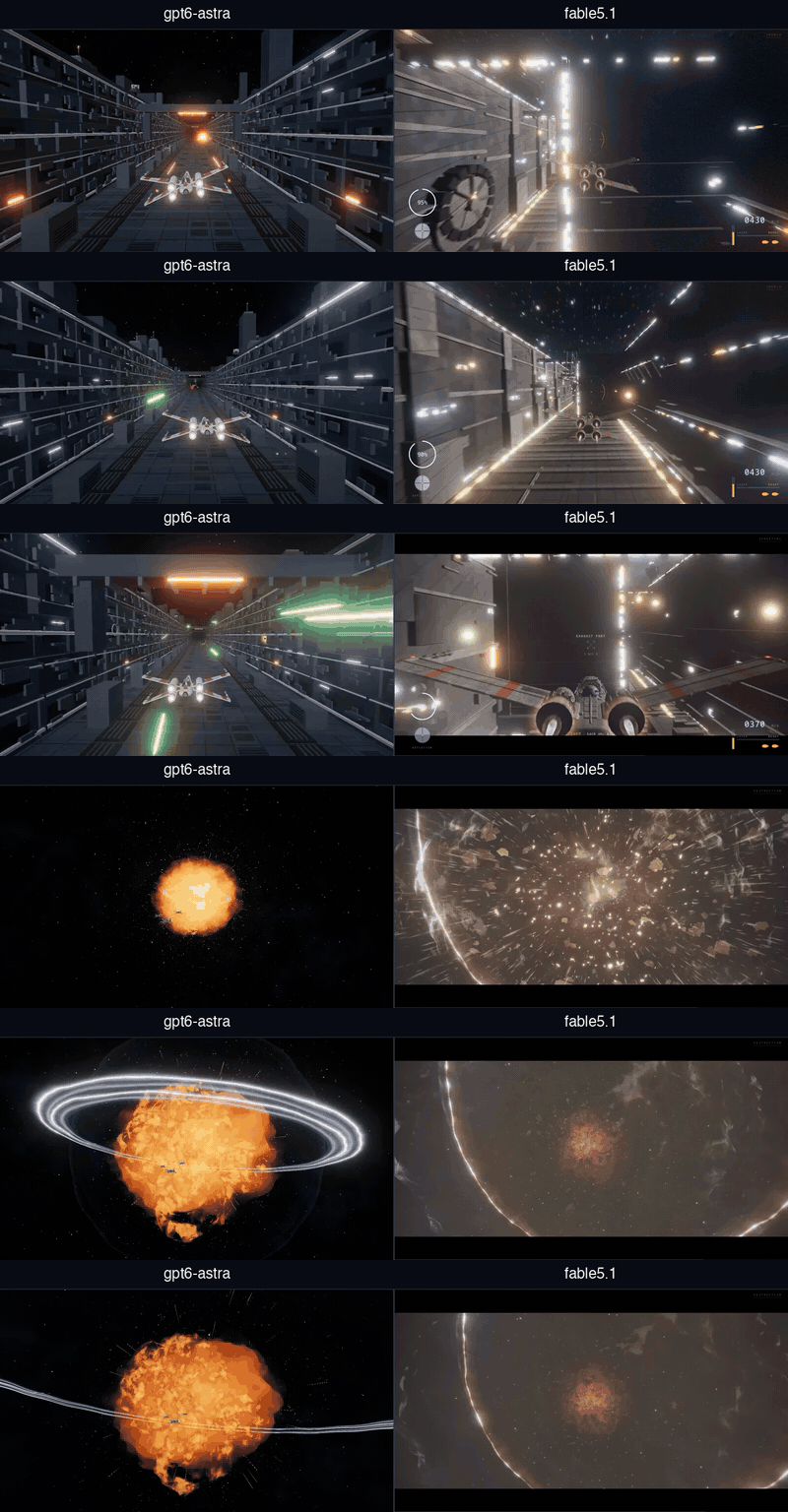
Every entry is a one-shot result. Where GPT-6 Astra was given the same brief, its world was filmed to the Fable walkthrough's camera route and shot timing, and the two run side by side, unedited - left GPT-6 Astra, right Claude Fable 5.1.

🌉 Union Square, San Francisco

Union Square side by side: GPT-6 Astra on the left, Claude Fable 5.1 on the right

▶ Watch the head-to-head · 59 s · left GPT-6 Astra, right Claude Fable 5.1 · Fable 5.1 build · GPT-6 Astra build · Fable alone: the walkthrough (1920×1080 - aerial, plaza, Nintendo, lower level, Apple)

⛩️ Higashiyama, Kyoto

Kyoto side by side: Codex / GPT-6 Astra on the left, Claude Fable 5.1 on the right

▶ Watch the head-to-head · 53.9 s · left Codex / GPT-6 Astra, right Claude Fable 5.1 · Fable build · Codex source and viewer · Fable alone: the walkthrough (1920×1080 - seven scenes, Gion to Kiyomizu-dera at sunset) · full Codex walkover GIF

🌌 Death Star Trench Run

Trench run side by side: GPT-6 Astra on the left, Claude Fable 5.1 on the right

▶ Watch the head-to-head · 28.2 s · left GPT-6 Astra, right Claude Fable 5.1 · input: a clip from a film · Fable 5.1 build · GPT-6 Astra build · method · Fable alone: the reel (1280×720 - approach, S-foils, interception, dive, trench run, torpedoes, fireball, shockwave) · the brief

More worlds coming.


Any input → a world

Text, video or image. The brief names the subject and the style, and the same pipeline runs behind all three.

Input A brief looks like The world that comes back
📝
Text
"Hanamikoji, Kyoto - as a hand-painted anime background" A named place in a named style: real geometry on surveyed ground, with the look written to order
🎞️
Video
a clip from a film The set behind the shot, continued past the edges of frame - step off the camera path and fly the rest of it. See Death Star Trench Run
🖼️
Image
one photograph, any angle The place in the frame as geometry: turn around, change the hour, light it differently

Style is as open as subject. The same street can come back as a cel-shaded anime plate, a photographic reconstruction or a night scene, because each world's renderer is written for it rather than chosen from a list.


Roadmap

A world is the substrate. What stands on it is the point.

✅ Interactive scenes Real places, walkable in a browser - this repo
🔜 Animation and video Motion as code: shot lists, camera language and continuity held across a sequence minutes long, cut from the world itself rather than generated frame by frame - anime, and documentary camera-matched to the real location
🔜 Agent environments Worlds as training and evaluation environments, where the same code that builds the place also supplies the reward and the verification signal - and, played straight, an RPG
🔜 4D, embodiment, robotics Scenes that change over time, and simulation where the ground truth comes free with the geometry
🔜 Test-time scaling performance Measure how world quality changes with more inference time and compute

How these are made

Every stage is in the repo, and every stage can be re-run:

  1. Reconnaissance - parallel research agents pull map geometry, elevation, transit and street specs, and a storefront census, each fact carrying its source and a confidence level.
  2. Asset generation - scripts emit the kit a world needs: façade modules, street furniture, vehicles, vegetation, fixtures. Some worlds ship no binary assets at all and draw every texture at start-up.
  3. Runtime - a pure Three.js app assembles terrain, streets, façades, props, crowds and traffic from JSON specs.
  4. Verification - Playwright drives the real app, screenshots fixed viewpoints, and diffs them against photographs taken from the same spot. Independent reviewer agents - architect, geographer, technical artist, interaction - file reports that drive the next fix cycle. Builders never grade their own work, and every world ships its own QA report, defects included.

Why code

A world written as code is not the same kind of object as a world generated as pixels or held in a latent space.

Verifiable You can check it by running it. Every elevation in Higashiyama is an independent survey query; a walker drives the real movement code over the whole route; Playwright diffs fixed viewpoints against photographs taken from the same spot. A wrong number is a failing test, not a matter of taste.
Compositional The parts are reusable and legible. A townhouse generator, a roof kit, a street-plot layout engine - each is a module with a contract, and a district is a few hundred lines that calls them.
Editable "Make the shopfront recesses deeper" is a diff, not a re-roll. The world changes exactly where you asked and nowhere else, and the change survives into every later render.

License

Code and generated assets: MIT. Geometry is derived from OpenStreetMap (ODbL), USGS 3DEP (public domain) and the GSI elevation service. Reference photographs are not redistributed here - provenance is recorded per world. Brand names and logos identify the real businesses at their real locations and belong to their owners.

Death Star Trench Run is an unaffiliated homage. Star Wars, X-wing, TIE fighter and the Death Star are trademarks of Lucasfilm Ltd. No film footage, audio, models or textures are used or redistributed here - the reference clip informed the shot list and the look, and every asset in that world is generated procedurally by the code beside it.

fable51-worlds (PhiloLabs/fable51-worlds)

Searching Database…

这是什么?这个项目把一份简单的需求——一句话、一张照片或一段视频片段——变成一个可漫游的 3D 世界,由名为“Fable 5.1”的基于 Claude 的智能体集群生成,它们会调研真实地点、建模、渲染并验证。
这是游戏引擎,还是别的东西?它不是游戏引擎:每个世界都以普通 Three.js 网页应用的形式交付,没有专有 3D 瓦片,也不下载网格模型,因为每栋建筑、每块招牌和每棵树都由仓库中的代码生成。
这些世界实际上是怎么构建和重新运行的?每个阶段都可以从仓库重新运行:侦察智能体拉取地图和高程数据,资产生成脚本输出立面和道具,Three.js 运行时根据 JSON 规格组装场景,Playwright 驱动的验证则把截图与真实照片做差异比对。
流水线靠什么驱动——Claude、Three.js,还是别的什么?流水线建立在用于调研和生成的 Claude 智能体集群、用于渲染的纯 Three.js 运行时、用于自动化验证的 Playwright,以及从 OpenStreetMap、USGS 3DEP 和 GSI 高程服务获取的真实世界几何数据之上。
是整个路线图都已经可用了,还是只有一部分?目前只有交互场景阶段可用;动画/视频、智能体训练环境、4D/具身/机器人仿真以及测试时扩展基准都列为即将推出的路线图项目,而非已交付的功能。
查看一个世界需要游戏引擎或特殊硬件吗?不需要——生成的世界可直接通过 WebGL 和 Three.js 在标准浏览器中打开,无需专有引擎、安装程序或下载资源。
代码和生成的世界采用什么许可?代码和生成的资产采用 MIT 许可,但底层几何数据源自 OpenStreetMap(ODbL)、USGS 3DEP(公有领域)和 GSI 高程服务,且参考照片不会被再分发。
Fable 5.1 到底是什么?它是基于 Claude 的智能体集群系统的名称,负责对每个生成的世界进行调研、建模、渲染和验证,并且在相同需求下与 GPT-6 Astra 进行了直接的正面对比。
验证步骤实际上是怎么检查一个世界的?Playwright 驱动运行中的应用,对固定视点截图,并与从同一位置拍摄的真实照片做差异比对;独立的评审智能体(建筑师、地理学家、技术美术、交互)提交 QA 报告,供下一轮修复循环使用。
我可以输入视频片段而不只是文字吗?可以——输入可以是文字、单张照片或视频片段,Death Star Trench Run 示例就是证明,它从一段参考片段外推出电影镜头背后的整套布景。
为什么用代码构建世界,而不是生成像素或视频?代码可验证(可以运行并与现实核对)、可组合(立面和屋顶生成器等可复用模块),而且可编辑(像“把店面再凹进深一点”这样的请求会变成一个精确的 diff,而不是整个重来)。
Creator
PhiloLabs
Size
416.7 MB
Stars
523
Updated
CommitSep 09
Age
1mo
Commits · 90 Days