Topics / #oci
Oci projects on GitHub
Open Container Initiative standards for container images and runtimes.
As of , the most-starred Oci projects on GitHub are dive (54.6K stars), container (50.7K stars) and podman (33.1K stars). GitHub.Locker tracks 15 Oci repositories with 277.6K stars combined. The fastest-growing on October 16 was container, with +18 stars in a day.
Hot right now
Most stars gained in a day · Oct 16
 +18
+18container
apple/container · ★ 50.7KA tool for creating and running Linux containers as lightweight virtual machines on a Mac, optimized for Apple silicon.
 +18
+18docker-agent
docker/docker-agent · ★ 4.5KDocker Agent is a tool for building, running, and sharing AI agents using a declarative YAML config, with built-in tools and multi-agent orchestration — no code required.
 +9
+9gvisor
google/gvisor · ★ 19.7KAn application kernel for containers: it wraps running applications in a strong isolation layer from the host OS, implementing a Linux-like interface in memory-safe Go, entirely in userspace.
 +9
+9smolvm
smol-machines/smolvm · ★ 6.8Ksmolvm is a CLI tool for running embeddable, portable, branchable virtual machines so you can safely run AI agents and untrusted code locally, with sub-second cold start on macOS, Linux, and Windows.
The all-time top
15 projects · by stars
- 54.6K
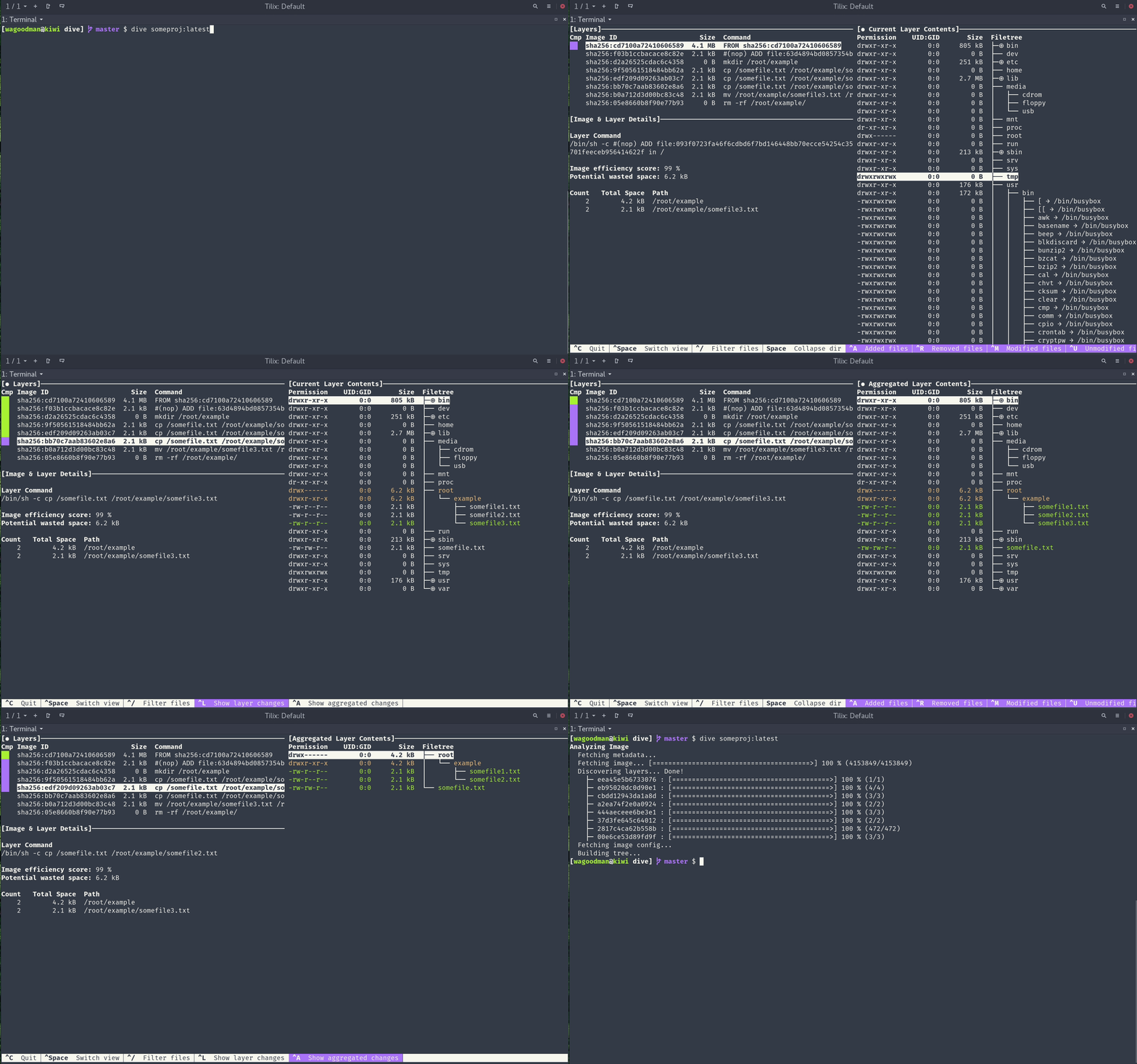 #1 · wagoodman/dive
dive
dive is a CLI tool that breaks a Docker or OCI image into its layers, shows what each layer contains, and points out where the image wastes space so you can shrink it.
- 50.7K#2 · apple/container
container
A tool for creating and running Linux containers as lightweight virtual machines on a Mac, optimized for Apple silicon.
- 33.1K
 #3 · podman-container-tools/podman
podman
Podman (the POD MANager) is a tool for managing OCI containers and images, volumes, and pods — groups of containers managed together. It is built on libpod, a container lifecycle management library included in the same repo.
- 4

containerd
21.4Kcontainerd/containerd · Gocontainerd is an industry-standard container runtime — a daemon for Linux and Windows that manages the complete container lifecycle of its host: image transfer and storage, container execution and supervision, and low-level storage and network attachments. It's a CNCF graduated project.
- 5
gvisor
19.7Kgoogle/gvisor · GoAn application kernel for containers: it wraps running applications in a strong isolation layer from the host OS, implementing a Linux-like interface in memory-safe Go, entirely in userspace.
- 6

jib
14.5KGoogleContainerTools/jib · JavaJib builds optimized Docker and OCI container images for Java applications without needing a Docker daemon or deep Docker expertise.
- 7
runc
13.5Kopencontainers/runc · Gorunc is a command-line tool for spawning and running containers on Linux according to the OCI (Open Container Initiative) specification.
- 8

grype
13Kanchore/grype · GoGrype is a command-line vulnerability scanner that checks container images, filesystems, and SBOMs for known security vulnerabilities.
- 9

clair
11.1Kquay/clair · GoClair is an open source tool for static analysis of vulnerabilities in application container images, covering both OCI and Docker image formats.
- 10

distribution
10.7Kdistribution/distribution · GoThe open source registry implementation for storing and distributing container images and other content — the toolkit to pack, ship, store, and deliver container content, built on the OCI Distribution Specification.
- 11

buildkit
10.3Kmoby/buildkit · GoBuildKit is a Go toolkit for turning source code into build artifacts efficiently and repeatably — concurrent, cache-efficient and Dockerfile-agnostic. It is the engine docker build uses by default since Docker Engine 23.0.
- 12

nasiko
9.5KNasiko-Labs/nasiko · RustNasiko is a single control-plane server that deploys, routes, secures, and observes AI agents built on the A2A protocol, acting as the one checkpoint every agent-to-agent call passes through.
- 13
smolvm
6.8Ksmol-machines/smolvm · Rustsmolvm is a CLI tool for running embeddable, portable, branchable virtual machines so you can safely run AI agents and untrusted code locally, with sub-second cold start on macOS, Linux, and Windows.
- 14
docker-agent
4.5Kdocker/docker-agent · GoDocker Agent is a tool for building, running, and sharing AI agents using a declarative YAML config, with built-in tools and multi-agent orchestration — no code required.
- 15

arcbox
4.2Karcboxlabs/arcbox · RustArcBox is a fast, open-source container and VM runtime for macOS, built from scratch in Rust, that acts as a drop-in Docker replacement while also offering disposable sandboxes for AI agents, native Kubernetes, and full Linux and macOS VMs.
Related topics
Often tagged together
- containers121
- docker1,660
- linux4,184
- cli2,227
- apache-2.01,434
- open-source5,666
- go681
- macos3,544
- developer-tools2,924
- devops455
- windows3,403
- kubernetes316
- cross-platform2,623
- security976
- virtualization81
- cloud-native122
- command-line-tool715
- self-hosted1,929
- server1,459
- ai-agents1,289
- sandbox172
- ai1,955
- api1,094
- hacktoberfest454