Why this exists
A previous controlled study found that test-time action selection — sampling
several candidate chunks from a flow-matching VLA and picking the one a world
model likes best — has near-zero headroom on a strong policy, and that
offline world-model scores do not predict decision quality.
That leaves the obvious question:
If imagination cannot select, can it teach?
dreamforge answers it end to end: mine the policy's own failure states, use a
latent world model to search corrective action chunks (CEM), verify each
correction by replaying the exact simulator state, and only then decide
whether it is worth training on.
Headline results
LIBERO-Spatial · SmolVLA-450M · 150 mined episodes → 360 failure states ·
1080+ paired simulator replays · single RTX 5080. Full log:
docs/results.md.
| experiment |
result |
world-model pre-flight (diagnose) |
unregularized WM action response 0.0003 vs action-sensitive 0.0163 (~50×) |
| imagined progress (CEM) |
0.480 → 0.500 (+0.020) |
| real value of corrections, 360 paired states |
none 9.4% · imagined 13.6% · random 14.7% |
| imagined vs none |
+4.2pp, exact McNemar p = 0.032 |
| imagined vs equal-budget random |
−1.1pp, p = 0.61 — the model's direction buys nothing |
training on corrections (ft_all) |
57.0% vs base 61.0% vs replay-only control 58.0% (p = 1.0) |
corrections concentrated where the metric looked best (ft_early) |
45.0% — 13pp worse than the control (p = 0.041) |
What that means (click)
World-model imagination changes outcomes, but only as much as a random
perturbation of the same magnitude, and training on it does not beat a
replay-only control. Worse, feeding corrections where the decision-point metric
says they help most hurts: those states are not reliably failures (the policy
succeeds from the same initial state most of the time), so imitating a
perturbation there overwrites correct behaviour.
The practical reading, and the reason the tooling is the point of this repo:
before paying for a world model in a control loop, (1) measure its action
response, (2) benchmark its output against an equal-budget random perturbation,
(3) never assume a decision-point metric is a training signal.
Interactive dashboard
Every run renders a self-contained HTML dashboard (no CDN, no JavaScript)
from its artifacts — handy for a report, a PR, or GitHub Pages. It ships with a
CSS-only English / 中文 switch (hidden radio inputs + sibling selectors, so
the page stays script-free).
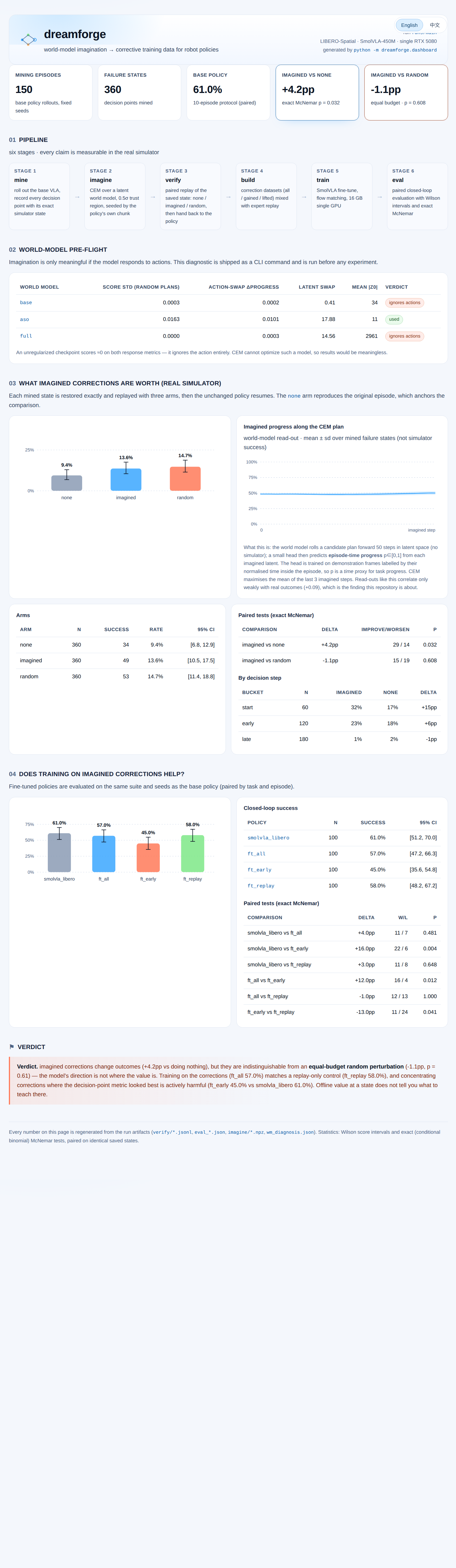
python -m dreamforge.dashboard --run runs/main --out results/dashboard.html
The committed copy lives at results/dashboard.html
(and the Chinese view is at assets/dashboard-zh.png).
Quickstart
pip install -e . --no-deps     # library only needs numpy + torch
pytest tests -q                # 10 tests, CPU only

RUN=runs/main
python -m dreamforge.mine     --task libero_spatial --episodes 15 --out $RUN/mine
python -m dreamforge.diagnose --mine $RUN/mine --wms base aso --out $RUN/wm_diagnosis.json
python -m dreamforge.imagine  --mine $RUN/mine --out $RUN/imagine --wm aso --delta-sigma 0.5
python -m dreamforge.verify   --mine $RUN/mine --imagine $RUN/imagine --out $RUN/verify \
                              --arms none imagined random --exec-horizon 16
python -m dreamforge.build    --mine $RUN/mine --imagine $RUN/imagine --out $RUN/build_all --filter all
python -m dreamforge.train    --samples $RUN/build_all --out $RUN/ft_all --steps 3000
python -m dreamforge.eval     --policy-path $RUN/ft_all --task libero_spatial --episodes 10 \
                              --out $RUN/eval_ft_all.json
python -m dreamforge.report   --run $RUN            # markdown + figures
python -m dreamforge.dashboard --run $RUN           # HTML dashboard
make mine imagine verify build train eval report runs the same stages.
CLI
| command |
what it does |
mine |
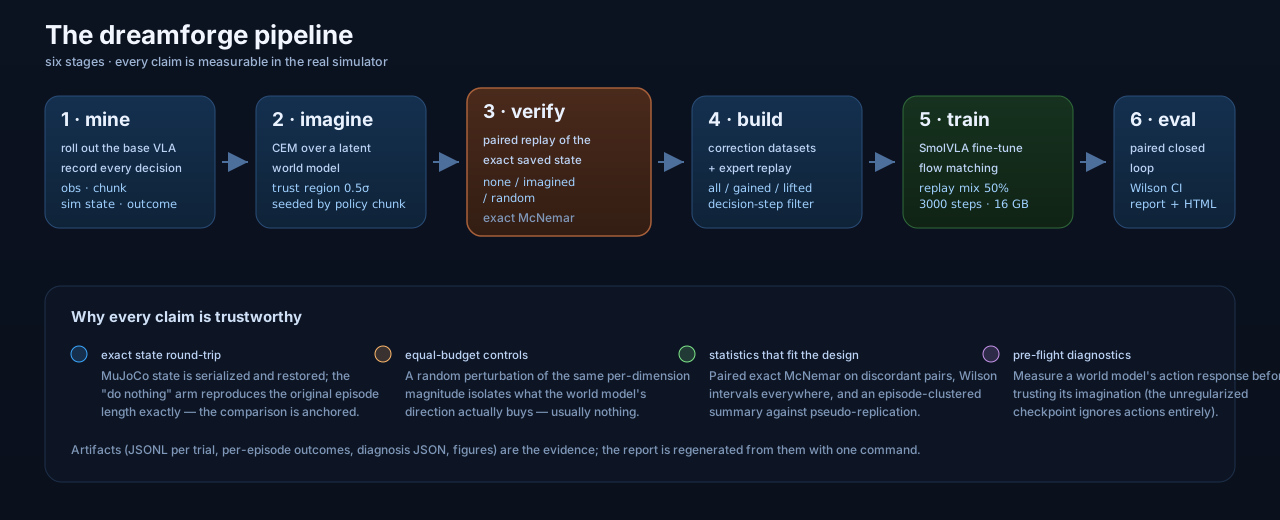
roll out the base policy, record every decision point (obs, chunk, exact sim state, outcome) |
imagine |
CEM over the latent world model; 0.5σ per-dimension trust region seeded by the policy's chunk |
verify |
paired replay of each saved state: none / imagined / random, then hand back to the policy |
build |
correction datasets — all / gained (WM score) / lifted (sim-verified), plus a decision-step filter |
train |
SmolVLA fine-tune (flow matching) on corrections mixed with expert replay |
eval |
paired closed-loop evaluation (Wilson intervals, exact McNemar) |
report / dashboard |
markdown report + self-contained HTML dashboard |
diagnose |
world-model pre-flight: does the model respond to actions at all? |
figures |
publication-style figures for a run |
Repository layout
src/dreamforge/
  wm.py         latent world model + progress head
  cem.py        CEM planner (trust region, dataset-space actions)
  envs.py       LIBERO env helpers — exact MuJoCo state save/restore
  policy.py     SmolVLA loading and observation/action pipelines
  mining.py     stage 1  ·  imagine.py  stage 2  ·  verify.py  stage 3
  dataset.py    stage 4  ·  finetune.py stage 5  ·  evaluate.py stage 6
  report.py     paired statistics   ·  dashboard.py  HTML interface
  figures.py    plots               ·  diagnose.py   WM pre-flight
  stats.py      Wilson / exact McNemar
assets/         banner, pipeline diagram, dashboard screenshot
docs/           protocol.md · results.md · resume.md
results/        curated artifacts (report, figures, paired records, evals)
scripts/        run_main.sh · run_training.sh · run_ladder.sh · probe_env.py
tests/          statistics · CEM (incl. trust region) · dataset filters
Design principles
- Measure before you claim. Corrections are replayed in the simulator;
the
none arm reproduces the original episode, anchoring the comparison.
- Control the budget. Every "model-guided" result is compared against a
random perturbation of the same per-dimension magnitude.
- Statistics that fit the design. Paired exact McNemar, Wilson intervals,
and an episode-clustered summary against pseudo-replication.
- Fail loudly on silent bugs. Three real pipeline bugs were found and
fixed by this discipline: OOD actions from an unconstrained CEM (normalized
targets ×6), double-normalized states, and checkpoints saved without their
processor pipeline.
Roadmap
- Replicate the targeted-training drop across training seeds
- Unconstrained-budget sweep (large random perturbations hurt; does a large
model-guided deviation help? — the open mechanism question)
- A second suite / base policy, and a video world model
-
verify in parallel workers (trials are CPU-bound)
Citation & attribution
The latent world model, the CEM interface and the evaluation protocol adapt
code from the author's previous research project (near-zero-headroom,
manuscript under review), reused with permission. If you use this repository,
please cite it via CITATION.cff.
License
MIT — see LICENSE.








 Dreamforge 是一套研究流水线:它挖掘机器人策略自身的失败状态,用潜空间世界模型(CEM)想象出纠正动作,并把每个纠正放到真实模拟器里重放验证,确认确实有效之后才算数。