openjev
One-pass option scoring with a local Gemma 3 4B on Apple silicon via MLX.
Design notes: docs/design/one-pass-option-scoring.md;
per-task training: docs/design/per-task-finetuning-with-gemma.md.
Given a context and a list of pre-written options, the model prefills the
context once, expands that KV cache across the option batch, and scores every
option in a single padded forward pass. No decoding. The score is the
log-probability of the option tokens given the context; a softmax over the
option scores gives a probability per option, like jevlike-predict.
Setup
make setup       # uv sync (arm64 Python 3.12 venv) + download google/gemma-3-4b-it into models/ (gated; needs HF login)
make serve       # start the HTTP server on :8000
make health      # curl /health
make request     # example curl against /score
make systemone   # TypeSafe-style request against /v1/systemone
make check       # verify cached batched scoring against naive re-encoding
make bench       # latency benchmark
make eval DATA=data/synthetic/test.jsonl
make setup also installs the optional torch extra, used only for the jevlike comparison and HF cross-checks.
make on macOS needs the Xcode licence accepted (sudo xcodebuild -license accept) or Homebrew's gmake.
Usage
# Rank options for one context (prints probability, score, raw sum, token count)
.venv/bin/openjev score --context "The capital of France is" \
    --option " Paris" --option " Berlin" --option " Lyon"

# Chat template (context as user turn, options scored as the reply) + PMI normalisation
.venv/bin/openjev score --chat --norm pmi --context "..." --option "..." --option "..."

# Predefined options: one per line in a text file, reused for every context
.venv/bin/openjev score --options-file options.txt --context "..."
.venv/bin/openjev eval contexts.jsonl --fixed-options options.txt   # rows need only {"context": ...}; add "label" for accuracy

# Top-1 / top-3 accuracy on jevlike-style JSONL: {"context": ..., "options": [...], "label": 0}
.venv/bin/openjev eval data.jsonl --norm mean

# Verify the cached batched path against naive re-encoding, and benchmark it
.venv/bin/openjev check
.venv/bin/openjev bench --context-tokens 200 --options 8 --option-tokens 30
Server
Loads the model once and answers scoring requests in about 90 ms each. Runs natively on macOS with
Metal; there is no container path because Linux containers cannot reach the Apple GPU.
make serve                                     # = .venv/bin/openjev serve --port 8000
curl -s localhost:8000/score -H 'content-type: application/json' -d '{
  "context": "Customer: my order arrived broken. Agent:",
  "options": [" I am sorry, I will send a replacement.", " Please read our returns policy."],
  "norm": "mean", "chat": false, "sep": ""
}'
The response has best, best_index, per-option probability / logprob_sum / n_tokens, and timing.
TypeSafe System One contract
POST /v1/systemone implements the request/response shape documented at
docs.typesafe.ai: a state (string, object or array) plus a map of typed
questions, answered against that state.
make systemone     # sends examples/systemone-quickstart.json; or:
curl -s localhost:8000/v1/systemone -H 'content-type: application/json' -d '{
  "state": "I ordered size 10 shoes but received size 8. Please send the right size.",
  "model": "jev-latest",
  "questions": {
    "department":  {"type": "choice", "instructions": "Which department handles this?",
                    "criteria": {"returns": "Returns and exchanges", "shipping": "Delivery issues", "billing": "Charges and refunds"}},
    "severity":    {"type": "score",  "instructions": "How severe is the problem?",
                    "criteria": ["minor", "moderate: wrong item", "major: safety or financial loss"]},
    "wants_refund":{"type": "noul",   "instructions": "Is the customer asking for a refund to their card?"}
  }
}'
question type |
request criteria |
answer fields |
choice |
map of option name to description (string, object, array or null); up to 255 options |
choice, probabilities (sum to 1), confidence |
score |
ordered array of level descriptions |
score (probability-weighted mean of level index), probabilities keyed "0".."n-1", legend, confidence |
noul |
optional {"true": ..., "false": ...} |
noul = probability of yes |
Response: {"model", "answers": {id: answer}, "usage": {"input_tokens", "output_tokens"}}.
Set OPENJEV_API_KEY before make serve to require Authorization: Bearer <key> on this route.
How it maps onto the scorer: each question is rendered to a plain-text prompt (state, instructions,
options or levels, then Answer: and a newline) and the option names, level numbers, or yes/no
are scored as continuations in one prefix-shared batched pass per question. confidence is 1 minus
the normalised entropy of the distribution; TypeSafe does not publish its formula, so treat it as an
approximation. usage.output_tokens counts the candidate-label tokens that were scored.
Comparison on the docs' quick-start request (examples/systemone-quickstart.json), Gemma 3 4B
zero-shot vs the numbers TypeSafe publishes for Jev:
| answer |
Jev (docs) |
openjev / Gemma 3 4B |
department.choice |
technical, p=0.84, confidence 0.60 |
technical, p=1.00, confidence 1.00 |
frustration.score |
1.04 (annoyed but polite) |
2.00 (furious) |
is_urgent.noul |
0.999 |
0.005 |
Same routing decision, but Gemma is over-confident and disagrees on the two judgement calls. Zero-shot
probabilities are softmaxed next-token likelihoods, not calibrated judgements. Closing the gap means
labelled data and a trained head (below).
Training a head (per-task, on frozen Gemma features)
make features    # one prefix-shared pass per example, cached to runs/feats/{train,validation,test}.npz
make train       # jevlike's cross-attention head in MLX, listwise cross-entropy -> runs/head.safetensors
make eval-head   # top-1/top-3, ECE, and the shuffled-context control on the test split
openjev features DATA --out F.npz stops Gemma before the LM head, keeps every context token's
final hidden state and the masked-mean of each option's tokens (float16). Options are encoded on
their own, as in jevlike, so the head has to do the matching. --contextual encodes them as
continuations of the context instead: stronger features, but the match leaks into the option
vectors and the shuffled-context control below stops meaning anything.openjev train = AdamW 5e-4 (2e-3 diverges on Gemma features, whose norms are ~115), weight decay 1e-4, grad clip 1.0, 8 epochs, batch 64, best validation
epoch kept. The checkpoint is head.safetensors plus head.json (rank, hidden size, training config).openjev eval-head reports what jevlike-eval reports: top-1, top-3, 10-bin expected calibration
error, and the same metrics with every example paired with another example's context. If the
shuffled number does not collapse, the head is reading option priors rather than the state.
Result on the synthetic split (2000 train / 400 validation / 400 test, 2026-09-17): features at
77 ms per example, head training 8 epochs in about 15 s.
|
top-1 |
top-3 |
ECE |
| head on frozen Gemma features, test |
0.970 |
1.000 |
0.027 |
| same head, shuffled-context control |
0.258 |
0.698 |
0.724 |
| jevlike tiny byte encoder, test |
0.998 |
1.000 |
0.008 |
Gemma zero-shot, --norm sum, test |
1.000 |
1.000 |
n/a |
The control sits at chance (about 4.5 options per row), so the head really matches options to the
state, and its ECE of 0.03 is what a calibrated confidence looks like.
Python:
from openjev import OptionScorer
s = OptionScorer("models/gemma-3-4b-it", batch_size=8)
for r in s.score("The capital of France is", [" Paris", " Berlin"], norm="mean"):
    print(r.option, r.probability, r.logprob_sum, r.n_tokens)
print(s.last_timing)
Normalisation (--norm)
| norm |
score |
use when |
mean (default) |
sum of option-token log-probs divided by token count |
options differ in length |
sum |
total log-prob |
options are the same length or you want raw likelihood |
pmi |
sum minus the option's unconditional log-prob (BOS-only context) |
options differ in base-rate plausibility; costs one extra batched pass |
Measured on M5 Pro, 64 GB (bf16, mlx-lm)
Workload: 202-token context, 8 options, 242 option tokens total.
| path |
median latency |
| context cached once, options batched |
0.17 s |
| context re-encoded per option, no cache |
0.68 s |
Model load is about 1 s from a warm disk. First forward pass adds under a second of warm-up.
Validating against jevlike
jevlike is installed into the same venv (uv pip install -e ../../vinnylarouge/jevlike), so both
CLIs read the same JSONL. Generate its synthetic menu set, then score it both ways:
.venv/bin/jevlike-data synthetic --output data/synthetic
.venv/bin/openjev eval data/synthetic/test.jsonl --norm sum --sep $'\nChoice: '
.venv/bin/jevlike-train data/synthetic/train.jsonl --validation data/synthetic/validation.jsonl \
    --output runs/synthetic-tiny.pt --device mps
.venv/bin/jevlike-eval runs/synthetic-tiny.pt data/synthetic/test.jsonl --device mps
Results on the 400-row synthetic test set (2026-09-16):
| scorer |
training |
top-1 |
top-3 |
median latency / example |
openjev, Gemma 3 4B zero-shot, --norm sum |
none |
1.000 |
1.000 |
0.086 s |
openjev, --norm mean |
none |
0.988 |
1.000 |
0.086 s |
openjev, --norm pmi |
none |
0.988 |
1.000 |
0.153 s |
| jevlike tiny byte encoder + head |
2000 rows, 8 epochs |
0.998 |
1.000 |
well under 10 ms |
The synthetic task is easy for both. The real validation is your own labelled rows: run
openjev eval on them zero-shot and compare against a jevlike-train/jevlike-eval run on the
same split. If Gemma zero-shot is close to the trained head, Route B is enough; if not, train a head
(Route A) with make features && make train && make eval-head.
Demo: Doom in the terminal
demo/doom/ runs ViZDoom headless, describes each frame in a line of text, and
lets the server rank the action menu with one /score call (or one System One
choice question). Start make serve, then make doom. Details and keys in
demo/doom/README.md.
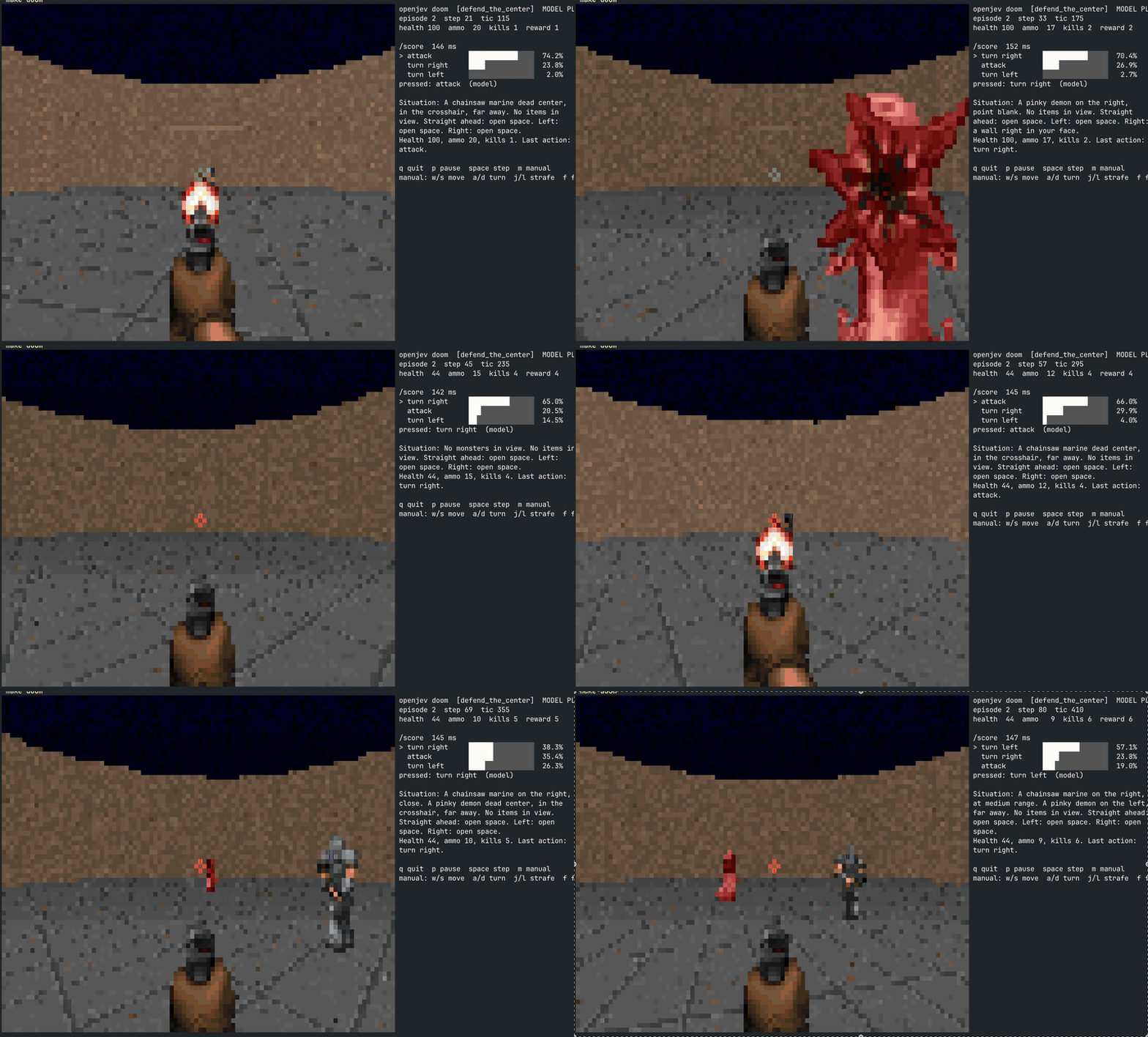
Full-resolution recording: docs/media/doom-recording.mov.
Layout
openjev/scorer.py: OptionScorer (prefill, cache expansion, batched scoring, naive reference).openjev/systemone.py: System One request/answer models, prompt renderers, zero-shot answers.openjev/server.py: FastAPI app, /health, /score, /v1/systemone.openjev/features.py: frozen-Gemma feature extraction and the .npz feature cache.openjev/head.py: jevlike's cross-attention head in mlx.nn, save/load.openjev/train.py: head training loop and evaluation (top-k, ECE, shuffled-context control).openjev/cli.py: openjev score | eval | bench | check | serve | features | train | eval-head.demo/doom/: Doom in the terminal, the server picks every action (make doom).models/: downloaded weights (git-ignored).

 Открытая реализация Jev: локальная модель Gemma 3 4B (через MLX) на чипах Apple silicon оценивает список заранее заготовленных вариантов относительно контекста за один пакетный проход — без генерации текста, только лог-вероятности по каждому варианту.