HRFFA: High-Angle Robust Fast FaceAlignment


A training, distillation and ONNX deployment pipeline for whole-head face alignment that stays robust at extreme head poses while remaining light enough for CPU inference.
- Face alignment on head crops, not face crops. Conventional face-alignment papers assume a tightly cropped face region; this is a special-purpose model that works on a crop of the whole head instead. The architecture is therefore at a considerable disadvantage against paper benchmarks, but the intent is to take in more features by processing the entire head and the background context contained in a small margin at the same time. It is also the practical choice: object detectors localize whole heads far more stably than faces.
- For head crops that include looking up / looking down (measured pitch beyond ±85°), in-plane rotation over the full 360° roll, and profile views (yaw ±90°), the models output 68 / 98 / 29 landmarks plus a 3-class visibility label per point (outside the image / occluded / visible).
- The teacher is a DINOv3 ViT-L/16 (320×320); the students are a ViT-T/16 (256 and 96 input) and a PP-HGNetV2-B0 based CNN (256 and 96 input). Students are trained by online distillation from the teacher and exported to ONNX graphs that run in 1.5–12 ms on a CPU.
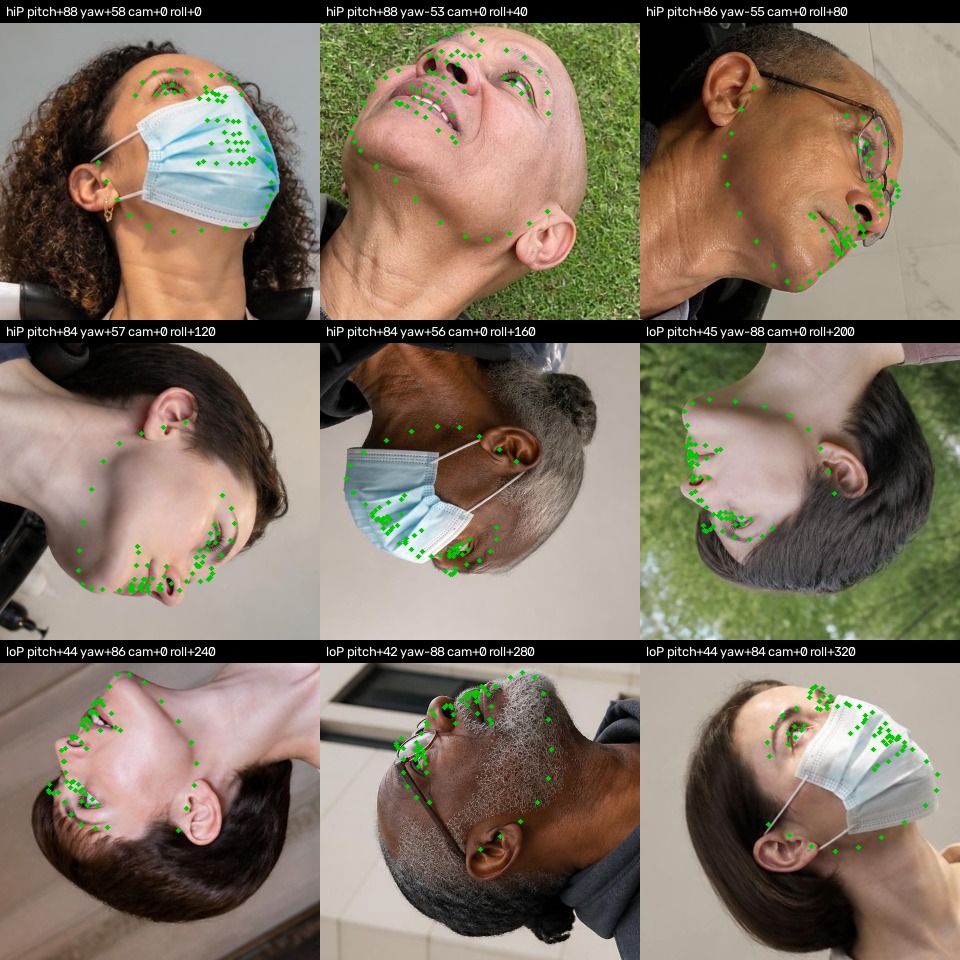
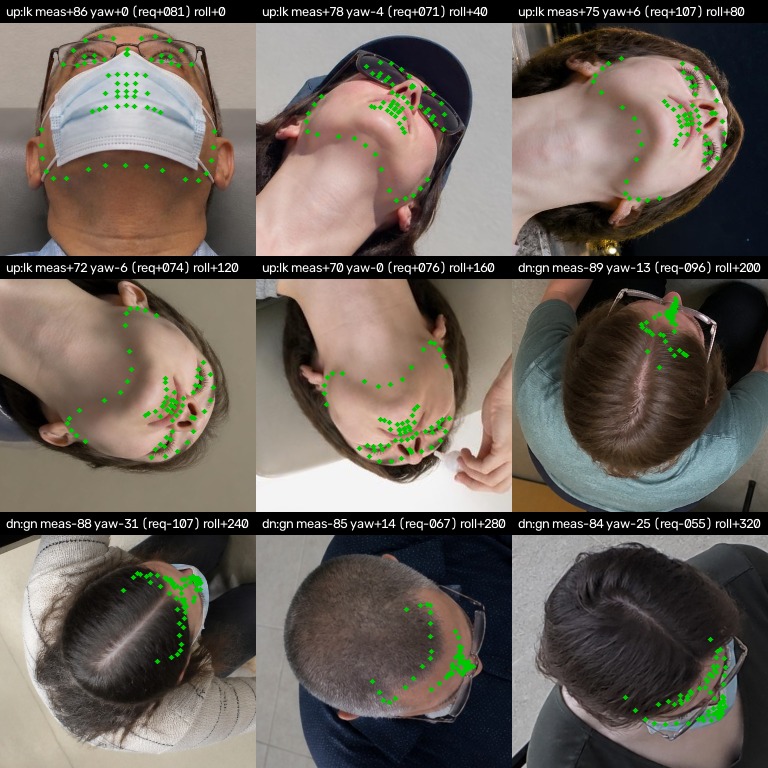
Left: teacher vitl-320 on nine looking-up × profile tiles with a roll of 0–320° composited onto each tile.
Right: student vitt-256 on measured pitch extremes (+86° to −89°) with roll. Predictions only.
1. Results at a glance
inter-ocular NME %, lower is better; CPU latency on an i9-10900K with onnxruntime 1.22 CPU EP, batch 1.
Checkpoints and ONNX/TFLite(LiteRT): https://github.com/PINTO0309/High-Angle_Robust_Fast_FaceAlignment/releases/tag/weights
| Model |
Input |
Params |
GMACs |
GFLOPs |
CPU ms |
WFLW Full |
WFLW Pose |
300W Full |
COFW |
| D-ViT (paper) |
256 |
96.4M |
≈73.15 |
≈146.30 |
– |
3.75 |
6.43 |
2.85 |
4.13 |
| vitl-320 (teacher) |
320 |
308.2M |
131.32 |
262.63 |
520 |
1.51 |
2.54 |
1.03 |
1.21 |
| vitt-256 |
256 |
9.0M |
2.05 |
4.09 |
12.4 |
3.36 |
5.64 |
2.66 |
2.76 |
| hg0-256 |
256 |
1.6M |
0.70 |
1.40 |
5.2 |
5.32 |
9.53 |
3.87 |
3.77 |
| vitt-096 |
96 |
9.0M |
0.43 |
0.85 |
4.6 |
5.14 |
8.65 |
3.86 |
3.90 |
| hg0-096 |
96 |
1.6M |
0.13 |
0.26 |
1.5 |
7.46 |
14.71 |
4.77 |
4.99 |
How to read these numbers (important): all splits of the real-image datasets — including WFLW test, 300W and COFW test — are used for training. The "official" numbers above therefore measure how well the models fit the training distribution and must not be compared with published benchmark results. The only unleaked instrument is 300wlp_val (head-NME on a held-out 300W-LP subset; values in 050). The full tables — WFLW subsets, FR/AUC, breakdowns by pose (yaw / pitch / roll) and by image degradation, and the D-ViT paper values listed side by side with an explicit non-comparability note — follow in §1.1 (same content as 050 §2). The D-ViT (paper) row lists the published benchmark values of arXiv 2411.07167 (Tables 1 / 2, "Ours": 256×256 input, 8 prediction blocks = 96.4M parameters per its Table S1) for format reference only. The paper does not report FLOPs or latency; the GMACs / GFLOPs are our estimate from the official code with its default arguments (8 prediction blocks, 32×32 heatmaps, depth 256, 256×256 input, all 8 stages, batch 1, same FlopCounterMode method as the other rows) and are approximate because that configuration has 101.1M parameters, about 5 % more than Table S1. Its COFW NME is normalized by the inter-pupil distance instead of inter-ocular, and its test sets are held out from training, so no ranking against the fit measures above is implied.
1.1 Full tables
All tables below are generated from runs/<run>/eval_best_{official,stratreal,stress,style}.log by scripts/make_results_tables.py. Notes:
- Absolute values are fit measures (all real-image splits are in the training data). The
D-ViT (paper) rows in Tables 1 / 2 are the published test-benchmark values of arXiv 2411.07167 (p.6, "Ours") and are listed for format reference only — the conditions differ, so no ranking is implied.
- Yaw / pitch / roll: the models do not output head pose, so pose robustness is expressed as landmark accuracy per pose. Table 3: inter-ocular NME per effective pose bin (6DRepNet-estimated pose plus the applied rotation, 3 sets × 300 images × 16 configurations). Table 4: NME per in-plane roll (exact 360° roll equivariance; a small worst−base means equivariant). Table 5: NME under projective camera pitch ±15/±25° and yaw ±15° perturbations. Table 6: head-NME (normalized by the crop side, not inter-ocular) of the three real sets stratified by 6DRepNet-estimated pose.
- Table 7 perturbations are applied in crop pixels (mblur9/21 = 30° motion blur of 9/21 px, warm/cool = channel gains, gamma 0.6/1.6, gray, jpeg30 = JPEG quality 30). Their strength therefore depends on the input resolution: for the 96 models (vitt-096 / hg0-096) a 21 px blur on a 96 px crop corresponds to ~56 px at 256, so their Table 7 rows are not comparable with the 256 models.
Table 1. NME (%, inter-ocular, lower is better)
| Model |
WFLW
Full |
Pose |
Exp |
Ill |
Mu |
Occ |
Blur |
COFW
Full |
300W
Full |
Comm |
Chal |
| D-ViT (paper) |
3.75 |
6.43 |
3.85 |
4.06 |
3.57 |
4.47 |
4.37 |
4.13 |
2.85 |
2.43 |
4.56 |
| vitl-320 |
1.51 |
2.54 |
1.55 |
1.47 |
1.42 |
1.56 |
1.58 |
1.21 |
1.03 |
0.96 |
1.34 |
| vitt-256 |
3.36 |
5.64 |
3.43 |
3.25 |
3.19 |
3.56 |
3.60 |
2.76 |
2.66 |
2.36 |
3.90 |
| hg0-256 |
5.32 |
9.53 |
5.54 |
5.16 |
5.09 |
6.29 |
6.04 |
3.77 |
3.87 |
3.37 |
5.96 |
| vitt-096 |
5.14 |
8.65 |
5.32 |
4.96 |
5.06 |
5.52 |
5.40 |
3.90 |
3.85 |
3.57 |
5.02 |
| hg0-096 |
7.46 |
14.71 |
7.77 |
7.19 |
8.10 |
8.91 |
8.16 |
4.99 |
4.77 |
4.24 |
6.91 |
Table 2. FR10 (%, lower is better) and AUC10 (%, higher is better) on WFLW
| Model |
FR10
Full |
Pose |
Exp |
Ill |
Mu |
Occ |
Blur |
AUC10
Full |
Pose |
Exp |
Ill |
Mu |
Occ |
Blur |
| D-ViT (paper) |
1.76 |
8.28 |
1.27 |
1.29 |
1.94 |
3.80 |
2.07 |
63.7 |
40.1 |
62.6 |
64.7 |
64.7 |
57.1 |
58.6 |
| vitl-320 |
0.00 |
0.00 |
0.00 |
0.00 |
0.00 |
0.00 |
0.00 |
84.9 |
74.5 |
84.5 |
85.4 |
85.8 |
84.4 |
84.2 |
| vitt-256 |
0.28 |
1.53 |
0.32 |
0.00 |
0.00 |
0.54 |
0.52 |
66.5 |
43.9 |
65.7 |
67.5 |
68.2 |
64.5 |
64.1 |
| hg0-256 |
7.00 |
32.21 |
5.73 |
5.44 |
6.31 |
13.04 |
9.44 |
49.2 |
17.5 |
46.7 |
50.3 |
50.2 |
42.4 |
42.8 |
| vitt-096 |
4.20 |
23.31 |
4.78 |
2.72 |
2.91 |
5.57 |
3.75 |
49.7 |
20.2 |
47.7 |
51.2 |
49.9 |
46.2 |
47.1 |
| hg0-096 |
17.88 |
67.48 |
18.79 |
14.18 |
20.87 |
26.09 |
22.38 |
36.1 |
5.8 |
31.9 |
37.6 |
34.4 |
28.7 |
30.0 |
Table 3. NME (%) by yaw / pitch bin (effective pose bins of pose-stress)
| Model |
Yaw
0–30 |
Yaw
30–60 |
Yaw
60–95 |
Pitch
−95..−45 |
Pitch
−45..−15 |
Pitch
−15..15 |
Pitch
15..45 |
Pitch
45..95 |
| vitl-320 |
1.26 |
1.71 |
2.04 |
1.76 |
1.37 |
1.30 |
1.29 |
1.85 |
| vitt-256 |
2.94 |
4.10 |
4.68 |
4.07 |
3.20 |
3.06 |
2.99 |
4.43 |
| hg0-256 |
4.21 |
6.35 |
8.14 |
6.26 |
4.63 |
4.46 |
4.35 |
7.51 |
| vitt-096 |
4.49 |
6.21 |
7.37 |
5.93 |
4.82 |
4.77 |
4.54 |
7.06 |
| hg0-096 |
5.69 |
8.70 |
10.85 |
8.02 |
6.17 |
6.21 |
5.79 |
10.07 |
| n |
5933 |
1124 |
143 |
223 |
2503 |
2944 |
1398 |
48 |
Table 4. NME (%) by in-plane roll (pose-stress, n=300 per set)
| Model |
Set |
Roll 0 |
45 |
90 |
135 |
180 |
225 |
270 |
315 |
worst−base |
| vitl-320 |
wflw |
1.61 |
1.61 |
1.64 |
1.60 |
1.63 |
1.61 |
1.63 |
1.60 |
+0.02 |
|
300w |
1.12 |
1.11 |
1.14 |
1.11 |
1.13 |
1.11 |
1.13 |
1.11 |
+0.01 |
|
cofw |
1.29 |
1.30 |
1.31 |
1.30 |
1.30 |
1.30 |
1.30 |
1.29 |
+0.02 |
| vitt-256 |
wflw |
3.67 |
3.61 |
3.67 |
3.60 |
3.70 |
3.61 |
3.68 |
3.61 |
+0.03 |
|
300w |
2.93 |
2.88 |
2.89 |
2.89 |
2.95 |
2.92 |
2.96 |
2.90 |
+0.03 |
|
cofw |
3.01 |
2.96 |
3.02 |
2.97 |
2.98 |
2.96 |
2.98 |
2.97 |
+0.01 |
| hg0-256 |
wflw |
5.96 |
5.95 |
5.90 |
6.06 |
5.92 |
6.03 |
5.98 |
5.96 |
+0.10 |
|
300w |
4.14 |
4.11 |
4.26 |
4.20 |
4.26 |
4.29 |
4.21 |
4.16 |
+0.15 |
|
cofw |
4.12 |
4.08 |
4.06 |
4.06 |
4.03 |
4.11 |
4.12 |
4.06 |
+0.00 |
| vitt-096 |
wflw |
6.30 |
6.05 |
6.17 |
5.98 |
6.30 |
6.26 |
6.40 |
6.19 |
+0.10 |
|
300w |
4.58 |
4.41 |
4.55 |
4.50 |
5.03 |
5.11 |
5.14 |
4.71 |
+0.57 |
|
cofw |
4.74 |
4.61 |
4.72 |
4.49 |
4.73 |
4.49 |
4.56 |
4.55 |
+0.00 |
| hg0-096 |
wflw |
8.89 |
9.03 |
9.09 |
9.21 |
8.98 |
9.33 |
9.90 |
8.72 |
+1.01 |
|
300w |
5.57 |
5.61 |
5.82 |
6.07 |
6.40 |
6.59 |
6.05 |
5.95 |
+1.03 |
|
cofw |
5.84 |
5.79 |
6.05 |
5.71 |
5.76 |
5.51 |
5.68 |
5.73 |
+0.21 |
Table 5. NME (%) under camera pitch / yaw perturbation (pose-stress, n=300 per set)
| Model |
Set |
base |
cam
pitch
−25 |
−15 |
+15 |
+25 |
cam
yaw
−15 |
+15 |
p+25,y+15 |
p−25,y−15 |
| vitl-320 |
wflw |
1.61 |
1.78 |
1.63 |
1.58 |
1.60 |
1.55 |
1.55 |
1.56 |
1.78 |
|
300w |
1.12 |
1.25 |
1.15 |
1.09 |
1.10 |
1.08 |
1.08 |
1.08 |
1.22 |
|
cofw |
1.29 |
1.36 |
1.29 |
1.26 |
1.29 |
1.23 |
1.24 |
1.25 |
1.35 |
| vitt-256 |
wflw |
3.67 |
3.84 |
3.67 |
3.52 |
3.48 |
3.52 |
3.50 |
3.44 |
3.94 |
|
300w |
2.93 |
3.07 |
2.93 |
2.81 |
2.75 |
2.78 |
2.81 |
2.73 |
3.03 |
|
cofw |
3.01 |
3.12 |
3.01 |
2.95 |
2.92 |
2.90 |
2.90 |
2.92 |
3.12 |
| hg0-256 |
wflw |
5.96 |
5.99 |
5.71 |
5.71 |
5.38 |
5.55 |
5.60 |
5.31 |
6.08 |
|
300w |
4.14 |
4.46 |
4.24 |
4.05 |
3.98 |
3.97 |
4.04 |
3.90 |
4.39 |
|
cofw |
4.12 |
4.27 |
4.11 |
4.02 |
3.96 |
3.98 |
3.97 |
3.99 |
4.23 |
| vitt-096 |
wflw |
6.30 |
5.94 |
5.83 |
5.97 |
5.51 |
5.78 |
5.76 |
5.30 |
6.05 |
|
300w |
4.58 |
4.49 |
4.39 |
4.41 |
4.10 |
4.24 |
4.34 |
4.06 |
4.41 |
|
cofw |
4.74 |
4.53 |
4.49 |
4.45 |
4.18 |
4.33 |
4.42 |
4.20 |
4.47 |
| hg0-096 |
wflw |
8.89 |
8.20 |
8.27 |
8.44 |
7.72 |
8.37 |
8.19 |
7.35 |
8.34 |
|
300w |
5.57 |
5.38 |
5.38 |
5.45 |
4.94 |
5.16 |
5.25 |
4.81 |
5.34 |
|
cofw |
5.84 |
5.62 |
5.57 |
5.67 |
5.28 |
5.35 |
5.53 |
5.13 |
5.48 |
Table 6. head-NME (×100) stratified by 6DRepNet-estimated pose (3,696 real images from the three sets)
| Model |
mean |
Yaw
0–30 |
Yaw
30–60 |
Yaw
60–95 |
Pitch
−90..−30 |
Pitch
−30..−10 |
Pitch
−10..10 |
Pitch
10..30 |
Pitch
30..90 |
| vitl-320 |
0.37 |
0.36 |
0.42 |
0.45 |
0.42 |
0.37 |
0.36 |
0.40 |
0.50 |
| vitt-256 |
0.85 |
0.81 |
0.98 |
1.01 |
0.98 |
0.85 |
0.82 |
0.93 |
1.13 |
| hg0-256 |
1.29 |
1.21 |
1.60 |
1.85 |
1.71 |
1.28 |
1.21 |
1.50 |
2.09 |
| vitt-096 |
1.27 |
1.22 |
1.46 |
1.58 |
1.48 |
1.27 |
1.22 |
1.38 |
1.71 |
| hg0-096 |
1.75 |
1.60 |
2.22 |
2.85 |
2.53 |
1.76 |
1.59 |
2.04 |
2.94 |
| n |
|
2939 |
672 |
85 |
143 |
1076 |
2136 |
232 |
32 |
Table 7. style-shift: NME (%) under image degradations (in parentheses: degradation vs clean, n=300 per set)
| Model |
Set |
clean |
mblur9 |
mblur21 |
warm |
cool |
gamma0.6 |
gamma1.6 |
gray |
jpeg30 |
| vitl-320 |
wflw_test |
1.49 |
1.57 (+5.5%) |
2.09 (+40.4%) |
1.51 (+1.4%) |
1.51 (+1.5%) |
1.50 (+1.1%) |
1.51 (+1.3%) |
1.60 (+7.8%) |
1.55 (+4.5%) |
|
300w_valid |
1.04 |
1.13 (+8.6%) |
1.46 (+40.6%) |
1.06 (+2.0%) |
1.05 (+1.2%) |
1.06 (+1.8%) |
1.05 (+1.4%) |
1.09 (+4.9%) |
1.08 (+4.3%) |
|
cofw_test |
1.21 |
1.27 (+5.3%) |
1.60 (+32.3%) |
1.22 (+1.3%) |
1.23 (+1.5%) |
1.22 (+1.1%) |
1.22 (+1.2%) |
1.27 (+5.0%) |
1.25 (+3.6%) |
| vitt-256 |
wflw_test |
3.26 |
3.32 (+1.8%) |
4.60 (+41.1%) |
3.32 (+1.9%) |
3.33 (+2.1%) |
3.35 (+2.7%) |
3.36 (+3.0%) |
3.48 (+6.6%) |
3.36 (+3.1%) |
|
300w_valid |
2.65 |
2.73 (+2.6%) |
3.66 (+37.7%) |
2.68 (+1.1%) |
2.69 (+1.3%) |
2.71 (+2.0%) |
2.72 (+2.3%) |
2.75 (+3.7%) |
2.73 (+2.9%) |
|
cofw_test |
2.76 |
2.82 (+2.1%) |
3.51 (+27.2%) |
2.79 (+1.0%) |
2.79 (+1.1%) |
2.83 (+2.4%) |
2.81 (+1.7%) |
2.85 (+3.3%) |
2.81 (+1.8%) |
| hg0-256 |
wflw_test |
5.08 |
5.28 (+3.9%) |
8.16 (+60.5%) |
5.14 (+1.2%) |
5.23 (+2.9%) |
5.13 (+0.9%) |
5.29 (+4.2%) |
5.41 (+6.4%) |
5.35 (+5.2%) |
|
300w_valid |
3.85 |
3.88 (+0.8%) |
5.20 (+35.0%) |
3.90 (+1.2%) |
3.90 (+1.3%) |
3.88 (+0.7%) |
3.92 (+1.7%) |
3.95 (+2.5%) |
3.90 (+1.0%) |
|
cofw_test |
3.79 |
3.90 (+2.9%) |
4.93 (+30.0%) |
3.83 (+1.1%) |
3.83 (+0.9%) |
3.82 (+0.8%) |
3.82 (+0.8%) |
3.91 (+3.2%) |
3.85 (+1.5%) |
| vitt-096 |
wflw_test |
5.01 |
6.26 (+25.0%) |
24.80 (+395.2%) |
5.10 (+1.9%) |
5.09 (+1.6%) |
5.13 (+2.4%) |
5.21 (+4.1%) |
5.37 (+7.3%) |
5.36 (+7.0%) |
|
300w_valid |
3.82 |
4.42 (+15.8%) |
18.31 (+379.4%) |
3.86 (+1.1%) |
3.86 (+1.1%) |
3.90 (+2.1%) |
3.94 (+3.1%) |
3.96 (+3.8%) |
4.04 (+5.8%) |
|
cofw_test |
3.89 |
4.52 (+16.3%) |
15.95 (+310.4%) |
3.95 (+1.8%) |
3.95 (+1.6%) |
3.99 (+2.8%) |
4.00 (+2.8%) |
4.05 (+4.2%) |
4.08 (+5.0%) |
| hg0-096 |
wflw_test |
7.01 |
9.18 (+31.0%) |
32.00 (+356.7%) |
7.15 (+2.0%) |
7.30 (+4.2%) |
7.11 (+1.5%) |
7.36 (+5.0%) |
7.77 (+10.9%) |
9.10 (+29.9%) |
|
300w_valid |
4.64 |
5.68 (+22.5%) |
19.79 (+326.5%) |
4.68 (+1.0%) |
4.74 (+2.1%) |
4.70 (+1.2%) |
4.72 (+1.7%) |
4.80 (+3.5%) |
5.60 (+20.8%) |
|
cofw_test |
5.03 |
5.71 (+13.7%) |
18.03 (+258.9%) |
5.07 (+0.8%) |
5.15 (+2.4%) |
5.04 (+0.3%) |
5.16 (+2.6%) |
5.19 (+3.2%) |
5.74 (+14.2%) |
2. Features
- Unified dataset: 300W-LP / WFLW / 300W / COFW converted into a single JSONL format (head bbox, visibility, pose, and a per-record
license_tag). Head boxes and face parts come from DEIMv2-Wholebody49 (Apache-2.0) pseudo labels; extreme poses are reinforced with depth-reprojection synthesis and generated image pools.
- Geometric augmentation composed into a single homography: full 360° roll, camera pitch ±25° / yaw ±15°, horizontal flip (with left/right index swap), scale and translation are applied in one warp, and the GT coordinates, visibility and rotation matrix follow exactly. Photometric augmentation (brightness, gamma, grayscale, noise, blur, JPEG quality 35–85, motion blur) is applied on the training side as well.
- Online teacher → student distillation: the same augmented crop is rendered at 320 for the teacher and at 256 (or 96) for the student; coordinate, visibility and decoder-token KD are combined with the GT losses. The learning-rate schedule is WSD (warmup → constant → cosine decay over the last epochs); the stable phase can be extended by editing
epochs and resuming.
- Evaluation instruments (
hrffa.train.evaluate): official (inter-ocular NME / [email protected] / [email protected]), stratify-real (stratified by 6DRepNet-estimated pose), pose-stress (real images + exact GT geometric transforms to measure equivariance under 360° roll and camera pose), and style-shift (motion blur, color temperature, gamma, grayscale, JPEG).
- ONNX export (
hrffa.export.export_onnx): a static batch-1 graph is optimized with onnxslim → onnxsim (without Gemm fusion), checked for parity against PyTorch, and an N-batch variant (<stem>_n.onnx) is derived from it. The batch axis stays the leading axis of every Reshape and no rank-5 tensors are produced.
3. Models and the ONNX I/O contract
|
Teacher vitl-320 |
Students vitt-256 / vitt-096 |
Students hg0-256 / hg0-096 |
| Backbone |
DINOv3 ViT-L/16 (the official implementation is imported at runtime from the torch.hub cache; its code is not vendored) |
ViT-T/16 (own implementation with RoPE, initialized from ckpts/vitt_distill.pt) |
PP-HGNetV2-B0 stages 0–2 (own implementation) + FPN (stride 8) |
| Head |
Point-query Transformer decoder (d256, 4 layers) with coordinate regression and visibility |
Same (d256, 3 layers) |
Same (d128, 2 layers, 4 heads) |
| Input normalization |
ImageNet mean/std |
center05 (x/255 − 0.5)/0.5 (no normalization op inside the ONNX graph) |
center05, folded into the stem conv (no input op at all) |
| Preset |
clean_v3 |
student_s256_96gb_r2 / student_s096_96gb_r2 |
student_hg0_wsd / student_hg0_s096_wsd |
ONNX (example for --scheme ibug68; wflw98 / cofw29 are exported as separate files):
# RGB, normalized as above. S = 320 / 256 / 96 (the preset's out_size)
input   images      float32 [N, 3, S, S]
# coordinates relative to the crop (0..1 inside the crop; points outside still get coordinates)
output  points      float32 [N, K, 2]
# visibility logits (0 = outside the image, 1 = occluded, 2 = visible)
output  vis_logits  float32 [N, K, 3]
- Crop: a square around the head bbox with a margin of 0.05 of the side length, rendered at S×S (the same geometry as in training and evaluation). The downscaling method (bilinear / area, with or without antialiasing) changes the results by less than ±1%.
- Two files are written: the fixed batch-1
*.onnx and *_n.onnx with a symbolic batch axis N. Both are verified with onnxruntime to agree at batch sizes 1 / 2 / 3.
- Head pose (rotation / roll_bit) is not an output. Pose supervision is not used in training; derive pose with an add-on head or PnP if needed.
4. Setup
Prerequisites: Linux, Python 3.13 (pinned in .python-version), uv, and an NVIDIA GPU (torch built for CUDA 12.8; an 8 GB GPU is enough for smoke tests, full training targets a 96 GB class GPU). Dependencies are pinned with == in pyproject.toml and hash-locked in uv.lock.
git clone https://github.com/PINTO0309/High-Angle_Robust_Fast_FaceAlignment.git
cd High-Angle_Robust_Fast_FaceAlignment
uv sync --frozen                                   # default: onnxruntime-gpu 1.22.0 (the validated toolchain)
uv sync --frozen --no-group ort --group tensorrt   # alternative: onnxruntime-gpu 1.26.0 for TensorRT BF16 (trt_bf16_enable)
# NOTE: `uv run` re-syncs the environment with the DEFAULT groups before running, i.e. a plain
# `uv run python ...` silently switches back to 1.22.0. Keep the same group flags on `uv run`
# (or use `uv run --no-sync` / `.venv/bin/python` after the manual sync):
uv run --no-group ort --group tensorrt \
python demo/demo_hrffa_onnx.py \
-v 0 \
-o output_dir \
-d tensorrt

uv run python -m unittest tests/test_model_arms.py
4.1 Weights (ckpts/, none of them are bundled)
| File | Purpose | Source /

 HRFFA 是一个面向整头人脸对齐的训练、蒸馏和 ONNX 部署流水线,在极端头部姿态(抬头/低头、完整 360° 翻滚、正侧脸)下依然稳健,同时轻量到可以在 CPU 上推理。