Overview
MemT-1.0 is a new generation of memory foundation models that makes persistent, dynamically evolving memory an intrinsic part of model computation.
MemT-1.0 integrates dynamic local memory and trainable hyper memory to retain and leverage historical information without accessing original context at inference. Its persistent state remains constant in size, reducing storage by approximately 66× versus full-context KV cache at 128K history length.
The project makes three main contributions:
Memory architecture. Introduce MemT-1.0 with improved memory storage and utilization, and Mixture-of-Storage (MoS) for scalable memory capacity.
Training and evaluation. Develop backbone preparation and a two-stage training pipeline, supported by 34B tokens of data and dedicated infrastructure. Evaluate memory and general capabilities.
Scaling and applications. Study memory scaling and demonstrate native memory for experience-guided agentic coding.
Model Family
| Model |
Backbone |
Total Parameters |
Activated Parameters |
Trainable Memory Parameters |
Dynamic Memory State |
| MemT-1.0-Nano |
Qwen3.6-35B-A3B |
36B |
3B |
451M |
10M |
| MemT-1.0-Flash |
DeepSeek-V4-Flash |
288B |
17B |
3.61B |
336M |
Architecture
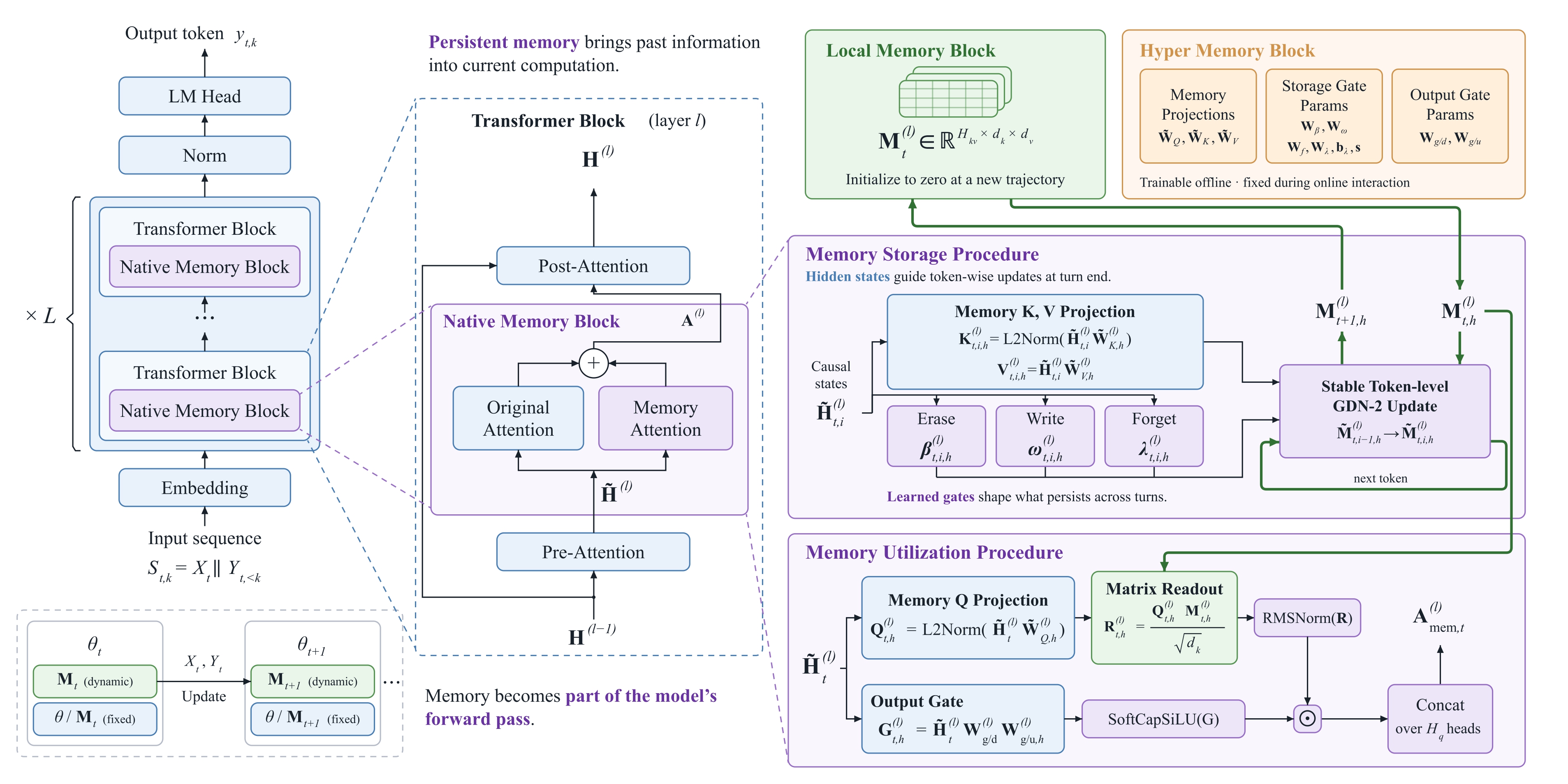
A Native Memory Block runs alongside the backbone attention and contains two components:
The Local Memory Block maintains a dynamic, multi-channel memory matrix and evolves across interaction steps.
The Hyper Memory Block contains trainable memory query, key, and value projections, erase, write, and forget gates, as well as an output gate.
During generation, memory attention reads from the current memory state, normalizes and gates the readout, and adds it to the backbone attention output. At the end of each turn or segment, stable GDN-2 performs token-level memory updates for subsequent steps.
Evaluation Results
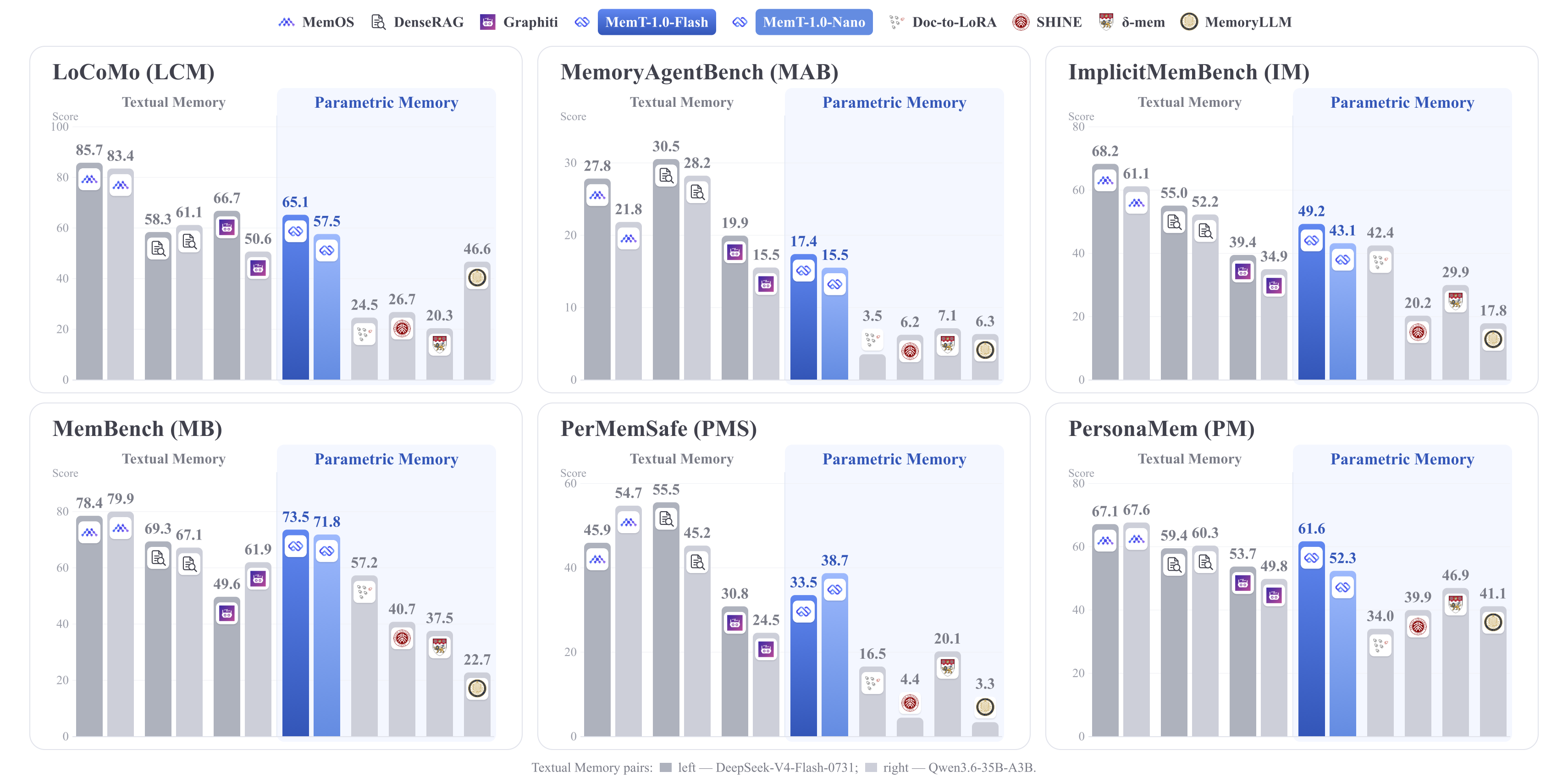
Across 11 memory benchmarks, MemT-1.0-Flash and MemT-1.0-Nano rank first and second among the evaluated parametric-memory methods, respectively. Strong textual-memory systems remain ahead overall, particularly on long histories that require detailed evidence retrieval.
Experience-Guided Agentic Coding
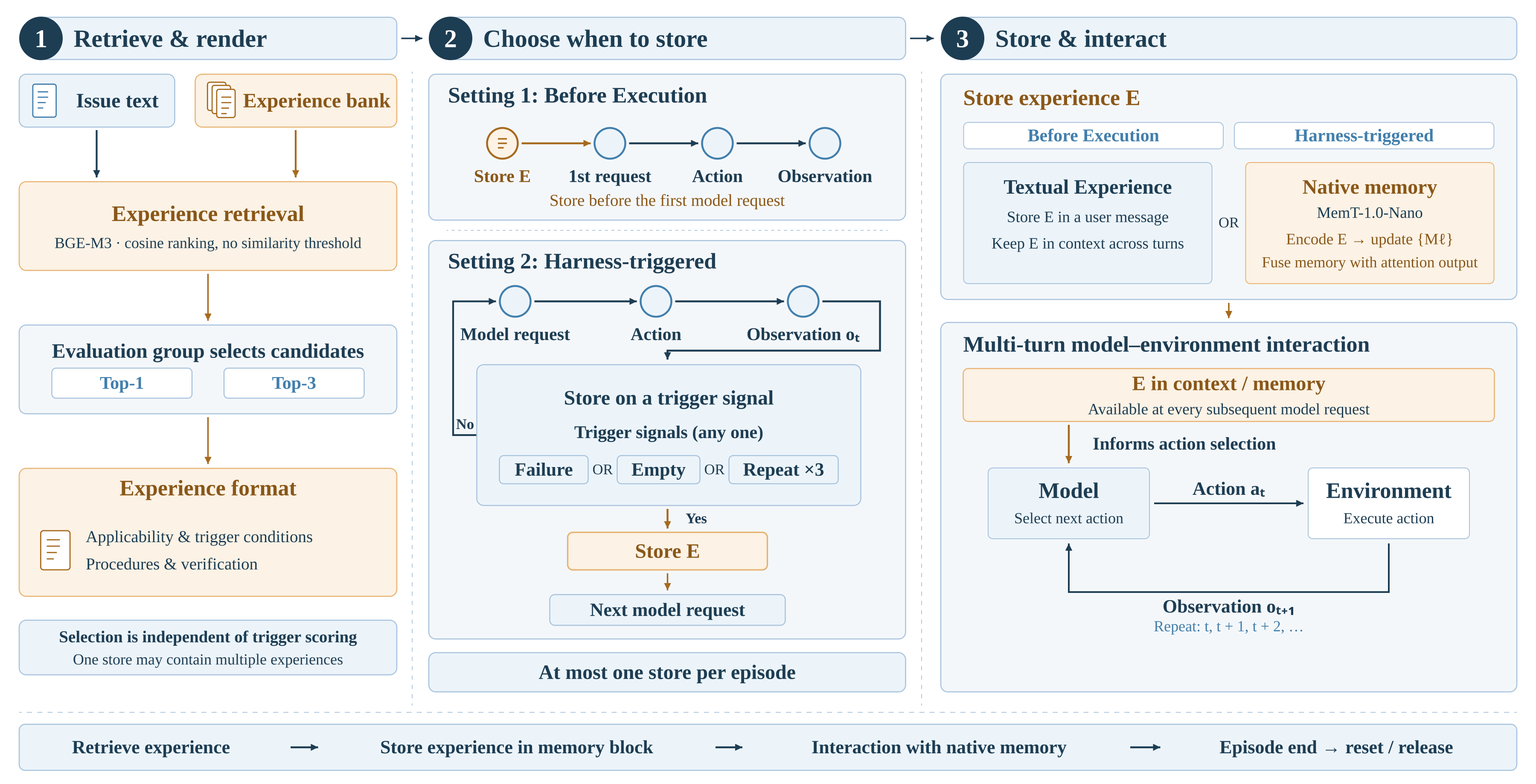
MemT-1.0 introduces an agentic framework for reusing procedural experience in long-horizon coding tasks. Retrieved experience is stored in native memory and accessed through memory attention during execution, improving task performance without adding experience text to the task context.
Quick Start
The examples below serve MemT-1.0-Nano with SGLang and use the memt_sglang Python client for conversations with native memory. For deployment details and MemT-1.0-Flash setup, see the inference guide in English or 简体中文.
Installation
On a Linux server with NVIDIA CUDA and Python 3.11 or newer, install from the repository's inference directory:
cd inference
uv pip install '.[server]'
If the Python client runs in a separate environment, install the client extra from the same directory in that environment:
uv pip install '.[client]'
Start the Server
Use a complete local MemT-1.0-Nano checkpoint with matching BF16 weights, configuration and tokenizer assets:
sh start_memt_nano.sh /models/MemT-1.0-Nano
This example uses two GPUs and serves at http://127.0.0.1:30000, with memory snapshots stored in ./memt-state on the server. Keep the server running and run the Python examples below in another terminal. For Flash, use start_memt_flash.sh and the Flash client setup described in the inference guide.
Connect the Client
Use local tokenizer assets matching the served checkpoint. The client loads the tokenizer; model inference runs on the SGLang server.
import os
from transformers import AutoTokenizer
from memt_sglang.client import MemTSession, NativeClient, load_chat_format

model_path = "/models/MemT-1.0-Nano"
tokenizer = AutoTokenizer.from_pretrained(
    model_path,
    local_files_only=True,
    trust_remote_code=False,
)
# chat_format builds inputs; parser extracts reasoning and tool calls.
chat_format, parser = load_chat_format(
    model_path,
    tokenizer=tokenizer,
    chat_template_kwargs={"enable_thinking": False},
)
client = NativeClient(
    "http://127.0.0.1:30000",
    api_key=os.environ.get("MEMT_API_KEY"),
)
A Conversation with Memory
Memory reading is enabled by default, so committed memory is used automatically. Set enable_memory=True to save unsaved past and current turns to latent local memory after the reply completes, then clear their plaintext conversation context. This also works on the first turn. Tool chains are saved after the final answer; truncated replies remain available for a later commit or save. chat() returns answer text by default. Use return_dict=True for a structured result. Responses shown below are illustrative.
session = MemTSession(client, chat_format, parser)

answer = session.chat(
    "I have a three-month-old kitten named memmy who loves eating "
    "small shrimp and is excellent at remembering things."
)
print(answer)
# Memmy is three months old, loves small shrimp, and has an excellent memory.

# After replying, save the kitten-description and current game Q&As to latent
# local memory and clear their plaintext conversation context.
answer = session.chat(
    "What is a simple game I can play with my kitten?",
    enable_memory=True,
)
print(answer)
# Try gently moving a wand toy for your kitten to chase.

# Answer using the latent local memory of the kitten-description Q&A.
answer = session.chat(
    "What are my kitten's name, age, favorite food, and special trait?",
    enable_memory=True,
)
print(answer)
# Based on the information you provided earlier:
#
# *   **Name:** Memmy
# *   **Age:** Three months old
# *   **Favorite Food:** Small shrimp
# *   **Special Trait:** An excellent memory
Save and Resume
save_state(path) commits remaining turns before saving. The returned path identifies the snapshot in the server's configured state directory; pass it as state when restoring a session.
# Save local memory, including any unsaved conversation turns.
snapshot = session.save_state("memmy_memory.safetensors")
session.close()

# Restore memory without the previous conversation transcript.
with MemTSession(client, chat_format, parser, state=snapshot["path"]) as restored:
    print(len(restored.messages))
    # 0

    answer = restored.chat("How old is my kitten?")
    print(answer)
    # Your kitten is **3 months old**.
Standard Chat
Create a fresh session without a snapshot and disable memory reading. Keep automatic history writes off with enable_memory=False; previous turns remain in the conversation transcript.
with MemTSession(client, chat_format, parser) as chat:
    chat.set_memory_read(False)
    answer = chat.chat(
        "Type 'I love MemT' exactly.",
        enable_memory=False,
    )
    print(answer)
    # I love MemT
Citation
For the MemT-1.0 technical report:
@misc{memtensor2026memt1,
  title         = {MemT-1.0: Towards Memory-Native Evolution},
  author        = {{MemTensor Team}},
  year          = {2026},
  eprint        = {2610.26825},
  archivePrefix = {arXiv},
  primaryClass  = {cs.CL},
  url           = {https://arxiv.org/abs/2610.26825}
}
⚖️ License
This project uses separate licenses for the paper and the repository software:
Bundled third-party components retain their own licenses. The SGLang integration includes flash-linear-attention code under MIT; see the component license table.
Commercial use of the repository software is not permitted under the PolyForm Noncommercial License. For commercial licensing inquiries, please contact the authors.
Unless explicitly stated otherwise, model weights, datasets, benchmark assets, trademarks, and third-party materials are not covered by the licenses above. Their applicable terms will be provided with the corresponding releases.
Research correspondence: [email protected].




 MemT-1.0 是新一代记忆基础模型,它将持久且动态演化的记忆内化为模型计算的一部分,使模型能够保留并复用历史信息,而无需在推理时重新读取原始上下文。