



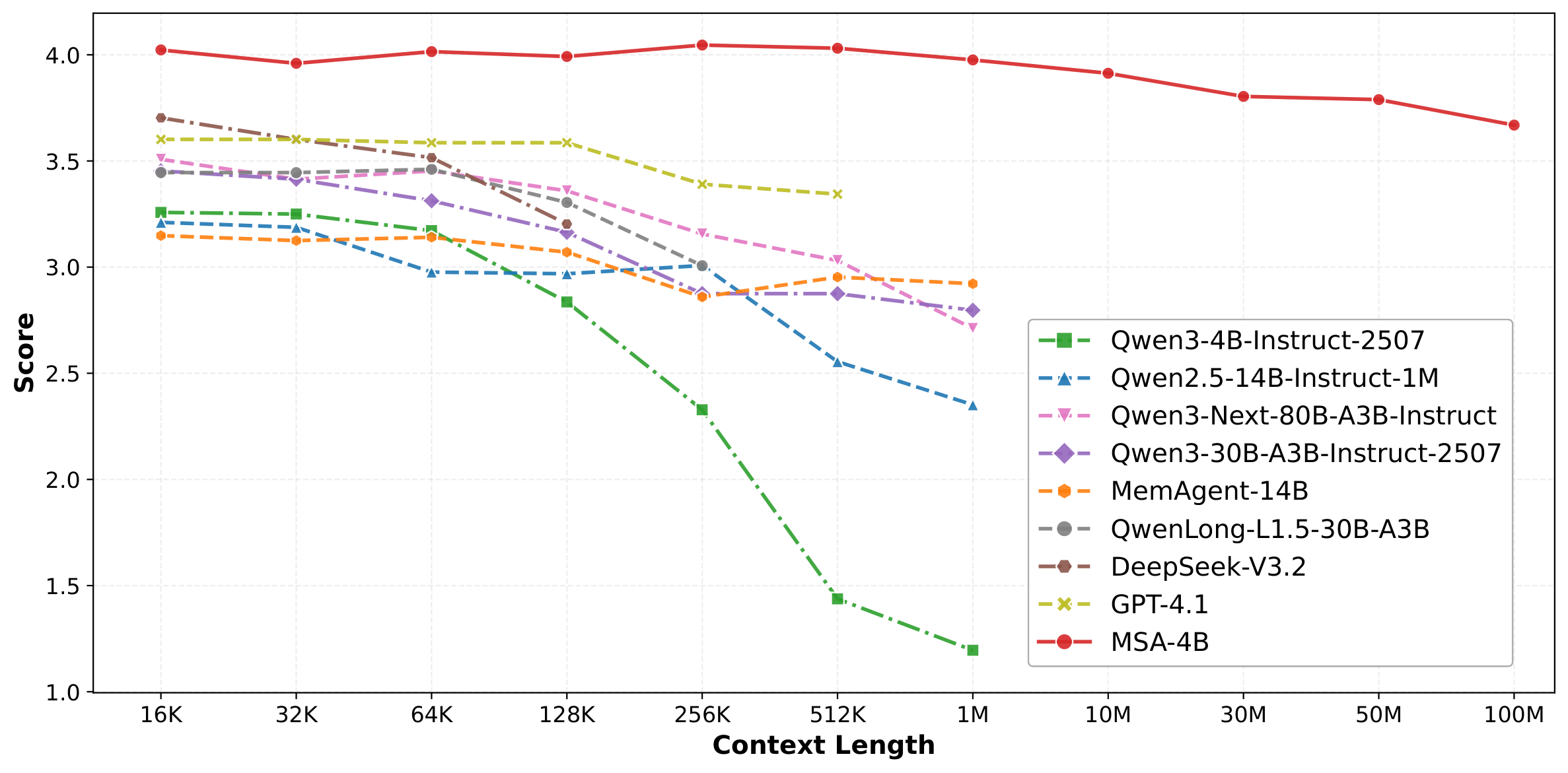
 Figure 1: MSA scalability under extreme-long contexts
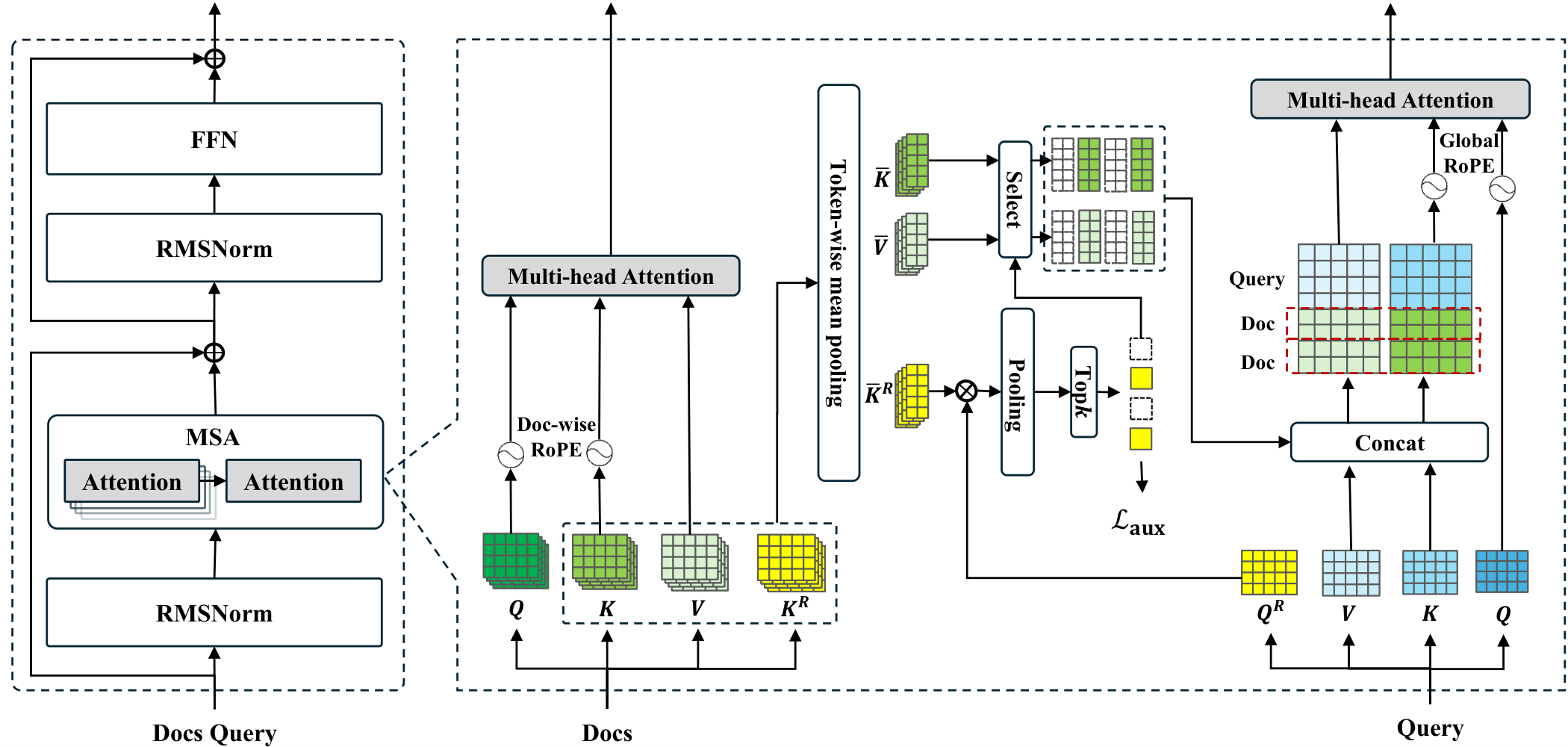 Figure 2: Memory-Sparse Attention layer and parallel/global RoPE
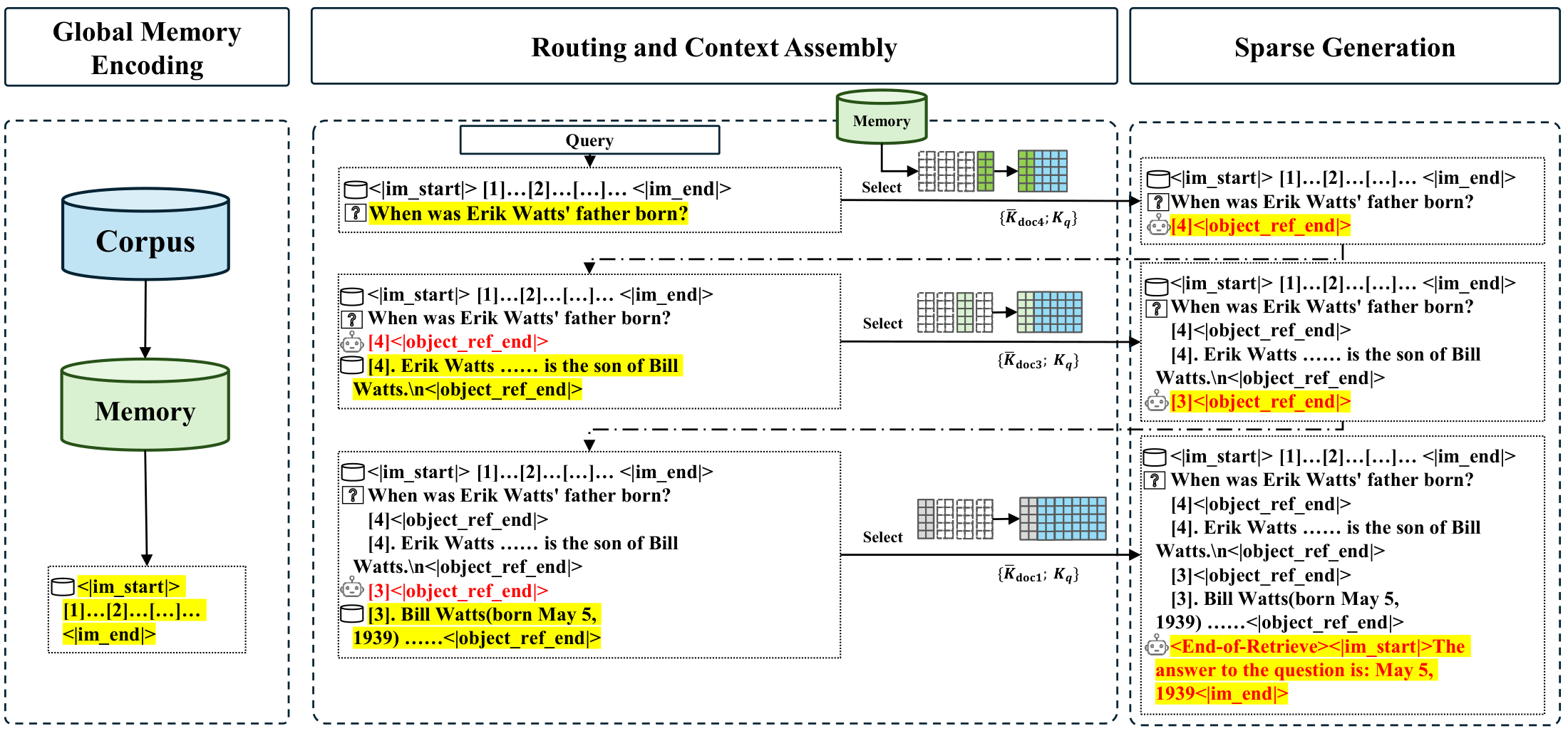 Figure 3: Offline encoding → online routing → sparse generation; optional multi-round interleave for multi-hop
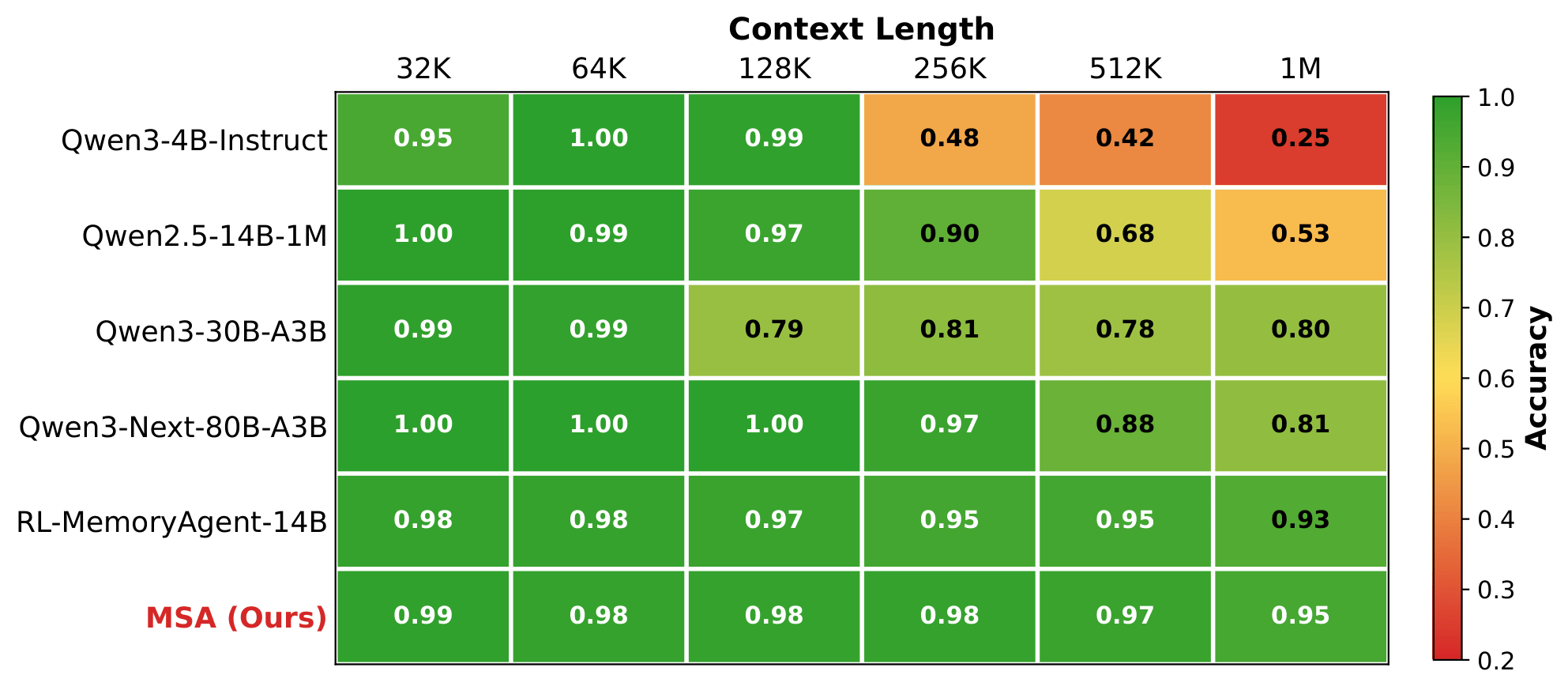 Figure 4: Accuracy vs context length (higher is better)
What is this?
 MSA (Memory Sparse Attention) is an end-to-end trainable, scalable latent-memory framework that lets LLMs handle context windows up to 100M tokens, replacing RAG or fixed-size RNN-style memory with a differentiable sparse-attention memory bank.
MSA (Memory Sparse Attention) is an end-to-end trainable, scalable latent-memory framework that lets LLMs handle context windows up to 100M tokens, replacing RAG or fixed-size RNN-style memory with a differentiable sparse-attention memory bank.Is this a ready-made chatbot or a research framework for training long-context models?It is a research/training framework built on a Qwen3-4B backbone: you continuously pretrain the model with MSA's attention layer and a custom Memory Parallel inference engine, not a drop-in chat app.
It is a research/training framework built on a Qwen3-4B backbone: you continuously pretrain the model with MSA's attention layer and a custom Memory Parallel inference engine, not a drop-in chat app.How do I get it running?Follow the quick start: install the package, download the pretrained model, then download the benchmark data, and run the provided scripts; benchmark data is auto-fetched from EverMind-AI/MSA-RAG-BENCHMARKS into data/ on first run (see QUICKSTART.md for full details).
Follow the quick start: install the package, download the pretrained model, then download the benchmark data, and run the provided scripts; benchmark data is auto-fetched from EverMind-AI/MSA-RAG-BENCHMARKS into data/ on first run (see QUICKSTART.md for full details).Do I need specific GPU hardware to run this?Yes — the reference setup uses 2×A800 GPUs to hit 100M-token throughput via the Memory Parallel inference engine; it's a Python codebase so you also need a Python environment.
Yes — the reference setup uses 2×A800 GPUs to hit 100M-token throughput via the Memory Parallel inference engine; it's a Python codebase so you also need a Python environment.Does performance hold up at very long context lengths?Yes, MSA keeps 94.84% accuracy at 1M tokens on the RULER NIAH benchmark, while the unmodified backbone collapses to 24.69% past 128K, and it decays less steeply than hybrid linear-attention or external-memory agent baselines.
Yes, MSA keeps 94.84% accuracy at 1M tokens on the RULER NIAH benchmark, while the unmodified backbone collapses to 24.69% past 128K, and it decays less steeply than hybrid linear-attention or external-memory agent baselines.Who is this built for?It's aimed at ML/NLP researchers working on long-context language models and memory-augmented architectures — it's a research codebase accompanying the arXiv/Zenodo paper, not an end-user product.
It's aimed at ML/NLP researchers working on long-context language models and memory-augmented architectures — it's a research codebase accompanying the arXiv/Zenodo paper, not an end-user product.How does MSA compare to standard RAG pipelines?On 9 QA benchmarks MSA averages 3.760 versus 3.372 for the best RAG-with-reranking setup and 3.275 for HippoRAG2 on the same backbone, a roughly 11-16% improvement, and it also beats best-of-breed RAG stacks built on much larger 70B-235B generator models on 4 of 9 datasets.
On 9 QA benchmarks MSA averages 3.760 versus 3.372 for the best RAG-with-reranking setup and 3.275 for HippoRAG2 on the same backbone, a roughly 11-16% improvement, and it also beats best-of-breed RAG stacks built on much larger 70B-235B generator models on 4 of 9 datasets.What is Memory Interleave?It's the mechanism that lets MSA perform multi-round, multi-hop reasoning by jumping across scattered memory segments instead of reading context linearly; ablations show removing it causes large accuracy drops on multi-hop QA datasets.
It's the mechanism that lets MSA perform multi-round, multi-hop reasoning by jumping across scattered memory segments instead of reading context linearly; ablations show removing it causes large accuracy drops on multi-hop QA datasets.How was the model trained?MSA was continuously pretrained on 158.95 billion tokens with an auxiliary routing loss, then went through a two-stage supervised fine-tuning curriculum that scales context from 8K to 64K tokens.
MSA was continuously pretrained on 158.95 billion tokens with an auxiliary routing loss, then went through a two-stage supervised fine-tuning curriculum that scales context from 8K to 64K tokens.What are similar projects?Attention-Residuals, context-language-models, gpt-3, bdh, jeeves, LLMSearchRecommender, Hy4-preview, train-llm-from-scratch
Attention-Residuals, context-language-models, gpt-3, bdh, jeeves, LLMSearchRecommender, Hy4-preview, train-llm-from-scratchWhich topics is it in?context-window, kv-cache, pretraining, long-context, question-answering, attention, arxiv, long-term-memory, reasoning, attention-mechanism, retrieval-augmented-generation, paper
context-window, kv-cache, pretraining, long-context, question-answering, attention, arxiv, long-term-memory, reasoning, attention-mechanism, retrieval-augmented-generation, paper