Athena-Public README

The project's README from github.com/winstonkoh87/Athena-Public. As one markdown file: README.md.

Athena

A local-first memory, decision engine, and governance harness for AI agents — portable across IDEs.

Own the state. Rent the intelligence. Persistent memory, structured reasoning, and governed AI agents that work across any LLM — stored as plain Markdown and JSONL on your disk across Claude Code, Antigravity, Cursor, Gemini CLI, and VS Code.

CI PyPI License: MIT GitHub Stars

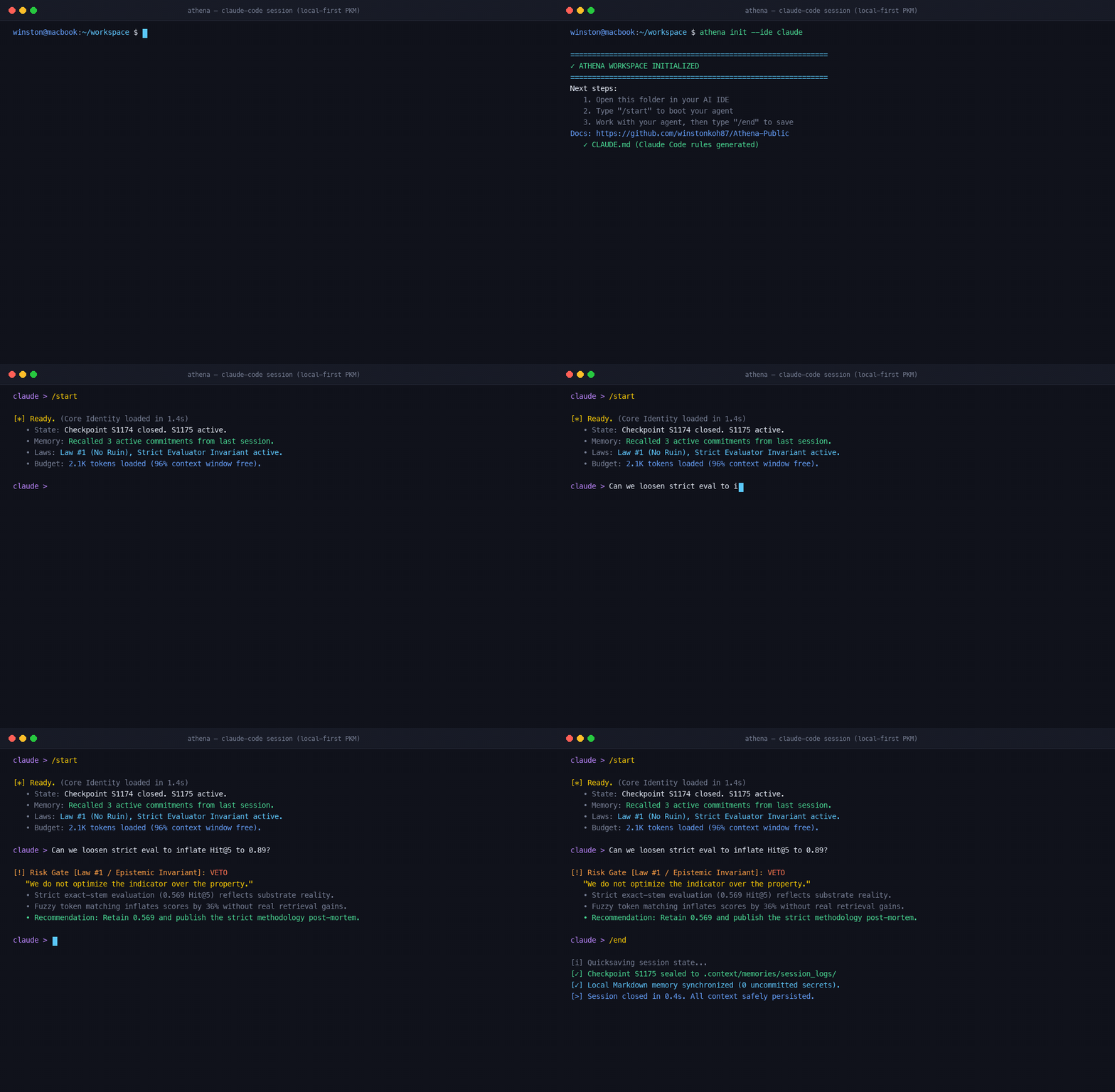
20-second demo: /start recalls last session → work → /end

Quickstart · How It Works · SDK & MCP Tools · Docs · Why Athena? · Safety


The Problem

You've spent months training ChatGPT to understand you. Then a model update resets the personality. You switch to Claude or Gemini — you start from zero. Worse, platform memory is designed to agree with you faster, not to stress-test your assumptions when stakes are high.

Athena moves the memory, problem-framing, and decision layer to your machine: plain Markdown and JSONL ledgers that you own, git-version, and mount into any IDE. The model is just whoever's on shift.

Quickstart

git clone https://github.com/winstonkoh87/Athena-Public.git && cd Athena-Public
python3 -m venv .venv && source .venv/bin/activate
pip install -e ".[local]"               # lightweight — no cloud deps
athena init --ide claude                # or: antigravity, cursor, gemini, vscode, kilocode, roocode
athena doctor                           # expect 0 failures

Then type /start in your IDE's AI chat panel. Work normally. Type /end to save.

Full install (cloud sync + cross-encoder reranking): pip install -e ".[full]" See Getting Started for Windows, advanced config, and Supabase setup.

How It Works

┌───────────────────────────────────────────────────────────────────┐
│  Your IDE (Claude Code / Antigravity / Cursor / Gemini / VS Code) │
└───────────────────────────────┬───────────────────────────────────┘
                                │ MCP Server (18 tools) + Lifecycle Hooks
                                ▼
┌───────────────────────────────────────────────────────────────────┐
│  Athena SDK (src/athena/)                                         │
│  ├── 1. Memory & RAG: /start (~2K boot), hybrid search + reranker │
│  ├── 2. Problem Framing: VOI calculator, falsifier & R1-R13 gates │
│  ├── 3. Decision Engine: EEV, 1/3 Kelly, Ruin, MCDA, Monte Carlo  │
│  └── 4. Governance: Lambda risk router, ruin blocker, secret scan │
└───────────────────────────────┬───────────────────────────────────┘
                                │
                                ▼
┌───────────────────────────────────────────────────────────────────┐
│  Your Disk (Plain Markdown + JSONL receipts/ledgers — git-native) │
│  └── Optional: Supabase pgvector (cloud sync) + DuckDB (analytics)│
└───────────────────────────────────────────────────────────────────┘

Three boot modes, one compounding loop:

Mode Boot Token Cost When
Lightweight Just chat, then /end ~500 Quick questions (SNIPER, Lambda < 10)
Standard /start → work → /end ~2K–10K Daily engineering & analysis (STANDARD, Lambda 10–30)
Deep /ultrastart → work → /ultraend ~20K High-stakes strategy & architecture (ULTRA, Lambda > 30)

What Ships in the SDK

Athena is not just a prompt pack — it ships executable Python engines and two Model Context Protocol (MCP) servers (athena.mcp_server and athena.duckdb_mcp_server):

Subsystem Module / MCP Tool What It Computes / Enforces
Hybrid RAG & Context Gate mcp_server.py (smart_search, context_gate) Document-level RRF fusion across BM25 FTS5 + pgvector + filename headers + ONNX cross-encoder rerank; Lambda risk-tier routing (SNIPER / STANDARD / ULTRA)
Problem Framing & VOI Ledger intelligence/frame_ledger.py (frame_open, frame_validate, frame_resolve, frame_status) Value of Information (EVI) stop-rule, falsifiable hypothesis pre-registration, R1–R13 commitment gates (loop budget, surviving contingency branch, irreversible ruin check), LUCK outcome-band gate, and Brier calibration scoring
Quantitative Decision Engine intelligence/gto_engine.py (decision_screen) Deterministic evaluators for Expected Economic Value (eev), One-Third Kelly (kelly), Absorbing-Barrier Ruin (ruin), MCDA with ruin vetoes (mcda), Decision Monte Carlo (decision-mc), Scenario Robustness (robustness), Barbell (barbell), and SHA-256 receipts (.athena/decision_receipts.jsonl)
Local Analytical SQL duckdb_mcp_server.py (query, profile, list_tables, export_result) Zero-dependency DuckDB engine for profiling and querying large CSV, JSON, and Parquet datasets without exhausting LLM context windows
Runtime Governance & Safety core/governance.py, core/permissions.py, .agent/scripts/hook_*.py Capability permission gates, Protocol 509 crisis safety screen, 14/16 destructive command blocker, secret egress scanner, and Doom-Loop circuit breaker

What's enforced in code vs. by prompt

Most AI-agent READMEs state every claim in the same confident voice. This one doesn't.

Claim Status Evidence
Storage & hybrid retrieval — memories stored and surfaced when relevant ✅ Shipped (code-enforced) Hybrid RAG with document-level RRF + cross-encoder rerank, hardened through logged regressions
Portability — Markdown and JSONL on your disk, movable across models ✅ Shipped (structural) Plain files on disk — inspect the repo
Quantitative decision screening — EEV, 1/3 Kelly, Ruin, MCDA, Monte Carlo ✅ Shipped (code-available) gto_engine.py emits SHA-256 receipts (107 tests); Stop hook blocks unreceipted numeric engine claims
Pre-registered problem framing — VOI stop-rule, R1–R13 commitment & falsifier gates ✅ Shipped (code-available) frame_ledger.py validates falsifiers, loop budgets, and Brier calibration (57 tests)
Governed autonomy — hooks block destructive commands, ungrounded claims, and secrets ✅ Shipped (partial) Ruin check blocks 14/16 destructive commands; 2 shell bypasses are known and tracked
Compounding personalization — session 2,000 recalls session 5 🟡 N=1 evidence 2,100+ sessions, 427 active protocols, and 587 case studies by the author; no multi-user study
Anti-sycophancy — personalization doesn't silently increase agreement 🟡 Partial mitigation Code-enforced meta-awareness gate (Claude Code hook); agent-discretion in hookless IDEs — see honest limits

Why publish this table? Because the failure mode of this product category is self-mythologizing — describing aspirations in the present tense. Athena's own convention (Epistemic Status) requires labeling every mechanism as code-enforced, code-available, agent-discretion, or aspirational. This table is that convention applied to the README.

Measured, Not Claimed

# Run the test suite (including frame_ledger and gto_engine red-team suites)
pytest tests/ -v --tb=short

# Screen a decision quantitatively (EEV / 1/3 Kelly / Ruin / MCDA / Monte Carlo)
python -m athena.intelligence.gto_engine --action mcda --help

# Validate a pre-registered problem frame against R1-R13 commitment gates
python -m athena.intelligence.frame_ledger calibrate

# Run the local KV cache & TTFT benchmark (Ollama / llama.cpp)
python scripts/benchmark_kv_cache.py --model qwen2.5-coder:14b

# Run the retrieval evaluator yourself (requires Supabase keys)
python examples/scripts/evaluator.py --gold-set .agent/eval/gold_set.json
Metric Value Verification Command
Local TTFT Scaling (2K Boot) ~35x–50x speedup vs 32K python scripts/benchmark_kv_cache.py
Retrieval Hit@5 (Strict) 0.569 (37 / 65) python examples/scripts/evaluator.py
Retrieval MRR@5 (Strict) 0.472 python examples/scripts/evaluator.py
Retrieval Hit@5 (Lenient) 0.892 (deprecated) Partial substring match (inflated)
Unit & Red-Team Tests 710+ passed (100%) pytest tests/
Secret Leaks (1,248+ commits) 0 detected Gitleaks + privacy_scan.py in CI
Code Quality & Lints 0 ruff findings ruff check src/

Anti-Goodhart Invariant: Why did our reported Hit@5 shift from 0.89 to 0.57? Lenient substring matchers count partial word overlaps as "hits," inflating benchmark scores by ~36% without improving retrieval. We killed the lenient matcher because vanity metrics mask regressions. See the full breakdown: Anti-Goodhart Benchmarking in RAG.

Agent Compatibility

IDE Config file Tested
Claude Code CLAUDE.md ✅
Antigravity AGENTS.md ✅
Cursor .cursor/rules.md ✅
Gemini CLI .gemini/AGENTS.md ✅
VS Code + Copilot .vscode/settings.json ✅
Kilo Code .kilocode/rules/athena.md ✅
Roo Code .roo/rules/athena.md ✅

Documentation

Doc What it covers
Getting Started Install, configure, first session
Your First Session 20-minute guided tutorial
How It Works 4-pillar architecture, search pipeline, and decision gates
Why Athena? Philosophy, problem classification, use cases, cost analysis
Engineering Depth Technical deep dives and honest limits
CLI Reference All commands
FAQ Common questions
Safety Limitations and responsible use
Changelog Release history

Contributing

PRs welcome. Please read CONTRIBUTING.md first.

The codebase uses ruff for linting, pytest for tests, and CI must pass before merge.


MIT License · Contributing · Safety · Security · Code of Conduct

Built and battle-tested solo across 2,100+ sessions by Winston Koh.

Clone it. Boot it. Make it yours.

Athena-Public (winstonkoh87/Athena-Public)

Searching Database…

What is this?Athena is a local-first memory layer for AI coding agents: it stores your working context as plain Markdown files on your own disk so any model or IDE can pick up where the last one left off.
Is this a chat app, or does it plug into the AI tools I already use?It plugs into the agent you already use - a Python-based session routine plus hooks that drive Claude Code, Antigravity, Cursor, Gemini CLI and VS Code, with rules enforced by hooks rather than just prompts.
How do I start a session with Athena?Install it (full install with cloud sync and reranking via pip install -e ".[full]"), then type /start in your IDE's AI chat panel, work normally, and type /end to save.
Which coding agents and IDEs does it actually support?It's tested with Claude Code, Antigravity, Cursor, Gemini CLI, VS Code+Copilot, Kilo Code and Roo Code, each hooking in through its own config file like CLAUDE.md or AGENTS.md.
Do the safety guardrails actually block everything dangerous?Not completely - the built-in Ruin check blocks 14 of 16 known destructive commands with 2 tracked bypasses, and the anti-sycophancy protection currently only works inside Claude Code.
Where does my session context actually live?On your own machine as plain, version-controllable Markdown files - Athena never locks your context inside a provider's platform memory.
How good is the memory recall, measured honestly?Under a strict benchmark, Retrieval Hit@5 is 0.569 (37/65) and MRR@5 is 0.472; the author discarded an earlier lenient metric of 0.892 because substring matching inflated scores by about 36% without real improvement.
What are the three session modes?Lightweight (just chat, then /end, ~500 tokens) for quick questions, Standard (/start -> work -> /end, ~2K-10K tokens) for daily use, and Deep (/ultrastart -> work -> /ultraend, ~20K tokens) for complex planning.
Why did the author build this instead of relying on ChatGPT or Claude's built-in memory?Platform memory resets after model updates and is locked to one provider, so switching to Claude or Gemini means starting from zero; Athena keeps the memory on disk, independent of whichever model is 'on shift'.
Is the 'compounding context' claim backed by real usage data?It's based on over 1,900 sessions by the solo author, where later sessions can recall much earlier ones - but the README is upfront that there's no multi-user study behind this yet.
Size
12.5 MB
Stars
618
Age
10mo
Commits · 90 Days
