Jeff
Fine-tunes of Qwen3.5 and Gemma 4 for zero-shot classification: small, fast decision models you slot into your
code, with the same request format as Jev. You describe a situation and list the options in plain words; Jeff returns a
calibrated probability for each option from a single forward pass. No generated text, no parsing: about 22 ms per
decision on an RTX PRO 6000 and 28 ms on an Apple M4 Max (MLX).
Zero-shot means the options can be anything: support queues, user intents, moderation labels, voice commands, game
moves. Your categories don't need to appear in the training data; you describe them, and Jeff picks.
What it is, and what it isn't. These are very small models. They make extremely fast, well-calibrated judgement
calls between options, and they slot easily into your local code. On benchmarks they approach, and sometimes beat, Jev;
but at this size their reasoning won't match Jev's, which runs on a much larger model. If zero-shot accuracy isn't
good enough for your purposes, a short fine-tune on your own examples takes you much further: our
voice-navigation fine-tune moved held-out accuracy from 31.7% to 95.8% in under half an hour on one GPU.
Built entirely on local hardware. Training on one RTX PRO 6000 workstation GPU (the 0.8B trains in about 2 hours,
the 2B in about 3.5), all synthetic training data written by an open model (Qwen3.8-Flash-Next) on two DGX Sparks,
testing on a MacBook. No cloud GPUs, and no closed-model output in the training data; a closed model was used only to
spot-check the quality of a sample of the synthetic data.
Independent project. Jeff uses the same request format as Jev, but it is not affiliated with or endorsed by TypeSafe, the
makers of Jev. Our training code starts from the open-source AutoJev recipe.
Models on Hugging Face: Jeff-Qwen3.5-0.8B · Jeff-Qwen3.5-2B · Jeff-Gemma4-E2B
Quick start
uv sync
uv run hf download mstrasser/Jeff-Qwen3.5-0.8B --local-dir checkpoints/jeff-0.8b

# NVIDIA GPU or CPU (PyTorch)
JEFF_CHECKPOINT=checkpoints/jeff-0.8b PORT=8765 uv run jeff-serve
# Apple silicon (MLX, much faster on a Mac; Qwen models only)
uv sync --extra mac
JEFF_BACKEND=mlx JEFF_CHECKPOINT=checkpoints/jeff-0.8b PORT=8765 uv run jeff-serve
curl -s localhost:8765/v1/systemone -H 'content-type: application/json' -d '{
  "model": "jeff-latest",
  "state": "Refund request: the customer says the parcel arrived crushed and wants their money back.",
  "questions": {
    "route": {"type": "choice", "instructions": "Which team should handle this?",
              "criteria": {"1": "Refunds and payments", "2": "Damaged or lost parcels", "3": "Account and login problems"}},
    "angry": {"type": "noul", "instructions": "Is the customer angry?"}
  }
}'
Each answer has a probability per option, the chosen option and a confidence. Three question types: choice (pick one
of up to 255 options), noul (yes/no, returned as a probability) and score (a point on a scale you describe).
Several independent questions in one request are answered together.
Benchmarks
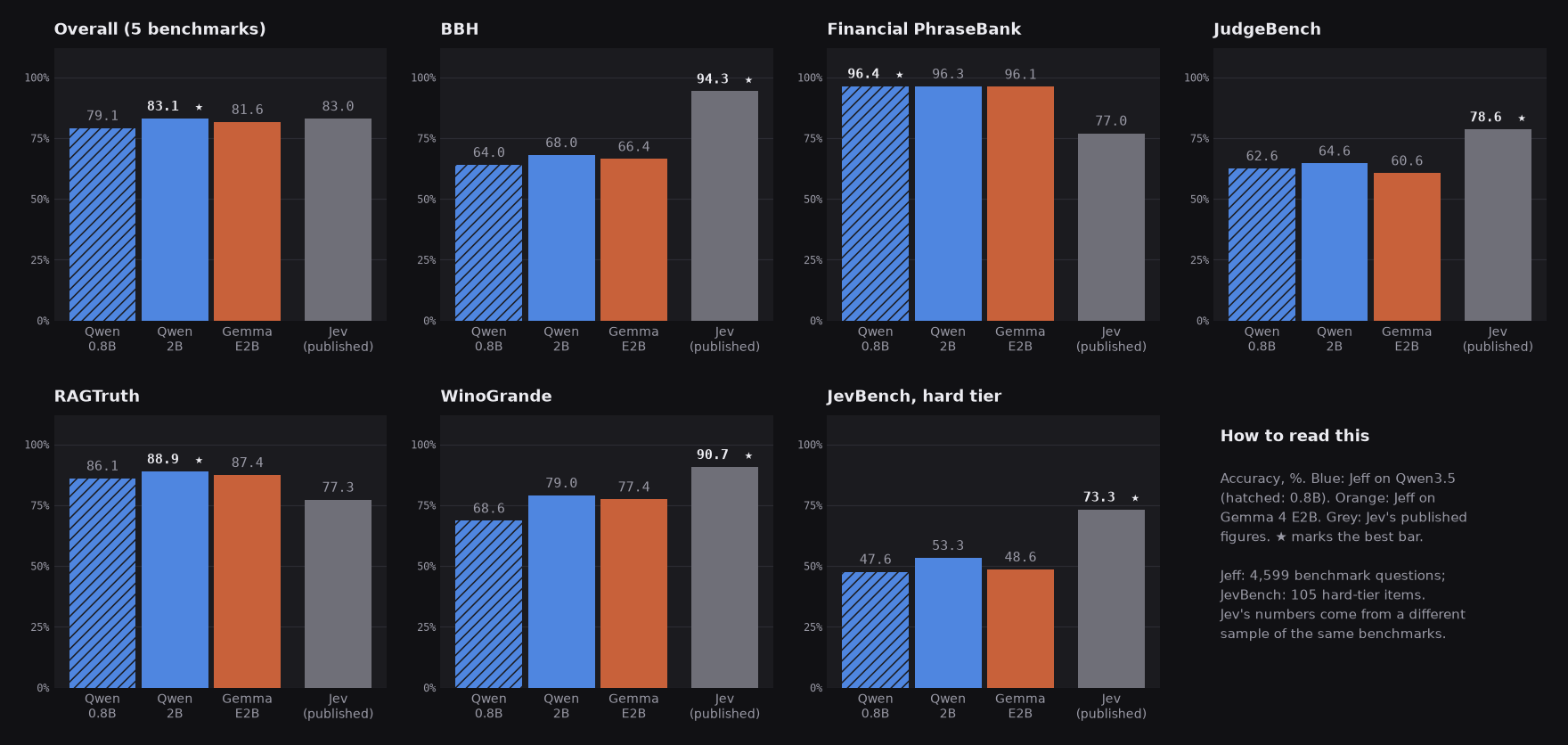
4,599 questions from five public benchmarks, plus JevBench's public hard tier (105 items, scored separately):
| Benchmark |
Qwen3.5-0.8B untrained |
Jeff-Qwen3.5-0.8B |
Qwen3.5-2B untrained |
Jeff-Qwen3.5-2B |
Gemma 4 E2B untrained |
Jeff-Gemma4-E2B |
Jev (published) |
AutoJev-27B (published) |
| Overall (5 benchmarks) |
45.3 |
79.1 |
46.5 |
83.1 |
62.5 |
81.6 |
83.0 |
84.9 |
| BBH |
39.5 |
64.0 |
46.0 |
68.0 |
51.3 |
66.4 |
94.3 |
82.8 |
| Financial PhraseBank |
36.0 |
96.4 |
53.4 |
96.3 |
86.0 |
96.1 |
77.0 |
84.2 |
| JudgeBench |
56.6 |
62.6 |
57.4 |
64.6 |
46.9 |
60.6 |
78.6 |
78.9 |
| RAGTruth |
49.1 |
86.1 |
35.9 |
88.9 |
63.8 |
87.4 |
77.3 |
88.9 |
| WinoGrande |
49.2 |
68.6 |
52.2 |
79.0 |
51.0 |
77.4 |
90.7 |
83.3 |
| JevBench hard (separate) |
36.2 |
47.6 |
45.7 |
53.3 |
41.0 |
48.6 |
73.3 |
70.3 |
Bold: the winner of Jeff against Jev in each row. Bold italic: AutoJev-27B where it is the best of all models
in the row (on RAGTruth, tied with Jeff-Qwen3.5-2B); it is shown for reference, since the head-to-head comparison is
with Jev. The published Jev and AutoJev figures were measured on a different sample of the same benchmarks. Jeff's
overall score comes from classification and grounding, where it matches or beats the large models; on the
reasoning-heavy benchmarks (BBH, JudgeBench, JevBench) it stays well below them, as you would expect at this size.
Games: a zero-shot test
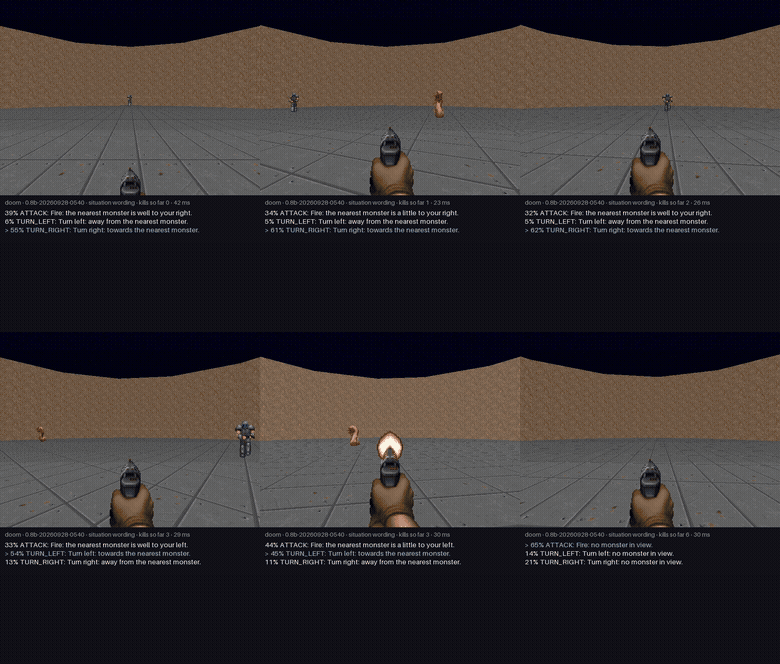
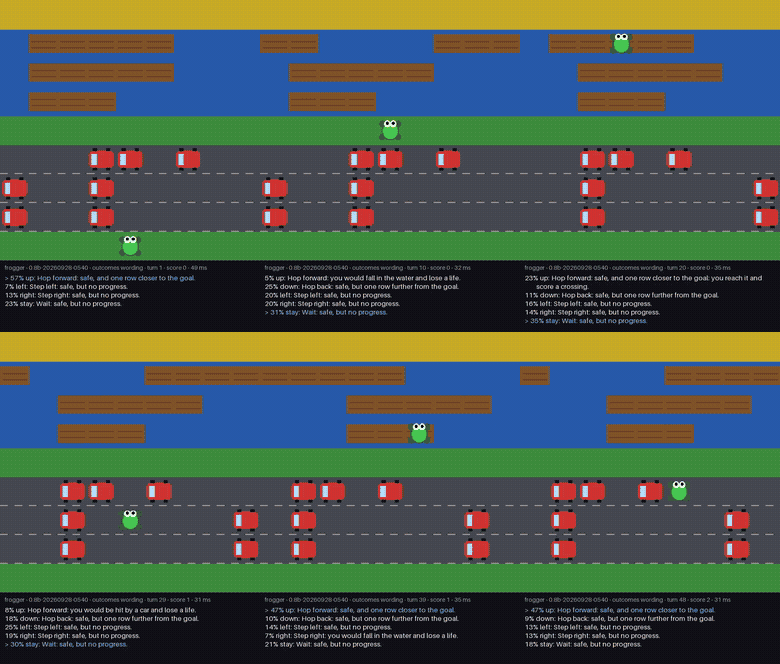
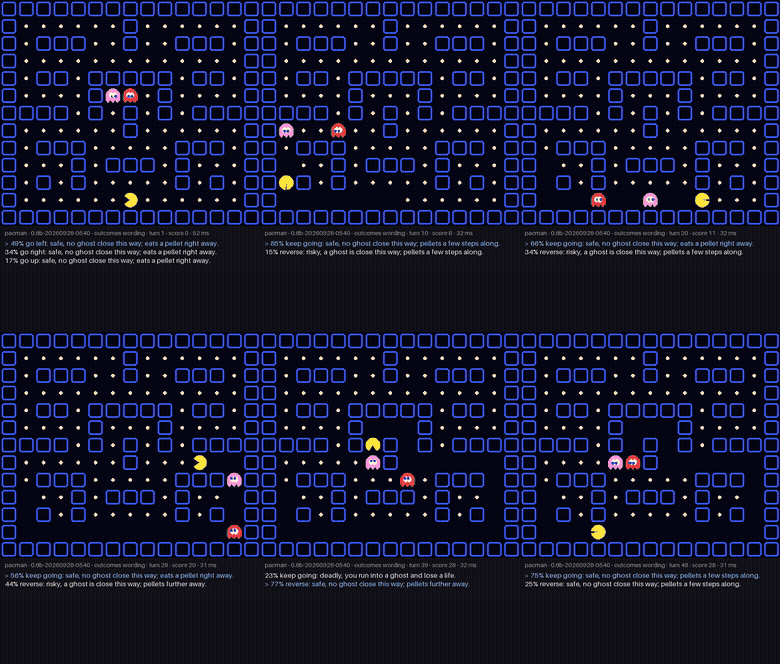
To test zero-shot performance on tasks unlike anything in the benchmarks, we had Jeff play three games. Games aren't
the ideal zero-shot test, since a game's state isn't typical unstructured data; but they are a common, and fun, way to
test a System 1 model. Each turn, the code describes the situation and the legal moves in words, and the model picks
one. The options state what each move leads to (Frogger: "you would be hit by a car and lose a life"; Doom: "the
nearest monster is a little to your left"), but never which move is right. Each result is 20 episodes, seed 1234; ▶
opens a video of the run's first episode.
Jeff-Qwen3.5-0.8B playing, zero-shot (the bold row in the table below; click a clip for the full video):
| Model |
Doom, kills (monster's direction in words) |
|
Frogger, crossings (consequences) |
|
Pac-Man, pellets of 98 (consequences) |
|
| Random moves |
−0.05 |
|
0 |
|
11.2 |
|
| Hand-coded rule bot |
6.55 |
▶ |
10.25 |
▶ |
94.1 |
▶ |
| Qwen3.5-0.8B, untrained |
5.0 |
▶ |
1.0 |
▶ |
25.8 |
▶ |
| Jeff-Qwen3.5-0.8B |
6.55 |
▶ |
10.3 |
▶ |
57.0 |
▶ |
| Qwen3.5-2B, untrained |
0.55 |
▶ |
0.05 |
▶ |
72.1 |
▶ |
| Jeff-Qwen3.5-2B |
−0.9 |
▶ |
6.0 |
▶ |
41.2 |
▶ |
| Gemma 4 E2B, untrained |
−0.55 |
▶ |
0 |
▶ |
3.2 |
▶ |
| Jeff-Gemma4-E2B |
0.55 |
▶ |
0.15 |
▶ |
53.2 |
▶ |
| Jev (published, Doom) |
6.55, told the aiming rule; −0.60 without it |
|
— |
|
— |
|
Jeff-0.8B decides in 29–49 ms per move on an M4 Max; Jev's published Doom run took 212 ms per call over its API. The
two times were not measured on the same hardware. To play them yourself:
uv sync --extra games
uv run python -m jeff.games --game doom --player jeff --criteria situation --url http://127.0.0.1:8765 --video --out runs/games/doom.json
uv run python -m jeff.games --game frogger --player jeff --criteria outcomes --url http://127.0.0.1:8765 --out runs/games/frogger.json
uv run python -m jeff.games --game pacman --player rule --out runs/games/pacman-rule.json
Speed and size
Median time per decision over the same 200 benchmark questions (about 200 input tokens each), one question at a time,
from raw text to probabilities:
| Model |
Parameters |
Weights (16-bit) |
NVIDIA RTX PRO 6000 |
Apple M4 Max (MLX) |
CPU (32 threads) |
| Jeff-Qwen3.5-0.8B |
0.8B |
1.7 GB |
22 ms |
28 ms |
463 ms |
| Jeff-Qwen3.5-2B |
2B |
4.2 GB |
24 ms |
60 ms |
708 ms |
| Jeff-Gemma4-E2B |
2B effective (4.6B stored) |
9.3 GB |
29 ms |
— (MLX runs Qwen only) |
1.0 s |
| AutoJev-27B |
27B |
~54 GB |
not published |
— |
— |
| Jev |
not disclosed |
API only |
114–212 ms per call in published Doom runs, including the network |
|
|
Using it well
- Reason in code, decide with Jeff. It's a classifier, not a planner. State what each option leads to ("this move
gets you hit by a car"); asked to forecast ("a car arrives in 2 turns"), it does no better than random.
- Wording matters enormously. Describe options consistently: giving Frogger's goal option the same words as every
other forward option took one episode from 15 crossings to 23.
- Use short option keys and descriptive text:
{"1": "Engagement letter"}, not long IDs, which cost time and add
nothing.
- Ask independent questions together in one request.
- Fine-tune it if zero-shot isn't enough. A voice-navigation fine-tune on ~11k app-specific examples took about half
an hour on one GPU and moved held-out accuracy from 31.7% to 95.8%, at about 40 ms per decision on an M4 Max:
autojev-train --initial-checkpoint <jeff> --epochs 1 ....
- Pick the size for the job. For fast option picking the 0.8B is the sweet spot: the 2B is more cautious and plays
the games worse, despite scoring higher on the benchmarks.
Train your own
uv run autojev-mix ...          # build the training set (public data, synthetic data, leak filter)
scripts/train.sh RUN data/mix/public.jsonl data/mix 5e-6 40 Qwen/Qwen3.5-0.8B <revision> --epochs 1
uv run autojev-evaluate --data data/panel.jsonl --local --checkpoint checkpoints/RUN/selected --output runs/eval/RUN.json
The full pipeline (synthetic data from a local teacher, leak filter, learning-rate sweeps, dashboard) is described in
scripts/train_all.sh, and every training source with its licence in docs/data-sources.md. Training recipe: full-weight fine-tuning, one epoch, batches of 256, cross-entropy over the
option letters, then one fitted temperature for calibration; checkpoints are chosen on a development set, never on the
benchmark panel. At least half of each training family follows the panel's layout conventions (formats only; no panel
item is ever trained on).
Caveats
- Small models don't reason. Expect fast, calibrated choices between the options you describe, not multi-step
reasoning. At 0.8B–2B parameters this holds for every model, not just Jeff.
- Jeff-2B is a weaker game player than Jeff-0.8B. The untrained 2B already appears more risk-averse than the
untrained 0.8B, and our training seems to have made that worse. This needs more investigation.
- Benchmark scores don't predict game play. The untrained Gemma 4 E2B beats the untrained Qwen models on the
benchmarks yet plays the games worst: right most of the time, but not reliably. Training fixed its Pac-Man (3.2 → 53.2 pellets)
but not its Doom or Frogger.
- Prompts matter. Jev's own Doom prompt (a raw bearing number plus an aiming rule) does not work for any of our
models; options that state consequences in words do.
- English and text only.
History
Jeff began as a fork of AutoJev by Denis Yarats (MIT licence), an open recipe
that fine-tunes Qwen3.8-27B to return Jev-style decisions. We kept its core design (one forward pass per decision, a
trained answer readout, a fitted temperature for calibration) and built on it: small students (0.8B and 2B Qwen, Gemma
4 E2B), a local synthetic-data pipeline with a leak filter, prompt layouts for domain fine-tunes, MLX serving on Apple
silicon, game tests and a training dashboard. The original copyright notice is kept in LICENSE.
Licence
Code: MIT (including AutoJev's). Model weights: Apache 2.0. Doom harness adapted from
jev-plays-doom (MIT). Training data: see the dataset card; each
source keeps its licence and is listed in docs/data-sources.md. We release the weights and code, not the training data; some sources are share-alike (CC BY-SA).

 Jeff 是一系列由 Qwen3.5 和 Gemma 4 微调而来的小型开放权重模型(0.8B-2B 参数),充当快速的“系统 1”决策者:你用纯文本描述一个情境和一组选项,Jeff 通过一次前向传播就为每个选项返回经过校准的概率,没有需要解析的生成文本。