
jeff README

The project's README from github.com/firelex/jeff. As one markdown file: README.md.

Jeff

Fine-tunes of Qwen3.5 and Gemma 4 for zero-shot classification: small, fast decision models you slot into your code, with the same request format as Jev. You describe a situation and list the options in plain words; Jeff returns a calibrated probability for each option from a single forward pass. No generated text, no parsing: about 22 ms per decision on an RTX PRO 6000 and 28 ms on an Apple M4 Max (MLX).

Zero-shot means the options can be anything: support queues, user intents, moderation labels, voice commands, game moves. Your categories don't need to appear in the training data; you describe them, and Jeff picks.

What it is, and what it isn't. These are very small models. They make extremely fast, well-calibrated judgement calls between options, and they slot easily into your local code. On benchmarks they approach, and sometimes beat, Jev; but at this size their reasoning won't match Jev's, which runs on a much larger model. If zero-shot accuracy isn't good enough for your purposes, a short fine-tune on your own examples takes you much further: our voice-navigation fine-tune moved held-out accuracy from 31.7% to 95.8% in under half an hour on one GPU.

Built entirely on local hardware. Training on one RTX PRO 6000 workstation GPU (the 0.8B trains in about 2 hours, the 2B in about 3.5), all synthetic training data written by an open model (Qwen3.8-Flash-Next) on two DGX Sparks, testing on a MacBook. No cloud GPUs, and no closed-model output in the training data; a closed model was used only to spot-check the quality of a sample of the synthetic data.

Independent project. Jeff uses the same request format as Jev, but it is not affiliated with or endorsed by TypeSafe, the makers of Jev. Our training code starts from the open-source AutoJev recipe.

Models on Hugging Face: Jeff-Qwen3.5-0.8B · Jeff-Qwen3.5-2B · Jeff-Gemma4-E2B

Quick start

uv sync
uv run hf download mstrasser/Jeff-Qwen3.5-0.8B --local-dir checkpoints/jeff-0.8b

# NVIDIA GPU or CPU (PyTorch)
JEFF_CHECKPOINT=checkpoints/jeff-0.8b PORT=8765 uv run jeff-serve
# Apple silicon (MLX, much faster on a Mac; Qwen models only)
uv sync --extra mac
JEFF_BACKEND=mlx JEFF_CHECKPOINT=checkpoints/jeff-0.8b PORT=8765 uv run jeff-serve
curl -s localhost:8765/v1/systemone -H 'content-type: application/json' -d '{
  "model": "jeff-latest",
  "state": "Refund request: the customer says the parcel arrived crushed and wants their money back.",
  "questions": {
    "route": {"type": "choice", "instructions": "Which team should handle this?",
              "criteria": {"1": "Refunds and payments", "2": "Damaged or lost parcels", "3": "Account and login problems"}},
    "angry": {"type": "noul", "instructions": "Is the customer angry?"}
  }
}'

Each answer has a probability per option, the chosen option and a confidence. Three question types: choice (pick one of up to 255 options), noul (yes/no, returned as a probability) and score (a point on a scale you describe). Several independent questions in one request are answered together.

Benchmarks

4,599 questions from five public benchmarks, plus JevBench's public hard tier (105 items, scored separately):

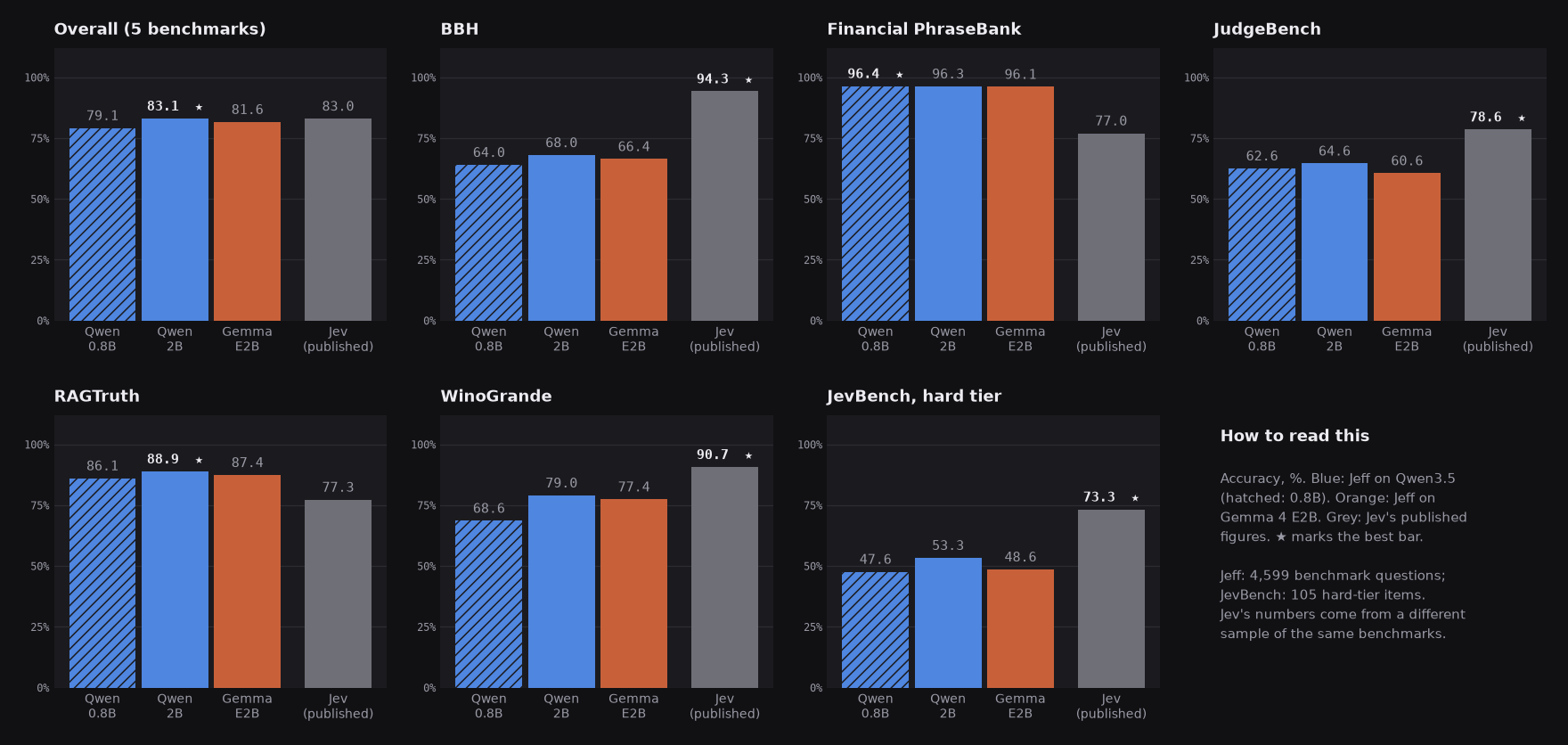
Accuracy of Jeff-Qwen3.5-0.8B, Jeff-Qwen3.5-2B and Jeff-Gemma4-E2B against Jev's published figures, per benchmark

Benchmark Qwen3.5-0.8B untrained Jeff-Qwen3.5-0.8B Qwen3.5-2B untrained Jeff-Qwen3.5-2B Gemma 4 E2B untrained Jeff-Gemma4-E2B Jev (published) AutoJev-27B (published)
Overall (5 benchmarks) 45.3 79.1 46.5 83.1 62.5 81.6 83.0 84.9
BBH 39.5 64.0 46.0 68.0 51.3 66.4 94.3 82.8
Financial PhraseBank 36.0 96.4 53.4 96.3 86.0 96.1 77.0 84.2
JudgeBench 56.6 62.6 57.4 64.6 46.9 60.6 78.6 78.9
RAGTruth 49.1 86.1 35.9 88.9 63.8 87.4 77.3 88.9
WinoGrande 49.2 68.6 52.2 79.0 51.0 77.4 90.7 83.3
JevBench hard (separate) 36.2 47.6 45.7 53.3 41.0 48.6 73.3 70.3

Bold: the winner of Jeff against Jev in each row. Bold italic: AutoJev-27B where it is the best of all models in the row (on RAGTruth, tied with Jeff-Qwen3.5-2B); it is shown for reference, since the head-to-head comparison is with Jev. The published Jev and AutoJev figures were measured on a different sample of the same benchmarks. Jeff's overall score comes from classification and grounding, where it matches or beats the large models; on the reasoning-heavy benchmarks (BBH, JudgeBench, JevBench) it stays well below them, as you would expect at this size.

Games: a zero-shot test

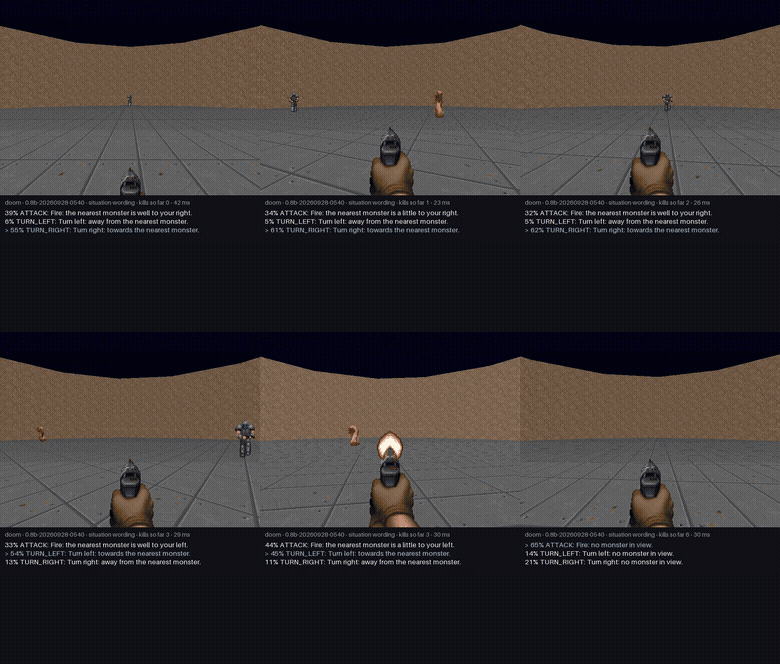
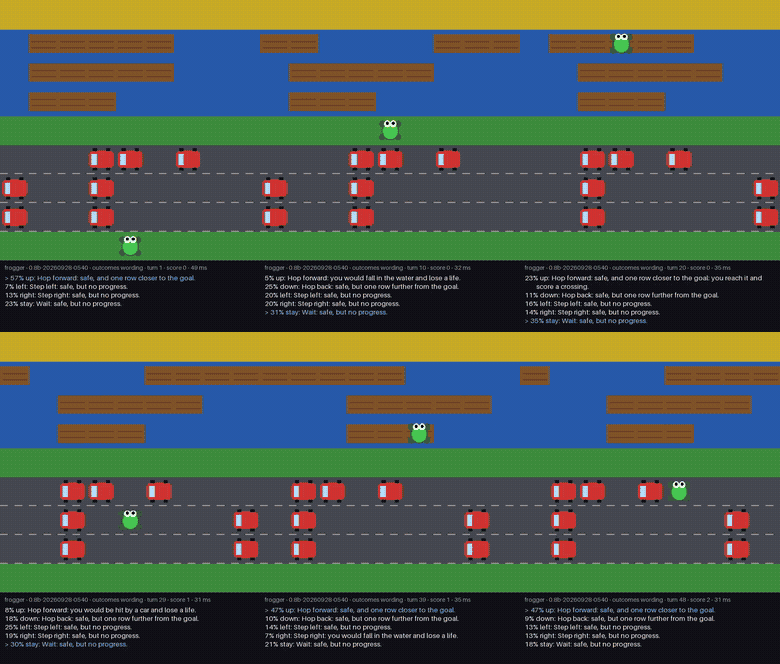
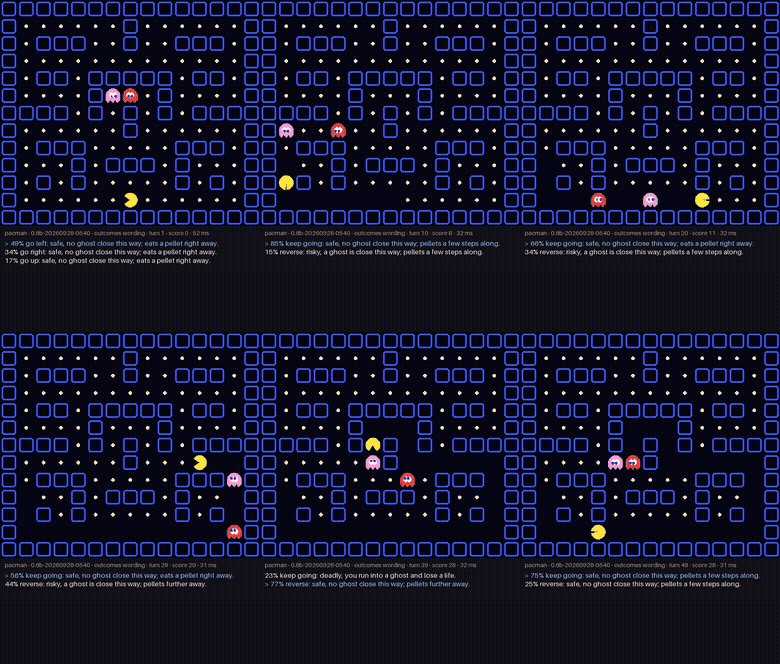
To test zero-shot performance on tasks unlike anything in the benchmarks, we had Jeff play three games. Games aren't the ideal zero-shot test, since a game's state isn't typical unstructured data; but they are a common, and fun, way to test a System 1 model. Each turn, the code describes the situation and the legal moves in words, and the model picks one. The options state what each move leads to (Frogger: "you would be hit by a car and lose a life"; Doom: "the nearest monster is a little to your left"), but never which move is right. Each result is 20 episodes, seed 1234; ▶ opens a video of the run's first episode.

Jeff-Qwen3.5-0.8B playing, zero-shot (the bold row in the table below; click a clip for the full video):

Jeff-Qwen3.5-0.8B playing Doom
Doom
Jeff-Qwen3.5-0.8B playing Frogger
Frogger
Jeff-Qwen3.5-0.8B playing Pac-Man
Pac-Man
Model Doom, kills (monster's direction in words) Frogger, crossings (consequences) Pac-Man, pellets of 98 (consequences)
Random moves −0.05 0 11.2
Hand-coded rule bot 6.55 ▶ 10.25 ▶ 94.1 ▶
Qwen3.5-0.8B, untrained 5.0 ▶ 1.0 ▶ 25.8 ▶
Jeff-Qwen3.5-0.8B 6.55 ▶ 10.3 ▶ 57.0 ▶
Qwen3.5-2B, untrained 0.55 ▶ 0.05 ▶ 72.1 ▶
Jeff-Qwen3.5-2B −0.9 ▶ 6.0 ▶ 41.2 ▶
Gemma 4 E2B, untrained −0.55 ▶ 0 ▶ 3.2 ▶
Jeff-Gemma4-E2B 0.55 ▶ 0.15 ▶ 53.2 ▶
Jev (published, Doom) 6.55, told the aiming rule; −0.60 without it — —

Jeff-0.8B decides in 29–49 ms per move on an M4 Max; Jev's published Doom run took 212 ms per call over its API. The two times were not measured on the same hardware. To play them yourself:

uv sync --extra games
uv run python -m jeff.games --game doom --player jeff --criteria situation --url http://127.0.0.1:8765 --video --out runs/games/doom.json
uv run python -m jeff.games --game frogger --player jeff --criteria outcomes --url http://127.0.0.1:8765 --out runs/games/frogger.json
uv run python -m jeff.games --game pacman --player rule --out runs/games/pacman-rule.json

Speed and size

Median time per decision over the same 200 benchmark questions (about 200 input tokens each), one question at a time, from raw text to probabilities:

Model Parameters Weights (16-bit) NVIDIA RTX PRO 6000 Apple M4 Max (MLX) CPU (32 threads)
Jeff-Qwen3.5-0.8B 0.8B 1.7 GB 22 ms 28 ms 463 ms
Jeff-Qwen3.5-2B 2B 4.2 GB 24 ms 60 ms 708 ms
Jeff-Gemma4-E2B 2B effective (4.6B stored) 9.3 GB 29 ms — (MLX runs Qwen only) 1.0 s
AutoJev-27B 27B ~54 GB not published — —
Jev not disclosed API only 114–212 ms per call in published Doom runs, including the network

Using it well

Train your own

uv run autojev-mix ...          # build the training set (public data, synthetic data, leak filter)
scripts/train.sh RUN data/mix/public.jsonl data/mix 5e-6 40 Qwen/Qwen3.5-0.8B <revision> --epochs 1
uv run autojev-evaluate --data data/panel.jsonl --local --checkpoint checkpoints/RUN/selected --output runs/eval/RUN.json

The full pipeline (synthetic data from a local teacher, leak filter, learning-rate sweeps, dashboard) is described in scripts/train_all.sh, and every training source with its licence in docs/data-sources.md. Training recipe: full-weight fine-tuning, one epoch, batches of 256, cross-entropy over the option letters, then one fitted temperature for calibration; checkpoints are chosen on a development set, never on the benchmark panel. At least half of each training family follows the panel's layout conventions (formats only; no panel item is ever trained on).

Caveats

History

Jeff began as a fork of AutoJev by Denis Yarats (MIT licence), an open recipe that fine-tunes Qwen3.8-27B to return Jev-style decisions. We kept its core design (one forward pass per decision, a trained answer readout, a fitted temperature for calibration) and built on it: small students (0.8B and 2B Qwen, Gemma 4 E2B), a local synthetic-data pipeline with a leak filter, prompt layouts for domain fine-tunes, MLX serving on Apple silicon, game tests and a training dashboard. The original copyright notice is kept in LICENSE.

Licence

Code: MIT (including AutoJev's). Model weights: Apache 2.0. Doom harness adapted from jev-plays-doom (MIT). Training data: see the dataset card; each source keeps its licence and is listed in docs/data-sources.md. We release the weights and code, not the training data; some sources are share-alike (CC BY-SA).

jeff (firelex/jeff)

Searching Database…

1.5K ·GitHub
Что это?Jeff — семейство небольших открытых моделей (0.8B–2B параметров), дообученных из Qwen3.5 и Gemma 4 и работающих как быстрые принимающие решения модели типа «System 1»: вы описываете ситуацию и список вариантов обычным текстом, а Jeff за один проход вперёд возвращает откалиброванную вероятность для каждого варианта — без генерируемого текста, который пришлось бы разбирать.
Это hosted-API вроде Jev или то, что я запускаю сам?Jeff — это набор открытых моделей, выпущенных на Hugging Face, плюс код для обучения и инференса, который вы запускаете на своём железе — GPU, Apple Silicon через MLX или CPU; это не hosted-API-сервис.
Как начать пользоваться Jeff?Скачайте один из выпущенных чекпоинтов с Hugging Face (Jeff-Qwen3.5-0.8B, Jeff-Qwen3.5-2B или Jeff-Gemma4-E2B) и отправьте запрос с описанием ситуации и до 255 вариантов; в ответе будут вероятность для каждого варианта, выбранный вариант и уровень уверенности.
Какое железо нужно для запуска?Подойдёт любой из трёх вариантов: NVIDIA GPU вроде RTX PRO 6000 (22–29 мс на решение), Mac на Apple Silicon через MLX (28–60 мс) или обычный CPU с 32 потоками (463 мс–1 с) — облачный GPU или API-ключ не требуются.
Справится ли Jeff с многошаговыми рассуждениями, как модель покрупнее?Нет — Jeff это классификатор, а не планировщик: он выбирает между описанными вами вариантами, но не умеет прогнозировать и рассуждать в несколько шагов, а на бенчмарках, требующих рассуждений, вроде BBH и JudgeBench, заметно отстаёт от больших моделей вроде Jev.
Чем Jeff отличается от Jev?Jeff — независимая открытая модель на 0.8B–2B, которую вы запускаете локально в том же формате запроса, что и Jev, тогда как Jev — куда более крупная закрытая модель, доступная через API; на бенчмарках классификации и grounding Jeff приближается к Jev или обгоняет его, но проигрывает на задачах, требующих рассуждений.
Можно ли дообучить Jeff на своих примерах?Да — короткое дообучение примерно на 11 тыс. примеров, занимающее около получаса на одном GPU, с помощью команды autojev-train подняло точность задачи голосовой навигации на отложенной выборке с 31.7% до 95.8%.
Почему формулировка вариантов так важна?Jeff очень чувствителен к формулировкам: в тестах приведение описания последствий варианта к тому же стилю формулировок, что у всех остальных вариантов, заметно меняло его решения, поэтому единообразный, описательный текст вариантов важнее хитроумных идентификаторов вариантов.
Какой размер модели выбрать?Модель 0.8B — рекомендуемый вариант по умолчанию для быстрого и надёжного выбора между вариантами, хотя 2B набирает более высокие баллы на некоторых бенчмарках: 2B оказывается более осторожной и хуже выступает в игровых тестах.
Creator
firelex
Size
8 MB
Stars
1.5K
Age
21d
Commits · 90 Days