中文 | English
MiniCPM Tech Report |
MiniCPM Wiki (in Chinese) |
MiniCPM-V Repo |
UltraData |
Online Demo
Join our discord and Feishu/Lark |
Join Us
✨ Highlights
We are releasing MiniCPM5-2B, the second model in the MiniCPM5 series, following MiniCPM5-1B. It is a dense 2B Transformer that scales up the same training recipe, built for on-device, local deployment, and resource-constrained scenarios, reaching 2B-class open-source SOTA.
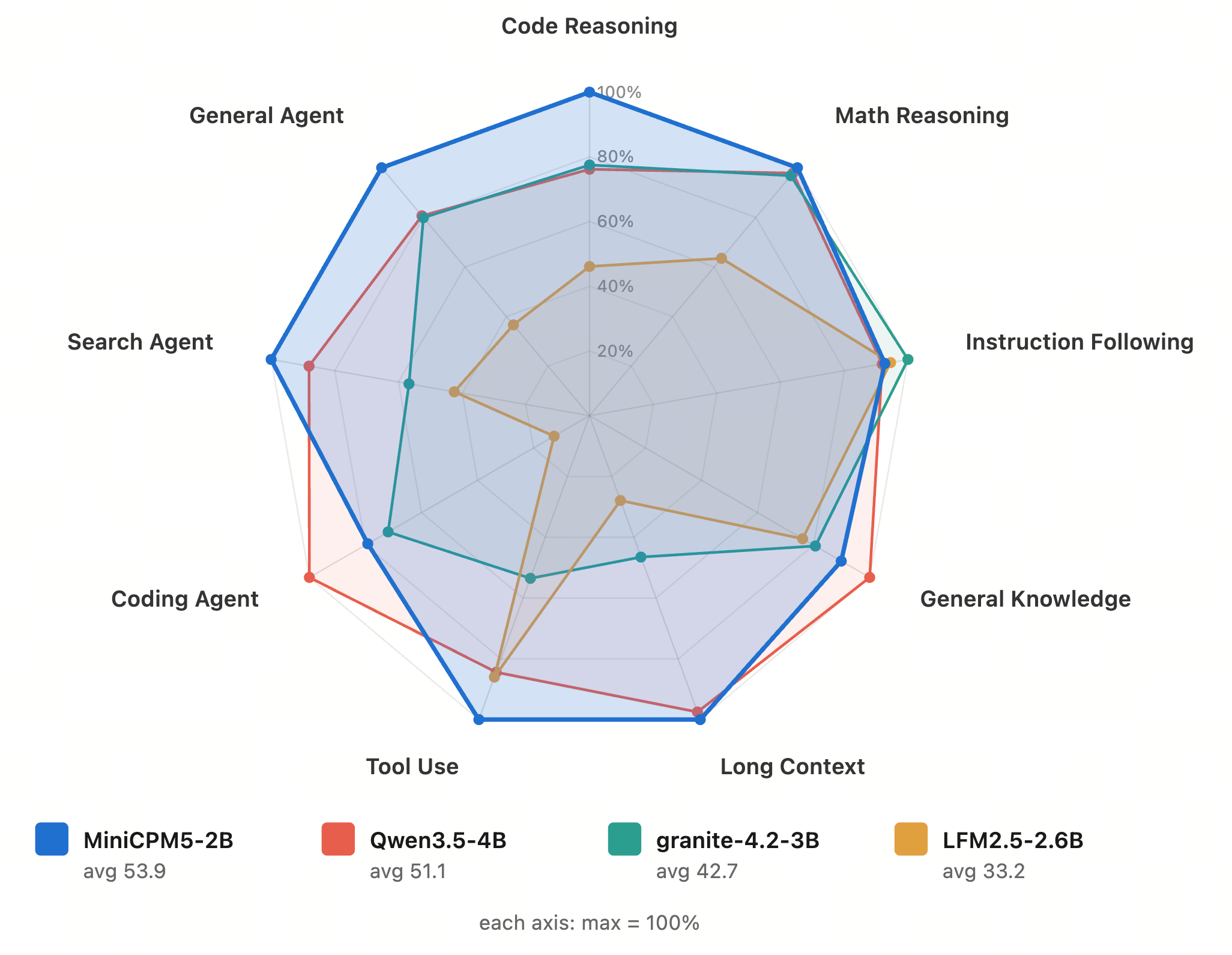
🏆 2B-class open-source SOTA: compared with strong open-source models of similar size, MiniCPM5-2B achieves SOTA performance within this comparison set. It remains competitive with 4B-class models overall, while showing its advantages over models of comparable size in coding, mathematics, long-context understanding, tool use, and agentic tasks.
📂 Open High-Quality Data: Alongside the model, we are releasing the high-quality training datasets behind it as part of the UltraData family: UltraX, a high-quality web pre-training dataset; UltraData-Code, featuring L0–L3 tiered code data management to drive a significant leap in coding capabilities; UltraData-SFT-Agent-2609, comprising 500K agent training samples to enhance comprehensive on-device agent capabilities; and UltraData-RL-2609, with 80K+ high-quality RL training samples covering mathematics, code, general knowledge, and long-context reasoning.
🔥 Changelog
- 📌 [2026.09.07] MiniCPM5-2B is released: a compact 2B-class dense model for on-device and resource-constrained use, paired with deployment / fine-tuning Agent Skills.
- [2026.05.19] MiniCPM5-1B is released: a compact 1B-class dense model for on-device and resource-constrained use, paired with deployment / fine-tuning Agent Skills.
- [2026.02.11] MiniCPM-SALA is released: a sparse-and-linear hybrid attention model for million-token context modeling and efficient inference.
- [2025.09.05] MiniCPM4.1 series is released: a trainable sparse-attention model with hybrid reasoning.
- [2025.06.06] MiniCPM4 is released: an end-side model with over 5x generation acceleration on typical edge chips.
Older entries (2024 + InfLLM-V2 paper)
- [2025.09.29] InfLLM-V2 paper is released! We can train a sparse attention model with only 5B long-text tokens.
- [2024.09.05] We release MiniCPM3-4B! This model outperforms Phi-3.5-mini-instruct and GPT-3.5-Turbo-0125 and is comparable to several models with 7B-9B parameters like Llama3.1-8B-Instruct, Qwen2-7B-Instruct, and GLM-4-9B-Chat.
- [2024.07.05] Released MiniCPM-S-1B! This model achieves an average sparsity of 87.89% in the FFN layer, reducing FFN FLOPs by 84%, while maintaining downstream task performance.
- [2024.04.11] Released MiniCPM-2B-128k, MiniCPM-MoE-8x2B and MiniCPM-1B! Click here to read our technical blog.
- [2024.02.01] Released MiniCPM-2B! This model performs similarly to Mistral-7B on public benchmarks (with better performance in Chinese, math, and code abilities) and overall outperforms models like Llama2-13B, MPT-30B, and Falcon-40B.
🧭 Quick Links
📦 Model Downloads
Current release: MiniCPM5-2B / MiniCPM5-1B(BF16 / GGUF / MLX):
MiniCPM5-2B
MiniCPM5-1B
Other key releases:
📋 Click to view earlier MiniCPM releases: 4, BitCPM, applications, MiniCPM3 / 2B / 1B
Earlier flagships:
MiniCPM4.1 quantized & speculative variants:
BitCPM4 ternary-quantized + MiniCPM4 Applications:
MiniCPM4 Eagle speculative decoding, QAT, and pre-2025 releases:
🚀 MiniCPM5-2B
Introduction
MiniCPM5-2B is the second checkpoint in the MiniCPM5 series, scaling the MiniCPM5-1B recipe up to 2B parameters for users who can afford a larger footprint in exchange for stronger capability. It is designed for local assistants, coding agents, tool-use workflows, and reasoning scenarios where a compact model is preferred. The model keeps a small deployment footprint while providing native long-context support.
|
|
| Architecture |
Standard LlamaForCausalLM |
| Parameters |
2,516,756,480 (non-embedding: 1,981,982,720) |
| Layers |
42 |
| Attention Heads (GQA) |
16 Q / 2 KV |
| Context Length |
131,072 |
Evaluation Results
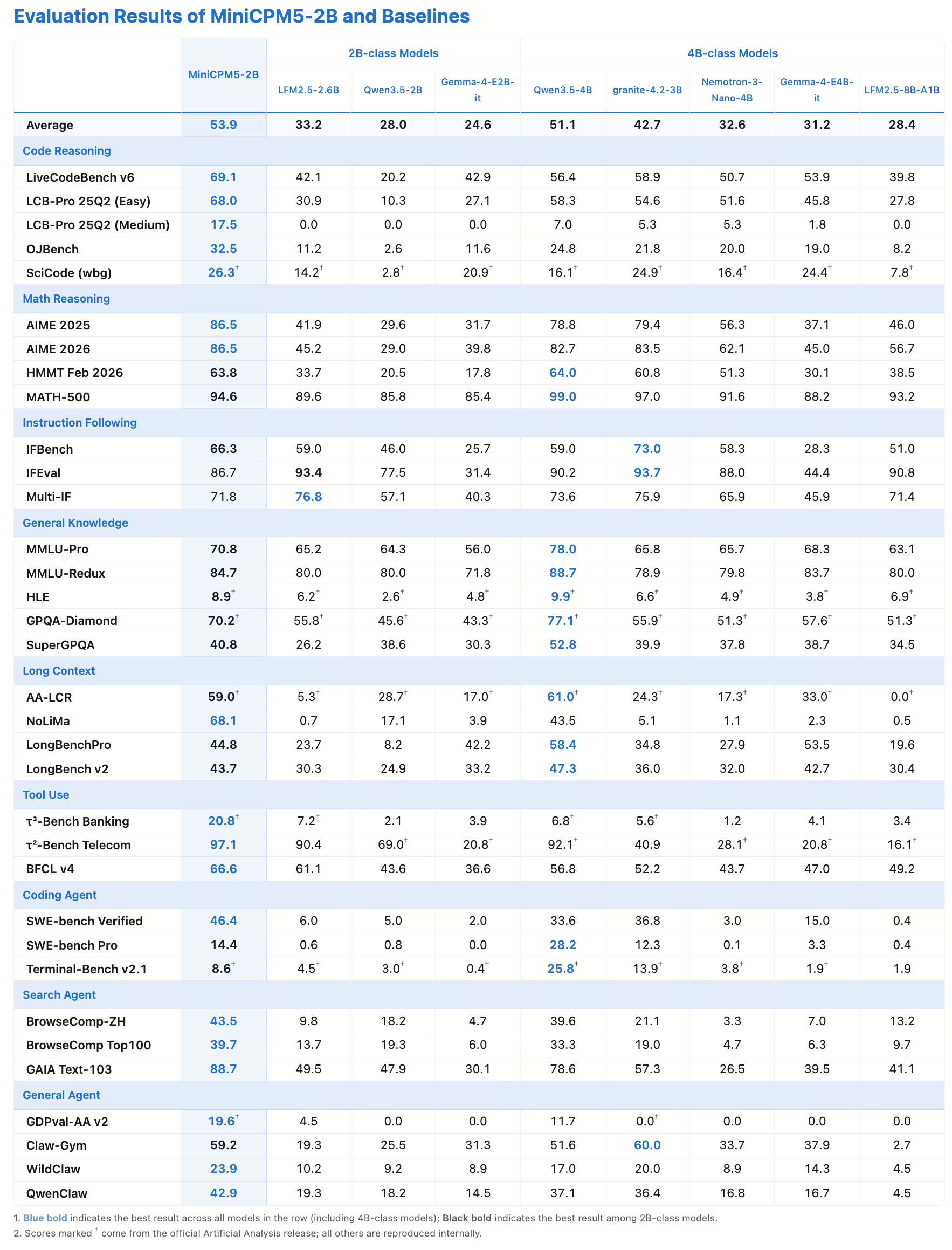
We compare MiniCPM5-2B with strong open-source models in the same size class, including LFM2.5-2.6B, Qwen3.5-2B, and Gemma-4-E2B-it, while also listing larger models such as Qwen3.5-4B, granite-4.2-3B, Nemotron-3-Nano-4B, Gemma-4-E4B-it, and LFM2.5-8B-A1B for reference.
Within this comparison set, MiniCPM5-2B reaches 2B-class open-source SOTA with an average score of 53.9, and also exceeds all of the larger models included here (the highest is 51.1). Its advantages are most visible in code reasoning, math reasoning, long-context understanding, tool use, and multiple agentic tasks.
Training Recipe
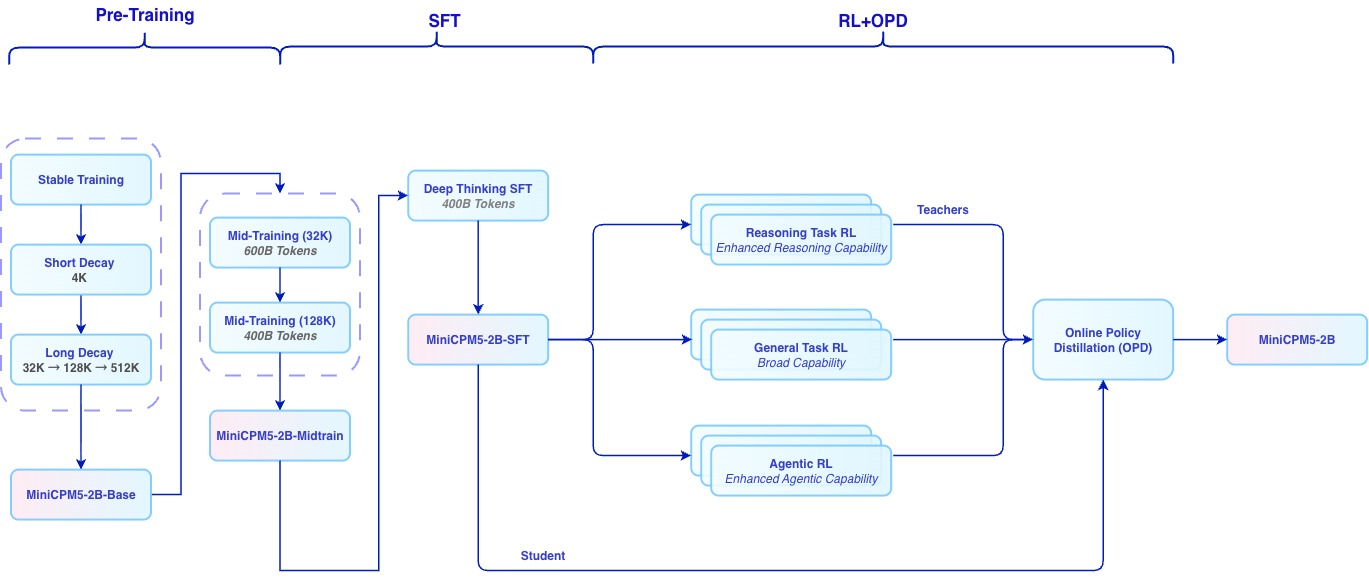
The training of MiniCPM5-2B is a full-stack practice of UltraData Tiered Data Management, covering three stages: base training, mid-training, and post-training.
During base training, the model goes through stable training and decay training to build core language capability and training stability. It then enters mid-training to further strengthen target capabilities and adapt to the target data distribution. The training corpus is released alongside the model as Ultra-FineWeb, Ultra-FineWeb-L3, UltraX, UltraData-Code and UltraData-Math.
During post-training, we proceed in three steps: SFT, RL, and OPD. We first use 400B tokens of deep-thinking SFT to establish deep-thinking and general chat abilities; the SFT data is released as UltraData-SFT-2605 and Agent SFT data as UltraData-SFT-Agent-2609. We then train specialized RL teachers for math, code, agentic tasks, writing, and related domains(with the corresponding data also open-sourced as UltraData-RL-2609), and use On-Policy Distillation (OPD) to distill these teachers back into one release model.
What does RL + OPD bring?
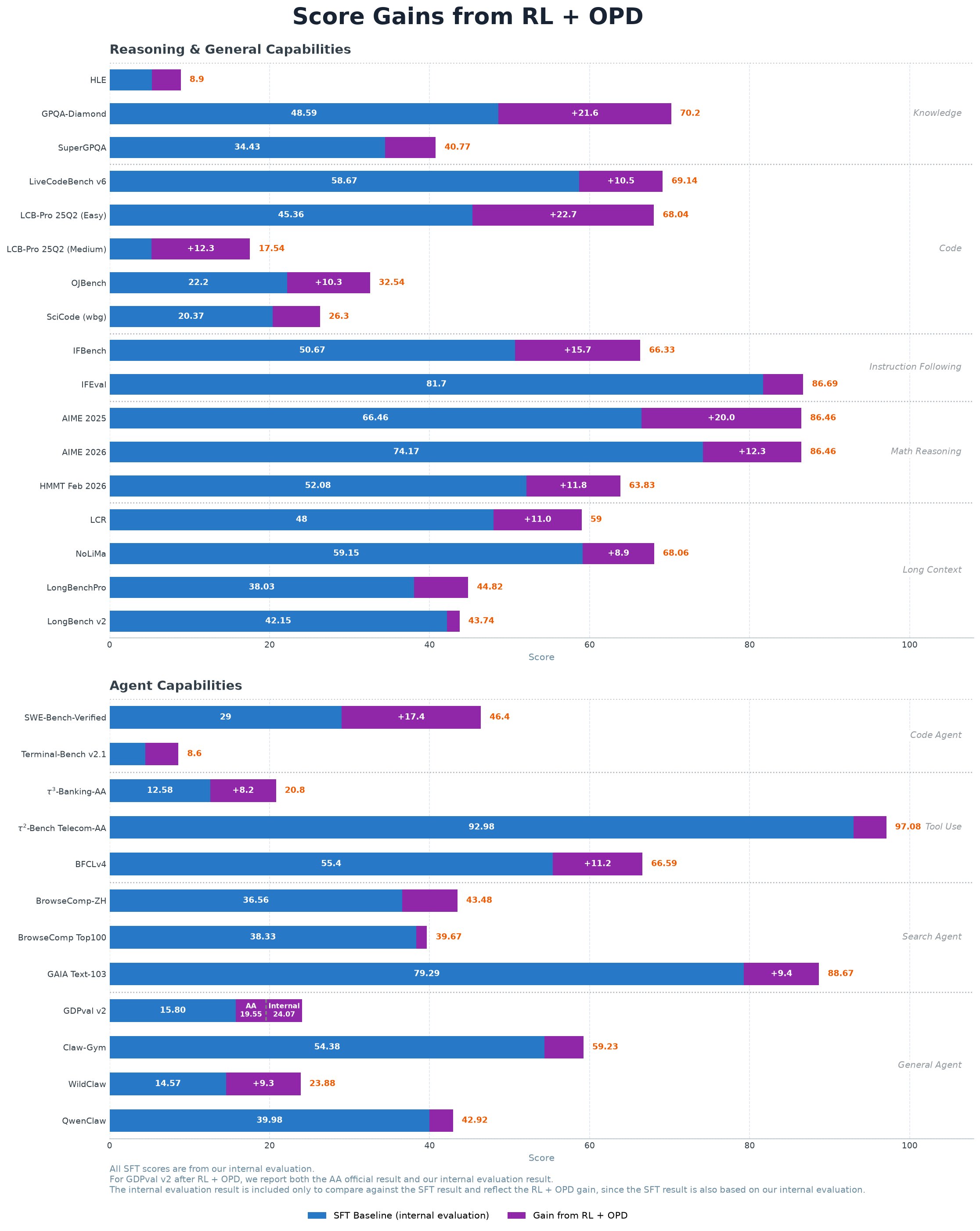
RL + OPD is a key part of MiniCPM5-2B post-training. During the RL stage, we adopted the critic-based algorithm described in JustRL II, substantially improving training stability and achieving significant gains across multiple domains. On the benchmarks listed below, RL + OPD improves reasoning and general capabilities by an average of ↑10.96 points, and agentic capabilities by ↑6.96 points.
OPD merges the capabilities of 16 expert models produced by RL training, including 5 agentic expert models. At each response position, we compute the full-vocabulary reverse KL divergence between student and teacher logits as the advantage estimate, replacing the original verification-based advantage. OPD directly reuses the prompts used to train each RL teacher as distillation data, so no additional corpus construction is required.
Quickstart
We recommend using the following sets of sampling parameters for generation: temperature=1.0, top_p=0.95, min_p=0.0.
If you encounter repetitive outputs, try: temperature=1.0, top_p=0.95, min_p=0.0, repetition_penalty=1.05.
Please note that the support for sampling parameters varies according to inference frameworks.
vLLM
pip install "vllm>=0.21"
vllm serve openbmb/MiniCPM5-2B --port 8000
curl http://localhost:8000/v1/chat/completions \
  -H "Content-Type: application/json" \
  -d '{
    "model": "openbmb/MiniCPM5-2B",
    "messages": [{"role": "user", "content": "Who are you? Please briefly introduce yourself."}],
    "max_tokens": 128,
    "temperature": 1.0, "top_p": 0.95
  }'
SGLang
pip install "sglang[srt]>=0.5.16"
python -m sglang.launch_server --model-path openbmb/MiniCPM5-2B --port 30000
curl http://localhost:30000/v1/chat/completions \
  -H "Content-Type: application/json" \
  -d '{
    "model": "openbmb/MiniCPM5-2B",
    "messages": [{"role": "user", "content": "Who are you? Please briefly introduce yourself."}],
    "max_tokens": 128,
    "temperature": 1.0, "top_p": 0.95
  }'
Speculative decoding (DSpark): we also release MiniCPM5-2B-DSpark, a DSpark draft model trained for MiniCPM5-2B. Enable it in SGLang to accelerate decoding while keeping the target model's outputs unchanged:
python -m sglang.launch_server \
  --model-path openbmb/MiniCPM5-2B \
  --trust-remote-code \
  --speculative-algorithm DSPARK \
  --speculative-draft-model-path openbmb/MiniCPM5-2B-DSpark \
  --speculative-dspark-block-size 7 \
  --port 30000
Llama.cpp
llama-server -m MiniCPM5-2B-F16.gguf -a MiniCPM5-2B --port 8080 -ngl 99 -c 8192 --jinja
-c 8192 sets the context length. You can adjust this value as needed.
curl http://localhost:8080/v1/chat/completions \
    -H "Content-Type: application/json" \
    -d '{
        "model": "MiniCPM5-2B",
        "messages": [{"role": "user", "content": "1+1=?"}],
        "temperature": 1.0, "top_p": 0.95, "min_p": 0.0, "max_tokens": 256
    }'
In llama.cpp, the default min_p=0.05 can lead to repetitive output: it filters out tokens whose probability is below 5% of the highest-probability token, potentially discarding the exact tokens needed to break out of a repetition loop. To prevent this, we set min_p=0.0.
pip install -U "transformers>=5.6" accelerate torch
from transformers import AutoModelForCausalLM, AutoTokenizer
model_id = "openbmb/MiniCPM5-2B"
tokenizer = AutoTokenizer.from_pretrained(model_id)
model = AutoModelForCausalLM.from_pretra

 MiniCPM 是面壁智能(OpenBMB)推出的一系列小型开源大语言模型,面向端侧设备和资源受限的场景。最新版本 MiniCPM5-2B 是一个 20 亿参数的稠密模型,在同级别开源模型中达到了最先进水平,同时表现可以和更大的 40 亿参数级别模型相媲美。