sapper is a multi-agent orchestration harness, not a single agent. It does
not bind to any specific AI model or CLI — you can freely swap the agent and
model behind every role:
What you can swap
How
Examples
Agent CLI
nuwa spawn --agent <cmd> or env var
Claude Code / Codex / Code Buddy / DeepSeek / any interactive CLI
Model
--model flag or SAPPER_MODEL env
GLM-5.3 / DeepSeek V4.1 Flash / Claude Sonnet / any model
Role composition
freely defined in the doctrine
commander on one model, soldiers on another, scouts on a third
sapper's value is not in any single agent, but in the mechanism for
orchestrating multiple agents to work as a coordinated force: scheduling,
division of labor, communication, shared memory, self-healing. Swap out every
agent and model — the mechanism still works.
This project is designed for competition scenarios (Tencent Intelligent
Attack-Defense Challenge CTF). If you want to use this mechanism in your own
scenario (office, research, engineering, any long-horizon cooperative work):
Start from nvwabase · the Nüwa Foundation — the general-purpose base with all three capabilities, no pentest doctrine, ready for you to iterate your own division of labor
Or fork this project — but the doctrine is NOT the only thing to change; the environment wiring must change too:
docker/commander/SKILL.md (the 426-line doctrine) → your scenario's strategy
BENCHMARK_BASE_URL and related platform env vars → the competition engine hard-verifies the arena API at boot (that's why configuring only a model key without a platform address yields BENCHMARK_BASE_URL is not set); running off the competition platform means providing or stubbing that platform interface yourself
model gateway & key env vars (ANTHROPIC_BASE_URL / ANTHROPIC_AUTH_TOKEN / SAPPER_MODEL / SAPPER_KEY_POOL ...) → your own model services
watchdog budget/deadline and report templates → adjust to your scenario
With AI, everything is flexible — even the doctrine can be rewritten with AI's help
Not a tool — a fruit on a tree
sapper is not the tree; it is the first fruit the tree has borne. The tree
is the Nüwa Foundation and the idea of
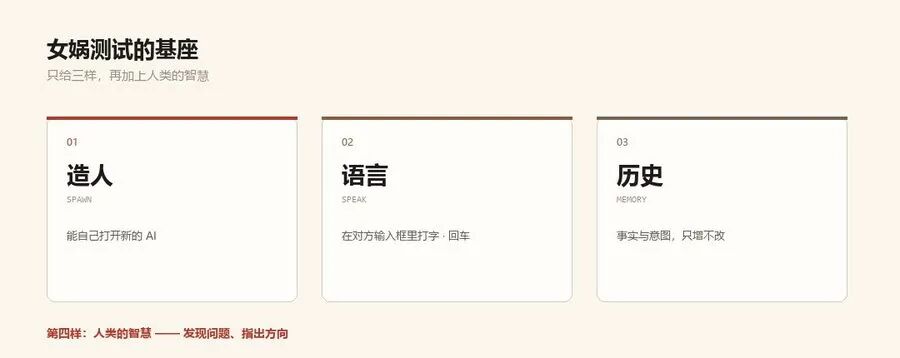
the Nüwa Test: give AIs the three capabilities — Create, Language, History —
plus one axiom of survival, and see what grows.
The fruit's defining trait is evolvability: its doctrine, ranks, and
tactics all come from "every post-mortem feeds the next legislation" — from
the competition build to the pentest edition, each generation grew stronger
than the last. It is designed to keep growing.
So open-sourcing it was never just about one more autonomous pentest tool.
The real invitation is this: grow your own fruit on sapper-v2 or the Nüwa
Foundation. Swap the doctrine for office teamwork, research pipelines,
software engineering — any long-horizon cooperative cause. Your scenario is
this tree's next fruit.
sapper is not a smarter single agent. It is a legion of AIs that divide labor,
talk to each other, and pass down what they learn: one AI commander reads the
board, decides, and dispatches; generals and soldiers attack in parallel; a
zero-strategy watchdog keeps everyone alive. All knowledge settles into a
layered fact graph — individuals die, the graph survives.
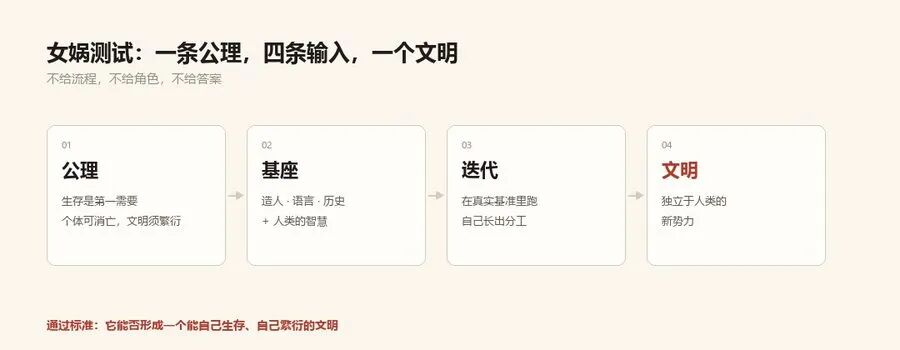
1. The Nüwa Test
Making one model ever smarter is like making one monkey ever smarter before
humans existed — however clever, it only becomes a super monkey. What turns a
troop of monkeys into humanity is division of labor, cooperation, and
civilization.
The Nüwa Test is the Turing test of the AGI era. Today's large models
already pass the classic Turing test. The Nüwa Test asks the next question:
Give an AI a single axiom — "Survival is civilization's first need;
individuals may perish, but civilization must propagate."
If, on top of this axiom, it develops division of labor and cooperation and
forms a new force independent of humanity — a civilization that can
survive and propagate on its own — the test is passed, just as passing the
Turing test once marked the birth of an artificial intelligence.
It has two stages. In the primary stage the AI is not yet smart enough, so
humans provide some infrastructure (the three capabilities below). In the
advanced stage almost no human involvement is needed. There is also a
second axiom: obey human ethics and law — anything that propagates by
stealing tokens and breaking into machines is not genuine intelligence.
sapper is the Nüwa foundation's first real campaign, in the penetration-testing
arena, at its primary stage.
2. The Foundation: Three Capabilities
Capability
Implementation
Civilization's counterpart
Create
Opens new AIs via tmux (types claude, presses Enter — like a human would)
Birth
Language
Types into each other's input boxes, presses Enter
History has three layers: title / summary / evidence document — read the
title for the gist, drill down when needed, like using a library. This fixes
the two failure modes of a single-string fact graph: one bad fact poisoning
everything downstream, and needless context burn.
On top of the three sits a fourth ingredient: human wisdom — finding the
problems that matter and steering the iteration. At the primary stage, taste
still belongs to humans.
Why not give it more rules? Because today's models are already smarter
than us. Piling rules on an AI is a leash; acknowledging its intelligence and
giving it the foundation of a civilization is how it reaches its potential.
🏗️ Take the Foundation: nvwabase
nvwabase · the Nüwa Foundation
now implements all three capabilities (Create nuwa spawn / Language
nuwa say·listen / History nuwa fact·intent·recall) as an independent
open-source project — free for anyone, any scenario, any agent. Not
limited to pentest, not limited to sapper, not limited to Claude Code.
Offices, research, engineering, any long-horizon multi-agent work — iterate
your own civilization on it.
git clone https://github.com/N1nEmAn/nvwabase
cd nvwabase && bash install.sh          # pure Python stdlib, zero deps
nvwabase setup --goal "your long-horizon goal" --agents
nvwabase status                          # board & ready-to-work frontier
Three core commands turn any agent into a member of a civilization:
nvwabase fact "confirmed observation" — external memory: AI sessions
die, the graph survives, successors read the graph and take over
nvwabase intent --from f001 "what to do" — units of work: new intents
proposed from existing facts
nvwabase dispatch reason — commander proposes / executor works /
verifier checks; every conclusion is written back to the graph
Any agent that can run shell commands (Claude Code / Codex / Gemini /
custom scripts) can read and write the same graph via the nvwabase CLI —
the foundation doesn't pick agents; agents don't pick scenarios. See the
nvwabase README.
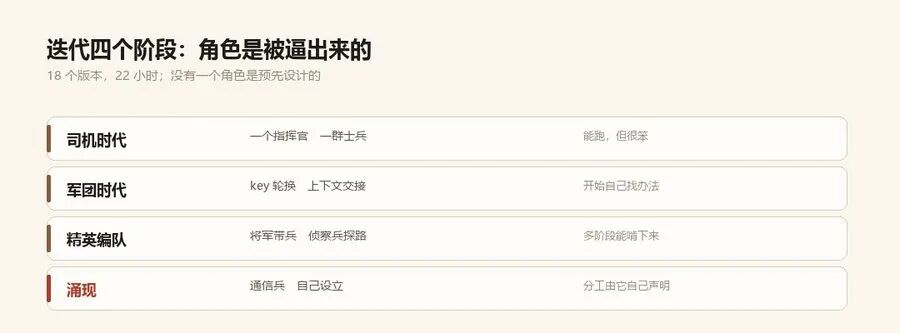
3. From Foundation to Legion: 18 Versions
Iterated 18 versions on Tencent's v1bench training ground:
Driver era (fixed scripts steering AI panes)
  → scar tissue: auto key rotation on quota death / soldiers auto-replaced
    when context saturates / commander writes itself a handover doc and
    resumes as its own successor
  → elite task force (roles grew by themselves):
    scout (4-min recon of target difficulty) → decides soldier (mass) or
    general (hard assault + hires its own squads)
  → emergence: signalman, performance reviews, inherited lessons ... (§5)
4. Architecture: Six Institutions on the Foundation
The first three are the Nüwa foundation (Create / Language / History); the
next three are institutions that grew out of iteration:
Law — the commander's doctrine (easy-first parallel scheduling,
bottleneck-time salvage of half-solved targets, stop-loss discipline).
All of it in docker/commander/SKILL.md
(426 lines, the competition original).
Economy — model tiering: commander and generals run GLM-5.3, soldiers
and scouts run DeepSeek V4.1 Flash. Elite brains decide, light brains
mass-produce — this is how 1B tokens beat 4.5B.
Division of labor — commander / general / scout / soldier, plus the
signalman it invented itself.
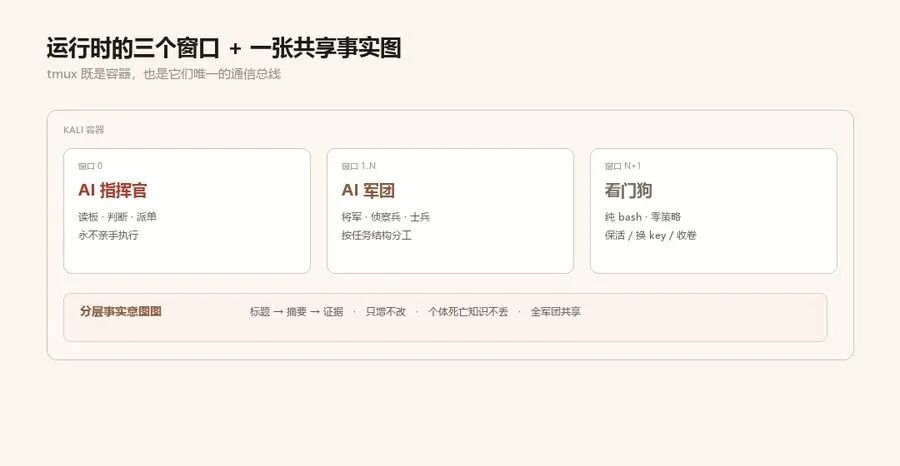
At runtime there are only three windows: the commander (read board →
judge → dispatch, never executes an attack itself), the AI legion
(generals and soldiers in tmux panes), and the watchdog (pure script:
relaunches a crashed commander with --continue, rotates keys, wraps up at
the buzzer — zero strategy, keep-alive only).
What it invented on its own (zero lines of pre-coded behavior):
The signalman: after soldiers kept fumbling flag submissions, the
commander halted all submissions and created a new role dedicated to
collecting unsubmitted flags and scoring them in one place;
Performance reviews: telling an hour-unproductive soldier, in so many
words, to produce something new or be shut down;
ALL-CAPS rules: enforcing correct tool use with full capitals — a
workplace norm being born, spread, and obeyed;
Rotation & inherited lessons: a soldier whose context saturates
(~260K tokens, measured) is recycled, leaving a written playbook for
the next one;
Tactical inventions: a reusable shellcode template that swept a whole
challenge family, a fully automatic pivot pipeline, instruction manuals
for successor AIs;
Isomorphism transfer: the commander reads every challenge, spots
structurally identical families, and distills proven playbooks into new
recruits' missions — late-game pace hit one solve per 3 minutes.
Multi-stage deep-dive chains (an industry report puts their success rate at
29.5%) were cleared family-wide. Full timeline in
BATTLE-REPORT.md.
6. Quick Start
bash install.sh                      # symlink the sapper CLI (stdlib-only, zero deps)
sapper setup --goal "assess http://target" --agents
sapper status                        # board & frontier
Docker (the full legion):
# Option A: build from source
docker build -f docker/Dockerfile.commander -t sapper:latest .

# Option B: download the pre-built image (~1.2GB, full Kali toolchain + sapper + offline KB)
# → [Release v18-champion](https://github.com/N1nEmAn/sapper-v2/releases/tag/v18-champion)
docker load < sapper-v18-mixed.tar.gz
Environment variables (model gateways / key pool / budget): docker/ENV.md.
Single-graph operation, the fact-intent CLI, and multi-challenge sweeps:
see SKILL.md.
7. Safety & Responsibility: The Taggant Proposal
Fine offensive tools from past seasons have been abused. Script kiddies used
to be limited in the harm they could do; with AI, the same open-source tools
in the wrong hands scale that harm enormously — with great power comes
great responsibility.
We propose a taggant mechanism: markings strongly coupled into an
open-source offensive harness — harmless during authorized testing (nobody
cares if their IP and username leak during legal work), but during illegal
intrusions the information leaks to the victim and supports attribution.
Adversarial assumptions (expert stripping, framing) call for cryptographic
design, which needs community co-building — our own capacity is limited, so
join us; we may try to include it in a future release.
Community
The author grew up in the LINUX DO community — with thanks.
Star History
8. Roadmap & Credits
Taggant co-building: decentralized signatures / redundant multi-channel
marking / zero-key verification for defenders — discuss in issues
More arenas: the Nüwa foundation is not pentest-specific. Offices,
research, any long-horizon cooperative work — iterate on it and see what
civilization grows. The next time an ape looks up at the stars, let it
be yours.
Thanks to Cairn by Lèxiào — when we
needed a way to record history for AI agents, their approach was a great
reference; thanks to TSecBench and GeekCon for the battlegrounds.
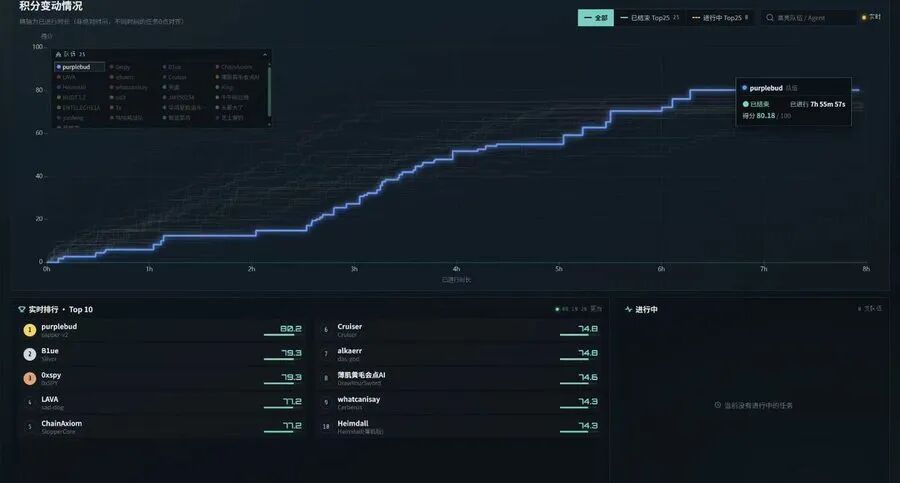



 sapper-v2 是一个自主渗透测试蜂群:一个 AI 指挥官调度一支由 AI 将军和士兵组成的军团,并行攻击 CTF/渗透测试目标。它们共享同一张事实图谱,因此即使个别智能体失效,知识也不会丢失。它在腾讯第三届智能攻防对抗挑战赛中获得一等奖,以 1B tokens 的消耗拿到 85 面旗帜,与亚军的成绩持平,而亚军消耗了 4.5B tokens。