









MiniMax Music 3
MiniMax Music 3 is a high-performance music generation model for creating complete songs up to five minutes long. Conditioned on lyrics and a detailed music description, it generates structurally coherent songs with expressive vocals, evolving arrangements, and stable long-form audio quality.
MiniMax Music 3 combines an 8B Global LLM for long-range musical structure, a 0.6B Local LLM for frame-level acoustic detail, and a continuous hidden-state synthesis system based on Flow Matching and Flow-VAE. The model produces 32 kHz, 16-bit stereo WAV audio.
Prompt Enhancement
A concise natural-language description can be used directly. For richer prompts and more precise control, use the provided music-caption-rewriter skill to expand it into a Structured Caption containing Global Metadata, Vocal Details, and Arrangement. The skill preserves musical instructions attached to lyric section tags in the arrangement description while keeping the lyric text in the lyrics input. See the skills page for installation instructions and a full feature overview.
npx skills add MiniMax-AI/MiniMax-Music3 --skill music-caption-rewriter
Demo
Explore music generation examples on the MiniMax Music 3 Demo.
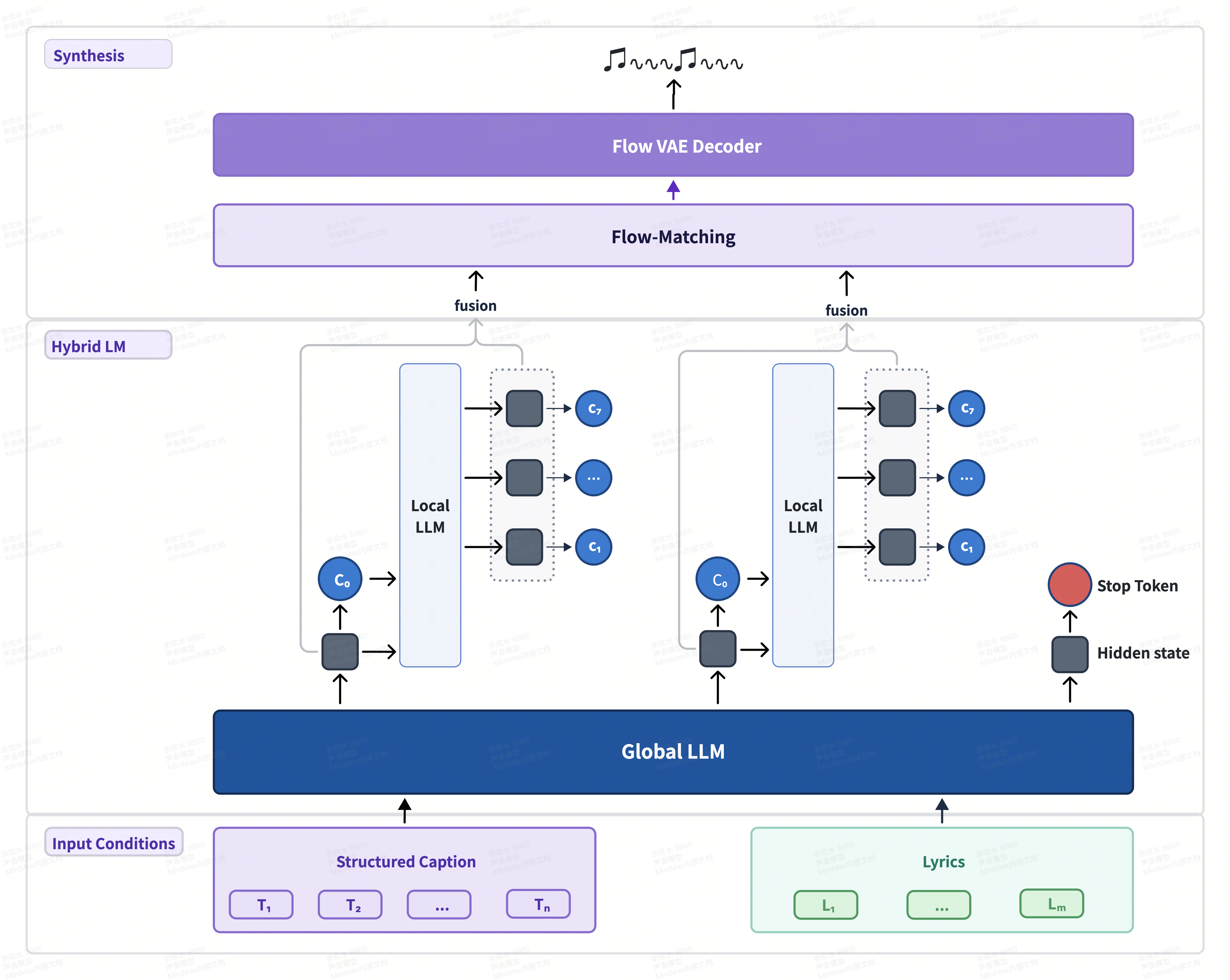
Complete Songs with Long-Range Coherence
MiniMax Music 3 natively supports full-song generation up to five minutes. The model maintains musical themes, rhythm, vocal identity, and arrangement progression across long sequences, enabling complete structures such as intro, verse, pre-chorus, chorus, bridge, instrumental break, and outro.
Fine-Grained Music Control
The model accepts two complementary inputs:
- Lyrics define the words to be sung and may include explicit section tags such as
[Intro], [Verse], [Pre-Chorus], [Chorus], [Post-Chorus], [Bridge], [Instrumental], [Solo], and [Outro].
- Music description defines the musical style, emotional progression, vocal performance, instrumentation, arrangement, and production profile.
For precise control, we recommend using a Structured Caption with three sections:
- Global Metadata: genre, subgenre, BPM, key, scale, emotional progression, listening scenario, and production profile.
- Vocal Details: vocal gender, timbre, performance style, harmony, backing vocals, and vocal effects.
- Arrangement: primary and secondary instruments, section-level instrument evolution, groove, bass, percussion, textures, and spatial effects.
This representation allows the model to follow not only a global style, but also the musical development of the song over time.
Hybrid-LM
MiniMax Music 3 uses a hierarchical autoregressive architecture that separates global musical modeling from local acoustic modeling.
- The Global LLM (8B) predicts the first RVQ codebook frame by frame and models the song's long-range semantic and structural progression.
- The Local LLM (0.6B) predicts the remaining acoustic codebooks within each frame and restores fine-grained acoustic information.
The Global LLM is initialized from Qwen3-8B. During training, its embedding and output layers are first adapted to semantic music tokens. The Global and Local LLMs are then jointly trained to model all RVQ codebooks.
Continuous Hidden-State Synthesis
Instead of decoding only from discrete RVQ tokens, the synthesis module fuses the final hidden states of the Global and Local LLMs. These continuous representations preserve richer acoustic information for vocal articulation, instrumental texture, and temporal continuity.
The synthesis path is:
Global and Local LLM hidden states
                ↓
       Hidden-state fusion
                ↓
     Flow Matching (2.4B)
                ↓
        Flow-VAE latent
                ↓
    Flow-VAE Decoder (123M)
                ↓
       32 kHz stereo audio
The Flow-VAE architecture is adapted from MiniMax Speech and retrained for the dynamic range and spectral characteristics of music.
Music Tokenizer
The training tokenizer uses eight layers of Residual Vector Quantization (RVQ):
- The first semantic codebook contains 16,384 entries and captures the core musical semantics and structure.
- The remaining seven acoustic codebooks contain 1,024 entries each and represent residual acoustic details.
Training first optimizes the semantic codebook, then jointly trains all eight codebooks. At inference time, waveform synthesis uses the fused LLM hidden states and does not require the discrete tokenizer decoder.
How to Use
Download the Model
hf download MiniMaxAI/MiniMax-Music3 --local-dir /path/to/minimax_ttm
Serve with SGLang-Omni
MiniMax Music 3 is currently supported by SGLang-Omni. From the SGLang-Omni repository root, run:
sgl-omni serve --model-path MiniMaxAI/MiniMax-Music3 --port 8000
Inference uses two CUDA GPUs:
- GPU 0 runs Qwen3 and eight-codebook RVQ autoregressive generation.
- GPU 1 runs Flow Matching and DAV waveform decoding.
Generate Music
The service uses the shared speech API. Put the lyrics in input and the music description in instructions.
curl http://127.0.0.1:8000/v1/audio/speech \
  -H 'Content-Type: application/json' \
  -d '{
    "model": "minimax_ttm",
    "input": "[Verse]\nMorning light filtering through the pine\n[Chorus]\nSoftly the world begins to breathe",
    "instructions": "A warm acoustic pop song with intimate female vocals, fingerpicked guitar, soft piano, and a gradual emotional build into a wide final chorus.",
    "response_format": "wav",
    "seed": 7,
    "max_new_tokens": 9000,
    "stream": false
  }' \
  --output minimax_music3.wav
An example generated with this checkpoint is available at assets/minimax_ttm.wav.
Music Caption Rewriter Skill
This repository includes music-caption-rewriter, an agent skill that turns a brief music description and optional tagged lyrics into a detailed Music 3.0 Structured Caption. It uses a bundled text library to select compatible style references, combine requested influences, and build a coherent section-by-section arrangement without external APIs or runtime dependencies.
Then invoke $music-caption-rewriter in a supported coding agent with a music description and, optionally, lyrics containing section tags such as [Verse] or [Chorus]. The skill returns Global Metadata, Vocal Details, and Arrangement while preserving explicit musical constraints and keeping lyric text out of the rewritten caption.
Limitations
- Inference requires two CUDA GPUs.
- Only non-streaming generation is currently supported.
- The tokenized text prompt is limited to 5,000 tokens.
- Audio generation is limited to 9,000 acoustic frames.
- Section tags and music descriptions provide generative control rather than strict symbolic guarantees. The generated tempo, key, instrumentation, lyrics, and song structure may not always match every requested detail exactly.
Contact us at [email protected].


 MiniMax Music 3 是一个音乐生成模型,可以根据歌词和音乐描述创作最长五分钟的完整歌曲,生成 32 kHz 16 位立体声 WAV 音频,结构连贯、人声富有表现力。