










961 ·GitHub
What is this?
 MiniMax Music 3 is a music generation model that creates complete songs up to five minutes long from lyrics and a music description, producing 32 kHz 16-bit stereo WAV audio with coherent structure and expressive vocals.
MiniMax Music 3 is a music generation model that creates complete songs up to five minutes long from lyrics and a music description, producing 32 kHz 16-bit stereo WAV audio with coherent structure and expressive vocals.Is this a ready-to-use app or just a raw model?It is a raw model checkpoint, not a hosted app — you download the weights and run them yourself through a supported inference server.
It is a raw model checkpoint, not a hosted app — you download the weights and run them yourself through a supported inference server.How do I actually generate a song with it?Download the model, serve it from the SGLang-Omni repository root, then call the shared speech API putting your lyrics in the input field and the music description in instructions.
Download the model, serve it from the SGLang-Omni repository root, then call the shared speech API putting your lyrics in the input field and the music description in instructions.What do I need to run inference besides the weights?You need the SGLang-Omni serving stack, since it is currently the only supported way to run this model.
You need the SGLang-Omni serving stack, since it is currently the only supported way to run this model.What are the main limits I should know about?Generation is non-streaming only, text prompts are capped at 5,000 tokens, audio output is limited to 9,000 acoustic frames, and requested tempo, key, instrumentation or structure may not always be followed exactly.
Generation is non-streaming only, text prompts are capped at 5,000 tokens, audio output is limited to 9,000 acoustic frames, and requested tempo, key, instrumentation or structure may not always be followed exactly.How many GPUs does inference need, and what do they do?Two CUDA GPUs are required: one handles the Qwen3-based eight-codebook RVQ autoregressive generation, and the other runs Flow Matching and waveform decoding.
Two CUDA GPUs are required: one handles the Qwen3-based eight-codebook RVQ autoregressive generation, and the other runs Flow Matching and waveform decoding.What does the music-caption-rewriter skill do?It is a bundled agent skill that turns a brief description and optional tagged lyrics into a detailed Music 3.0 Structured Caption with Global Metadata, Vocal Details, and Arrangement, using an internal text library without external APIs.
It is a bundled agent skill that turns a brief description and optional tagged lyrics into a detailed Music 3.0 Structured Caption with Global Metadata, Vocal Details, and Arrangement, using an internal text library without external APIs.How do I control the song's structure, like verses and chorus?Lyrics can include section tags such as [Intro], [Verse], [Pre-Chorus], [Chorus], [Bridge], [Instrumental], and [Outro], while the music description separately controls style, instrumentation, and arrangement across those sections.
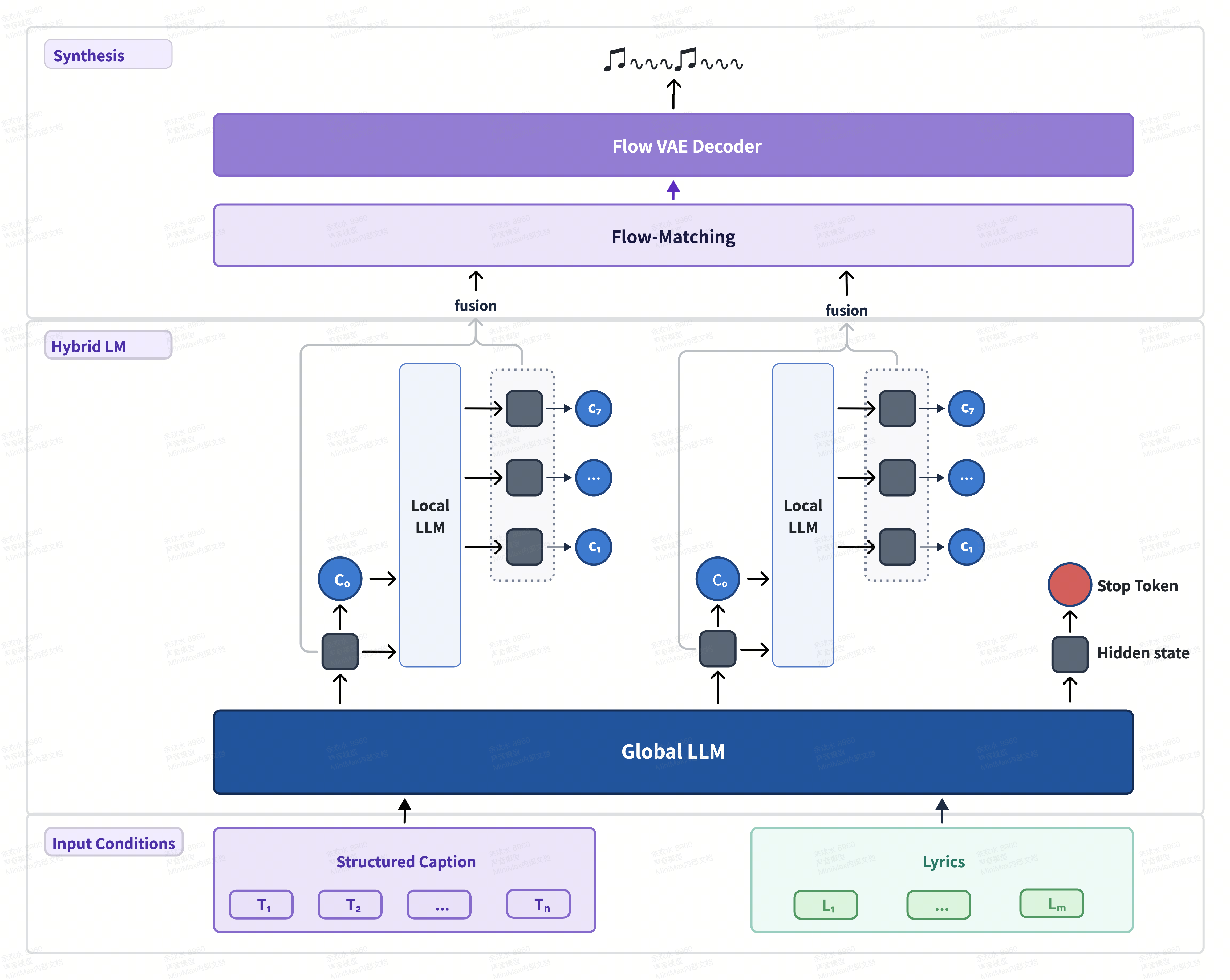
Lyrics can include section tags such as [Intro], [Verse], [Pre-Chorus], [Chorus], [Bridge], [Instrumental], and [Outro], while the music description separately controls style, instrumentation, and arrangement across those sections.How does the model keep a 5-minute song coherent?It uses a hierarchical Hybrid-LM: an 8B Global LLM (initialized from Qwen3-8B) models long-range musical structure, while a 0.6B Local LLM fills in frame-level acoustic detail, with both feeding a Flow Matching/Flow-VAE synthesis module for final audio.
It uses a hierarchical Hybrid-LM: an 8B Global LLM (initialized from Qwen3-8B) models long-range musical structure, while a 0.6B Local LLM fills in frame-level acoustic detail, with both feeding a Flow Matching/Flow-VAE synthesis module for final audio.What are similar projects?jeeves, YuE, audiocraft, vllm-omni, DramaBox, Qwen3.8-Flash-Next, vllm, TypeLLM
jeeves, YuE, audiocraft, vllm-omni, DramaBox, Qwen3.8-Flash-Next, vllm, TypeLLMWhich topics is it in?generative-model, text-to-audio, music-generation, sglang, model, inference-engine, model-serving, audio-generation, audio-processing, music, qwen, multimodal
generative-model, text-to-audio, music-generation, sglang, model, inference-engine, model-serving, audio-generation, audio-processing, music, qwen, multimodal