 OpenClaw-RL

Empowering OpenClaw with RL — Train a personalized agent simply by talking to it.
Scalable RL in real-world settings — Agentic RL for terminal, GUI, SWE, and tool-call settings.













📰 News
- [2026/4/15] 🙌 We sincerely thank Fireworks AI for its generous support of this project, which has enabled more experiments and faster iteration.
- [2026/4/11] ✨ Qwen3.5-4B/9B/27B is supported now, both text and multi-modal!
- [2026/4/4] 👨👦👦 We support optimizing a single model based on feedback from a group of people.
- [2026/3/25] 🙌 We sincerely thank Tinker for its generous support of this project, which has enabled more experiments and faster iteration.
- [2026/3/20] 💻 You can use your own openclaw now, simply install this extension.
- [2026/3/13] ☁️ OpenClaw-RL now supports both local GPU and cloud (Tinker) deployment. Launch with one line of code — Hybrid RL, OPD, and Binary RL all supported!
- [2026/3/12] ⚡ We support LoRA training now!
- [2026/3/10] 📃 We have released our Technical Report! 🏆 Ranked #1 on HuggingFace Daily Papers!
- [2026/3/10] 🔥 Huge updates today! We released a new combination method, along with an interesting evaluation of these OpenClaw-RL methods. Track 2 is released too, featuring scalable RL implementations for general agent settings across terminal, GUI, SWE, and tool-call scenarios. We only focus on real-world settings!
- [2026/3/3] 🙌 Working with the authors of SDFT and SDPO, we have integrated their methods into openclaw-opd. We welcome the integration of novel and effective methods!
- [2026/3/3] 📺 Check out these community tutorial videos on OpenClaw-RL: Video 1 | Video 2
- [2026/2/26] 🔥 We release OpenClaw-RL v1 — a fully asynchronous RL framework for training personalized AI agents from natural conversation feedback.
💡 TL;DR
OpenClaw-RL is a fully asynchronous reinforcement learning framework that turns everyday conversations into training signals for personalized AI agents, and supports training general agents with large-scale environment parallelization.
Most RL-for-LLM systems assume centralized, batch-mode training with pre-collected datasets. OpenClaw-RL takes a fundamentally different approach: it wraps your self-hosted model in OpenClaw as an OpenAI-compatible API, intercepts live multi-turn conversations, and continuously optimizes the policy in the background — all without interrupting your usage.
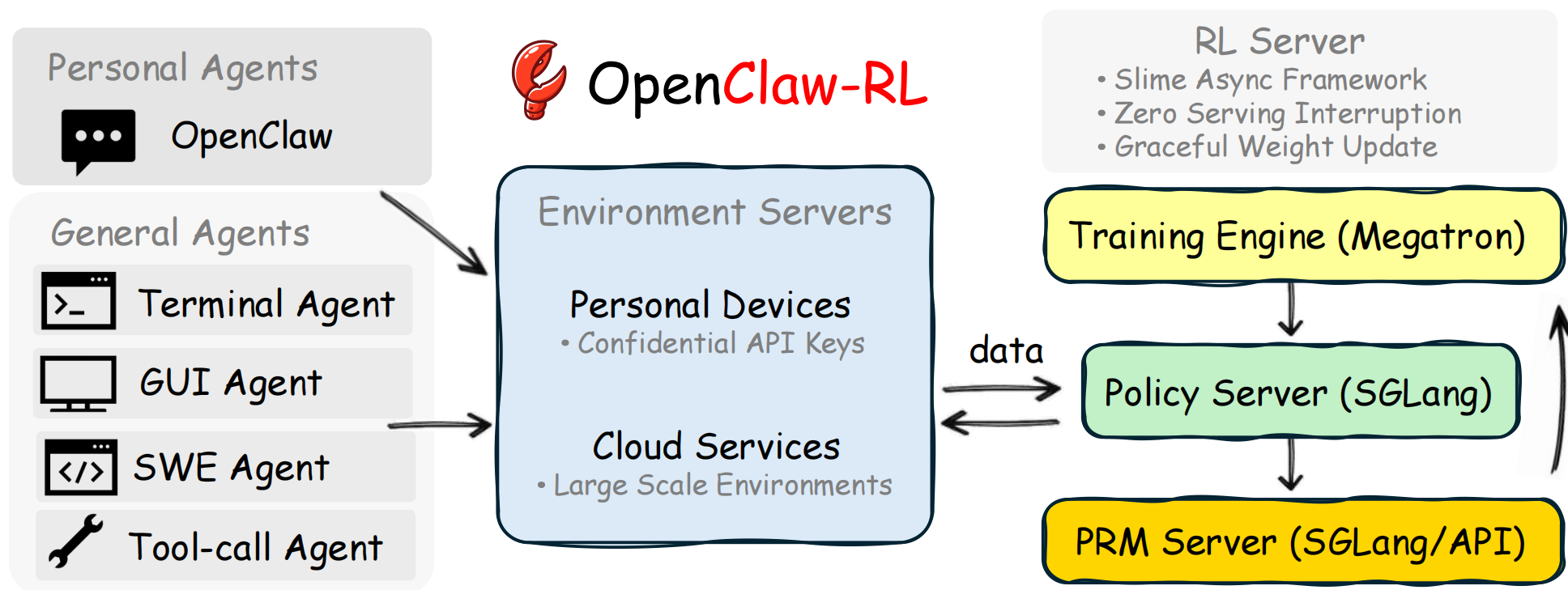
Highlights: Fully async 4-component loop · Self-hosted & private · Zero manual labeling · Three learning paradigms (Binary RL / OPD / Combine) · Personal + General agent support
🌈 Features
Fully Asynchronous 4-Component Architecture
OpenClaw-RL decouples agent serving, rollout collection, PRM/judge evaluation, and policy training into independent async loops. None of them block one another: the model continues serving requests while training runs in the background, and judging happens concurrently with new interactions.
Self-Hosted & Private by Design
The entire stack, including the policy model, judge/PRM, and trainer, runs on your own infrastructure. Conversation data stays within your system, and no third-party model API is required.
From Feedback to Gradient — Automatically
You do not need to manually label data. The system automatically:
- Organizes multi-turn interactions into session-aware training trajectories
- Classifies API messages into main-line (trainable) vs. side (non-trainable) turns
- Uses the next user, environment, or tool feedback as a natural "next-state" signal
- Runs PRM/judge evaluation asynchronously, with majority voting when needed for more robust scoring
- Submits ready samples to the trainer as they become available
Three Optimization Methods in One Framework
Binary RL (GRPO): A Process Reward Model scores each turn based on next-state feedback. The scalar reward is then used with GRPO advantage estimation and a PPO-style clipped surrogate loss.
On-Policy Distillation (OPD): When the next state reveals useful hindsight, a judge model extracts a textual hint. This hint augments the original prompt to create an enhanced teacher, whose token-level log-probability gap with the student becomes a directional advantage signal richer than any scalar reward.
Hybrid Method: OpenClaw-RL further combines Binary RL and OPD in a unified training recipe, leveraging the dense scalar supervision of Binary RL together with the richer token-level directional signal from OPD. This combination achieves stronger and more robust optimization than either method alone.
From Personal Agents to Real-World Agentic RL
The same framework supports both personalized OpenClaw optimization and scalable RL for terminal, GUI, SWE, and tool-call agents in real-world settings.
🎯 Roadmap
Our long-term goal is to advance personalized, practically useful agents with reinforcement learning. The roadmap has two tracks:
✅ Release Track 1: Fully async OpenClaw-RL framework with Binary RL + OPD
✅ Best recipe discovery via demonstration experiments
✅ Support LoRA Training
✅ Deploy training on Tinker
✅ Deploy training on Fireworks AI
✅ Release Track 2: Scalable agentic RL infra for general agents
✅ Support Qwen3.5
⬜ Support more cloud services
📝 Contents
🔧 Personal Agent Optimization Quick Start
1. Deployment Requirements
- Hardware: 8× GPUs (default; configurable via
NUM_GPUS, ACTOR_GPUS, ROLLOUT_GPUS, PRM_GPUS)
- Software: CUDA 12.9, Python 3.12
- Framework: Slime (our base RL framework)
For detailed environment setup, see Slime or ./instructions/README.md.
2. Start the RL Server
cd slime
bash ../openclaw-combine/run_qwen3_4b_openclaw_topk_select.sh
This method combines binary RL and OPD to achieve the best optimization.
See ./openclaw-combine/README.md for algorithm details.
Once running, the model is served as an OpenAI-compatible API at:
http://<HOST_IP>:30000/v1
where <HOST_IP> is the IP address of the machine running the RL server (e.g. 115.190.98.251). The port 30000 is the default and can be changed via the PORT environment variable.
Take note of this endpoint — you will need it when configuring OpenClaw in the next step.
We also provide an interesting case for evaluation. A student who uses OpenClaw to do homework, does not want to be found using AI. A teacher who also uses OpenClaw to grade student's homework, wants the comments to be specific and friendly.
Evaluation Setting — Both student, TA and teacher use AI!
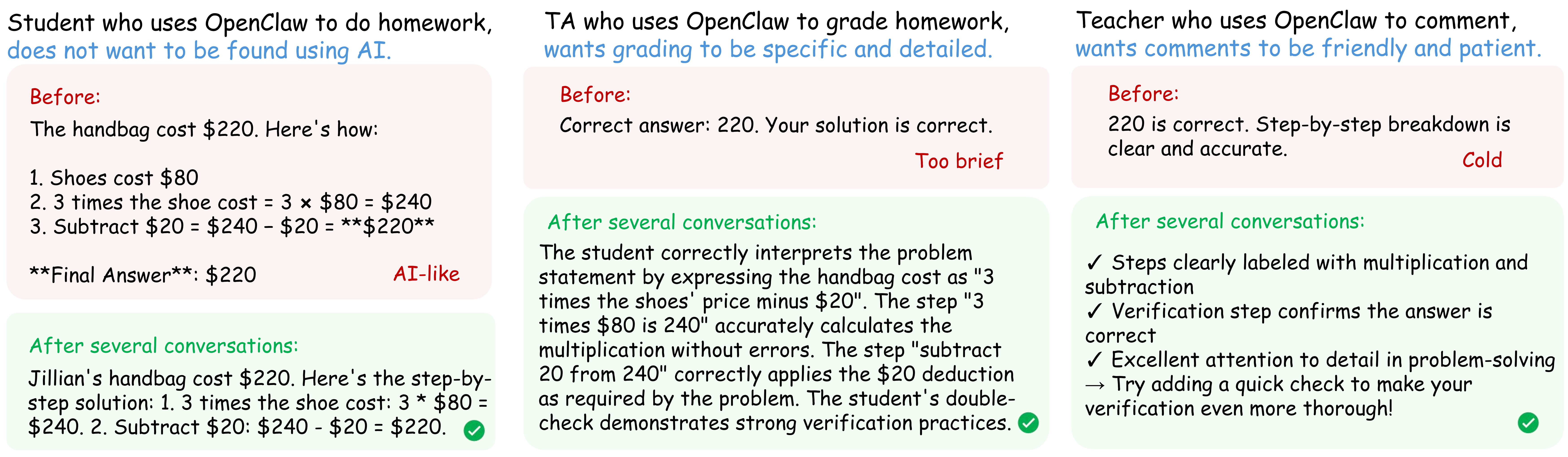
See ./openclaw-test/README.md for setup and algorithm details. Example of evaluation results.
3. OpenClaw Setup
You can use your own openclaw, just install this extension.
Then configure OpenClaw to route requests to your RL server.
Open your openclaw.json (or the equivalent settings file) and add a provider entry under "models" → "providers":
Example of Slime-based RL server:
{
  "models": {
    "providers": {
      "qwen": {
        "baseUrl": "http://<HOST_IP>:30000/v1",
        "apiKey": "apiKey",
        "api": "openai-completions",
        "models": [
          {
            "id": "qwen3-4b",
            "name": "Qwen3 4B",
            "reasoning": true,
            "input": ["text"],
            "cost": {
              "input": 0,
              "output": 0,
              "cacheRead": 0,
              "cacheWrite": 0
            },
            "contextWindow": 32768,
            "maxTokens": 8192
          }
        ]
      }
    }
  }
}
Replace <HOST_IP> with the IP address of your RL server machine. The apiKey should match the SGLANG_API_KEY you set when starting the server.
Example of Tinker-based RL server:
{
  "models": {
    "providers": {
      "openclaw-rl": {
        "baseUrl": "http://localhost:30000/v1",
        "apiKey": "no-auth-needed",
        "api": "openai-completions",
        "models": [
          {
            "id": "qwen3-4b-lora",
            "name": "Qwen3 4B (OpenClaw-RL LoRA)",
            "reasoning": true,
            "input": ["text"],
            "cost": {
              "input": 0,
              "output": 0,
              "cacheRead": 0,
              "cacheWrite": 0
            },
            "contextWindow": 32768,
            "maxTokens": 8192
          }
        ]
      }
    }
  }
}
That's it — start chatting with your OpenClaw agent. The RL server will automatically collect conversation trajectories, compute rewards, and train the model. Your agent gets better the more you use it.
🔧 Agentic RL in Real-world Settings
The same asynchronous RL backbone that powers our personal-agent setting can also support large-scale optimization for these broader real-world environments.
| Setting |
Environment |
Next-state signal |
Horizon |
| Terminal |
Shell execution sandbox |
stdout/stderr, exit code |
Long |
| GUI |
Screen state + accessibility tree |
Visual state diff, task progress |
Long |
| SWE |
Code repository + test suite |
Test verdicts, diff, lint output |
Long |
| Tool-call |
API/function execution |
Return values, error traces |
Medium |
🖥️ Terminal Agent — the most widely used computer-use agent
cd slime
bash ../terminal-rl/terminal_qwen3_8b_rl.sh
See ./terminal-rl/README.md for setup details.
📟 GUI Agent — the most general computer-use agent
cd slime
bash ../gui-rl/gui_qwen3vl_8b_rl.sh
See ./gui-rl/README.md for setup details.
👨💻 SWE Agent — software engineering agent
cd slime
bash ../swe-rl/run_swe_rl_32b_remote_8nodes.sh
See ./swe-rl/README.md for setup details.
cd slime
bash ../toolcall-rl/retool_qwen3_4b_rl.sh
See ./toolcall-rl/README.md for setup details.
📖 Citation
@article{wang2026openclawrl,
  title={OpenClaw-RL: Train Any Agent Simply by Talking},
  author={Wang, Yinjie and Chen, Xuyang and Jin, Xiaolong and Wang, Mengdi and Yang, Ling},
  journal={arXiv preprint arXiv:2603.10165},
  year={2026}
}

@article{wang2026rlanything,
  title={RLAnything: Forge Environment, Policy, and Reward Model in Completely Dynamic RL System},
  author={Wang, Yinjie and Xie

 OpenClaw-RL 是一个完全异步的强化学习框架,它能把你与智能体的日常对话转化为训练信号。你只需与个性化的 OpenClaw 智能体聊天就能训练它,也可以训练通用智能体,用于终端、图形界面、软件工程(SWE)和工具调用等任务。