18.7K ·GitHub
What is this?
 Agent Lightning is an open-source reinforcement-learning training framework from Microsoft that lets you train any existing AI agent with RL, with almost zero changes to the agent's own code.
Is this an agent itself or a framework for training agents?It's a training framework, not an agent. It sits between your existing agent and the LLM via a proxy that turns the agent's model calls into reinforcement-learning training data, while your agent's own tools and control flow stay untouched.
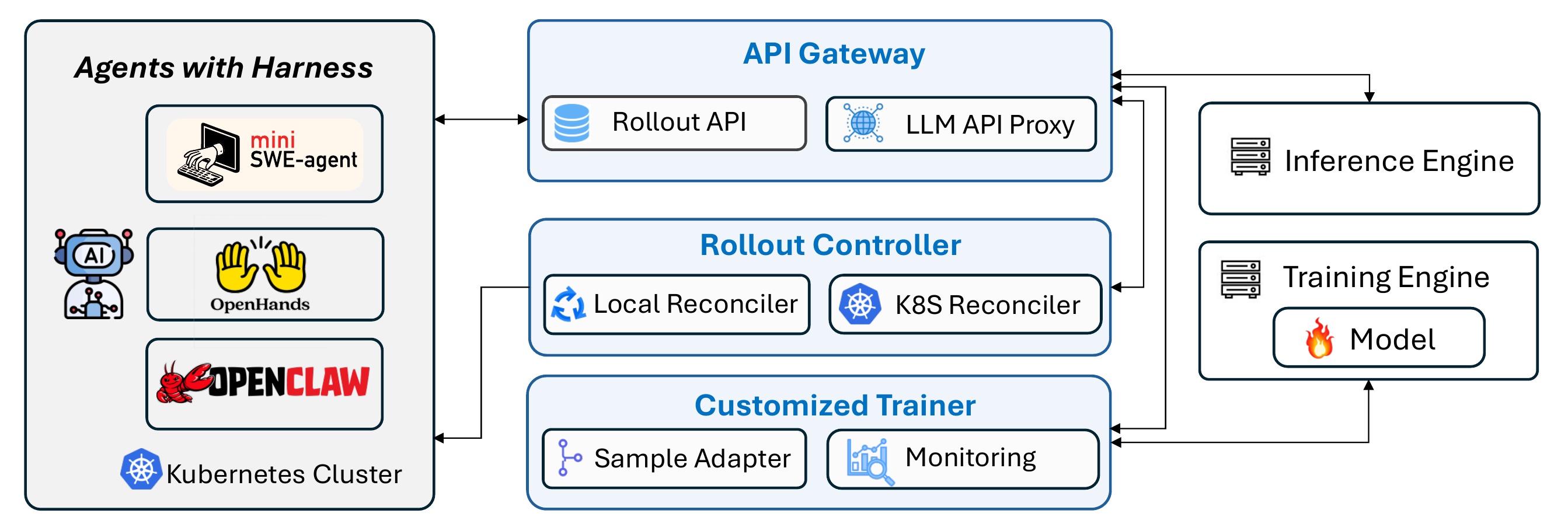
It's a training framework, not an agent. It sits between your existing agent and the LLM via a proxy that turns the agent's model calls into reinforcement-learning training data, while your agent's own tools and control flow stay untouched.How do I get it running?Set up a CUDA GPU machine and follow the Installation Guide; the Trainer runs verl and vLLM, the API Gateway proxies your agent's model requests, and the Rollout Controller launches your agent locally or as Kubernetes Jobs.
Set up a CUDA GPU machine and follow the Installation Guide; the Trainer runs verl and vLLM, the API Gateway proxies your agent's model requests, and the Rollout Controller launches your agent locally or as Kubernetes Jobs.Do I need to rewrite my agent to train it with this?No — that's the core design goal. Your agent keeps its existing harness, tools, and control flow; it just routes model calls through the Agent Lightning proxy instead of calling the model directly.
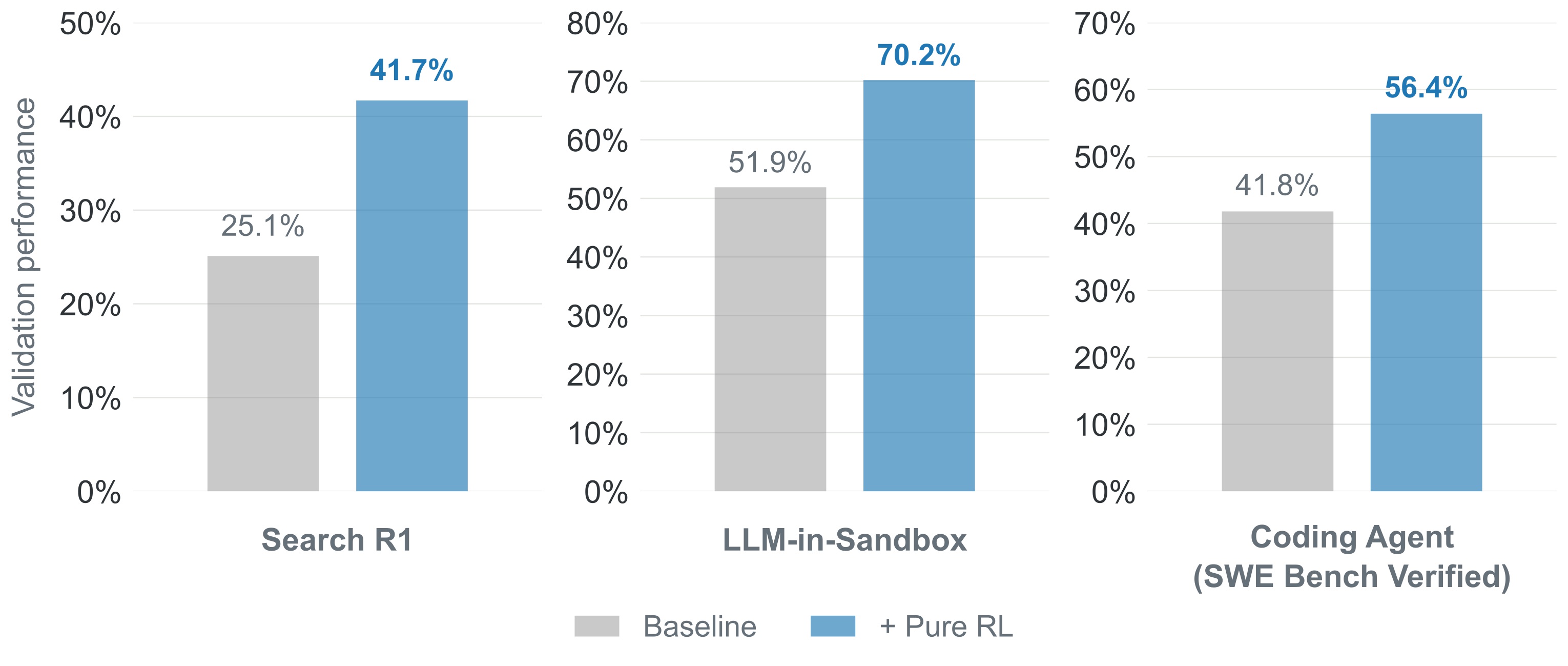
No — that's the core design goal. Your agent keeps its existing harness, tools, and control flow; it just routes model calls through the Agent Lightning proxy instead of calling the model directly.What results has it achieved on coding agents?Using only 6K training samples, an end-to-end Qwen3.5-9B coding agent workflow trained with Agent Lightning improved SWE-bench Verified from 41.8% to 56.4%, a 14.6 point gain.
Using only 6K training samples, an end-to-end Qwen3.5-9B coding agent workflow trained with Agent Lightning improved SWE-bench Verified from 41.8% to 56.4%, a 14.6 point gain.What example tasks come with the framework?It ships with POC examples covering Calc-X math reasoning, GSM8K, ScienceWorld science tasks, Search-R1 multi-turn retrieval, LLM-in-Sandbox tool use, and a full coding agent trained on repository tests.
It ships with POC examples covering Calc-X math reasoning, GSM8K, ScienceWorld science tasks, Search-R1 multi-turn retrieval, LLM-in-Sandbox tool use, and a full coding agent trained on repository tests.Why is the codebase kept so small?The project treats simplicity as a first principle, keeping the whole framework to roughly 3,500 lines of code so the training architecture stays easy to understand and extend.
The project treats simplicity as a first principle, keeping the whole framework to roughly 3,500 lines of code so the training architecture stays easy to understand and extend.What are the three core components?The Trainer runs verl and vLLM to build training samples and update the policy, the API Gateway proxies model requests and captures training data, and the Rollout Controller runs agents locally or as Kubernetes Jobs.
The Trainer runs verl and vLLM to build training samples and update the policy, the API Gateway proxies model requests and captures training data, and the Rollout Controller runs agents locally or as Kubernetes Jobs.What are similar projects?OpenClaw-RL, DeepAnalyze, reef, ART, minimind, halo, verl, open-r1
OpenClaw-RL, DeepAnalyze, reef, ART, minimind, halo, verl, open-r1Which topics is it in?llm-training, mlops, llm-agents, vllm, agent-framework, reinforcement-learning, qwen, fine-tuning, openai-compatible, agentic-ai, kubernetes, cuda
llm-training, mlops, llm-agents, vllm, agent-framework, reinforcement-learning, qwen, fine-tuning, openai-compatible, agentic-ai, kubernetes, cuda