4.8K ·GitHub
What is this?
 Marble Skill Taxonomy is an open dataset mapping what children learn in primary/elementary school, broken into 1,590 fine-grained micro-topics linked by a prerequisite graph and aligned to national curriculum standards like NGSS and Common Core.
Marble Skill Taxonomy is an open dataset mapping what children learn in primary/elementary school, broken into 1,590 fine-grained micro-topics linked by a prerequisite graph and aligned to national curriculum standards like NGSS and Common Core.Is this a tool I run, or just data files?It's pure data: plain JSON files under data/ plus JSON Schemas under schema/, with no runtime, library, or code to install.
It's pure data: plain JSON files under data/ plus JSON Schemas under schema/, with no runtime, library, or code to install.How do I actually use the data?Load the JSON files directly — topics.json, dependencies.json, curriculum-standards.json, clusters.json and manifest.json all live in data/ as UTF-8 JSON — in whatever language or tool you want.
Load the JSON files directly — topics.json, dependencies.json, curriculum-standards.json, clusters.json and manifest.json all live in data/ as UTF-8 JSON — in whatever language or tool you want.Do I need any libraries to work with it?No — it's plain JSON with no runtime or package dependencies; the included validate.mjs script just needs Node.js if you want to check structure and referential integrity.
No — it's plain JSON with no runtime or package dependencies; the included validate.mjs script just needs Node.js if you want to check structure and referential integrity.What's deliberately left out of the dataset?Marble excludes semantic embeddings, since they're derived and recomputable, and any per-child or user data, which is never published.
Marble excludes semantic embeddings, since they're derived and recomputable, and any per-child or user data, which is never published.Does it contain any personal data about real kids?No — any per-child or user data is deliberately never published in this release.
No — any per-child or user data is deliberately never published in this release.What are the licensing terms?It's multi-licensed: the database structure, IDs and relationships are ODbL 1.0 (free for research and commercial use, attribution + share-alike), Marble's authored text is CC BY-SA 4.0, and curriculum-standards.json keeps each source's own upstream license.
It's multi-licensed: the database structure, IDs and relationships are ODbL 1.0 (free for research and commercial use, attribution + share-alike), Marble's authored text is CC BY-SA 4.0, and curriculum-standards.json keeps each source's own upstream license.Can I build a commercial product on this without open-sourcing my product?Yes — ODbL only requires you to share back improvements to the taxonomy database itself (a 'derivative database'); using it inside a product, model, or app (a 'produced work') stays yours.
Yes — ODbL only requires you to share back improvements to the taxonomy database itself (a 'derivative database'); using it inside a product, model, or app (a 'produced work') stays yours.How are the micro-topics structured?Each topic has an id, a plain-language description, mastery evidence criteria, a type (conceptual / procedural / representational / language / meta), a subject and domain, an approximate age range, and links into curriculum-standards.json.
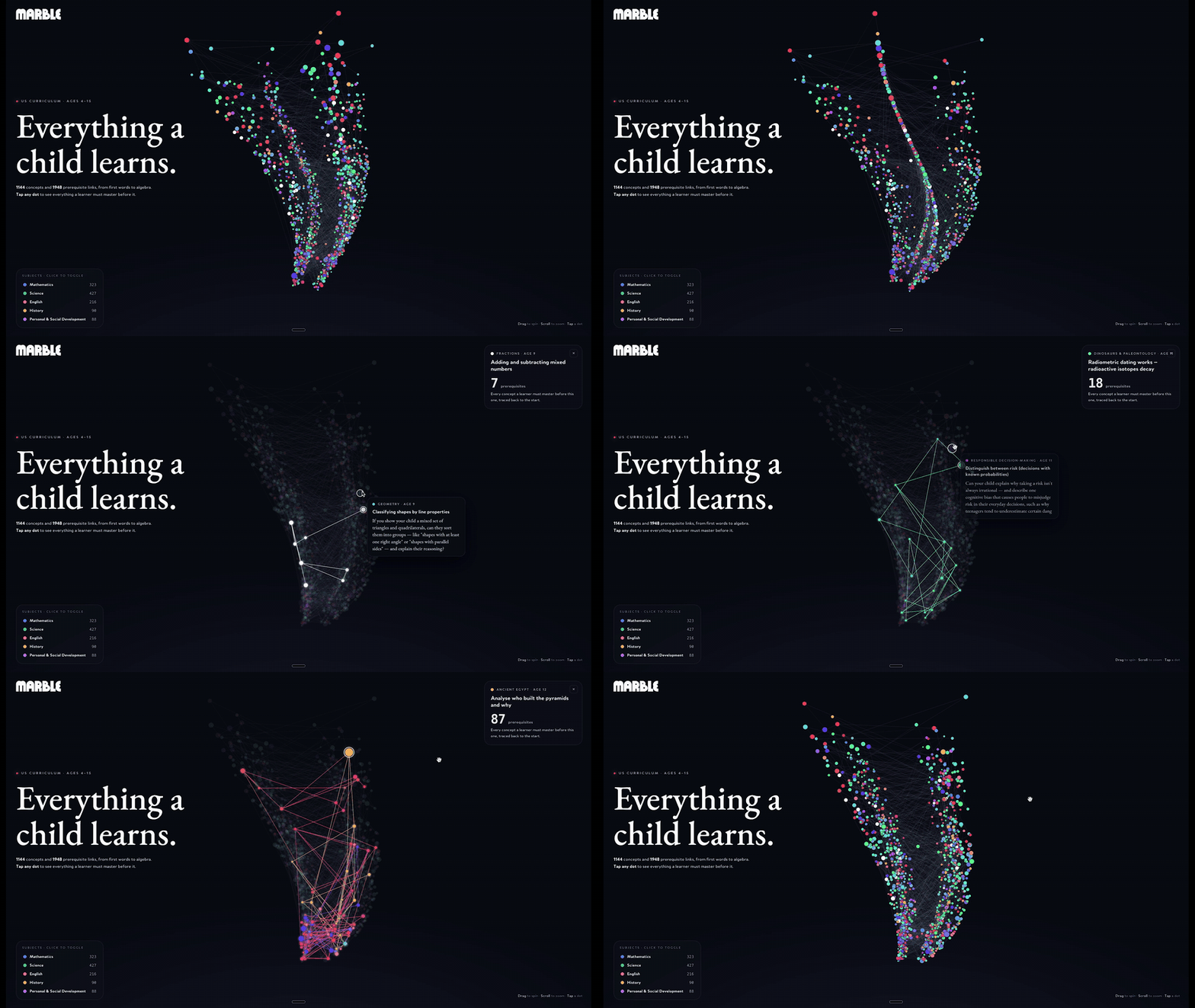
Each topic has an id, a plain-language description, mastery evidence criteria, a type (conceptual / procedural / representational / language / meta), a subject and domain, an approximate age range, and links into curriculum-standards.json.How can I explore the taxonomy visually?Marble has an interactive explorer at withmarble.com/curriculum where every dot is a micro-topic colored by subject, height represents age, and threads show prerequisites you can trace.
Marble has an interactive explorer at withmarble.com/curriculum where every dot is a micro-topic colored by subject, height represents age, and threads show prerequisites you can trace.Which curriculum standards is it aligned to?Topics link to source standards including NGSS, Common Core, and the UK National Curriculum, among others.
Topics link to source standards including NGSS, Common Core, and the UK National Curriculum, among others.What are similar projects?ajv, react-jsonschema-form, sqlmodel, pkl, prediction-market-analysis, elosys, big-list-of-naughty-strings, exercises-dataset
ajv, react-jsonschema-form, sqlmodel, pkl, prediction-market-analysis, elosys, big-list-of-naughty-strings, exercises-datasetWhich topics is it in?dag, json-schema, metadata, schema, validation, data, graph, knowledge-graph, dataset, academic-research, json, research
dag, json-schema, metadata, schema, validation, data, graph, knowledge-graph, dataset, academic-research, json, research