Argus
The open-source security operations platform where AI agents do the legwork and you stay in control.


Argus watches your cloud, identity, code, endpoints, network and Kubernetes. It catches
attacks at machine speed, investigates them with AI agents, and contains them in seconds.
Every action is typed, checked against policy, dry-run first and reversible. It is
self-hosted, multi-tenant and MIT licensed, so your security data never leaves your hands.
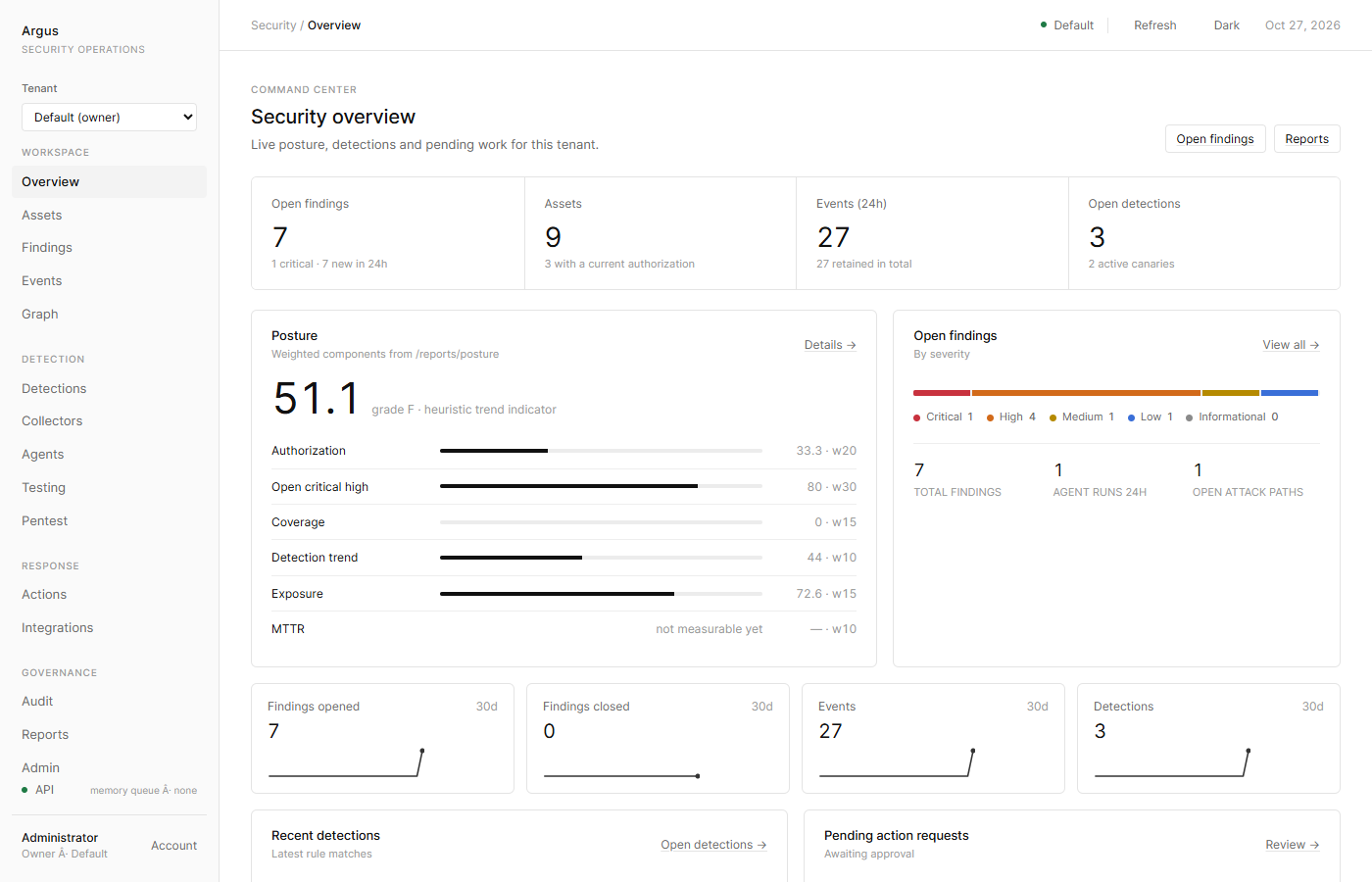
Why Argus
Stop attacks while they are happening, not the next morning. Autonomous response
playbooks act the moment a detection fires: block an attacker at Cloudflare, cut a laptop off
the network through CrowdStrike or SentinelOne, and more from a catalog of 27 typed actions.
They start in shadow mode so you can see what they would do, use only reversible actions,
stay within hourly and blast-radius caps, and roll themselves back unless you keep the change.
Approve from Slack in one click. Approve, deny or roll back actions straight from the
alert. No console, no context switch.
AI that investigates without taking the wheel. Nine specialist agents triage, investigate
and hunt using read-only tools. They can propose a fix but never execute one. Everything they
read is treated as untrusted data, so a prompt injection hidden in a log becomes a signal
instead of a hijack.
See every AI tool your company is really using. The AI gateway puts OpenAI and Anthropic
traffic behind org-held keys, model allowlists, data-loss prevention, prompt-injection flags
and budgets. Shadow-AI discovery finds the services people use without approval, using your
network, cloud and SSO telemetry.
Catch rogue AI agents in the act. Plant canaries built for agents: hidden prompt
injections, agent rules files, a fake MCP server and fake LLM API keys. Any agent that takes
the bait trips a detection, with its IP, model and prompt recorded.
Prove your detections work before an attacker tests them. The agentic attack simulator
replays 8 AI-driven attack scenarios in an isolated sandbox tenant, with optional evasion
variants, and reports exactly which ones you caught, which you missed and which rules were off.
Pentest continuously, not once a year. Autopilot and native autonomous pentesting plan tests,
run them through the scope-checked harness, and re-plan from what they find. They only run inside
scopes a human has marked for unattended testing.
Fix what attackers are exploiting right now. Every finding with a CVE is enriched with
CISA's Known Exploited Vulnerabilities list and EPSS exploit-probability scores, and severity
is raised automatically. It works offline for air-gapped installs.
Never lose a day of data. Encrypted backups run on a schedule and land on disk, S3 or Azure. Restore is one
command, and it proves itself: row counts and every tenant's audit chain are checked before you switch over.
Per-tenant retention keeps the database lean without touching the audit trail.
Audit-ready from day one. A hash-linked, signed audit chain records every action, approval
and agent step, mirrored to S3 Object Lock or Azure immutable storage. Control mappings for
SOC 2, NIST 800-171 and ISO 27001 are included.
Runs anywhere you do. Docker Compose for a pilot, Helm for Kubernetes, and Terraform for
AWS and Azure. Every autonomous feature ships off by default, so you turn on exactly as much
autonomy as you trust.
Tested on every push
692 automated tests run on every commit against both SQLite and PostgreSQL,
alongside Bandit and pip-audit security scans, a container build and smoke test, a full
Compose stack smoke test, and Terraform and Helm validation. docs/GO-LIVE.md walks you
through a production rollout: start in monitoring mode, tune detections to your estate, then
switch on actions and autonomy when you are ready.
Architecture
  Browser / SDK / sensors
          |
          v  HTTPS (Caddy, ALB, Front Door or your ingress)
  +-------------------------------------------------------------+
  |  API  (FastAPI)  auth: session / OIDC+PKCE / TOTP / API keys |
  |  RBAC (viewer < analyst < operator < admin < owner), CSRF,   |
  |  per-principal rate limits, request ids, security headers    |
  +------+------------------+------------------+----------------+
         |                  |                  |
   PostgreSQL           Redis queue        Audit chain
   (tenant_id on       (leases, retries,   (hash-linked per tenant,
    every table)        python -m          HMAC, JSONL / S3 Object
                        app.worker)        Lock / Azure immutable)
         |                  |
  +------+------------------+----------------------------------+
  |  Worker processes run the same handlers as the API:        |
  |   collectors.run   detections.run / baselines              |
  |   graph.recompute  testing.run   agents.run                |
  |   autoresponse.evaluate   testing.autopilot   pentest.run  |
  |   discovery.run   exploit.execute   simulation.run         |
  |   intel.enrich / refresh   ai.discover                     |
  +------------------------------------------------------------+
         |
         v  agents call propose_action only -> ActionRequest(pending)
  Action broker (separate policy, approvals, dry run, rollback, kill switch)
Trust boundaries, in one sentence each (details in docs/THREAT-MODEL.md):
- Agents cannot execute anything; their one write-capable tool creates a pending request.
Autonomous response acts only through the broker, as the system principal, with reversible
non-critical actions, caps and automatic rollback.
- Everything an agent reads is wrapped as untrusted data and the prompt says so.
- Active testing runs only inside a recorded authorization and scope, re-checked at run time.
- Every domain table carries
tenant_id; queries go through a scoped helper; tests assert it.
- The audit chain is hash-linked, HMAC-signed (required in production), and mirrored to an external, optionally WORM, sink.
What is in this checkout
| Area |
Status |
Where |
| App factory, settings, DB, RBAC, auth (local, OIDC, TOTP, API keys), CSRF, rate limits |
implemented, tested |
app/core/, app/api/auth.py, app/api/deps.py |
| Audit chain with JSONL / S3 Object Lock / Azure immutable blob sinks |
implemented |
app/core/audit.py |
| Job queue (in-memory and Redis, leases, retries, cancellation, reaper) and standalone worker |
implemented |
app/core/queue.py, app/worker.py |
| Prometheus metrics, JSON logging, optional OpenTelemetry tracing |
implemented |
app/core/telemetry.py |
| Evidence graph: nodes, edges, attack paths, exposure scoring |
implemented |
app/graph/, app/api/graph.py |
| Detections: 15 rules (swarm x4, identity x2, cloud, k8s, code, canary, anomaly, agentic x3 including unsanctioned AI service and cross-source attack chain, industrial), baselines, canaries (12 kinds, 4 aimed at AI agents: planted prompt injection, agent rules file, fake MCP server, fake LLM key) |
implemented |
app/detections/, app/api/detections.py, app/api/canaries.py |
| Collectors: AWS, Azure, GCP, Kubernetes, GitHub, Okta, Entra, osquery, netflow |
implemented; cloud SDKs optional |
app/collectors/, app/api/collectors.py |
| Test harness: scope policy (passive, active, intrusive, exploit), rate limits, 28 adapters (web_baseline, browser_xss, caldera, dir_probe, ffuf_dir, gitleaks, idor_probe, js_analyze, js_libs, jwt_analyze, jwt_attack, nmap_sv, nuclei, oob_probe, param_mine, param_probe, payload_fuzz, port_probe, prowler, retire_js, semgrep, sqli_proof, strix, subdomain_enum, trivy, trufflehog_verify, waf_detect, zap) |
implemented; runs the tools installed on your workers or sandbox |
app/testing/, app/api/tests.py, app/api/scans.py |
| Agent runtime, providers (Anthropic, OpenAI, Ollama, none), read-only tools, 9 specialists (including offensive pentest and PoC author), eval suites |
implemented |
app/agents/, app/api/agents.py, app/api/evals.py |
| Action broker: catalog of 27 typed actions (AWS, Azure, GCP, Kubernetes, GitHub, Okta, Entra, Cloudflare, CrowdStrike, SentinelOne, Argus-internal), policy, approvals, dry run, execute, rollback, kill switch |
implemented |
app/actions/, app/api/actions.py |
| Autonomous response: playbooks that act on detections without a human (shadow mode first, reversible actions only, caps, automatic rollback); Slack approve / deny / roll back buttons |
implemented; off by default |
app/actions/autoresponse.py, app/api/autoresponse.py, app/api/slack.py, docs/AUTONOMOUS-RESPONSE.md |
| AI gateway (governed OpenAI / Anthropic proxy: org-held keys, model allowlists, DLP, prompt-injection flags, budgets, usage log) and shadow-AI discovery from network, cloud and SSO telemetry |
implemented; gateway off by default |
app/ai/, app/api/ai_gateway.py, app/api/ai_inventory.py, docs/AI-GATEWAY.md |
| Autonomous pentesting, native pentest orchestrator, recon/browser discovery, and gVisor PoC exploit sandbox |
implemented; gated by scope, asset authorization and kill switches |
app/testing/autopilot.py, app/pentest/, app/discovery/, app/exploit/, docs/AUTOPENTEST.md, docs/NATIVE-PENTEST.md, docs/DISCOVERY.md, docs/EXPLOIT-SANDBOX.md |
| Threat intel: automatic CISA KEV and EPSS enrichment of findings, offline cache |
implemented |
app/intel/, app/api/intel.py, docs/INTEL.md |
| Agentic attack simulator: 8 agent-driven attack scenarios replayed in an isolated sandbox tenant, coverage report, evasion variants |
implemented |
app/simulator/, app/api/simulations.py, docs/SIMULATOR.md |
Integrations: 15 inbound sources (14 parser modules; network covers Suricata and Zeek) behind POST /api/v1/ingest/{source}, 6 outbound channels (webhook, Slack, Jira, ServiceNow, PagerDuty, email) with deliveries and retries, Wazuh indexer pull |
implemented |
app/integrations/, app/api/ingest.py, app/api/integrations.py |
| Backups and retention: scheduled encrypted backups to disk, S3 and Azure, verified one-command restore, per-tenant retention policies |
implemented |
app/ops/, app/api/backups.py, app/api/retention.py, docs/BACKUP.md |
| Admin, assets, findings, events, investigations, approvals, audit, reports routers |
implemented |
app/api/ |
Alembic migrations (18 revisions, through fail-closed tenant RLS, session revocation and unique action approvals) and scripts/migrate.py |
implemented |
alembic/, docs/MIGRATIONS.md |
| Containers, compose, Helm, Terraform (AWS, Azure), CI, observability, docs |
implemented |
Dockerfile, compose*.yaml, infra/, .github/, docs/ |
Routers are discovered automatically. The full v1 surface is in docs/API.md.
Quick start (development, SQLite, no Docker)
Requirements: Python 3.12 or 3.13.
python -m venv .venv && . .venv/bin/activate        # Windows: .venv\Scripts\activate
pip install -r requirements.txt -r requirements-dev.txt
cp .env.example .env
python scripts/generate_secrets.py --write          # fills the three REPLACE_ values, plus AUDIT_SIGNING_KEY and DATA_ENCRYPTION_KEY when they are empty
uvicorn app.main:app --host 127.0.0.1 --port 8080
Open http://127.0.0.1:8080 and sign in as ADMIN_EMAIL / ADMIN_PASSWORD from .env.
With REDIS_URL empty, jobs run inside the API process (WORKERS_INPROCESS=true). With
DB_AUTO_CREATE=true (the default) tables are created at startup; for Alembic-managed
schemas set it to false and run python scripts/migrate.py (see docs/MIGRATIONS.md).
Synthetic demo data in an isolated tenant (never touches the network):
python scripts/seed_demo.py
It prints a demo tenant login and creates DEMO-labelled assets, authorizations, events that
trip cloud.public_exposure_change and swarm.machine_speed_sequence, findings, a canary and
an agent run record. Refuses to run when APP_ENV=production.
Tests:
python -m pytest -q
Pilot (Docker Compose: API, worker, PostgreSQL, Redis)
cp .env.example .env && python scripts/generate_secrets.py --write
docker compose up --build -d
docker compose logs -f api
compose.yaml binds the API to 127.0.0.1:8080 only, runs the API and worker from one image
with a read-only root filesystem, no capabilities and no Docker socket, mounts ./targets
read-only, and applies the schema at API start (RUN_MIGRATIONS=true). Add
--profile observability for an OpenTelemetry collector, Prometheus (scraping /metrics) and
Grafana with the dashboard in infra/grafana/argus.json.
TLS termination for a single host:
# .env: APP_ENV=production COOKIE_SECURE=true BASE_URL=https://host ARGUS_DOMAIN=host [email protected]
docker compose -f compose.yaml -f compose.prod.yaml up -d
Production
Kubernetes: infra/helm/argus (API + worker deployments, HPA, PDB, default-deny
NetworkPolicy, ingress with TLS, optional ServiceMonitor). AWS: infra/terraform (ECS
Fargate, RDS, ElastiCache, S3 Object Lock audit bucket, Secrets Manager, ALB + WAF).
Azure: infra/terraform-azure (Container Apps, Flexible Postgres, Azure Cache, immutable
blob container, Key Vault, Front Door + WAF).
The production checklist is in docs/DEPLOYMENT.md. The short version, enforced partly by
assert_safe_config() at startup:
APP_ENV=production refuses to start without PostgreSQL, REDIS_URL, COOKIE_SECURE=true,
an https:// BASE_URL, DATA_ENCRYPTION_KEY(S), AUDIT_SIGNING_KEY(S), an external audit
sink, and either OIDC or TOTP_REQUIRED=true.- Dedicated workers (
WORKERS_INPROCESS=false, python -m app.worker).
- Separate PostgreSQL credentials: migrate as the schema owner; run API and workers as a restricted non-owner, non-BYPASSRLS role with tenant RLS enabled and verified. See tenant-isolation deployment guide.
- Use an object-lock audit sink (S3 Object Lock or Azure immutable blob), not only JSONL.
/metrics blocked at the edge; egress filtering for workers; secrets in a secret manager.- Images pinned by digest and verified with cosign (
.github/workflows/release.yml).
Roles
Roles are cumulative (app/core/rbac.py):
| Role |
Adds |
| viewer |
read everything in the tenant, including autoresponse playbooks and the AI inventory |
| analyst |
edit findings and detections, run agents and evals, manage canaries, record approvals, use the AI gateway |
| operator |
manage and authorize assets, run tests, scans, autopilot and collectors, request, approve, execute and roll back actions, run detections and simulations |
| admin |
users, API keys, settings, collector and integration configuration, the actions kill switch, test scopes (including marking one autonomous), autoresponse playbooks, AI gateway policy |
| owner |
tenant settings, approving critical actions; owners of the bootstrap tenant also manage backups |
API keys carry a role and optional scopes (for example ingest) that further restrict them.
A system principal is used only inside queue handlers.
How agents, testing and actions are governed
Agents (app/agents/runtime.py). A specialist is an AgentSpec with a system prompt, a
list of tool names, an output schema and budgets (AGENT_MAX_STEPS, AGENT_MAX_TOKENS,
AGENT_MAX_SECONDS, AGENT_COST_CEILING_USD, with AGENT_MODEL_PRICES for models outside
the built-in Claude price table). Tools are read-only views over Argus data;
the only propose tool creates a pending ActionRequest through the broker. Every tool
result is redacted, truncated and wrapped as <untrusted_data source=...>; the guardrail
prompt tells the model that instructions inside evidence are indicators of injection. Each
model and tool step is persisted (agent_steps) with input hash, tokens and latency. With
AI_PROVIDER=none, specialists run deterministic fallbacks. Prompt-injection and precision
eval suites live in app/agents/evals/suites/.
Testing (app/testing/). A TestScope lists assets, allowed tiers (passive, active,
intrusive, exploit), environments, a UTC window, a rate limit and a concurrency limit (runs beyond
max_concurrency wait in the queue). A run is allowed only if
the asset has a current AssetAuthorization whose flags permit the tier, the scope permits
it, the window is open and the target passes policy validation. scope.check() runs at
request time and again inside the worker; intrusive and exploit tiers are limited to staging and lab
environments by default. External tools run through run_tool() with a fixed argv, a timeout, bounded
output and a minimal environment.
Actions (app/actions/). Typed actions declare risk, reversibility and a parameter
schema, and implement dry_run, execute and rollback. A request (from an operator or an
agent's propose_action) goes through policy (app/actions/policy.py: kill switch, tenant
actions_enabled, deny-lists, maintenance window, auto-approval only for low-risk reversible
actions when ACTIONS_AUTO_APPROVE_LOW), approvals (approver differs from requester; high risk
needs two when ACTIONS_REQUIRE_TWO_FOR_HIGH; critical additionally needs a principal with
actions:approve_critical), a dry run with blast radius, execution as the actions.execute
queue job with a stored rollback payload, and an audit entry at every transition.
ACTIONS_KILL_SWITCH=true (global, environment) or POST /api/v1/actions/kill-switch
(per tenant, sets actions_enabled=false) rejects every request and execution.
Autonomy (docs/AUTONOMOUS-RESPONSE.md, docs/AUTOPENTEST.md). Both autonomous features
need a global switch and a tenant opt-in, and both are off by default. Autonomous response
playbooks start in shadow mode (they record what they would have done), may only use
reversible, non-critical actions, are capped per hour and by blast radius, roll actions back
automatically unless a human keeps them, and ignore detections from the simulator. Autopilot
runs only in scopes a human has marked autonomous; the red-team agent plans, and every test
it proposes is re-checked by the normal scope machinery before and during execution.
AUTOPENTEST_KILL_SWITCH and the actions kill switch stop each one at once.
Documentation
| Document |
Content |
docs/ARCHITECTURE.md |
design: packages, interfaces, data model, API table |
docs/API.md |
v1 route summary with status |
docs/DEPLOYMENT.md |
dev, compose, Kubernetes, AWS, Azure; production checklist |
docs/AUTONOMOUS-RESPONSE.md |
autonomous response playbooks, safety limits, Slack buttons |
docs/AUTOPENTEST.md |
autonomous pentesting gates and how runs proceed |
docs/AI-GATEWAY.md |
AI gateway policy, DLP, budgets and shadow-AI discovery |
docs/SIMULATOR.md |
agentic attack simulator scenarios and coverage reports |
docs/INTEL.md |
CISA KEV and EPSS enrichment, caching and offline mode |
docs/BACKUP.md |
backups, restore procedure and drill, data retention policies |
docs/MIGRATIONS.md |
Alembic workflow |
docs/GO-LIVE.md |
step-by-step production rollout in monitoring-only mode |
docs/SECURITY.md |
security model as implemented, reporting |
docs/THREAT-MODEL.md |
STRIDE per trust boundary, prompt injection, SSRF, tenancy, credentials, broker abuse, supply chain |
docs/RUNBOOKS.md |
incident procedures |
docs/COMPLIANCE.md |
SOC 2 / NIST 800-171 / ISO 27001 control mapping and the evidence Argus produces for each control |
docs/ROADMAP.md |
implemented versus next |
CONTRIBUTING.md |
contributing guide |
Security
Please report vulnerabilities privately through GitHub's private vulnerability reporting
(Security tab), not in public issues. Details in docs/SECURITY.md.
License
MIT for this repository. Third-party tools (nuclei, ZAP, Prowler, CALDERA, Semgrep, Gitleaks,
Trivy), cloud SDKs and model providers are governed by their own licenses and terms.

 Argus 是一个开源的自托管安全运营平台。AI 智能体会在云、身份、代码、终端、网络和 Kubernetes 等领域调查告警,而它提出的任何操作都需要由人工批准或拒绝。