
This repository is an overview of what you need to learn penetration testing and a collection of hacking tools, resources and references to practice ethical hacking. Most of the tools are UNIX compatible, free and open source.
Status
This project has been terminated and archived. Content might be outdated.
Before you start
- If you're new to information security, forget everything you know about hacking.
- Don't start using tools without reading about pen testing and how it works (see Additional resources section).
- Don't download or use tools if you haven't audited its code.
- Don't use these tools to do stupid things like investigating/hacking without consent on your friends, or worst, your recruiter.
- Read books, manuals, articles, be curious and not just a script kiddie.
- I wish you don't use these tools for illegal purposes, but if you do, I sure hope you know what you're doing.
- Practice using challenges, not real targets!
Table of Contents
(TOC made with nGitHubTOC)
Introduction
What is penetration testing?
Penetration testing is a type of security testing that is used to test the security of an application. It is conducted to find a security risk which might be present in a system.
If a system is not secure, then an attacker may be able to disrupt or take unauthorized control of that system. A security risk is normally an accidental error that occurs while developing and implementing software. For example, configuration errors, design errors, and software bugs, etc. Learn more
Want to become a penetration tester?
Knowing about risks on the internet and how they can be prevented is very useful, especially as a developer. Web hacking and penetration testing is the v2.0 of self-defense! But is knowing about tools and how to use them really all you need to become a pen tester? Surely not. A real penetration tester must be able to proceed rigorously and detect the weaknesses of an application. They must be able to identify the technology behind and test every single door that might be open to hackers.
This repository aims first to establish a reflection method on penetration testing and explain how to proceed to secure an application. And secondly, to regroup all kind of tools or resources pen testers need. Be sure to know basics of programming languages and internet security before learning pen testing.
Also, this is important to inform yourself about the law and what you are allowed to do or not. According to your country, the computer laws are not the same. First, check laws about privacy and surveillance: Nine eyes countries, Five eyes and Fourteen Eyes. Always check if what you're doing is legal. Even when it's not offensive, information gathering can also be illegal!
(Table of Contents)
Some vocabulary
Infosec: Information security, which is the practice of preventing unauthorized access, use, disclosure, disruption, modification, inspection, recording or destruction of information. The information or data may take any form, e.g. electronic or physical. Infosec can also be a person who practices ethical security. Wikipedia
Opsec: Operations security, which is a process that identifies critical information to determine if friendly actions can be observed by enemy intelligence, determines if information obtained by adversaries could be interpreted to be useful to them, and then executes selected measures that eliminate or reduce adversary exploitation of friendly critical information. Wikipedia
Black/grey/white hat hacker: Someone who uses bugs or exploits to break into systems or applications. The goal and the method differs depending if they're a black, grey or white hat hacker. A black hat is just someone malicious that does not wait permission to break into a system or application. A white hat is usually a security researcher who practice ethical hacking. A grey hat is just in the middle of these two kind of hackers, they might want to be malicious if it can be benefit (data breach, money, whistleblowing ...).
Red team: According to Wikipedia, a red team or the red team is an independent group that challenges an organization to improve its effectiveness by assuming an adversarial role or point of view. It is particularly effective in organizations with strong cultures and fixed ways of approaching problems. The United States intelligence community (military and civilian) has red teams that explore alternative futures and write articles as if they were foreign world leaders. Little formal doctrine or publications about Red Teaming in the military exist. In infosec exercises, Red teamers are playing the role of attackers. Wikipedia
Blue team: A blue team is a group of individuals who perform an analysis of information systems to ensure security, identify security flaws, verify the effectiveness of each security measure, and to make certain all security measures will continue to be effective after implementation. As a result, blue teams were developed to design defensive measures against red team activities. In infosec exercises, Blue teamers are playing the role of defenders. Wikipedia
Penetration tester: An ethical hacker who practices security, tests applications and systems to prevent intrusions or find vulnerabilities.
Security researcher: Someone who practices pen testing and browses the web to find phishing/fake websites, infected servers, bugs or vulnerabilities. They can work for a company as a security consultant and are most likely a Blue teamer.
Reverse engineering: Reverse engineering, also called back engineering, is the process by which a man-made object is deconstructed to reveal its designs, architecture, or to extract knowledge from the object. Similar to scientific research, the only difference being that scientific research is about a natural phenomenon. Wikipedia
Social engineering: In the context of information security, it refers to psychological manipulation of people into performing actions or divulging confidential information. A type of confidence trick for the purpose of information gathering, fraud, or system access, it differs from a traditional "con" in that it is often one of many steps in a more complex fraud scheme. The term "social engineering" as an act of psychological manipulation of a human, is also associated with the social sciences, but its usage has caught on among computer and information security professionals. Wikipedia
Threat analyst: A threat hunter, also called a cybersecurity threat analyst, is a security professional or managed service provider (MSP) that proactively uses manual or machine-assisted techniques to detect security incidents that may elude the grasp of automated systems. Threat hunters aim to uncover incidents that an enterprise would otherwise not find out about, providing chief information security officers (CISOs) and chief information officers (CIOs) with an additional line of defense against advanced persistent threats (APTs). SearchCIO
(Table of Contents)
Difference between hacking and ethical hacking
A black hat is practicing penetration testing, but unlike a white hat, this is not ethical hacking. Ethical hacking is about finding vulnerabilities and improve the security of a system. An ethical hacker is the ultimate security professional. Ethical hackers know how to find and exploit vulnerabilities and weaknesses in various systems, just like a malicious hacker (a black hat hacker). In fact, they both use the same skills; however, an ethical hacker uses those skills in a legitimate, lawful manner to try to find vulnerabilities and fix them before the bad guys can get there and try to break in. An ethical hacker is basically a white hat hacker.
(Table of Contents)
Languages
Learning programming is the very first way to start learning about security. There's a lot of languages, most people start with Python, it's the easiest and the most popular one. PHP and Go are the less popular to write security-related stuff, but any of these can still be used in such context. Bash and Powershell are mostly about scripting and writing simple CLI applications.
Since not all languages work the same way, you need to look at how they work and what you want to learn. For example, C++ and Java compile, PHP and Python do not, they are interpreted languages. This definitely changes what you should use them for. Each language also has its own design patterns.
Scripting
Software & mobile apps
General purpose
(Table of Contents)
Content Management Systems
- Wordpress
- Joomla
- Drupal
- SPIP
These are the most used Content Management Systems (CMS). See a complete list here.
(Table of Contents)
Basic steps of pen testing
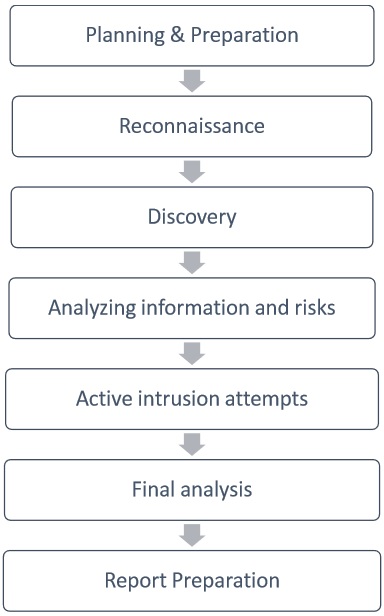
Source: tutorialspoint
Read more about pen testing methodology
(Table of Contents)
A more complete list of tools can be found on Kali Linux official website.
Information Gathering tools allows you to collect host metadata about services and users. Check informations about a domain, IP address, phone number or an email address.
| Tool |
Language |
Support |
Description |
| theHarvester |
Python |
Linux/Windows/macOS |
E-mails, subdomains and names Harvester. |
| CTFR |
Python |
Linux/Windows/macOS |
Abusing Certificate Transparency logs for getting HTTPS websites subdomains. |
| Sn1per |
bash |
Linux/macOS |
Automated Pentest Recon Scanner. |
| RED Hawk |
PHP |
Linux/Windows/macOS |
All in one tool for Information Gathering, Vulnerability Scanning and Crawling. A must have tool for all penetration testers. |
| Infoga |
Python |
Linux/Windows/macOS |
Email Information Gathering. |
| KnockMail |
Python |
Linux/Windows/macOS |
Check if email address exists. |
| a2sv |
Python |
Linux/Windows/macOS |
Auto Scanning to SSL Vulnerability. |
| Wfuzz |
Python |
Linux/Windows/macOS |
Web application fuzzer. |
| Nmap |
C/C++ |
Linux/Windows/macOS |
A very common tool. Network host, vuln and port detector. |
| PhoneInfoga |
Go |
Linux/macOS |
An OSINT framework for phone numbers. |
:lock: Password Attacks
Crack passwords and create wordlists.
| Tool |
Language |
Support |
Description |
| John the Ripper |
C |
Linux/Windows/macOS |
John the Ripper is a fast password cracker. |
| hashcat |
C |
Linux/Windows/macOS |
World's fastest and most advanced password recovery utility. |
| Hydra |
C |
Linux/Windows/macOS |
Parallelized login cracker which supports numerous protocols to attack. |
| ophcrack |
C++ |
Linux/Windows/macOS |
Windows password cracker based on rainbow tables. |
| Ncrack |
C |
Linux/Windows/macOS |
High-speed network authentication cracking tool. |
| WGen |
Python |
Linux/Windows/macOS |
Create awesome wordlists with Python. |
| SSH Auditor |
Go |
Linux/macOS |
The best way to scan for weak ssh passwords on your network. |
:memo: Wordlists
| Tool |
Description |
| Probable Wordlist |
Wordlists sorted by probability originally created for password generation and testing. |
:globe_with_meridians: Wireless Testing
Used for intrusion detection and wifi attacks.
| Tool |
Language |
Support |
Description |
| Aircrack |
C |
Linux/Windows/macOS |
WiFi security auditing tools suite. |
| bettercap |
Go |
Linux/Windows/macOS/Android |
bettercap is the Swiss army knife for network attacks and monitoring. |
| WiFi Pumpkin |
Python |
Linux/Windows/macOS/Android |
Framework for Rogue Wi-Fi Access Point Attack. |
| Airgeddon |
Shell |
Linux/Windows/macOS |
This is a multi-use bash script for Linux systems to audit wireless networks. |
| Airbash |
C |
Linux/Windows/macOS |
A POSIX-compliant, fully automated WPA PSK handshake capture script aimed at penetration testing. |
Acesss systems and data with service-oriented exploits.
| Tool |
Language |
Support |
Description |
| SQLmap |
Python |
Linux/Windows/macOS |
Automatic SQL injection and database takeover tool. |
| XSStrike |
Python |
Linux/Windows/macOS |
Advanced XSS detection and exploitation suite. |
| Commix |
Python |
Linux/Windows/macOS |
Automated All-in-One OS command injection and exploitation tool. |
| Nuclei |
Go |
Linux/Windows/macOS |
Fast and customisable vulnerability scanner based on simple YAML based DSL. |
:busts_in_silhouette: Sniffing & Spoofing
Listen to network traffic or fake a network entity.
| Tool |
Language |
Support |
Description |
| Wireshark |
C/C++ |
Linux/Windows/macOS |
Wireshark is a network protocol analyzer. |
| WiFi Pumpkin |
Python |
Linux/Windows/macOS/Android |
Framework for Rogue Wi-Fi Access Point Attack. |
| Zarp |
Python |
Linux/Windows/macOS |
A free network attack framework. |
:rocket: Web Hacking
Exploit popular CMSs that are hosted online.
| Tool |
Language |
Support |
Description |
| WPScan |
Ruby |
Linux/Windows/macOS |
WPScan is a black box WordPress vulnerability scanner. |
| Droopescan |
Python |
Linux/Windows/macOS |
A plugin-based scanner to identify issues with several CMSs, mainly Drupal & Silverstripe. |
| Joomscan |
Perl |
Linux/Windows/macOS |
Joomla Vulnerability Scanner. |
| Drupwn |
Python |
Linux/Windows/macOS |
Drupal Security Scanner to perform enumerations on Drupal-based web applications. |
| CMSeek |
Python |
Linux/Windows/macOS |
CMS Detection and Exploitation suite - Scan WordPress, Joomla, Drupal and 130 other CMSs. |
:tada: Post Exploitation
Exploits for after you have already gained access.
| Tool |
Language |
Support |
Description |
| TheFatRat |
C |
Linux/Windows/macOS |
Easy tool to generate backdoor and easy tool to post exploitation attack like browser attack, dll. |
:package: Frameworks
Frameworks are packs of pen testing tools with custom shell navigation and documentation.
| Tool |
Language |
Support |
Description |
| Operative Framework |
Python |
Linux/Windows/macOS |
Framework based on fingerprint action, this tool is used to get information on a website or a enterprise target with multiple modules. |
| Metasploit |
Ruby |
Linux/Windows/macOS |
A penetration testing framework for ethical hackers. |
| cSploit |
Java |
Android |
The most complete and advanced IT security professional toolkit on Android. |
| radare2 |
C |
Linux/Windows/macOS/Android |
Unix-like reverse engineering framework and commandline tools. |
| Wifiphisher |
Python |
Linux |
The Rogue Access Point Framework. |
| Beef |
Javascript |
Linux/Windows/macOS |
The Browser Exploitation Framework. It is a penetration testing tool that focuses on the web browser. |
| Mobile Security Framework (MobSF) |
Python |
Linux/Windows/macOS |
Mobile Security Framework (MobSF) is an automated, all-in-one mobile application (Android/iOS/Windows) pen-testing, malware analysis and security assessment framework capable of performing static and dynamic analysis. |
| Burp Suite |
Java |
Linux/Windows/macOS |
Burp Suite is a leading range of cybersecurity tools, brought to you by PortSwigger. This tool is not free and open source |
(Table of Contents)
Additional resources
Books / Manuals
Warning : I haven't read them all so do not consider I am recommending as I liked them. They just seem to provide useful resources.
Discussions
- Reddit/HowToHack Learn and ask about hacking, security and pen testing.
- Reddit/hacking Discuss about hacking and web security.
- ax0nes Hacking, security, and software development forum.
- 0Day.rocks on discord Discord server about the 0day.rocks blog for technical and general InfoSec/Cyber discussions & latest news.
- Reddit/AskNetsec Discuss about network security, ask professionals for advices about jobs and stuff.
Security Advisories
Challenges
- Vulnhub - Has a lot of VMs to play with. Some are beginner friendly, some aren't.
- Itsecgames - bWAPP or buggy web app is a deliberately insecure web application.
- Dvwa - Damn Vulnerable Web Application is another deliberately insecure web application to practice your skills on.
- Hackthissite - A site which provides challenges, CTFs, and more to improve your hacking skills.
- Defend the Web - Defend the Web is an interactive security platform where you can learn and challenge your skills.
- Root-me - Another website which hosts challenges to test your hacking skills.
- HackTheBox - An online platform to test and advance your skills in penetration testing and cyber security.
- Overthewire - Learn and practice security concepts in the form of fun-filled games.
- Ctftime - The de facto website for everything CTF related.
- TryHackMe - TryHackMe is a free online platform for learning cyber security, using hands-on exercises and labs.
- PicoCTF - Provides you with fun CTF challenges of varying levels of difficulty to practice on.
(Table of Contents)
License
This repository is under MIT license.
(Table of Contents)

 This is a curated roadmap and toolkit index for learning and practicing ethical hacking: it explains what penetration testing is and groups hundreds of security tools, wordlists and references by category (recon, password attacks, wireless, exploitation, web hacking, post-exploitation, frameworks).