💡 Why KITE by Memoket
Most AI memory turns every sentence into a cloud of numbers and hands back whatever
lands closest to your question. It always returns something, even when the answer
was never there, and it cannot show you why.
KITE by Memoket reads what a question means, not how it sounds.
"Who's the decision-maker on the Henderson account now?"
Nothing in memory says decision-maker:
- March. Marcus: "I'll sign off on Henderson."
- June. The new VP of Ops: "Dana owns Henderson from here."
Both were filed under the same topic when they were written. Then now sorts them
by date. Similarity has no notion of now: nearest-match memory rates March just as
relevant and answers "Marcus", with nothing to tell you it is wrong. KITE answers
"Dana", with the June line attached.
|
Nearest-match memory |
🪁 KITE by Memoket |
| Finds |
whatever sounds like the question |
the facts that answer it |
| When it was never said |
returns something anyway |
comes back empty, and says so |
| Why this answer? |
a similarity score |
a readable plan, with who said it and when |
| Runtime stack |
embeddings · vector DB · rerankers |
one portable, topic-indexed file |
| Ask again tomorrow |
depends on the index that day |
the same plan walks the same steps |

⚙️ How It Works
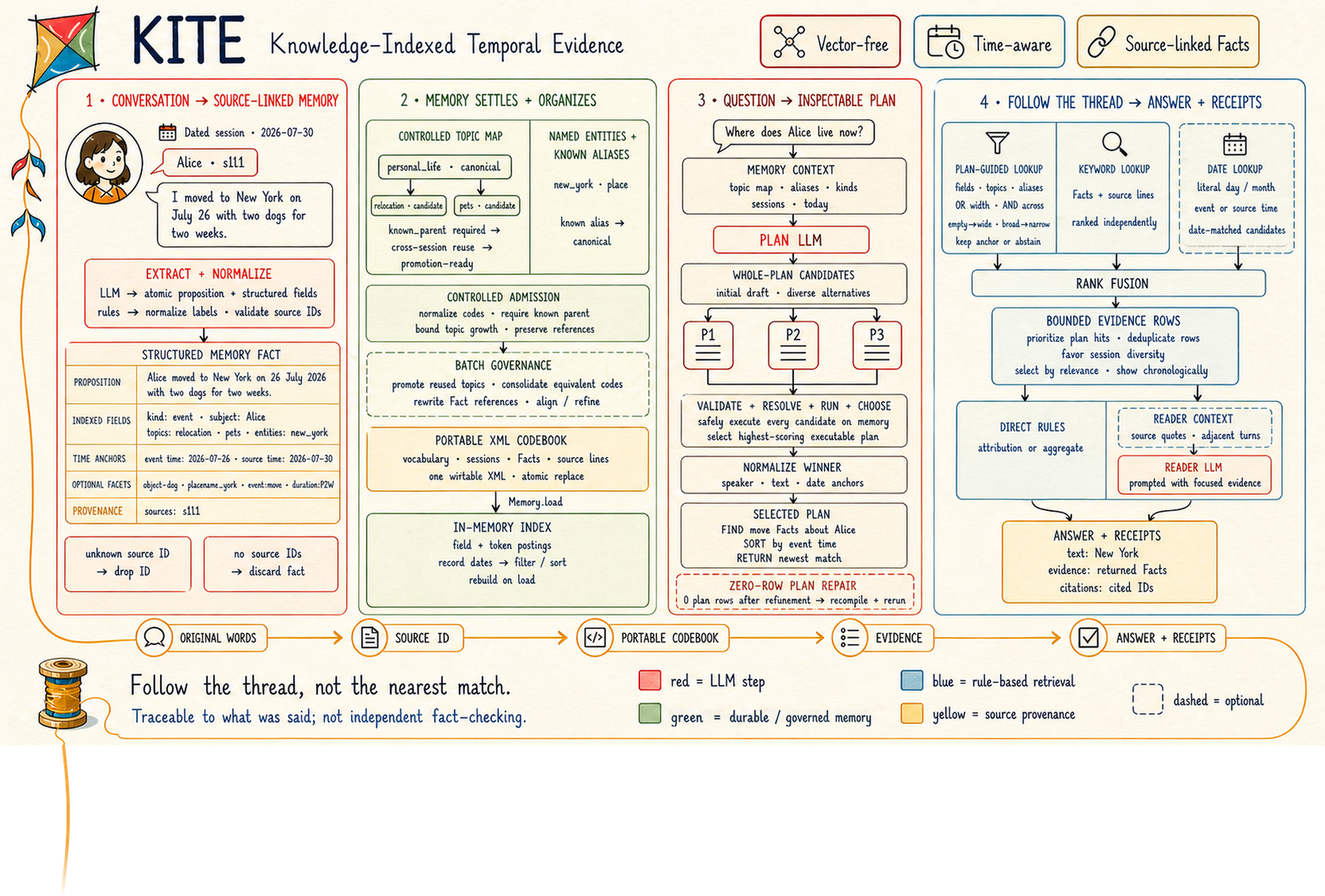
The whole idea in one line: conversations settle into facts under topics, and a
question finds its topic and pulls that topic's memories, receipts included.
1 · Message → Fact
A user says, "I moved to Tokyo on July 26." KITE by Memoket extracts what happened and
files it under its topics, keeping the original message as evidence:
<fact t="2026-07-26" kind="event" who="user"
      place="tokyo" event="move" src="chat1L1">
  The user moved to Tokyo on 26 July 2026.
</fact>
<line id="chat1L1" who="user">I moved to Tokyo on July 26.</line>
2 · Question → Plan
When the agent asks "Where does the user live now?", KITE by Memoket compiles the
question into a plan you can read, validate, and cache:
{
  "select": "facts",
  "where": {"who": ["user"], "event": ["move"]},
  "pipe": [
    {"op": "sort", "key": "t", "desc": true},
    {"op": "head", "n": 1}
  ]
}
3 · Plan → Execution
The executor runs the plan over the topic index. Keywords and associations come
first, then conditions filter down to the one moment that answers the question:
SEARCH facts
FILTER who = "user" AND event = "move"
SORT BY event_time DESC
TAKE 1
The same validated plan always follows the same steps over the same memory, with no
embeddings and no vector database anywhere.
4 · Evidence → Answer
Answer: Tokyo
Source: chat1L1, "I moved to Tokyo on July 26."
Key Features
🚫 No vector stack
No embeddings, no vector database, no layers to embed, sort, and re-rank every result. |
🗂️ Structured facts
Conversations crystallize into typed, dated, topic-indexed memory you can open and read. |
🔍 Inspectable queries
Every question becomes a symbolic plan, revealing exactly how each answer was matched. |
🕐 Time-aware retrieval
People, events, dates, and updates handled directly, so "now" means now. |
🧾 Shows its work
Evidence links straight back to the moment it came from: who said it, when, and the actual words. |
🤷 Knows what it doesn't know
When something was never said, the search comes back genuinely empty, and KITE says so. |

🚀 Quick Start
python -m pip install memoket-kite
export OPENAI_API_KEY="sk-..."
mkdir -p artifacts
curl -fsSL \
  https://raw.githubusercontent.com/memoket/memoket-kite/main/examples/data/demo_codebook.xml \
  -o artifacts/quickstart.xml
Using another OpenAI-compatible provider? Set OPENAI_BASE_URL as well.
2. Remember
Turn a conversation into structured, source-backed facts:
from memoket_kite import Memory

memory = Memory.load("artifacts/quickstart.xml")
memory.remember(
    [{"role": "user", "content": "I moved to Tokyo."}],
    session_id="session_1",
)
3. Recall
Compile a question into a plan and retrieve matching facts, each carrying its sources:
from memoket_kite import Memory

memory = Memory.load("artifacts/quickstart.xml")

for fact in memory.recall("Where did the user move?"):
    print(fact.content)
    print(fact.sources)
4. Answer
Generate an answer from the retrieved evidence and keep the receipts:
from memoket_kite import Memory

memory = Memory.load("artifacts/quickstart.xml")

result = memory.answer_with_evidence("Where did the user move?")
print(result.text)  # "The user moved to Tokyo."
for fact in result.evidence:
    print(fact.content, fact.sources)  # the moments the answer stands on

print(memory.answer("Where did the user move?"))  # just the text
Full reference in docs/api.md;
more runnable examples in
examples/.
📊 Benchmark Results
KITE by Memoket posts the top overall score on both public long-conversation memory
benchmarks. It is the only system up there that uses no vectors, and it reads less
context than any capable rival.
| Benchmark |
Overall Accuracy |
Avg. Reader Context |
| LoCoMo |
🥇 93.51% |
1.51k tokens |
| LongMemEval-S |
🥇 85.60% |
1.65k tokens |
All systems are evaluated under one shared protocol, with gpt-4.1-mini as the
common reader and judge; the exact rubrics are in the
LoCoMo protocol
and
LongMemEval protocol.
Reader context is the mean per-question evidence budget: what the reader actually
gets to see, measured by the same ledger on every question.
Each figure comes from a reference run under the default configuration, with
gpt-4.1-mini reading and judging and no ablation flags set. The reproduction
contract pins the dataset revisions, protocols, model IDs, expected row counts,
and reported scores. The provided scripts rebuild the evaluation locally from
the official datasets with a configured compatible LLM endpoint.
How a local run is recorded
Every rebuilt run writes a local manifest naming the exact commit, corpus
digest, tokenizer, and plan-cache digest it used. Judging records the answers,
verdicts, and score in a second manifest keyed to the first. A completed run can
validate that seal and recompute its metrics offline; the reference verifier
also checks the manifest-declared paths, counts, and reported aggregate. Details
are in the
benchmark guide
and
reproducibility notes;
the benchmark corpora keep their own licences, spelled out in
LICENSE-DATA.md.
🔗 Integrations
KITE by Memoket is a plain Python library: three calls take you from a raw conversation
to a cited answer. Integrations across the agent ecosystem (Claude Code, Codex,
Cursor, OpenCode, and more) are next on the roadmap.
Want yours first? Tell us on Discord.



✨ Experience KITE with Memoket
The memory you just read about ships today. KITE is the algorithm inside
every Memoket: the same topic-filed facts, the same line back to the source,
running on your own device. Ask it "didn't this client say their fiscal year ends
in March?" months later, and it surfaces the exact moment: who said it, when, and
in their words.
Memoket captures memories; KITE is the memory itself.
https://github.com/user-attachments/assets/685ac90d-95ab-4114-a7d3-c22ec3db94a0
See more of Memoket in action →
📖 Citation
A technical report is in preparation; BibTeX will land here with the arXiv
release. Until then, please cite this repository.
📄 License
KITE by Memoket is released under the
Apache License 2.0.
Like its name, KITE by Memoket stays light enough to fly, always on a line back to the truth. 🪁






 KITE 是一个开源、无向量的 AI 代理长期记忆引擎:它把对话转化为按主题索引的结构化事实,用可审查的检索计划(而非嵌入相似度搜索)来回答问题,在 LoCoMo 和 LongMemEval 基准上名列第一。