


What is this?
 APSD is a large-scale dataset for studying how visually stealthy adversarial perturbations look to humans, containing 10,586 clean-adversarial image pairs with human opinion scores.
APSD is a large-scale dataset for studying how visually stealthy adversarial perturbations look to humans, containing 10,586 clean-adversarial image pairs with human opinion scores.Is this a dataset only, or does it also include the A2SM model code?It is primarily the APSD dataset itself (images plus human MOS scores); the paper also describes an A2SM assessment model, but this repo is framed as the dataset release, not training code.
It is primarily the APSD dataset itself (images plus human MOS scores); the paper also describes an A2SM assessment model, but this repo is framed as the dataset release, not training code.How do I get the dataset?Download APSD from the project repository link referenced in the README; the release should contain the clean images, the corresponding adversarial images, and their human subjective scores.
Download APSD from the project repository link referenced in the README; the release should contain the clean images, the corresponding adversarial images, and their human subjective scores.Is the released dataset structure finalized?The README itself warns that the shown folder layout is only a placeholder and the actual released files may be organized differently.
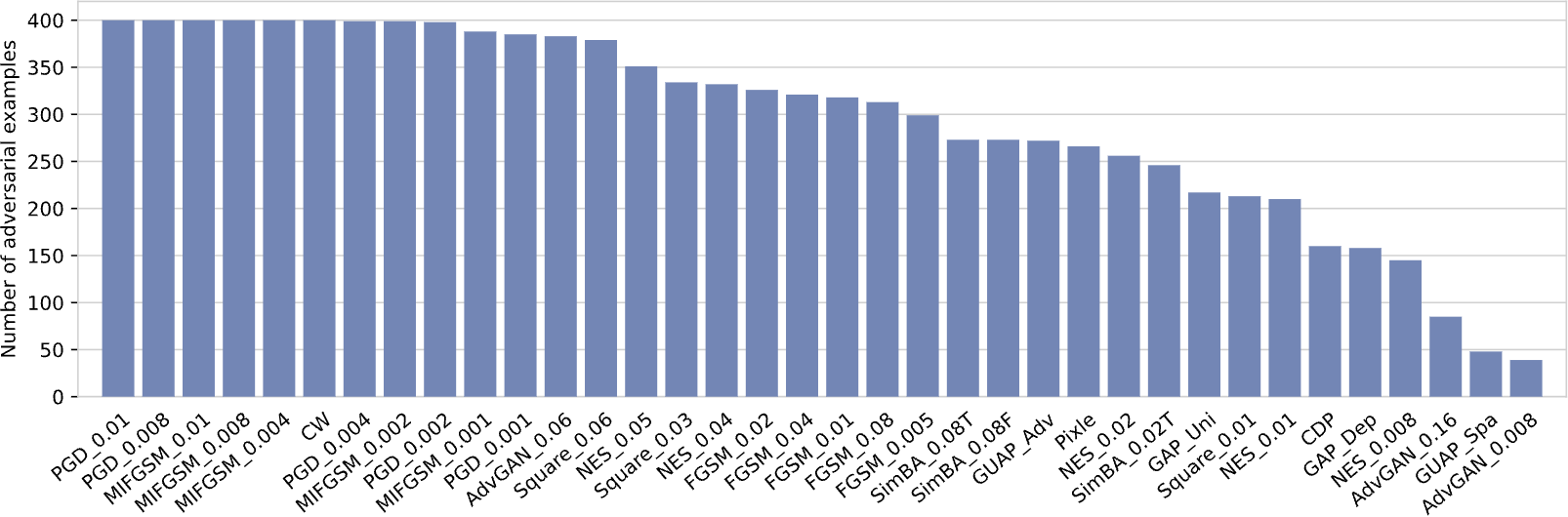
The README itself warns that the shown folder layout is only a placeholder and the actual released files may be organized differently.Which attacks are covered by APSD?APSD spans 12 attack methods across 5 families: gradient-based (FGSM, MIFGSM, PGD, NES), optimization-based (CW), generative-model-based (CDP, AdvGAN, GAP, GUAP), pixel-based (SimBA, Pixel), and block-based (Square).
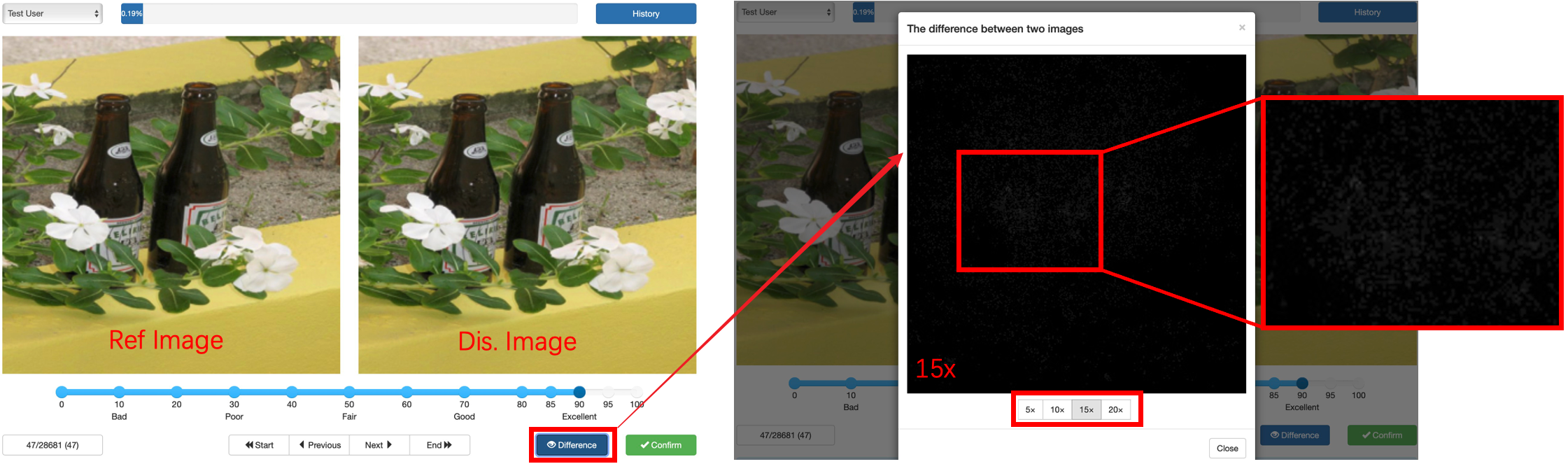
APSD spans 12 attack methods across 5 families: gradient-based (FGSM, MIFGSM, PGD, NES), optimization-based (CW), generative-model-based (CDP, AdvGAN, GAP, GUAP), pixel-based (SimBA, Pixel), and block-based (Square).How were the human stealthiness scores collected?60 observers rated each of the 10,586 adversarial examples in a two-step protocol (coarse hardly/readily perceptible classification, then fine-grained scoring with amplified difference maps), and 15 ratings per example are averaged into a Mean Opinion Score (MOS) between 0 and 1.
60 observers rated each of the 10,586 adversarial examples in a two-step protocol (coarse hardly/readily perceptible classification, then fine-grained scoring with amplified difference maps), and 15 ratings per example are averaged into a Mean Opinion Score (MOS) between 0 and 1.How good is the companion A2SM model at predicting human perception?A2SM, which combines global/local features with self-, cross-, and spatial-attention, reaches 0.984 PLCC and 0.978 SROCC against human MOS scores on APSD.
A2SM, which combines global/local features with self-, cross-, and spatial-attention, reaches 0.984 PLCC and 0.978 SROCC against human MOS scores on APSD.Where was this research published?It is the official dataset for the paper 'Stealthiness Assessment of Adversarial Perturbation: From a Visual Perspective,' published in IEEE Transactions on Information Forensics and Security (TIFS), 2024.
It is the official dataset for the paper 'Stealthiness Assessment of Adversarial Perturbation: From a Visual Perspective,' published in IEEE Transactions on Information Forensics and Security (TIFS), 2024.What are similar projects?reverse-SynthID, Engram, math, arc-task-gen, pointdit, transferlearning, Mira-Scene, High-Angle_Robust_Fast_FaceAlignment
reverse-SynthID, Engram, math, arc-task-gen, pointdit, transferlearning, Mira-Scene, High-Angle_Robust_Fast_FaceAlignmentWhich topics is it in?adversarial-attacks, vision, security-research, ai-security, attention-mechanism, papers, paper, dataset, evaluation, neural-network, academic-research, image-processing
adversarial-attacks, vision, security-research, ai-security, attention-mechanism, papers, paper, dataset, evaluation, neural-network, academic-research, image-processing