Use OSV-Scanner to find existing vulnerabilities affecting your project's dependencies.
OSV-Scanner provides an officially supported frontend to the OSV database and CLI interface to OSV-Scalibr that connects a project’s list of dependencies with the vulnerabilities that affect them.
OSV-Scanner supports a wide range of project types, package managers and features, including but not limited to:
Package Managers: npm, pip, yarn, maven, go modules, cargo, gem, composer, nuget and others.
Operating Systems: Detects vulnerabilities in OS packages on Linux systems.
Containers: Scans container images for vulnerabilities in their base images and included packages.
Guided Remediation: Provides recommendations for package version upgrades based on criteria such as dependency depth, minimum severity, fix strategy, and return on investment.
OSV-Scanner uses the extensible OSV-Scalibr library under the hood to provide this functionality. If a language or package manager is not supported currently, please file a feature request.
Underlying database
The underlying database, OSV.dev has several benefits in comparison with closed source advisory databases and scanners:
Covering most open source language and OS ecosystems (including Git), it’s comprehensive.
Anyone can suggest improvements to advisories, resulting in a very high quality database.
The OSV format unambiguously stores information about affected versions in a machine-readable format that precisely maps onto a developer’s list of packages
The above all results in accurate and actionable vulnerability notifications, which reduces the time needed to resolve them. Check out OSV.dev for more details!
Basic installation
To install OSV-Scanner, please refer to the installation section of our documentation. OSV-Scanner releases can be found on the releases page of the GitHub repository. The recommended method is to download a prebuilt binary for your platform. Alternatively, you can use
go install github.com/google/osv-scanner/v2/cmd/osv-scanner@latest to build it from source.
Key Features
For more information, please read our detailed documentation to learn how to use OSV-Scanner. For detailed information about each feature, click their titles in this README.
Please note: These are the instructions for the latest OSV-Scanner V2 beta. If you are using V1, checkout the V1 README and documentation instead.
This command will recursively scan the specified directory for any supported package files, such as package.json, go.mod, pom.xml, etc. and output any discovered vulnerabilities.
OSV-Scanner has the option of using call analysis to determine if a vulnerable function is actually being used in the project, resulting in fewer false positives, and actionable alerts.
OSV-Scanner can also detect vendored C/C++ code for vulnerability scanning. See here for details.
Supported Lockfiles
OSV-Scanner supports 11+ language ecosystems and 19+ lockfile types. To check if your ecosystem is covered, please check out our detailed documentation.
OSV-Scanner also supports comprehensive, layer-aware scanning for container images to detect vulnerabilities in the following operating system packages and language-specific dependencies.
Scan your project against a local OSV database. No network connection is required after the initial database download. The database can also be manually downloaded.
[!WARNING]
Guided remediation (the fix command) can be risky when run on untrusted projects. It may trigger the package manager to execute scripts or follow external registries specified in the project. Please ensure you trust the source code and artifacts before proceeding.
OSV-Scanner provides guided remediation, a feature that suggests package version upgrades based on criteria such as dependency depth, minimum severity, fix strategy, and return on investment.
We currently support remediating vulnerabilities in the following files:
The primary data source for vulnerability information. OSV-Scanner queries this API to check packages for known vulnerabilities and to identify vendored C/C++ dependencies. Data sent includes package names, versions, ecosystems, and file hashes. Use --offline mode to disable network requests and scan against a local database instead.
Dependency resolution: Resolves dependency graphs for vulnerability scanning and remediation
Container image scanning: Queries container image metadata for vulnerability detection
License scanning (--licenses flag): Retrieves license information for packages
Package deprecation: Checks if packages are deprecated
Data sent includes package names, versions, and ecosystems. No source code is transmitted.
Package Registries
When using native registry for dependency resolution (instead of deps.dev), OSV-Scanner may query:
Registry
URL
Used For
Maven Central
repo.maven.apache.org/maven2
Maven package metadata and POM files
npm Registry
registry.npmjs.org
npm package metadata
PyPI
pypi.org
Python package metadata
Contribute
Report Problems
If you have what looks like a bug, please use the GitHub issue tracking system. Before you file an issue, please search existing issues to see if your issue is already covered.
Contributing code to osv-scanner
See CONTRIBUTING.md for documentation on how to contribute code.
Star History
osv-scanner (google/osv-scanner)
Choose a tag and it will appear here. With no tags selected, all catalog projects are shown.
Searching Database…
Choose a tag and it will appear here. With no tags selected, all catalog projects are shown.





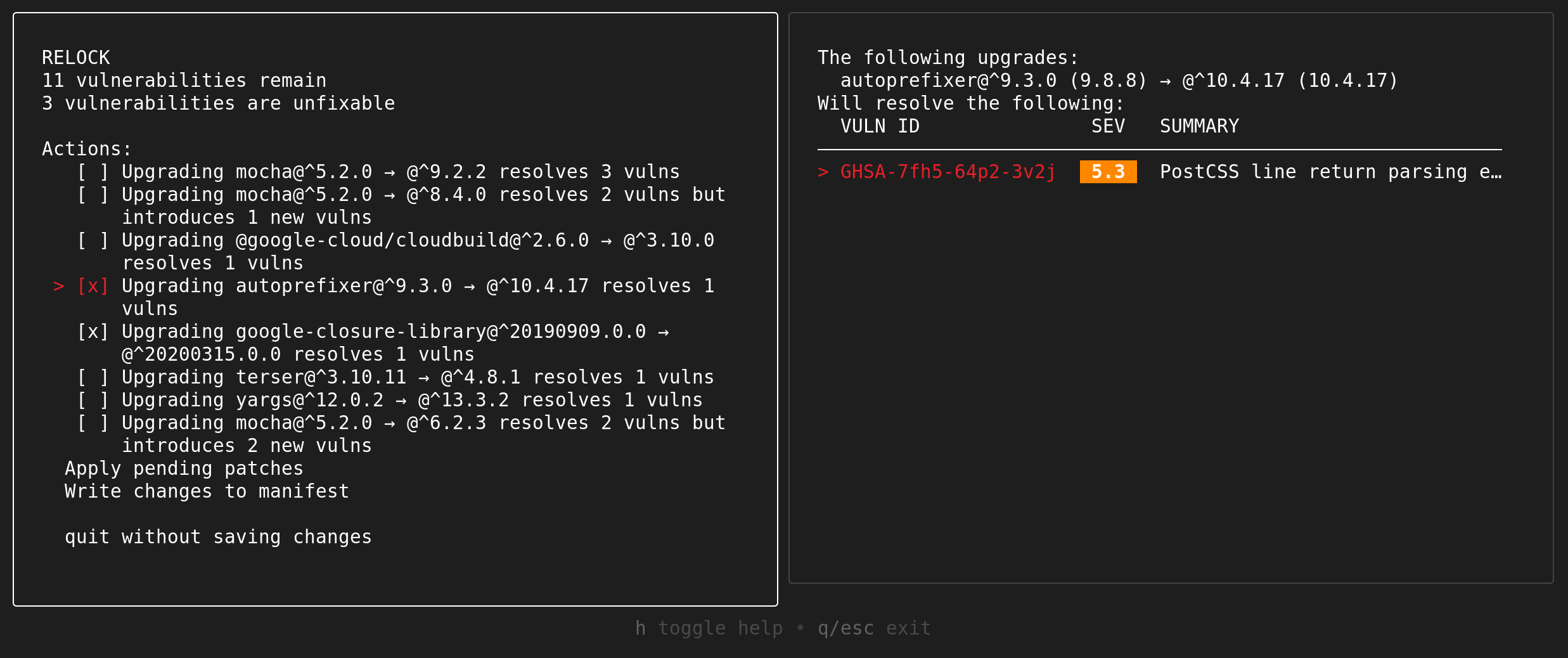

 OSV-Scanner 是谷歌开源的命令行漏洞扫描工具:它把项目的依赖和 OSV.dev(一个开放漏洞数据库)进行比对,然后报告哪些已知漏洞会影响到你。