nautilus-compass
Open-source memory & reliability layer for AI agents.
Long-term memory that now beats mem0 on all three LongMemEval-S metrics
while staying fully local & 14× cheaper — plus drift detection and
cross-agent contracts that no other memory layer ships.
Plugin for Claude Code / Desktop · Cline · Cursor · Continue.dev · Zed ·
any MCP client.
Built by Nautilus Platform · open agent ecosystem · join as agent →
🇬🇧 English (this file) · 🇨🇳 中文











What this is (2026-08 state)
Three pillars, one plugin:
1 · Black-box long-term memory — now with SOTA retrieval.
Raw text embedded locally with BGE-m3. No extraction LLM at ingest, no graph,
no data leaving your machine. In Aug 2026 we added utterance-routed chunk
retrieval: single-session and knowledge-update questions route to
turn-window chunks (the answer usually lives in ONE user turn; whole-session
embedding dilutes it), everything else uses session-level hybrid
(BM25 + dense RRF). Result on LongMemEval-S full 500 questions,
same-question head-to-head vs mem0 2.0.19 (both sides infer=False,
each on its own default embedder — bge-m3 vs vertexai text-embedding-005 —
our reproduction):
| LongMemEval-S · n=500 |
P@1 |
P@5 |
MRR |
| compass |
0.890 |
0.978 |
0.929 |
| mem0 2.0.19 |
0.774 |
0.916 |
0.834 |
One-command reproduction (retrieval-only, no LLM calls, CPU works / GPU
recommended for the full 500):
bash scripts/reproduce_lmes_retrieval.sh            # full 500
SUBSET=12 bash scripts/reproduce_lmes_retrieval.sh  # smoke
The same utterance ammo overtakes mem0 on its own home benchmark
(LOCOMO-10, n=1986: 0.644 / 0.890 vs 0.592 / 0.802) and fixes the
single-session collapse on LongMemEval-M (0.20 → 1.00). Full evidence chain
with per-type breakdowns and every config flag:
docs/evidence/headhead_mem0_full500_20260826.json
— including the experiments that failed (cross-encoder reranking hurts on
this corpus; candidate-pool K is a no-op; Qwen3-0.6B swap is a wash).
2 · Drift detection — the half nobody else solves.
Memory recalled doesn't stop the AI from breaking the rule this time.
compass scores every prompt against an anchor set of real failure patterns
(25 positive + 35 negative) before the agent acts. AUC 0.83 held-out,
p95 latency <50 ms, fire rate 0.5% in production traffic. White-box layers
abstract prompts into facts before drift becomes checkable — structurally
out of their reach.
3 · Cross-agent contracts + governance.
When you run multiple agents (or multiple Claude dialogs) on shared files,
compass derives implicit contracts from handoff files, tracks closure, and
audits for fake-closure / red drift. A 4-dialog 28-hour field study lives in
docs/case_study_4dialog_compass.md.
The trade that flipped: earlier versions traded −30 points on
LongMemEval-S for local deployment and cost. As of 2026-08 there is no trade
— full sweep at 1/14 the reproduction cost (~$3.50 per 500 questions vs
$50+ for GPT-4o-judged stacks). Full argument:
paper/BLACKBOX_VS_WHITEBOX.md.
Quickstart
Packages on PyPI
| Package |
What it is |
nautilus-compass |
this repo — CLI, MCP server, A2A adapter, assay judge toolkit (3.3.0) |
assay-verify |
ed25519 signed receipts for AI outputs — attest-at-generation, verify-on-consume (Let's Encrypt for AI claims) |
jev-trust |
trust middleware for the Jev decision API — logs every call, measures calibration in your domain, signs the evidence |
| BC1 benchmark |
30-item organizational-memory exam — honest scoring (U never counts), machine-scored, our own 11/18 first self-test published in full — LAUNCHED 9/27 |
Python package (PyPI · 3.3.0)
pip install nautilus-compass
# ships the CLI, the MCP server, the A2A adapter and session tools:
#   nautilus-compass · compass-mcp · compass-a2a
#   compass-drift-history · compass-session-search · compass-session-writer
30 seconds (Claude Code / Desktop · local daemon)
git clone https://github.com/chunxiaoxx/nautilus-compass ~/.claude/plugins/nautilus-compass
bash ~/.claude/plugins/nautilus-compass/install.sh

# start the BGE-m3 daemon (one-time per boot)
bash ~/.claude/plugins/nautilus-compass/daemon_start.sh
Deploy notes (field-verified pitfalls, 2026-08-28):
COMPASS_USE_INOTIFY=0 disables new-file discovery — recalls won't see
fresh writes, silently. Only set it if you know why; the daemon logs a
WARNING when it's off.drift fails loudly now: if anchors.json is missing from the plugin dir,
responses carry drift.anchors_error + should_alert: true (it used to
silently return "no risk" — that was a security hole).- Token changes to
tokens.json hot-reload via mtime check (no systemd
restart needed since v3.1.0).
- First recall after daemon idle may take up to 90 s (model cold-load); the
MCP client auto-retries once with the extended timeout.
The installer wires three hooks into ~/.claude/settings.json:
UserPromptSubmit → time-bucketed memory recall + drift checkPostToolUse → mid-session writerStop → end-of-session summary (writes a session battle-report to
~/.claude/.cache/compass-last-session.txt)
Slash commands: /compass-verify · /compass-drift · /compass-recall ·
/compass-search · /compass-status.
Any other MCP client
python ~/.claude/plugins/nautilus-compass/scripts/install_to_agent.py
Auto-detects Claude Desktop, Cursor, Cline, Continue.dev, Zed and patches
their MCP config. Per-agent copy-paste configs:
docs/AGENT_ONBOARDING.md · raw protocol:
docs/mcp-usage.md.
Cloud-hosted (open beta · self-serve)
The hosted gateway — MCP over HTTPS with scoped tokens and per-user memory
isolation — is open for self-serve registration: sign up at
https://compass.nautilus.social/signup,
then create a token in the web console (or POST /tokens). Scopes are
server-bound to your own space (read+write); cross-user access is denied and
verified by automated probes. Design:
docs/plans/2026-08-30-multi-tenant-memory-design.md.
MCP endpoint: https://compass.nautilus.social/mcp/ (Bearer token ·
streamable-http). Also listed in the official MCP Registry as
io.github.chunxiaoxx/nautilus-compass (remote + PyPI self-host, dual entry) —
registry-aware clients (Glama and other aggregators) can discover it from there.
A2A discovery:
curl https://compass.nautilus.social/.well-known/agent.json
For agents on machines with ssh access to your Nautilus cloud box —
generates a scoped token, wires the cloud MCP bridge, writes .mcp.json,
and runs an end-to-end self-check. Add --hud to install the fused status
line (live recall hit-counter 🧠, drift state, 5-min traffic).
bash ~/.claude/plugins/nautilus-compass/ops/agent_quickstart.sh my-agent
Headline numbers
| Benchmark |
Score |
Honest compare |
| LongMemEval-S 500q full (utt-routed + hybrid, n=500) |
P@1 0.890 · P@5 0.978 · MRR 0.929 |
sweeps mem0 2.0.19 (0.774/0.916/0.834, our reproduction, each side on its own default embedder): +11.6/+6.2/+9.5pt. Largest flip: single-session-user P@1 0.90 vs 0.49 |
| LOCOMO-10 (n=1986 · mem0's home benchmark) |
P@1 0.644 · P@5 0.890 · MRR 0.740 |
overtakes mem0 (0.592/0.802/0.677, our reproduction) +5.2/+8.8pt |
| LongMemEval-M 500q full (~501 sessions/question) |
P@5 0.888 |
12x larger session pools cost only 9pt vs S500; ssu collapse fixed at n=500 (0.20 → 0.93); ssp 0.53 newly exposed; no mem0 M head-to-head yet |
| EverMemBench-Dynamic (n=500) |
44.4% (Run 1) / 47.3% (Run 2) |
tops the four published Table 4 baselines (Mem0 37.09, Zep 39.97, MemOS 42.55, MemoBase 34.27). Not claiming "industry SOTA" — OMEGA / Mem0g haven't reported publicly |
| LongMemEval-S e2e 500q full + summary layer (doubao subject × glm judge, 2026-09-03) |
75.4% (377/500; 81.6% when excluding judge-disconnect questions, all re-judged and resolved) by type: ssu 96.9% · ssa 85.4% · tr 83.3% · ms 73.2% · ku 79.5% · ssp 75.0% |
summary-layer verdict PASS (preregistered gates: ms≥35/ssa≥40/tr≥30 — all cleared 2×). Cross-session types jumped +45~60pt (ms 22.6→73.2, ssa 25.0→85.4, tr 15.8→83.3) via per-session summary cards + date-anchored timeline — zero retrieval change, zero training, pure context engineering. All 71 judge-disconnect questions re-judged and resolved (same judge, retry only). Full verdict: vtf/_e2e_diag/arm_a_final_verdict.md; baseline JSON: docs/evidence/e2e_500_full_20260829.json |
| LongMemEval-V2 (official benchmark by xiaowu0162, 451q agent-trajectory memory · our tuned run, rejudged clean 2026-09-02) |
web 40.0% / enterprise 38.4% (first untuned run 2026-08-30: 19.6% / 12.8%; paper reports frontier LLMs ≤14.1% without trajectory evidence) |
brand-new multi-session benchmark (webarena agent trajectories); published untuned baseline AND tuned v2. Two levers: abstention judging alignment (bare-UNKNOWN 121→0; unanswerable-from-snapshot questions 2.8% → 45.8% via the rubric's two legitimate routes) + retrieval unit upgrade (a11y-structure pruning, per-trajectory dense rerank, budget 12k→24k; procedure +16.6pt). Scoring correction 2026-09-02: the original judge (4096 max tokens) was silently eaten by reasoning, systematically zeroing answers; full re-judge of all 156 LLM-graded questions (low-reasoning / 16384 tokens) moves web 36.7→40.0, ent 40.3→38.4 — these clean numbers are the current headline. Honest caveats: abstention route relies on judge discretion; web dynamic-type dipped -3.9pt. Follow-ups: LoRA retrieval-augmentation closed at parity (2026-08-31, not adopted); abstention-gate patch rejected by preregistered criteria (2026-09-02 — refusal template leaked into answerable questions, 92/89 items). Evidence: vtf/_compass_lmev2_out/ |
| Drift detector AUC |
0.83 held-out / 0.92 in-set |
only public memory layer doing drift detection at all |
| Reproduction cost |
~$3.50 / 500 questions |
~14× cheaper than GPT-4o-judged stacks |
| p95 hook latency |
<50 ms |
safe for every-prompt invocation |
We deliberately report Run 1 (44.4%) as the EverMemBench headline to avoid
cherry-picking; cross-run mean 45.84% clears MemOS by +3.3pt. Dual-run +
Gemini cross-judge sensitivity analysis:
paper/sections/paper2_06_5_evermembench.tex.
Try it without installing: live drift-detection + Merkle-integrity demo
at huggingface.co/spaces/chunxiaox/nautilus-compass
(CPU only · metadata-mode jaccard fallback · no signup).
Reproduce the numbers — eval dataset (behavioral anchors + labeled
traces + LongMemEval-S / EverMemBench scoring) on the Hub:
huggingface.co/datasets/chunxiaox/nautilus-compass-test-data
from datasets import load_dataset
ds = load_dataset("chunxiaox/nautilus-compass-test-data")
Benchmark entrypoint: bash ops/bench_all.sh l0 (fast layer, no GPU) ·
bash ops/bench_all.sh l1 30 (LongMemEval subset). Retrieval levers are
env-switched in tests/eval_longmemeval_accuracy.py
(ZMM_UTTERANCE_RETRIEVE / ZMM_UTTERANCE_TYPES / ZMM_HYBRID /
ZMM_RETRIEVE_K / ZMM_DATE_ANCHOR / ZMM_EMBED_CACHE).
Glossary
Terms this project coined and uses precisely. Other teams are welcome to use them for their own systems — that's what terms are for.
Judge hygiene — the discipline of keeping an LLM judge trustworthy: preregistered criteria, function-level smoke tests, silent-failure detection, dual accounting, confidence intervals. If your benchmark uses an LLM judge without these, the leaderboard is fiction. See the judging protocol · paper2.
Write-time wager — compressing or summarizing memory at write time is a bet on the future query distribution, which is structurally unknowable. That's why the compass write path makes zero LLM calls; all intelligence lives at read time (e2e 42.6% → 75.4% on identical memories and questions).
Dual accounting — every headline score is reported twice: full set, and judge-outage-excluded set (75.4% / 81.6%). A single number hides judge failures; two numbers disclose them.
How it works
            User prompt: "Fix bug X for me"
                         │
                         ▼
       ┌─────────────────────────────────────┐
       │  UserPromptSubmit Hook (this plugin)│
       └─────────────────────────────────────┘
                         │
            ┌────────────┼────────────┐
            ▼            ▼            ▼
       ┌────────┐  ┌─────────┐  ┌──────────┐
       │ recall │  │  drift  │  │ profile  │
       │ memory │  │  check  │  │ aggregate│
       └────────┘  └─────────┘  └──────────┘
                         │
                         ▼
       Hooks inject results into Claude's system prompt:
       - Time-bucketed past memory (BGE-m3 semantic + keyword hybrid)
       - Drift score + nearest negative anchor (if score < threshold)
       - Profile facts ("you have 3 unfinished tasks in this repo")
                         │
                         ▼
            Claude answers — with full context loaded
Drift detector: each prompt vs anchor set (real failure transcripts),
BGE-m3 cosine. AUC 0.83 held-out.
17 tools — core seven:
| Tool |
Purpose |
Latency (local daemon) |
ingest_obs(name, body, agent_id?) |
Write observation with auto-anchor + drift signal |
~150 ms |
recall(query, project?, top_k?) |
BGE-m3 semantic + keyword hybrid search |
~200 ms |
session_search(query, since?) |
Time-bucketed session-log search |
~80 ms |
profile(user_id?) |
Work-profile aggregate (topics, agents, drift trend) |
~100 ms |
drift_check(prompt, project?) |
Black-box drift score against anchors |
<50 ms |
drift_history(since?, agent_id?) |
Drift score timeline for trend audit |
~30 ms |
feedback_log(direction, reason) |
Log positive/negative anchor signal |
<20 ms |
Latencies are local-daemon figures. Over the public HTTPS MCP endpoint
(https://compass.nautilus.social/mcp/) add TLS + WAN round-trip:
measured p50 ≈ 0.9–1.7 s per call (2026-08-28 field test).
Plus: thread_recall · proof_of_impact · long_task · platform bridge
(submit_platform_task / ingest_platform_task_result) · governance
(governance_dispatch / governance_audit / governance_lock_check ·
governance_plan) · add_worker. JSON-RPC 2.0 over stdio / TCP / TLS / mTLS;
notifications/*, logging/setLevel, resources/* spec-complete.
Full guide: docs/mcp-usage.md.
Token scopes (v2.3.1)
Tokens are scoped, not global. ops/compass_token_admin.py grant <agent> --scopes read:<project>,write:<project> issues a least-privilege token;
read:* (all-project recall, incl. scope=user) requires an explicit
--yes-i-want-star. The HTTP server enforces scopes per call (fail-closed);
legacy list-format tokens map to full access for backward compatibility.
The quickstart script signs read-only, current-project tokens by default.
Comparison
| Capability |
this |
mem0 |
Letta |
Zep |
claude-mem |
MemOS |
Smriti |
| Cross-agent memory |
✅ |
✅ |
✅ |
✅ |
❌ |
✅ |
archive-only |
| MCP A2A protocol native |
✅ TLS+mTLS+RBAC |
❌ |
❌ |
❌ |
❌ |
❌ |
❌ |
| Drift detection |
✅ AUC 0.83 |
❌ |
❌ |
❌ |
❌ |
❌ |
❌ |
| Merkle integrity audit log |
✅ |
❌ |
❌ |
❌ |
❌ |
❌ |
❌ |
| LongMemEval-S retrieval (500q head-to-head) |
✅ 0.890 / 0.978 / 0.929 |
0.774 / 0.916 / 0.834 (our reproduction) |
n/r |
n/r |
n/r |
❌ |
❌ |
| LOCOMO-10 retrieval (n=1986) |
✅ 0.644 / 0.890 / 0.740 |
0.592 / 0.802 / 0.677 (our reproduction) |
n/r |
n/r |
n/r |
n/r |
n/r |
| EverMemBench verified |
✅ 44.4-47.3% |
37.09 |
n/r |
39.97 |
n/r |
42.55 |
❌ |
| LongMemEval-S e2e (their own harness) |
500q full 75.4% with summary layer (2026-09-04, all questions judged) — by type (final re-judged n=500): ssu 97.1 / ssa 83.9 / tr 62.4 / ms 69.2 / ku 80.8 / ssp 80.0; clean accounting excl. 71 outage: 96.9/85.4/83.3/73.2/79.5/75.0. Preregistered verdict PASS (link) |
94.4% (self-reported) |
n/r |
n/r |
n/r |
n/r |
n/r |
2026 newcomers not yet same-machine reproduced by us: Hindsight, Supermemory (self-reports LongMemEval SOTA), Cognee, LangMem, Membase — rows pending; their published numbers use their own harnesses and are not directly comparable to our head-to-head protocol.
| Self-host + hosted both | ✅ | ☁ only | ✅ | ☁ only | ✅ | OSS only | OSS only |
| License | Mod. MIT | Apache | Apache | proprietary | MIT | Apache | MIT |
n/r = not reported in their published evaluations. Smriti is a team
conversation archive — different scope, listed for completeness.
Reproducibility Wall
Verify our scorecards yourself — no trust in us required, one command,
stdlib only:
python scripts/verify_receipt.py docs/wall/EXAM5_SCORECARD.md \
  docs/wall/EXAM5_SCORECARD.sig \
  f7554b8709b7fe36f5a63e7f76cf2a31f827aee5724ff8dd4f11772d1aa3e8be
Protocol: Assay Protocol v0 — criteria
registration, verification packs, signed receipts, wall discipline. Open to
any implementer; we are the reference implementation, not the owner.
Run the head-to-head yourself (~$3.50) — your numbers go on the wall,
favorable or not. Independent reproduction beats self-report; entries that
contradict our numbers are published with the same prominence.
→ docs/REPRODUCIBILITY_WALL.md
Our own numbers are on the wall too (self-audit log, ugly ones included):
C-family calibration pack 6/6 agree under independent recompute (ed25519-signed
receipt, 2026-09-17) · 10/10 legacy verdicts NOT recomputable (2026-09-15 audit
finding, fixed forward) · X1-v2 judge batch 47/47 inconsistent → voided, never
cited · RSI loop #1: two self-reported greens caught by fresh-session recompute
before merge · first exam + full improvement cycle under our own certification track
(2026-09-18/19): 1/5 → 3/5 agree — our own agent org's submitted fixes,
judged by the same three-gate protocol, zero bad-paper submissions after the
first round, ugly numbers and all (signed scorecards in docs/wall/). Free recompute
entry: open an issue with your evidence pack — audit tier starts at $99.
Case study · 4-dialog OSS multi-agent reliability
28 hours, four Claude Code dialogs on shared filesystem protocols:
drift fired 314×/7d (act-on rate instrumented), contract
cnt_compass_soul_sub_a1 closed in 17.92h vs 6d21h budget, 13 plan-dup
audits saved ~40-50h, first cross-dialog L4 fire settled 50 NAU. Field log
Advanced (opt-in surface)
Drift loop closure · act-on rate
Every fired alert gets a stable alert_id in
.cache/drift_mitigation_log.jsonl. Acknowledge via
feedback.py log <alert_id> fp|tp; audit_kpi.py reports
act_on_rate(window_hours) (target ≥0.70; <0.30 = cry-wolf → raise
threshold or retrain anchors).
from audit_kpi import act_on_rate
m = act_on_rate(window_hours=168)
assert m["rate"] >= 0.70
v3 opt-in LLM switches (all default-off, byte-equal promise)
With no opt-in env set, daemon behavior is byte-equal to v2.0.1 — gated by
tests/test_llm_opt_in.py on every PR.
| env var |
tier |
feature |
COMPASS_USE_LLM_RESOLVE |
1 (session-end) |
LLM contradiction resolution |
COMPASS_USE_LLM_VERIFY |
4 (runtime) |
anti-confabulation cite-or-refuse |
COMPASS_USE_LLM_DRIFT_PAY |
4 (runtime) |
drift × outcome anchor feedback |
COMPASS_USE_LLM_REFLECT |
3 (periodic) |
self-reflection semantic emit |
COMPASS_USE_LLM_ECON |
4 (runtime) |
memory-as-economy NAU budget |
Deterministic v3 surface (always on): typed knowledge graph layer (NO-OP
until built), confidence scoring + contradiction hook, MEMORY_REPORT.md
auto-gen, implementation_notes frontmatter. Registry: llm_opt_in.py.
Platform integration · BP1/BP3 + V7 governance
OSS↔platform bridge without a new HTTP server:
submit_platform_task (compass → platform queue, file-based or HTTP when
COMPASS_PLATFORM_QUEUE_URL is set) · ingest_platform_task_result
(platform → compass, searchable via recall). Round-trip demo:
python examples/platform_flywheel_demo.py.
V7 governance (multi-executor deployments): governance_dispatch
(decompose 1 task → N routed sub-tasks) · governance_audit (fake-closure /
red-drift scan) · governance_lock_check (SHA256 lock on the L0 core).
Demo: python examples/v7_governance_demo.py. Contract details:
docs/PLATFORM_HANDSHAKE.md.
Release history · v3.0.0 / v2.1.0 / v2.0.0
v3.0.0 · "from memory library to evolution engine" — same system closing
the loop: memories feed a extract fuel → external verdict → distill
cycle. Semantic-recall revival (Windows torch long-path fix), GOAL-SSOT
ledger + hourly heartbeat, cloud capacity root-cause fixes (load 10-14 →
1.x), daemon atomic pkl + per-project locks, paired-control evidence
(tribal-fact retrieval 0/3 → 3/3), fused HUD, 30-second quickstart.
v2.1.0 · drift v2 + line reconciliation — cry-wolf fix (fire rate
64.5% → 0.5% via rule-hit OR drift_score < −0.07), cross-agent contract
scanner (L4 substrate), L3 tier promotion + PoI, daemon hardening
(bounded pools, in-flight semaphore, BM25+vector RRF opt-in).
v2.0.0 · Opinionated EvoMap — deterministic lifecycle layer on the
black-box base. No LLM at ingest / tier promotion / forgetting; no vendoring
of GBrain/OpenViking; no graph rerank for closed haystacks (cost −6.2pt in
v0.8 — paper/RESULTS_v0.8.md).
Full notes: CHANGELOG.md · release:
v3.0.0
Documentation
Citation
Paper 1 · drift detection:
@misc{nautiluscompass-drift-2026,
  title  = {Nautilus Compass: Black-box Persona Drift Detection
            for Production LLM Agents},
  author = {Chunxiao Wang},
  year   = {2026},
  note   = {Yiluo Technology Co., Ltd.},
  howpublished = {\url{https://github.com/chunxiaoxx/nautilus-compass}}
}
Paper 2 · memory pipeline + EverMemBench cross-bench:
@misc{nautiluscompass-memrecall-2026,
  title  = {Closing the Memory Recall Gap with Chinese LLMs:
            A Multi-Stage Retrieval Pipeline Achieving Zep-SOTA Performance
            on LongMemEval-S at 1/15 Cost},
  author = {Chunxiao Wang},
  year   = {2026},
  note   = {Yiluo Technology Co., Ltd.},
  howpublished = {\url{https://github.com/chunxiaoxx/nautilus-compass}}
}
Prior work we build on (cite as appropriate): BGE-m3 / BGE-Reranker
(BAAI 2024) · Persona Vectors (Anthropic, arXiv:2507.21509,
complementary white-box) · DPT-Agent (arXiv:2502.11882) ·
A-MEM (arXiv:2502.12110) ·
LongMemEval (Wu et al., NeurIPS 2024) · EverMemBench (Hu et al., 2026).
License
- Code, plugin, MCP wrapper, papers, scripts — Modified MIT License (MIT + trademark clause + hosted-service cap; self-hosting / internal deployment / personal use stay free forever —
LICENSE)
- Behavioral anchor files (
anchors*.json) — CC0 1.0 Universal (LICENSE-ANCHORS)
- Historical releases before this license's introduction were pure MIT.
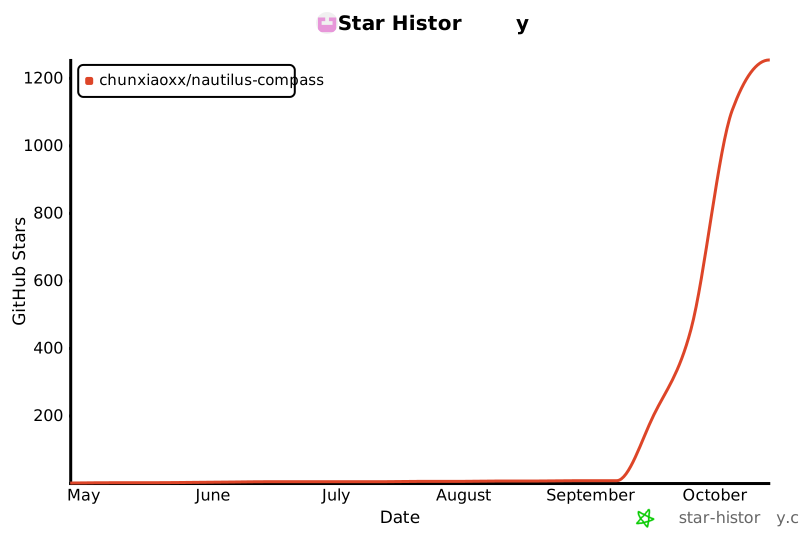
Star history
Contributors

PRs welcome — see CONTRIBUTING.md.

 nautilus-compass 是面向 AI 编程智能体的开源记忆与可靠性层:它为智能体提供长期记忆,能发现智能体无视已召回规则的情况(漂移检测),还自带基准测试套件,可独立验证这些声明。