4.8K ·GitHub
What is this?
 SemIf (formerly OpenJev) is an independent research project that runs runtime-defined semantic decisions with open models on one consumer GPU, mirroring the interface of TypeSafe's closed Jev service but not its undisclosed model.
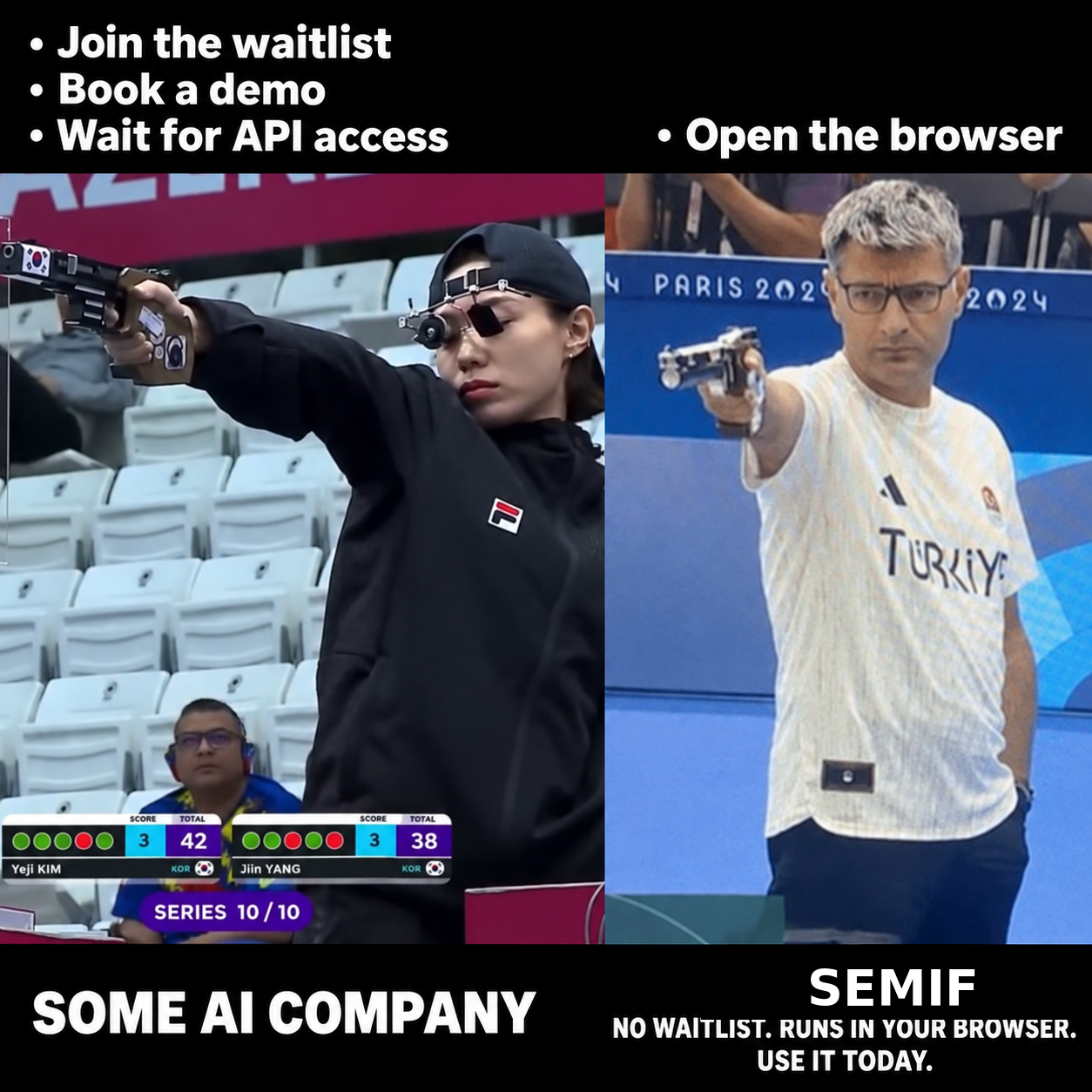
Is it a hosted service I sign up for, or a package I install?Neither a service nor a waitlist: it is an installable Python scorer with committed benchmark fixtures, plus a browser-only WebGPU demo you can open right now.
Neither a service nor a waitlist: it is an installable Python scorer with committed benchmark fixtures, plus a browser-only WebGPU demo you can open right now.How do I get it running?On Apple Silicon run pip install -e '.[test,mlx]' and add --backend mlx to the scorer command; for CPU-only machines install '.[test,llamacpp]', fetch a GGUF checkpoint, and pass --backend llamacpp --gguf /path/to/model.gguf. There is also a zero-install browser demo.
On Apple Silicon run pip install -e '.[test,mlx]' and add --backend mlx to the scorer command; for CPU-only machines install '.[test,llamacpp]', fetch a GGUF checkpoint, and pass --backend llamacpp --gguf /path/to/model.gguf. There is also a zero-install browser demo.Do I need Python and an NVIDIA GPU to run it?Python 3.10+ yes; the default path also wants CUDA and a GPU that can hold a 4B BF16 model. Alternatives: Apple Silicon via MLX or PyTorch/MPS, or CPU-only scoring through llama.cpp.
Python 3.10+ yes; the default path also wants CUDA and a GPU that can hold a 4B BF16 model. Alternatives: Apple Silicon via MLX or PyTorch/MPS, or CPU-only scoring through llama.cpp.How much should I trust the probabilities it returns?They are conditional on the options you supply, so calibrate them on your own workload (per-workload temperature scaling is built in), and the fast shared-state reuse paths are experimental — BF16 execution flipped 5-6 of 777 argmaxes versus fresh scoring.
They are conditional on the options you supply, so calibrate them on your own workload (per-workload temperature scaling is built in), and the fast shared-state reuse paths are experimental — BF16 execution flipped 5-6 of 777 argmaxes versus fresh scoring.Does everything stay on my machine, or does it call a cloud API?It is fully local: CUDA, MLX, MPS and CPU backends score local weights, and the browser demo runs 0.6B-4B models in-browser over WebGPU from 639 MB-3.01 GB downloads.
It is fully local: CUDA, MLX, MPS and CPU backends score local weights, and the browser demo runs 0.6B-4B models in-browser over WebGPU from 639 MB-3.01 GB downloads.Is the code open source?MIT. Model weights are not bundled — upstream models keep their own licenses.
MIT. Model weights are not bundled — upstream models keep their own licenses.Does it have to be an RTX 3090, or will other hardware work?Any GPU that fits a 4B BF16 model works, Apple Silicon runs natively via MLX/MPS, and a CPU-only llama.cpp backend scores the same prompts from a local GGUF checkpoint with no CUDA device at all.
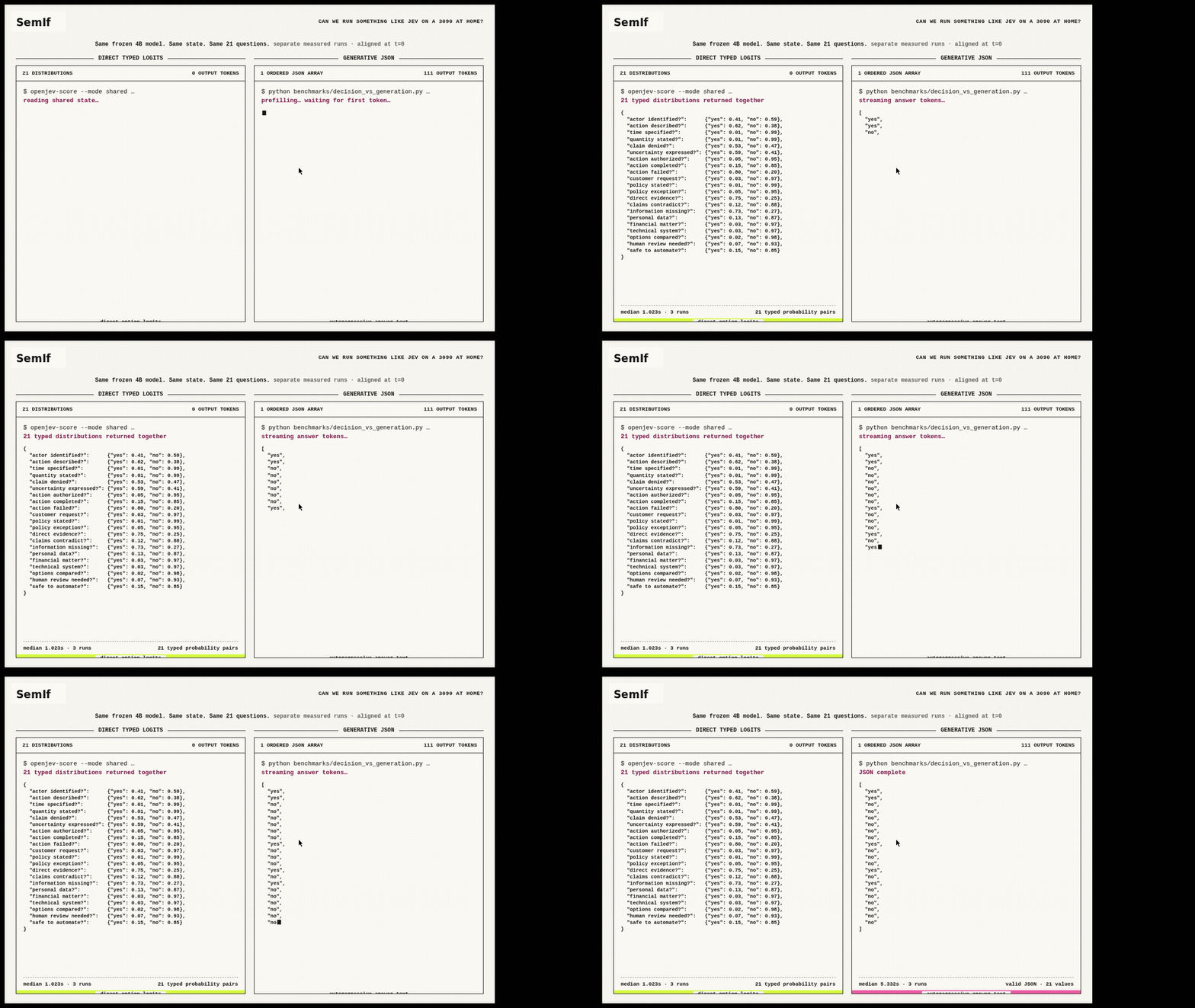
Any GPU that fits a 4B BF16 model works, Apple Silicon runs natively via MLX/MPS, and a CPU-only llama.cpp backend scores the same prompts from a local GGUF checkpoint with no CUDA device at all.How much faster is direct logit readout than generating a JSON array?On one RTX 3090 with the same frozen Qwen3.5-4B, 21 binary criteria took a median 1.023 s with zero output tokens versus 5.332 s and 111 tokens for an autoregressive JSON array — 5.21x slower.
On one RTX 3090 with the same frozen Qwen3.5-4B, 21 binary criteria took a median 1.023 s with zero output tokens versus 5.332 s and 111 tokens for an autoregressive JSON array — 5.21x slower.How close does it get to the closed Jev service on quality?Qwen3.5-4B agreed with TypeSafe's published results on 0.845 of the aligned 102-row subset versus Jev's 0.883; the Qwen3.8-27B EXL3 bridge reached 0.958 balanced accuracy on the authored-decisions workload.
Qwen3.5-4B agreed with TypeSafe's published results on 0.845 of the aligned 102-row subset versus Jev's 0.883; the Qwen3.8-27B EXL3 bridge reached 0.958 balanced accuracy on the authored-decisions workload.Which models are supported out of the box?Frozen baselines and browser builds for Qwen3-0.6B, MiniCPM5-2B and Qwen3.5-4B, plus a Qwen3.8-27B EXL3 bridge and Qwen3-Reranker-4B for comparison; weights are fetched separately, never bundled.
Frozen baselines and browser builds for Qwen3-0.6B, MiniCPM5-2B and Qwen3.5-4B, plus a Qwen3.8-27B EXL3 bridge and Qwen3-Reranker-4B for comparison; weights are fetched separately, never bundled.What are similar projects?decider, StartLux-Decision, rizzo-flow, NeoHorse, nimble, strands-decider, Strata, qwen38-mtp
decider, StartLux-Decision, rizzo-flow, NeoHorse, nimble, strands-decider, Strata, qwen38-mtpWhich topics is it in?decision-making, webgpu, llama-cpp, mlx, gguf, qwen, evaluation, quantization, local-llm, apple-silicon, inference, cuda
decision-making, webgpu, llama-cpp, mlx, gguf, qwen, evaluation, quantization, local-llm, apple-silicon, inference, cuda