What is this?
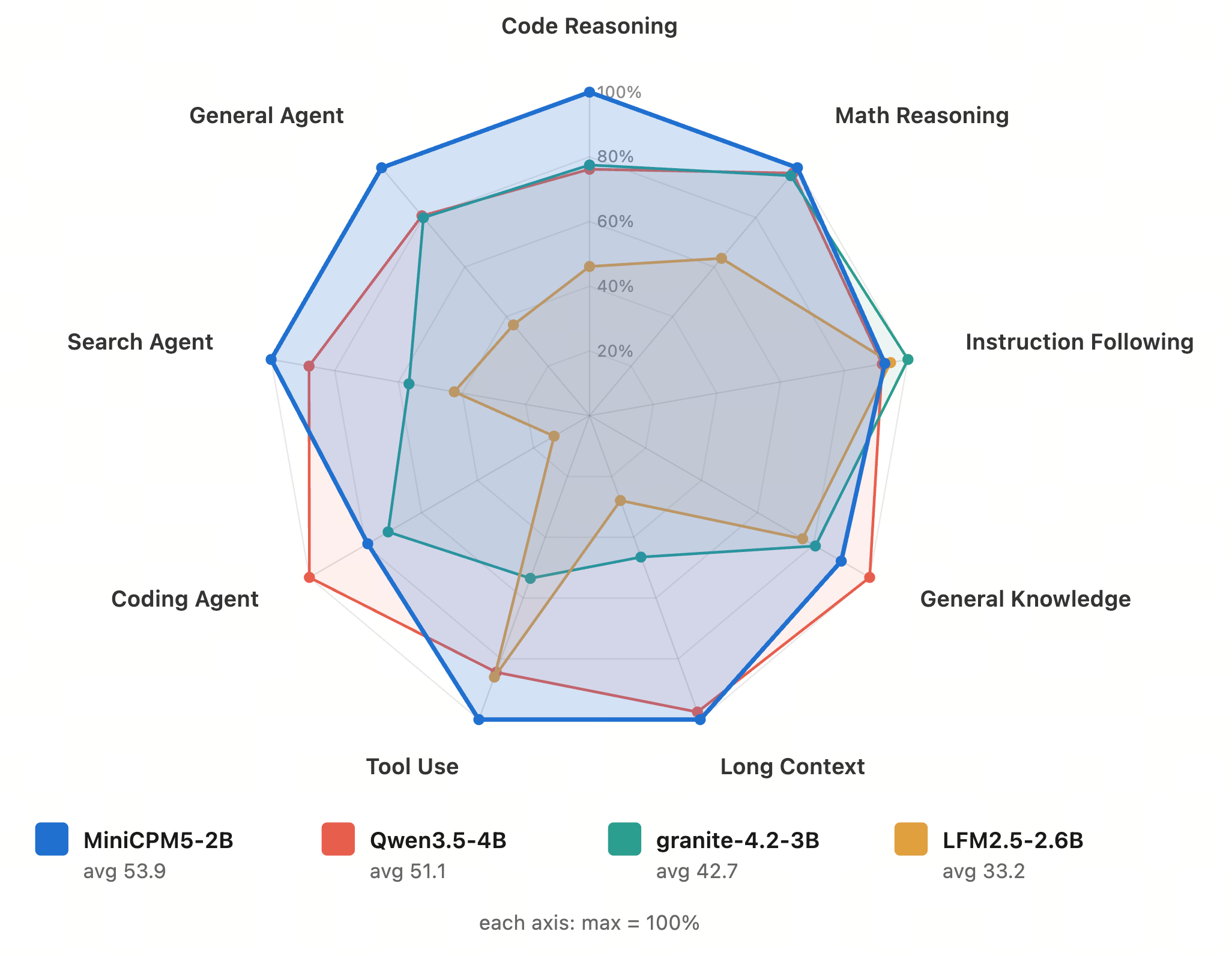
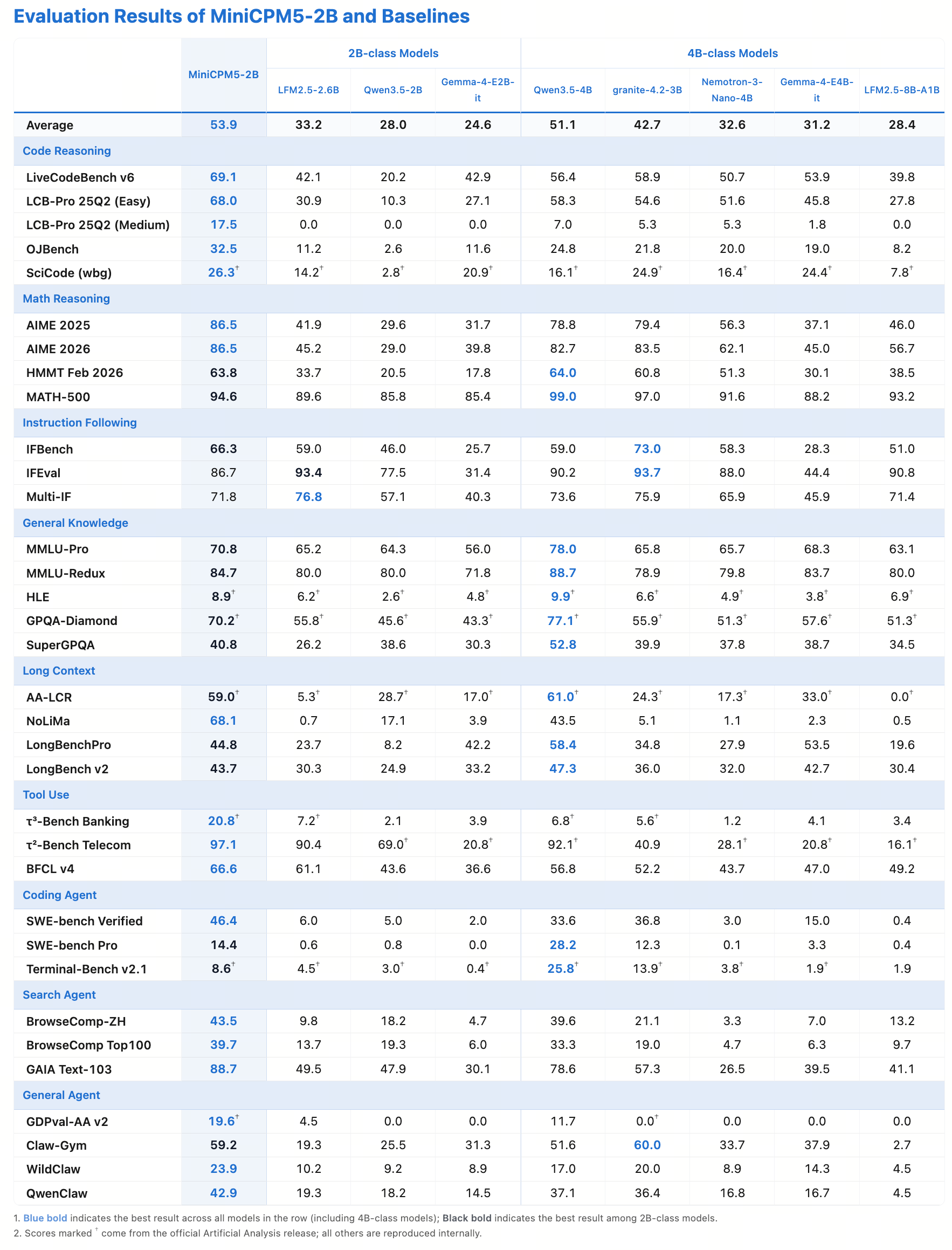
 MiniCPM is OpenBMB's family of small, open-source LLMs built for on-device and resource-constrained use. The newest release, MiniCPM5-2B, is a dense 2B-parameter model that reaches open-source state-of-the-art for its size class while staying competitive with much larger 4B-class models.
MiniCPM is OpenBMB's family of small, open-source LLMs built for on-device and resource-constrained use. The newest release, MiniCPM5-2B, is a dense 2B-parameter model that reaches open-source state-of-the-art for its size class while staying competitive with much larger 4B-class models.Is this a ready-to-use app or just model weights?It's a set of model checkpoints (BF16, GGUF, MLX, GPTQ) published on Hugging Face and ModelScope, not a standalone application. You load them through an existing inference framework such as Transformers, vLLM, SGLang, or llama.cpp.
It's a set of model checkpoints (BF16, GGUF, MLX, GPTQ) published on Hugging Face and ModelScope, not a standalone application. You load them through an existing inference framework such as Transformers, vLLM, SGLang, or llama.cpp.How do I run MiniCPM5-2B?Simplest path is Python: install Transformers and call AutoModelForCausalLM.from_pretrained('openbmb/MiniCPM5-2B'). Alternatively, pull the GGUF build into llama.cpp, or serve the BF16/GPTQ weights with vLLM or SGLang.
Simplest path is Python: install Transformers and call AutoModelForCausalLM.from_pretrained('openbmb/MiniCPM5-2B'). Alternatively, pull the GGUF build into llama.cpp, or serve the BF16/GPTQ weights with vLLM or SGLang.Which inference frameworks are supported?MiniCPM5-2B works with Hugging Face Transformers, vLLM, SGLang (with an optional DSpark speculative-decoding draft model), and llama.cpp via the GGUF build; MLX builds are provided for Apple Silicon.
MiniCPM5-2B works with Hugging Face Transformers, vLLM, SGLang (with an optional DSpark speculative-decoding draft model), and llama.cpp via the GGUF build; MLX builds are provided for Apple Silicon.Any gotchas with sampling settings?The recommended generation settings are temperature=1.0, top_p=0.95, min_p=0.0. llama.cpp's default min_p=0.05 can cause repetitive output by filtering out needed low-probability tokens, so it should be overridden.
The recommended generation settings are temperature=1.0, top_p=0.95, min_p=0.0. llama.cpp's default min_p=0.05 can cause repetitive output by filtering out needed low-probability tokens, so it should be overridden.Does it only run on GPU, or can I use it on a Mac or CPU?Multiple quantized formats are released so it can run across hardware: GGUF for CPU/llama.cpp, MLX for Apple Silicon Macs, and GPTQ/AWQ for GPU-accelerated serving.
Multiple quantized formats are released so it can run across hardware: GGUF for CPU/llama.cpp, MLX for Apple Silicon Macs, and GPTQ/AWQ for GPU-accelerated serving.What is UltraData?UltraData is the family of high-quality open datasets released alongside MiniCPM5, including UltraX (web pretraining), UltraData-Code, UltraData-SFT-Agent-2609 (500K agent samples), and UltraData-RL-2609 (80K+ RL samples for math, code, and reasoning).
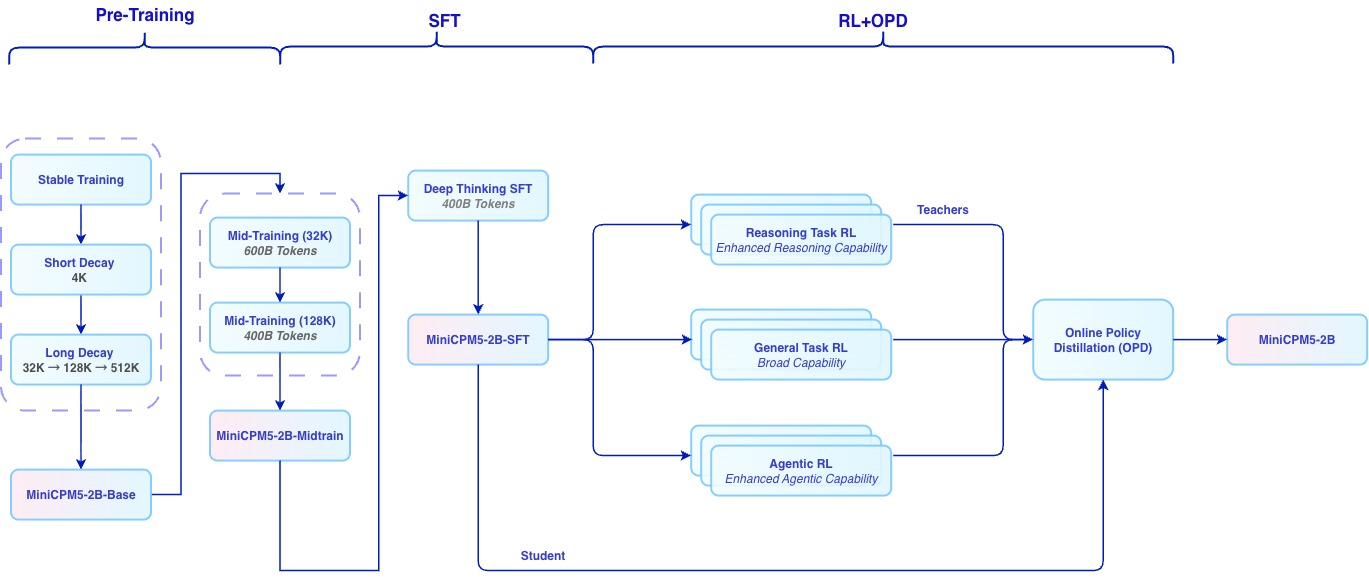
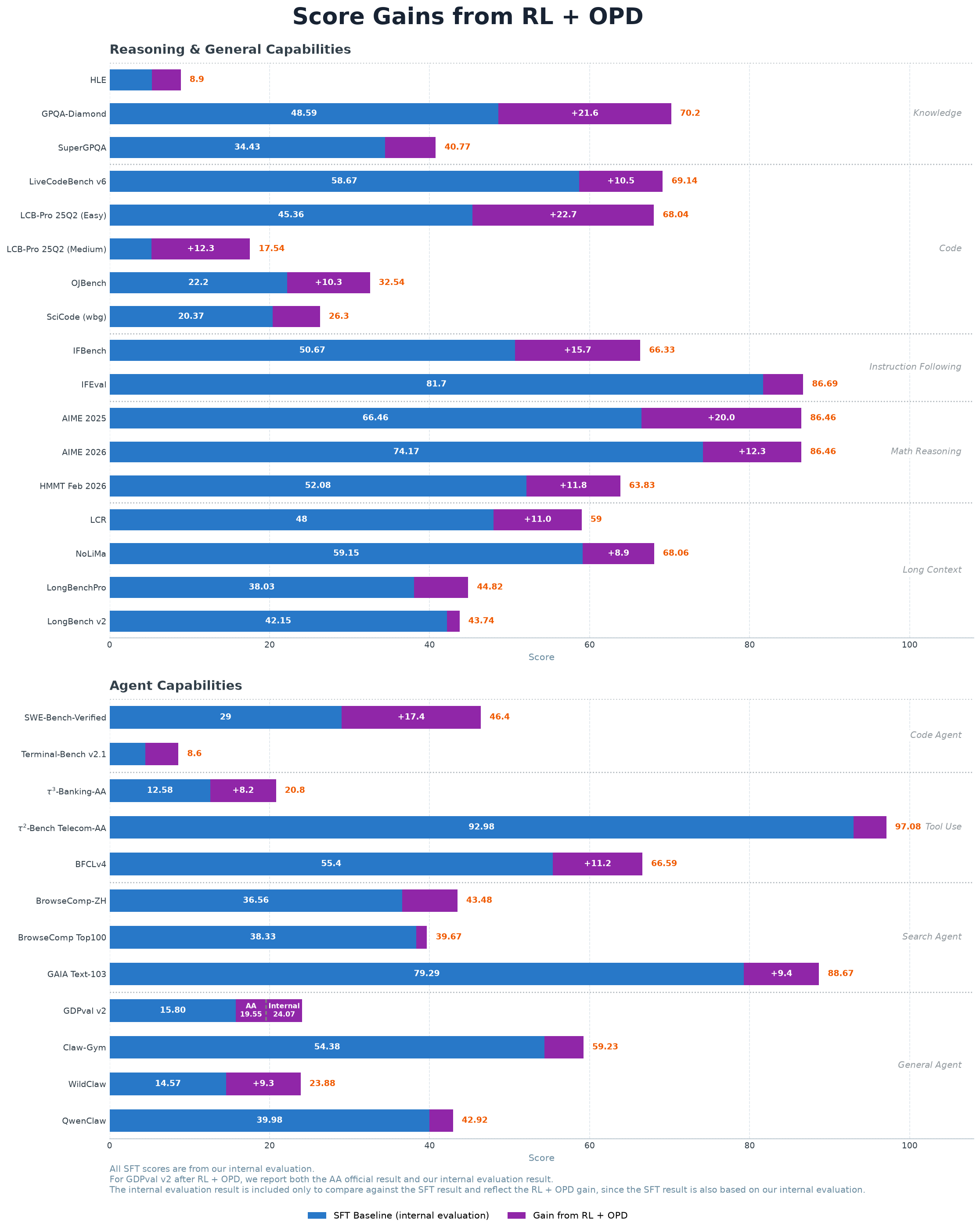
UltraData is the family of high-quality open datasets released alongside MiniCPM5, including UltraX (web pretraining), UltraData-Code, UltraData-SFT-Agent-2609 (500K agent samples), and UltraData-RL-2609 (80K+ RL samples for math, code, and reasoning).What does RL + OPD add to the model?On-Policy Distillation merges 16 RL-trained expert models (including 5 agentic experts) back into one checkpoint by matching student/teacher logits, boosting reasoning/general scores by about 11 points and agentic capability by about 7 points.
On-Policy Distillation merges 16 RL-trained expert models (including 5 agentic experts) back into one checkpoint by matching student/teacher logits, boosting reasoning/general scores by about 11 points and agentic capability by about 7 points.Are there other model sizes besides the 2B?Yes, the MiniCPM5 line also includes a 1B model, and the project keeps earlier generations (MiniCPM4/4.1, MiniCPM3, MiniCPM-SALA) plus ternary-quantized BitCPM4 variants ranging from 0.5B to 8B parameters.
Yes, the MiniCPM5 line also includes a 1B model, and the project keeps earlier generations (MiniCPM4/4.1, MiniCPM3, MiniCPM-SALA) plus ternary-quantized BitCPM4 variants ranging from 0.5B to 8B parameters.Why build another small LLM instead of using a 7B+ model?MiniCPM targets local assistants, coding agents, and tool-use workflows where a compact footprint matters; MiniCPM5-2B matches or beats larger 4B-class models on coding, math, long-context, and agentic benchmarks while staying small enough for on-device deployment.
MiniCPM targets local assistants, coding agents, and tool-use workflows where a compact footprint matters; MiniCPM5-2B matches or beats larger 4B-class models on coding, math, long-context, and agentic benchmarks while staying small enough for on-device deployment.What are similar projects?Model-Optimizer, Hy4-preview, decider, Hy-MT2, jeeves, DeepSeek-R1, DMI, NeoHorse
Model-Optimizer, Hy4-preview, decider, Hy-MT2, jeeves, DeepSeek-R1, DMI, NeoHorseWhich topics is it in?tool-use, knowledge-distillation, long-context, llamacpp, speculative-decoding, on-device, edge-ai, reasoning, language-model, gguf, vllm, reinforcement-learning
tool-use, knowledge-distillation, long-context, llamacpp, speculative-decoding, on-device, edge-ai, reasoning, language-model, gguf, vllm, reinforcement-learning