


What is this?
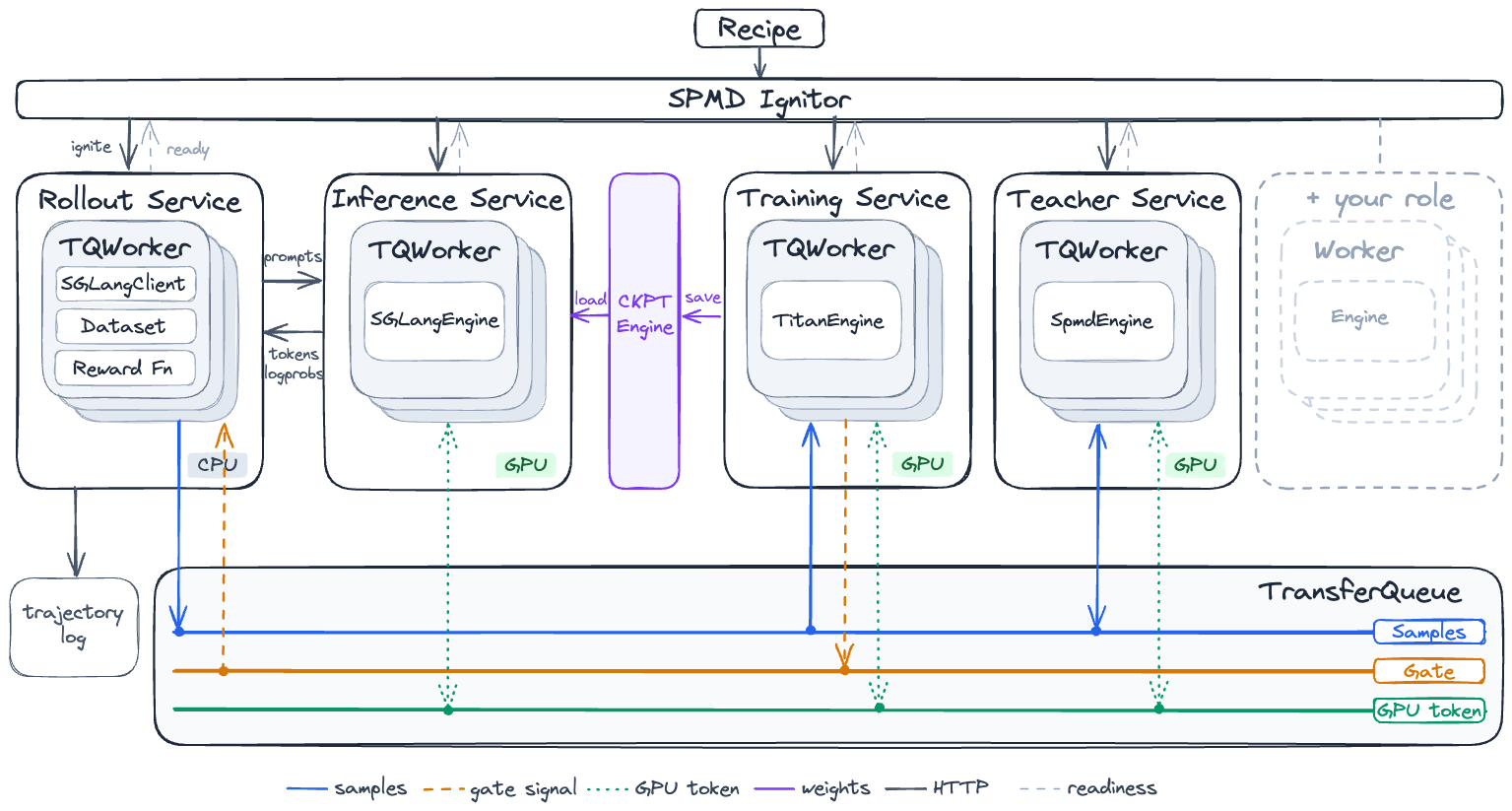
 Meshy is an open-source framework for running reinforcement learning (RL) training jobs where every role (inference, training, rollout) runs as an independent service, communicating through a shared TransferQueue data plane. It is built on SGLang and torchtitan.
Meshy is an open-source framework for running reinforcement learning (RL) training jobs where every role (inference, training, rollout) runs as an independent service, communicating through a shared TransferQueue data plane. It is built on SGLang and torchtitan.Is this a training framework or a ready-made model?It is a framework for orchestrating distributed RL training; it ships bundled recipes (plain Python modules) that wire together services, not a pretrained model itself.
It is a framework for orchestrating distributed RL training; it ships bundled recipes (plain Python modules) that wire together services, not a pretrained model itself.How do I get it running?Pull the prebuilt Docker image (recommended) or build it yourself with the provided Dockerfile, which pre-installs PyTorch, SGLang, TorchTitan and TransferQueue in /opt/meshy; then launch any recipe, which starts TransferQueue and runs torchrun with one ignitor per GPU.
Pull the prebuilt Docker image (recommended) or build it yourself with the provided Dockerfile, which pre-installs PyTorch, SGLang, TorchTitan and TransferQueue in /opt/meshy; then launch any recipe, which starts TransferQueue and runs torchrun with one ignitor per GPU.Do I need a specific GPU and CUDA version?Yes — an NVIDIA GPU with CUDA 12.9 support is required, along with Docker and the NVIDIA Container Toolkit (or a native Ubuntu 24.04 setup), plus Python 3.12+ if installing manually.
Yes — an NVIDIA GPU with CUDA 12.9 support is required, along with Docker and the NVIDIA Container Toolkit (or a native Ubuntu 24.04 setup), plus Python 3.12+ if installing manually.Does it support both synchronous and asynchronous training?Yes, through the exact same services — recipes like justrl, justrlasync and justrlfullyasync only change the rollout pacing window and GPU topology; there is no separate code path for sync vs async.
Yes, through the exact same services — recipes like justrl, justrlasync and justrlfullyasync only change the rollout pacing window and GPU topology; there is no separate code path for sync vs async.What is TransferQueue?It is the single data-and-control-plane middleware Meshy uses: tensors, gate pulses and GPU-ownership tokens all travel through its queue columns, and column readiness is the only signal services need, so they never handshake directly.
It is the single data-and-control-plane middleware Meshy uses: tensors, gate pulses and GPU-ownership tokens all travel through its queue columns, and column readiness is the only signal services need, so they never handshake directly.Which models and datasets does it ship recipes for?Bundled recipes cover Qwen3 (1.7B, 8B, and a 30B-A3B MoE variant), MiniCPM5 (1B/2B), and R1-Distill-Qwen-1.5B, trained on GSM8K, DAPO-Math-17k, or a local math dataset using GRPO/JustRL setups.
Bundled recipes cover Qwen3 (1.7B, 8B, and a 30B-A3B MoE variant), MiniCPM5 (1B/2B), and R1-Distill-Qwen-1.5B, trained on GSM8K, DAPO-Math-17k, or a local math dataset using GRPO/JustRL setups.Can multiple services share the same GPUs?Yes, GPU ownership is passed as a token over TransferQueue so any number of services can be colocated on the same cards, or run disaggregated by dropping colocatewith and COLOCATIONS from a recipe.
Yes, GPU ownership is passed as a token over TransferQueue so any number of services can be colocated on the same cards, or run disaggregated by dropping colocatewith and COLOCATIONS from a recipe.How do I add a new training task?Dataset, reward and advantage functions are supplied as 'module:attr' strings, so a new task just needs a class with a nextbatch() method and a reward function — no changes to the framework itself are required.
Dataset, reward and advantage functions are supplied as 'module:attr' strings, so a new task just needs a class with a nextbatch() method and a reward function — no changes to the framework itself are required.What are similar projects?verl, train-llm-from-scratch, halo, verl, open-r1, ms-swift, minimind, ColossalAI
verl, train-llm-from-scratch, halo, verl, open-r1, ms-swift, minimind, ColossalAIWhich topics is it in?grpo, model-training, distributed-training, mixture-of-experts, training, reinforcement-learning, qwen, fine-tuning, large-language-models, distributed-systems, nvidia, huggingface
grpo, model-training, distributed-training, mixture-of-experts, training, reinforcement-learning, qwen, fine-tuning, large-language-models, distributed-systems, nvidia, huggingface