ApexAgents-SkyRL-Recipe
A complete, public recipe for RL-training knowledge-work agents on Mercor's
APEX-Agents data, built on open-source SkyRL + open-source harbor —
import-only, zero forks. Companion code for the "Training Frontier Knowledge
Work Agents" blogpost.
Blogpost & artifacts
Architecture
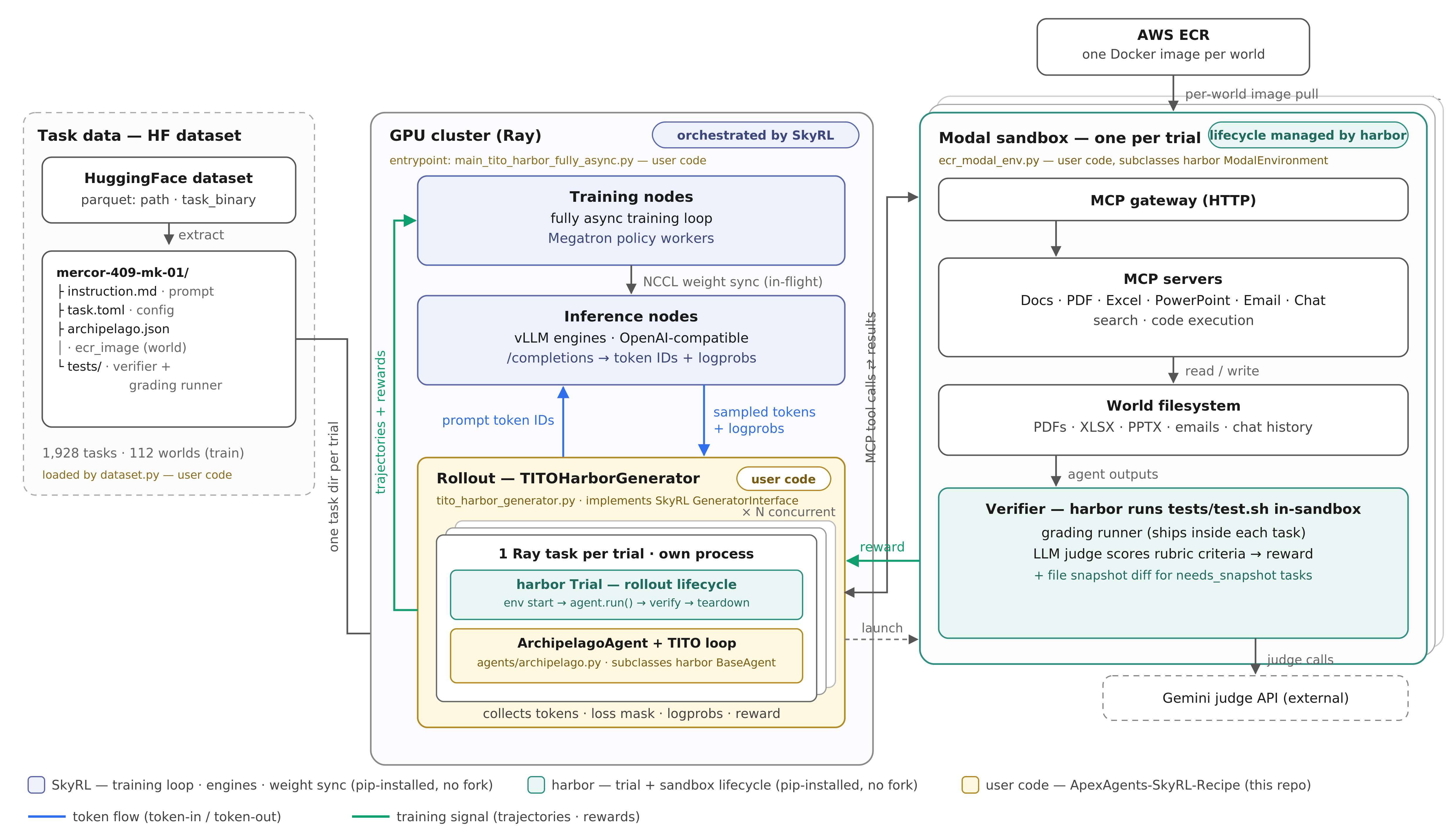
What runs where, for one RL trial. Training data is a HuggingFace dataset of
prebuilt harbor task directories (prompt, config, verifier); each trial consumes one
task directory (see "Data format" below). On the Ray GPU cluster, SkyRL provides the
fully-async training loop, the vLLM engines, and in-flight NCCL weight sync. Each trial
runs as its own Ray task, where harbor's Trial drives the rollout lifecycle
(env start → agent.run() → verify → teardown) around this repo's ArchipelagoAgent
(agents/archipelago.py), which exchanges raw token IDs with the engines (blue).
Every trial gets a Modal sandbox booted from its world's ECR image, exposing MCP
servers over the world's filesystem; after the agent finishes, harbor runs the
verifier in-sandbox, and the reward joins the trajectory flowing back to the trainer
(green). Box colors mark code ownership: indigo = SkyRL and teal = harbor (both
pip-installed, no forks); yellow = the code in this repo — the generator
(tito_harbor_generator.py, implementing SkyRL's GeneratorInterface), the agent,
the trial config (harbor_trial_config/archipelago_tito.yaml), and the entrypoints.
Dependency pinning (pyproject.toml): released versions — harbor[modal]==0.21.0
from PyPI; skyrl[megatron] 0.3.0 as an editable checkout of the release commit
(/mnt/local_storage/oss/SkyRL-v0.3.0, git worktree of NovaSky-AI/SkyRL @ b8a5caaa).
skyrl can't come from PyPI: uv only honors this repo's custom package sources/indexes
(Astral GPU wheels, pytorch-cu128, vllm-cu129, …) for path-dep requirements; a registry
skyrl pulls its GPU stack from PyPI sdists and fails to build. The mirrored
[tool.uv.*] blocks must be re-synced when bumping the skyrl pin.
Due to license issues, we cannot open-source the data. However, the data has the following format,
which can help you understand the repo's architecture and how components piece together.
Training consumes a HuggingFace dataset repo of prebuilt harbor tasks
(e.g. <HF_ORG>/apex-agents-dev-1928): parquet shards where each row is one
task, with two columns:
| column |
contents |
path |
task directory name, e.g. mercor-409-mk-01-c87181e6 |
task_binary |
gzip-compressed tar archive of the task directory |
Extracting every row yields standard harbor task directories:
mercor-409-mk-01-c87181e6/
├── instruction.md            # the prompt the agent sees
├── task.toml                 # harbor task config: agent/verifier timeouts,
│                             #   [verifier.env] key forwarding, resources
├── archipelago.json               # recipe-specific metadata (read by the generator)
├── environment/Dockerfile    # placeholder — real env is a prebuilt ECR image
└── tests/                    # verifier; never mounted for the agent
    ├── test.sh               # entrypoint harbor runs in-sandbox after the agent
    ├── grade.py              # drives the grading runner, emits the reward
    ├── verifiers.json        # rubric criteria (LLM-judged), hidden from agent
    ├── golden_responses.json # reference answers for the rubrics
    └── runner/               # vendored grading runner (see below)
archipelago.json fields:
{
  "task_id": "task_…",
  "task_name": "409_MK_01",
  "task_slug": "409-mk-01-c87181e6",
  "world_id": "world_…",
  "world_short_name": "management-consulting-world-409",
  "ecr_image": "<AWS_ACCOUNT_ID>.dkr.ecr.<REGION>.amazonaws.com/<REPO>:<world-tag>",
  "required_env_keys": ["FMP_API_KEY"],
  "needs_snapshot": false
}
Worlds vs. tasks (how ECR images work). APEX-Agents tasks are grouped into
worlds — simulated companies with documents, apps, and MCP tool servers. Many
tasks share one world, and environments are built per world, not per task:
one Docker image per world, pushed to ECR, referenced by every task in it via
ecr_image (the per-task environment/Dockerfile is only a placeholder to
satisfy harbor's layout). At trial time TITOHarborGenerator reads
archipelago.json and passes ecr_image to EcrModalEnvironment, which routes it
through harbor's native Image.from_aws_ecr(...) path; Modal authenticates the
pull with the secret named by ecr_modal_secret_name (e.g. aws-ecr-oidc) in
harbor_trial_config/archipelago_tito.yaml.
Grading. tests/runner/ is a per-task vendored copy of the grading runner
from Mercor-Intelligence/archipelago,
pinned at commit 79668ba, baked in when the dataset is built. tests/test.sh runs after the
agent finishes, installs the runner's deps inside the sandbox, and grades the
agent's output against verifiers.json with an LLM judge (GRADING_MODEL,
default a Gemini model via GOOGLE_API_KEY). The judge's per-criterion scores
become the trial reward. So at train time this repo needs no archipelago
checkout — the grading code ships inside every task.
Env key plumbing. task.toml's [verifier.env] (and
required_env_keys for agent-side keys) use ${VAR} templating resolved
from the trainer-side environment — the recipe's Ray init forwards them into
trial tasks (HARBOR_ENV_VARS). Tasks with needs_snapshot: true grade by
diffing document snapshots and additionally need MERCOR_DOCUMENT_API /
MERCOR_DOCUMENT_API_KEY.
Download + extract:
# uv run python - <<'PY'
import gzip, io, tarfile
from pathlib import Path
import pyarrow.parquet as pq
from huggingface_hub import snapshot_download

repo = snapshot_download("HF-ORG/apex-agents-dev-1928", repo_type="dataset")
out = Path("/mnt/local_storage/data/harbor/apex-agents-dev-1928")
for shard in Path(repo).rglob("*.parquet"):
    t = pq.read_table(shard)
    for path, blob in zip(t["path"].to_pylist(), t["task_binary"].to_pylist()):
        with tarfile.open(fileobj=io.BytesIO(blob), mode="r:*") as tf:
            tf.extractall(out / path, filter="data")
# PY
data.train_data then points at the extracted directory (one subdir per task).
Setup
# one-time: checkout skyrl at the 0.3.0 release commit. The path must match the
# skyrl entry in [tool.uv.sources] (and uv.lock) - if you clone elsewhere,
# update pyproject.toml accordingly and re-run `uv lock`.
git clone https://github.com/NovaSky-AI/SkyRL /mnt/local_storage/oss/SkyRL-v0.3.0
git -C /mnt/local_storage/oss/SkyRL-v0.3.0 checkout b8a5caaa
# .venv lives on big disk (repo dirs may have small quotas)
mkdir -p /mnt/local_storage/venvs/harbor-apex-recipe && ln -sfn /mnt/local_storage/venvs/harbor-apex-recipe .venv
cp <secrets>/.env.apex .   # WANDB/MODAL/HF/task-API keys; gitignored
uv sync
Workflow
1. Data — download and extract the task dataset (see "Data format" above).
2. Smoke test (1 GPU, validated) — full loop: trial → TITO rollout → DPPO → ckpt
bash scripts/run_1gpu_colocated_smoke.sh &> /mnt/local_storage/recipe_smoke.log
# defaults: Qwen3.5-0.8B, 2×2 batch, 2 steps. MODEL_NAME=Qwen/Qwen3.5-9B for the 9B.
3. Fully-async training (≥2 GPUs)
# Flattened hero runs (defaults = the actual production configs; a few knobs
# not present in OSS SkyRL 0.3.0 are omitted, noted in each header):
bash scripts/run_qwen36_35b_fully_async.sh &> train.log   # 35B: 10xTP8 + 4 nodes TP8/EP8, DPPO+prompt_mean, 160k
bash scripts/run_qwen35_397b_fully_async.sh &> train.log  # 397B: 12xTP8 + 8 nodes TP4/PP4/CP2/EP16, S3 ckpts
4. Eval
bash scripts/run_eval.sh &> eval.log # through the SkyRL eval entrypoint
Secrets are sourced from .env.apex in-script (not uv --env-file:
Ray's uv hook re-runs uv args inside the working_dir extract where the gitignored file
doesn't exist).
Environment keys needed
export WANDB_API_KEY=
export HF_TOKEN=

# Modal (sandboxes)
export MODAL_TOKEN_ID=
export MODAL_TOKEN_SECRET=
export MODAL_ENVIRONMENT=

# API keys needed by some tasks (see each task's required_env_keys)
export FMP_API_KEY=
export TERRAPIN_API_KEY=

# Grading: document-parse API for needs_snapshot tasks
export MERCOR_DOCUMENT_API=
export MERCOR_DOCUMENT_API_KEY=

# LLM judge for grading
export GOOGLE_API_KEY=

 这是一份完整公开的配方,用于在 Mercor 的 APEX-Agents 数据上对知识工作 agent 进行强化学习训练,基于开源的 SkyRL 训练库和开源的 harbor 沙箱/评分工具包构建。它是 Mercor《Training Frontier Knowledge Work Agents》博文的配套代码。