
ApexAgents-SkyRL-Recipe README

The project's README from github.com/Mercor-Intelligence/ApexAgents-SkyRL-Recipe. As one markdown file: README.md.

ApexAgents-SkyRL-Recipe

A complete, public recipe for RL-training knowledge-work agents on Mercor's APEX-Agents data, built on open-source SkyRL + open-source harbor — import-only, zero forks. Companion code for the "Training Frontier Knowledge Work Agents" blogpost.

Blogpost & artifacts

Architecture

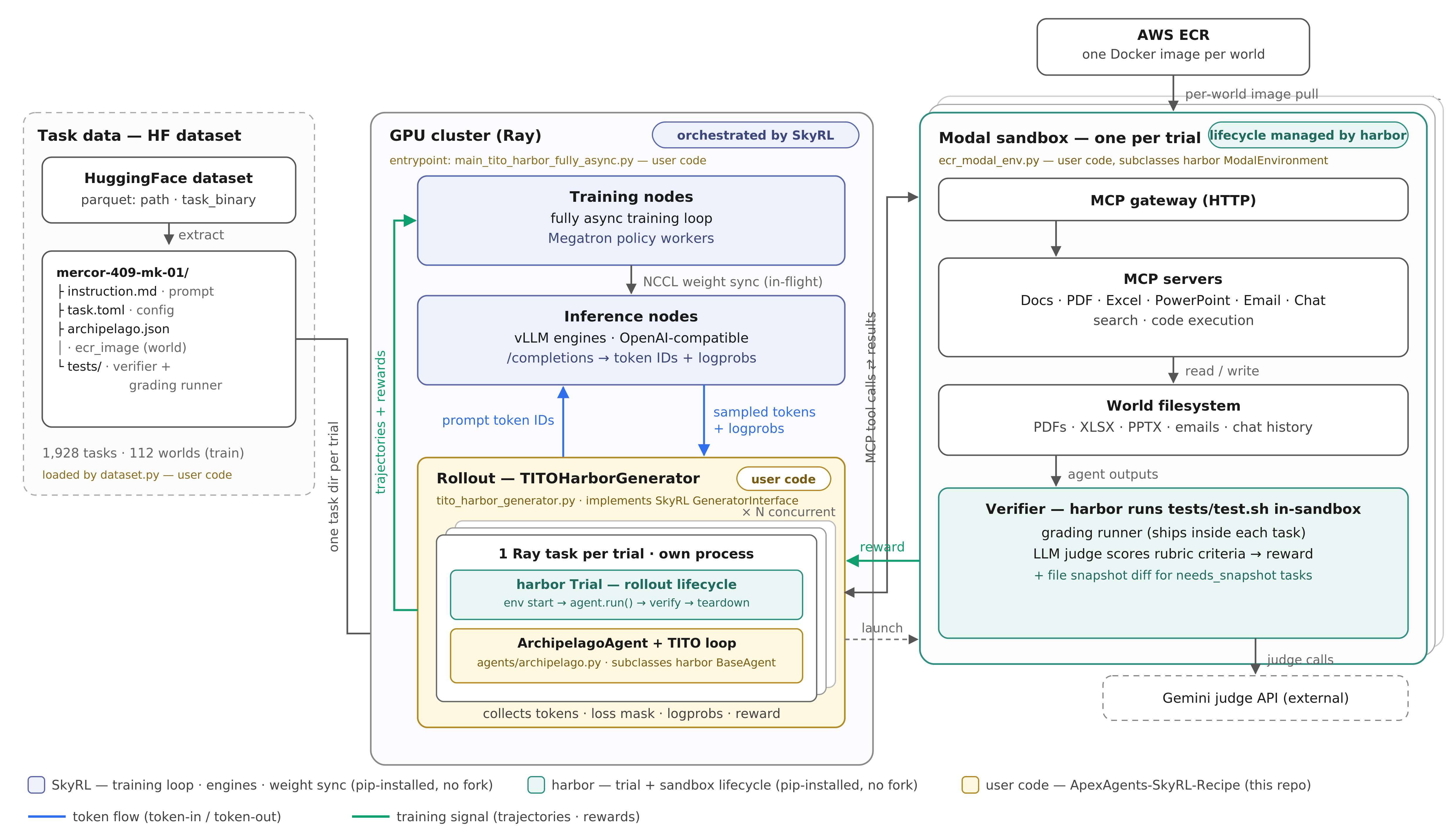
What runs where — one RL trial

What runs where, for one RL trial. Training data is a HuggingFace dataset of prebuilt harbor task directories (prompt, config, verifier); each trial consumes one task directory (see "Data format" below). On the Ray GPU cluster, SkyRL provides the fully-async training loop, the vLLM engines, and in-flight NCCL weight sync. Each trial runs as its own Ray task, where harbor's Trial drives the rollout lifecycle (env start → agent.run() → verify → teardown) around this repo's ArchipelagoAgent (agents/archipelago.py), which exchanges raw token IDs with the engines (blue). Every trial gets a Modal sandbox booted from its world's ECR image, exposing MCP servers over the world's filesystem; after the agent finishes, harbor runs the verifier in-sandbox, and the reward joins the trajectory flowing back to the trainer (green). Box colors mark code ownership: indigo = SkyRL and teal = harbor (both pip-installed, no forks); yellow = the code in this repo — the generator (tito_harbor_generator.py, implementing SkyRL's GeneratorInterface), the agent, the trial config (harbor_trial_config/archipelago_tito.yaml), and the entrypoints.

Dependency pinning (pyproject.toml): released versions — harbor[modal]==0.21.0 from PyPI; skyrl[megatron] 0.3.0 as an editable checkout of the release commit (/mnt/local_storage/oss/SkyRL-v0.3.0, git worktree of NovaSky-AI/SkyRL @ b8a5caaa). skyrl can't come from PyPI: uv only honors this repo's custom package sources/indexes (Astral GPU wheels, pytorch-cu128, vllm-cu129, …) for path-dep requirements; a registry skyrl pulls its GPU stack from PyPI sdists and fails to build. The mirrored [tool.uv.*] blocks must be re-synced when bumping the skyrl pin.

Data format

Due to license issues, we cannot open-source the data. However, the data has the following format, which can help you understand the repo's architecture and how components piece together.

Training consumes a HuggingFace dataset repo of prebuilt harbor tasks (e.g. <HF_ORG>/apex-agents-dev-1928): parquet shards where each row is one task, with two columns:

column contents
path task directory name, e.g. mercor-409-mk-01-c87181e6
task_binary gzip-compressed tar archive of the task directory

Extracting every row yields standard harbor task directories:

mercor-409-mk-01-c87181e6/
├── instruction.md            # the prompt the agent sees
├── task.toml                 # harbor task config: agent/verifier timeouts,
│                             #   [verifier.env] key forwarding, resources
├── archipelago.json               # recipe-specific metadata (read by the generator)
├── environment/Dockerfile    # placeholder — real env is a prebuilt ECR image
└── tests/                    # verifier; never mounted for the agent
    ├── test.sh               # entrypoint harbor runs in-sandbox after the agent
    ├── grade.py              # drives the grading runner, emits the reward
    ├── verifiers.json        # rubric criteria (LLM-judged), hidden from agent
    ├── golden_responses.json # reference answers for the rubrics
    └── runner/               # vendored grading runner (see below)

archipelago.json fields:

{
  "task_id": "task_…",
  "task_name": "409_MK_01",
  "task_slug": "409-mk-01-c87181e6",
  "world_id": "world_…",
  "world_short_name": "management-consulting-world-409",
  "ecr_image": "<AWS_ACCOUNT_ID>.dkr.ecr.<REGION>.amazonaws.com/<REPO>:<world-tag>",
  "required_env_keys": ["FMP_API_KEY"],
  "needs_snapshot": false
}

Worlds vs. tasks (how ECR images work). APEX-Agents tasks are grouped into worlds — simulated companies with documents, apps, and MCP tool servers. Many tasks share one world, and environments are built per world, not per task: one Docker image per world, pushed to ECR, referenced by every task in it via ecr_image (the per-task environment/Dockerfile is only a placeholder to satisfy harbor's layout). At trial time TITOHarborGenerator reads archipelago.json and passes ecr_image to EcrModalEnvironment, which routes it through harbor's native Image.from_aws_ecr(...) path; Modal authenticates the pull with the secret named by ecr_modal_secret_name (e.g. aws-ecr-oidc) in harbor_trial_config/archipelago_tito.yaml.

Grading. tests/runner/ is a per-task vendored copy of the grading runner from Mercor-Intelligence/archipelago, pinned at commit 79668ba, baked in when the dataset is built. tests/test.sh runs after the agent finishes, installs the runner's deps inside the sandbox, and grades the agent's output against verifiers.json with an LLM judge (GRADING_MODEL, default a Gemini model via GOOGLE_API_KEY). The judge's per-criterion scores become the trial reward. So at train time this repo needs no archipelago checkout — the grading code ships inside every task.

Env key plumbing. task.toml's [verifier.env] (and required_env_keys for agent-side keys) use ${VAR} templating resolved from the trainer-side environment — the recipe's Ray init forwards them into trial tasks (HARBOR_ENV_VARS). Tasks with needs_snapshot: true grade by diffing document snapshots and additionally need MERCOR_DOCUMENT_API / MERCOR_DOCUMENT_API_KEY.

Download + extract:

# uv run python - <<'PY'
import gzip, io, tarfile
from pathlib import Path
import pyarrow.parquet as pq
from huggingface_hub import snapshot_download

repo = snapshot_download("HF-ORG/apex-agents-dev-1928", repo_type="dataset")
out = Path("/mnt/local_storage/data/harbor/apex-agents-dev-1928")
for shard in Path(repo).rglob("*.parquet"):
    t = pq.read_table(shard)
    for path, blob in zip(t["path"].to_pylist(), t["task_binary"].to_pylist()):
        with tarfile.open(fileobj=io.BytesIO(blob), mode="r:*") as tf:
            tf.extractall(out / path, filter="data")
# PY

data.train_data then points at the extracted directory (one subdir per task).

Setup

# one-time: checkout skyrl at the 0.3.0 release commit. The path must match the
# skyrl entry in [tool.uv.sources] (and uv.lock) - if you clone elsewhere,
# update pyproject.toml accordingly and re-run `uv lock`.
git clone https://github.com/NovaSky-AI/SkyRL /mnt/local_storage/oss/SkyRL-v0.3.0
git -C /mnt/local_storage/oss/SkyRL-v0.3.0 checkout b8a5caaa
# .venv lives on big disk (repo dirs may have small quotas)
mkdir -p /mnt/local_storage/venvs/harbor-apex-recipe && ln -sfn /mnt/local_storage/venvs/harbor-apex-recipe .venv
cp <secrets>/.env.apex .   # WANDB/MODAL/HF/task-API keys; gitignored
uv sync

Workflow

1. Data — download and extract the task dataset (see "Data format" above).

2. Smoke test (1 GPU, validated) — full loop: trial → TITO rollout → DPPO → ckpt

bash scripts/run_1gpu_colocated_smoke.sh &> /mnt/local_storage/recipe_smoke.log
# defaults: Qwen3.5-0.8B, 2×2 batch, 2 steps. MODEL_NAME=Qwen/Qwen3.5-9B for the 9B.

3. Fully-async training (≥2 GPUs)

# Flattened hero runs (defaults = the actual production configs; a few knobs
# not present in OSS SkyRL 0.3.0 are omitted, noted in each header):
bash scripts/run_qwen36_35b_fully_async.sh &> train.log   # 35B: 10xTP8 + 4 nodes TP8/EP8, DPPO+prompt_mean, 160k
bash scripts/run_qwen35_397b_fully_async.sh &> train.log  # 397B: 12xTP8 + 8 nodes TP4/PP4/CP2/EP16, S3 ckpts

4. Eval

bash scripts/run_eval.sh &> eval.log             # through the SkyRL eval entrypoint

Secrets are sourced from .env.apex in-script (not uv --env-file: Ray's uv hook re-runs uv args inside the working_dir extract where the gitignored file doesn't exist).

Environment keys needed

export WANDB_API_KEY=
export HF_TOKEN=

# Modal (sandboxes)
export MODAL_TOKEN_ID=
export MODAL_TOKEN_SECRET=
export MODAL_ENVIRONMENT=

# API keys needed by some tasks (see each task's required_env_keys)
export FMP_API_KEY=
export TERRAPIN_API_KEY=

# Grading: document-parse API for needs_snapshot tasks
export MERCOR_DOCUMENT_API=
export MERCOR_DOCUMENT_API_KEY=

# LLM judge for grading
export GOOGLE_API_KEY=

ApexAgents-SkyRL-Recipe (Mercor-Intelligence/ApexAgents-SkyRL-Recipe)

Searching Database…

What is this?It's a complete, public recipe for RL-training knowledge-work agents on Mercor's APEX-Agents data, built on the open-source SkyRL training library and the open-source harbor sandbox/grading toolkit. It's the companion code for Mercor's 'Training Frontier Knowledge Work Agents' blogpost.
Is this a reusable framework, or a specific one-off training recipe?It's a specific recipe, not a general framework: SkyRL and harbor are pip-installed as-is with zero forks, and this repo only adds the glue code (the generator, the agent, trial configs, entrypoints) around them.
What's the actual workflow to run a training job?You first download and extract the HuggingFace task dataset, then run a 1-GPU smoke test of the full trial-to-checkpoint loop, then scale to fully-async training on 2+ GPUs, and finally run eval.
What do I need installed before running this?You need the pinned releases from pyproject.toml: harbor[modal]==0.21.0 from PyPI and an editable skyrl[megatron] 0.3.0 checkout (it can't be pulled as a plain PyPI package because of its custom GPU wheel sources), plus access to a Ray GPU cluster, Modal, and AWS ECR.
Can I get the actual training data myself?No — the APEX-Agents task dataset itself is not released due to licensing, only its format is documented so you can understand the architecture.
How many GPUs does training actually need?A smoke test of the full trial loop works on a single GPU, but real fully-async training requires at least 2 GPUs on a Ray cluster.
What models were trained with this recipe?Mercor published checkpoints for two models trained with this recipe: 'Qwen3.6-35B-A3B-Mercor' and 'Qwen3.5-397B-A17B-Mercor', both on HuggingFace.
What do SkyRL and harbor each handle?SkyRL runs the fully-async training loop, the vLLM inference engines, and in-flight NCCL weight sync, while harbor drives each trial's rollout lifecycle (env start, agent.run(), verify, teardown) inside a Modal sandbox.
How are agent rollouts graded?After the agent finishes, harbor runs a grading script inside the sandbox that uses an LLM judge (a Gemini model by default) to score the output against the task's verifiers.json; the per-criterion scores become the trial's reward.
What are 'worlds' in APEX-Agents tasks?Worlds are simulated companies with their own documents, apps, and MCP tool servers; many tasks share one world, so environments and their ECR Docker images are built per world rather than per task.
What are similar projects?open-r1, verl, NanoJev, jeeves, reef, NeoHorse, ms-swift, Valen
Size
0.8 MB
Stars
217
Updated
CommitSep 01
Age
1mo
Commits · 90 Days