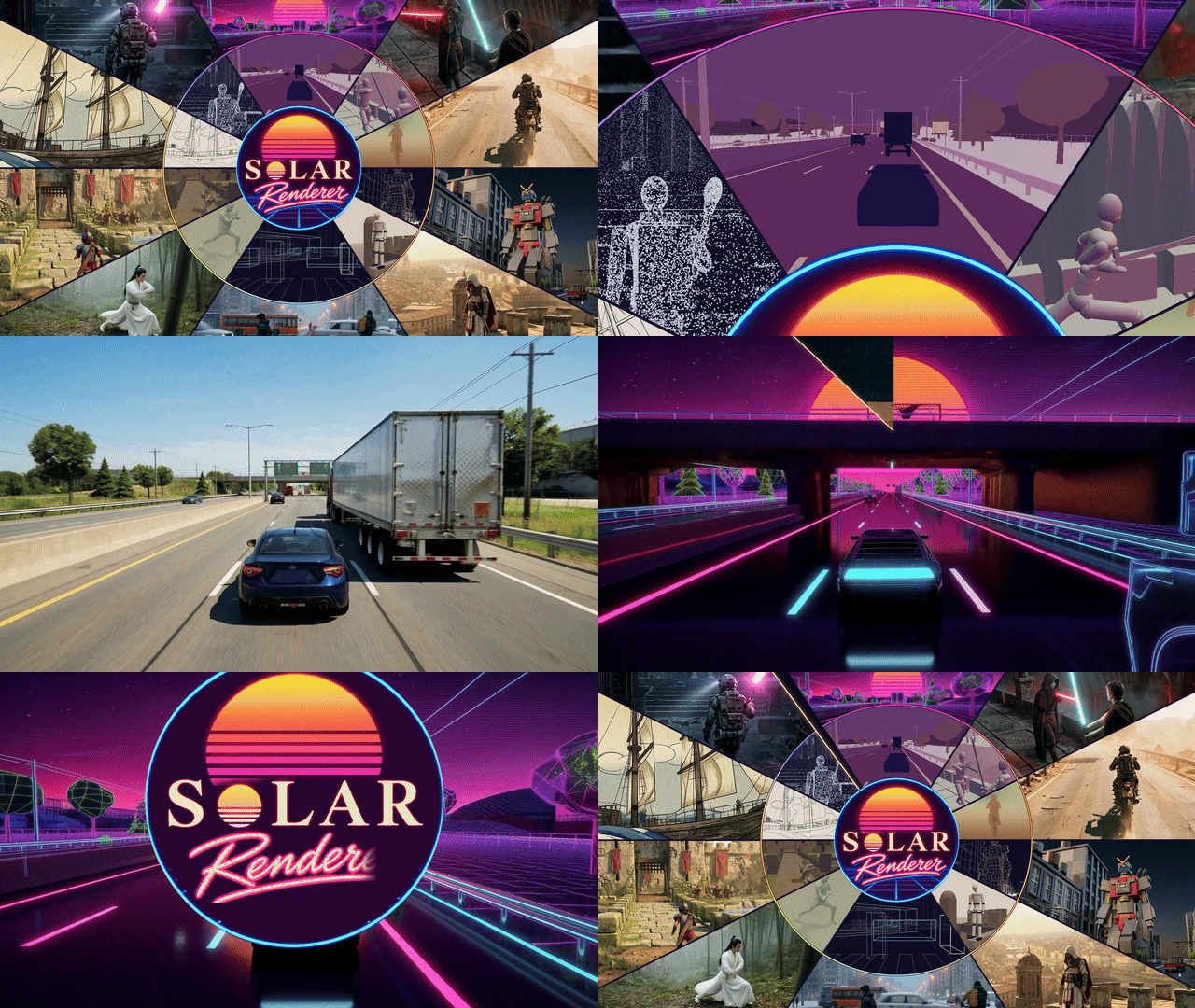
SolarRenderer: Few-Step Generative Reference Rendering
🌐 Project Page •
🎮 Online Demo •
📄 Paper •
🤗 Weights •
🤗 Data •
💻 Data code
SolarRenderer turns a structure video from a game engine or an agent (grey box, semantic map, skeletons, depth,
body mesh, or a sketch it never saw in training) into a finished video, with an optional first frame and a prompt
deciding the look. It runs on MiniMax-H3 with two LoRAs and renders a clip in four steps.
A block-causal pair of the same LoRAs streams the clip block by block.
News
- [2026-10] Try it in the browser: an online demo on Hugging Face Spaces.
- [2026-10] Code, weights, the shareable training data and the benchmark released.
Highlights
- 🧱 Any structure, one model: no extra branch and no condition-type label; the prompt names the structure.
- ⚡ Four steps: structure-guided post-training, 12.3× faster sampling than 50 steps.
- 🎨 Any look: the same structure renders as photoreal, anime, pixel art or ink, set by the first frame and prompt.
- 🌊 Streaming: a block-causal version of both LoRAs renders the video block by block, each block shown as soon as
it is done (guide).
- 📊 Open benchmark: 208 hard cases and 53 held-out clips, with scoring code, our renders and every judge verdict.
Gallery
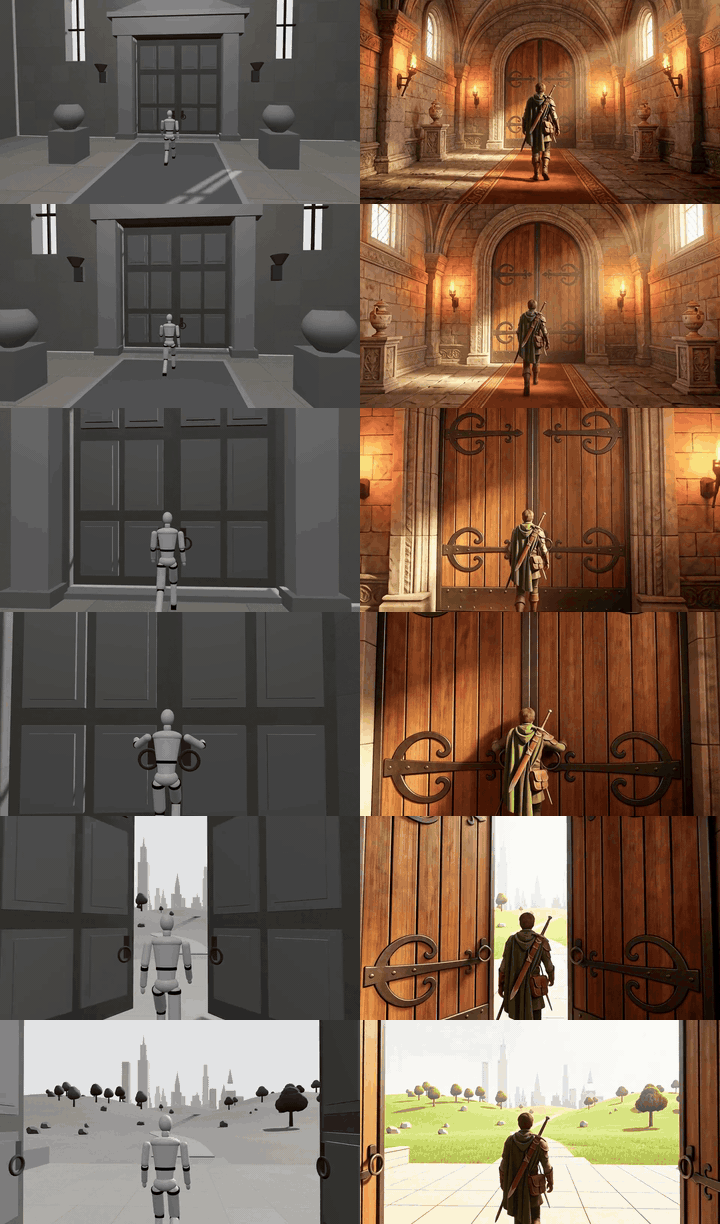
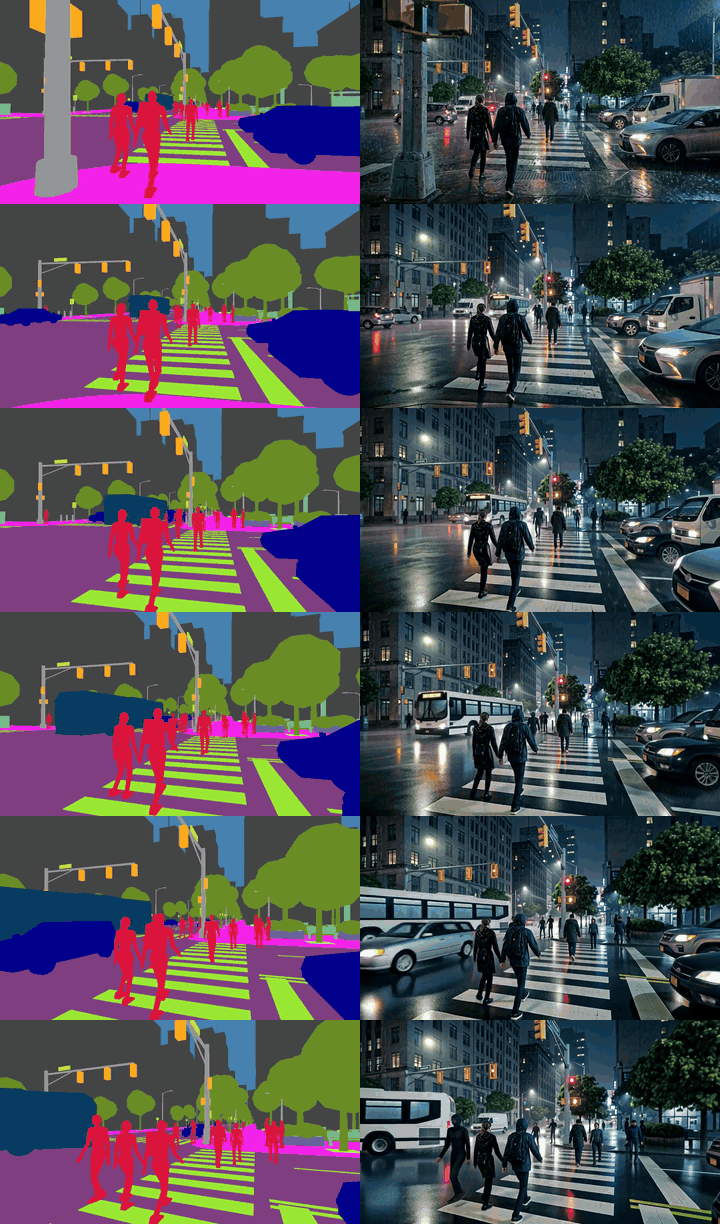
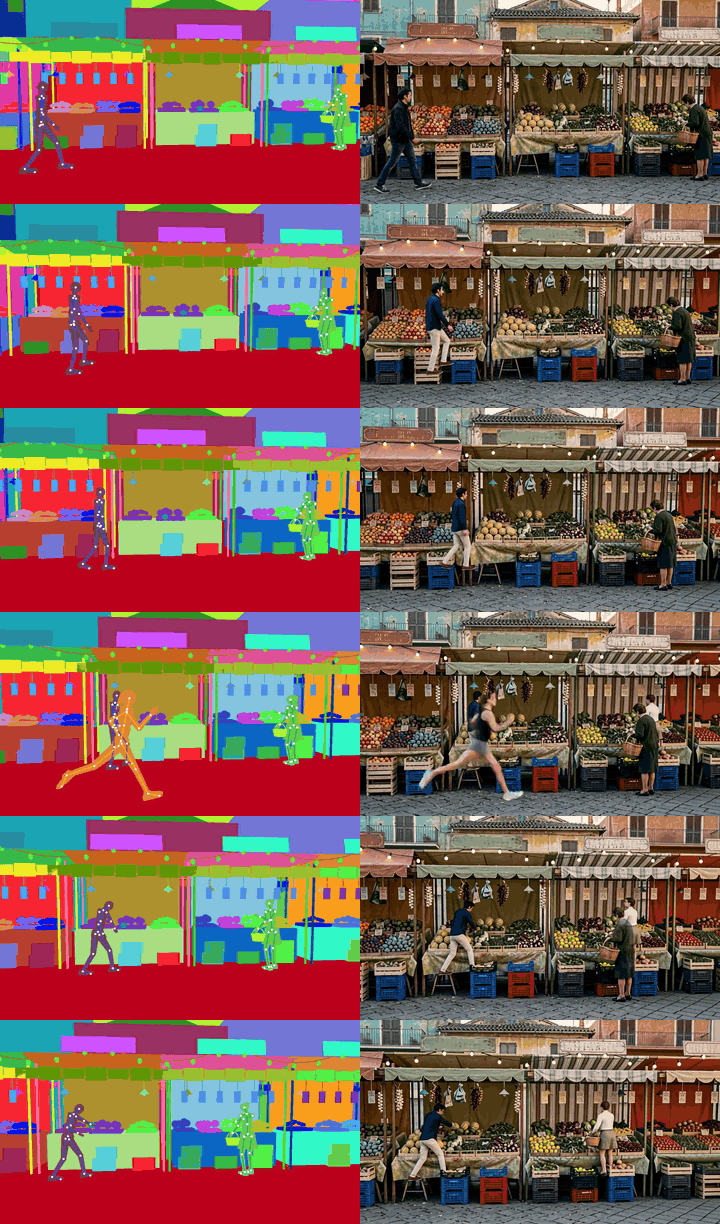
Structure video (left) and SolarRenderer (right).
| Scene grey box |
Semantic segmentation |
 |
 |
| Object masks + skeletons |
SMPL body mesh |
 |
 |
| Near-field shaded geometry |
Pencil storyboard (unseen) |
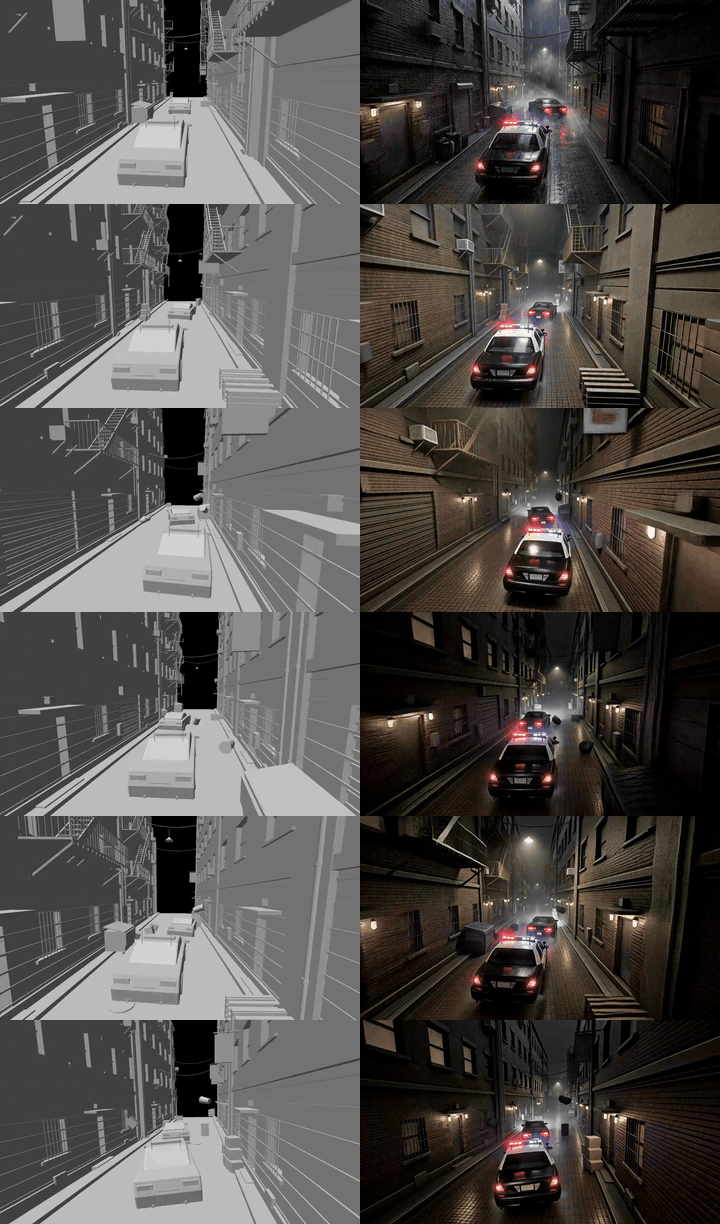 |
 |
| Point cloud (unseen) |
Child's crayon drawing (unseen) |
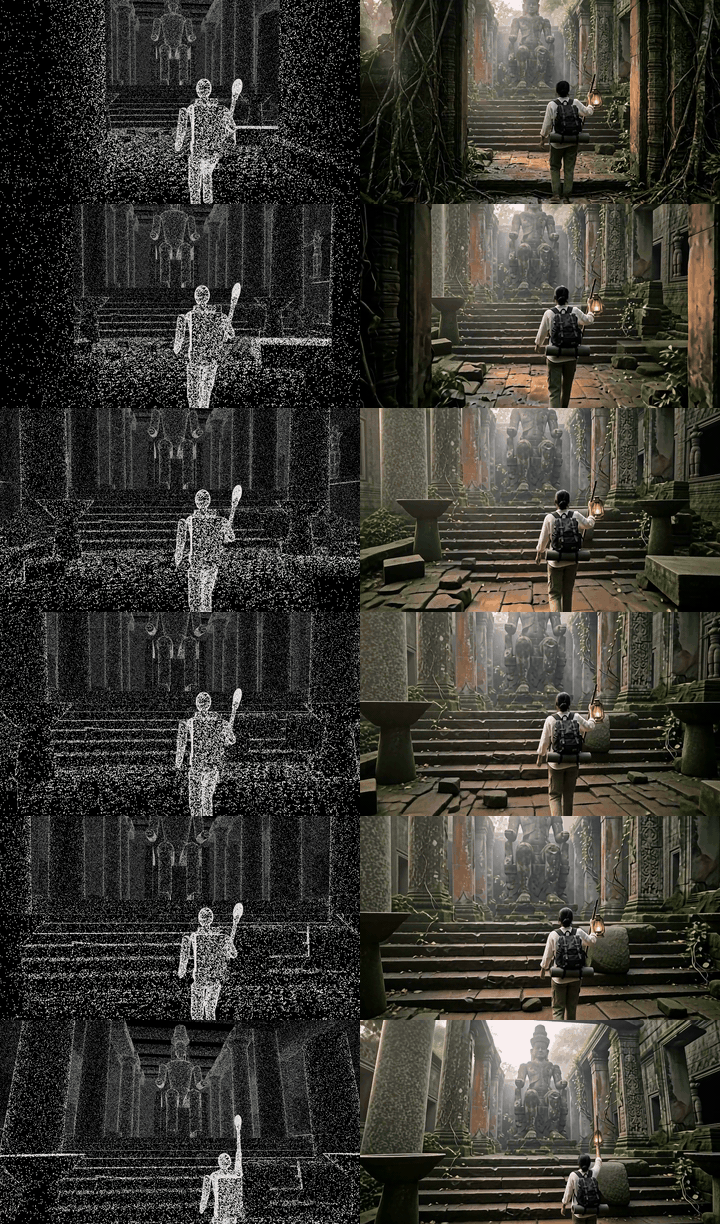 |
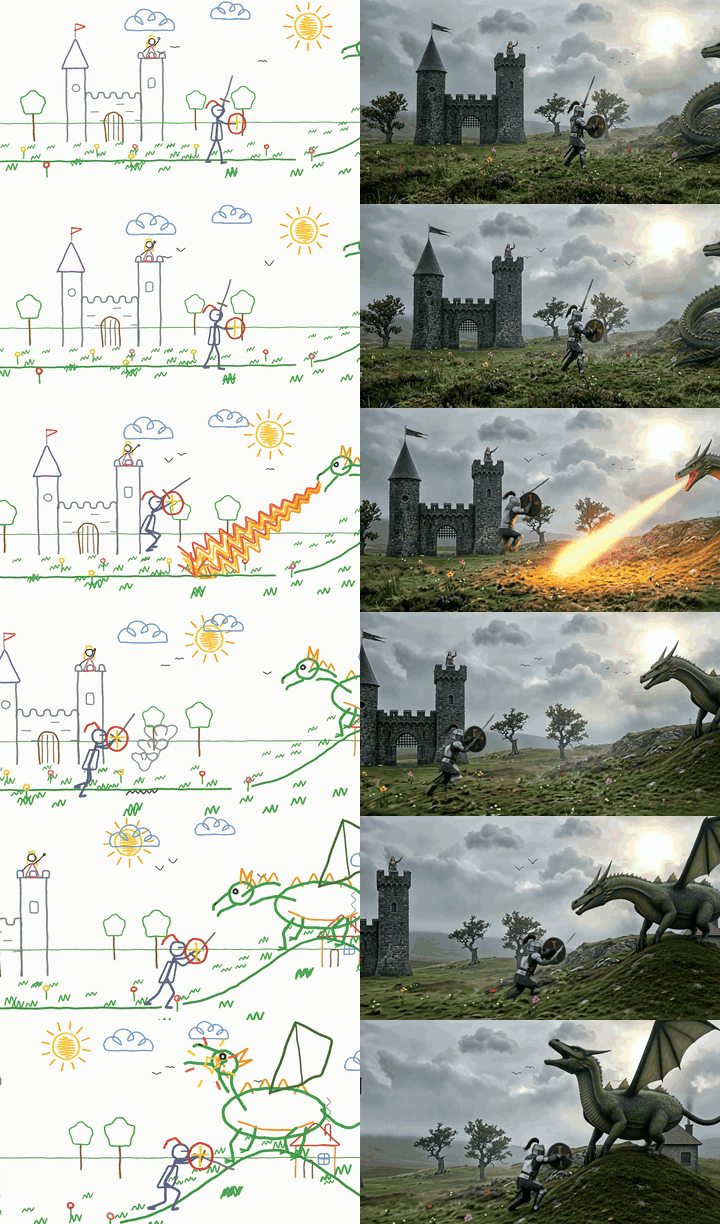 |
| Voxels (unseen) |
Wireframe (unseen) |
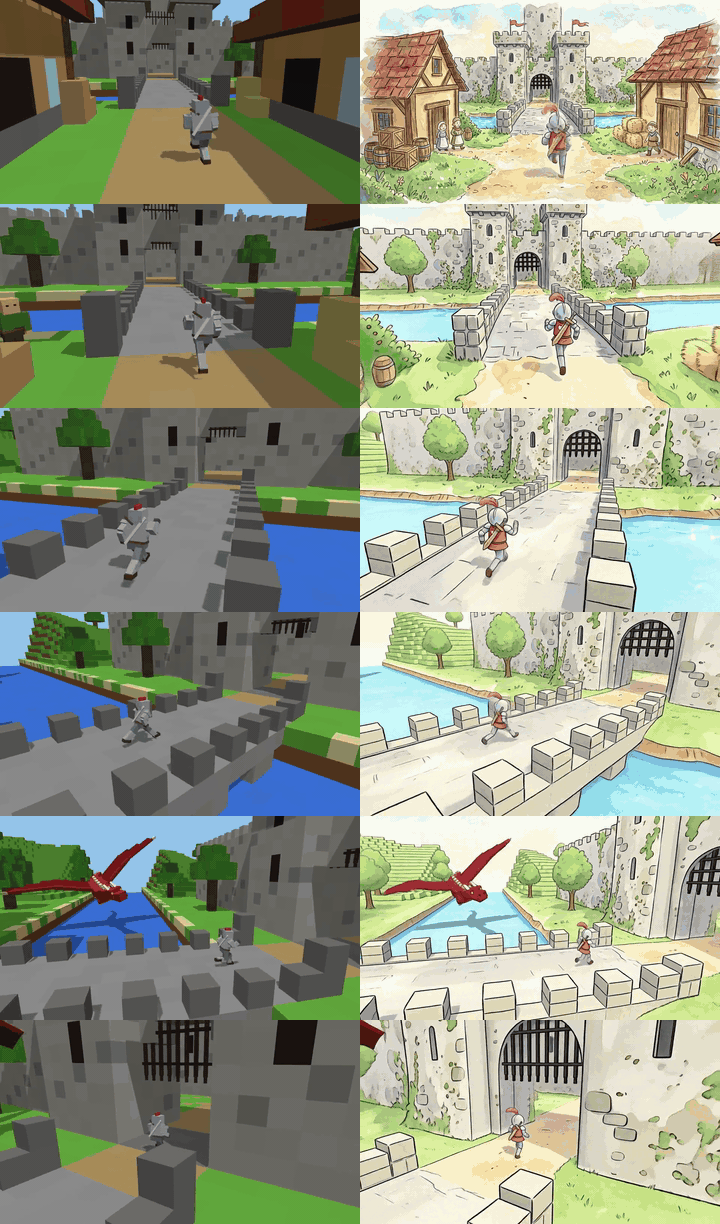 |
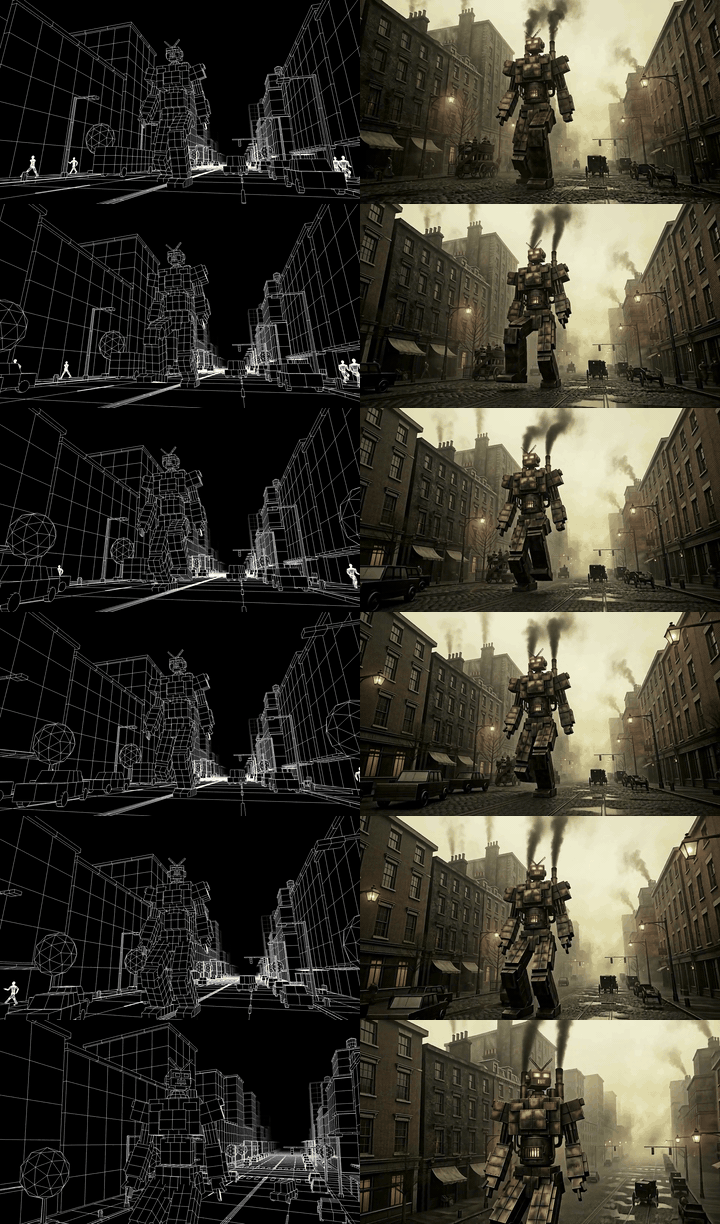 |
More structure types, styles and comparisons are on the project page.
Quick Start
git clone https://github.com/Enderfga/SolarRenderer && cd SolarRenderer
pip install -e . && pip install flash-attn==2.7.4.post1 --no-build-isolation
python scripts/prepare_h3.py --dir ./MiniMax-H3
hf download Enderfga/SolarRenderer config.json solarrenderer_control_lora.safetensors solarrenderer_4step_lora.safetensors \
    --local-dir ./weights
python scripts/render.py --h3 ./MiniMax-H3 \
    --control weights/solarrenderer_control_lora.safetensors \
    --fewstep weights/solarrenderer_4step_lora.safetensors \
    --structure examples/sem-highway_synthwave/structure.mp4 \
    --first examples/sem-highway_synthwave/first.png \
    --prompt examples/sem-highway_synthwave/prompt.txt --out render.mp4
The example is a synthwave highway run (semantic map in, neon render out).
Add --causal with the two causal LoRAs to stream the clip block by block
(details).
Ways to run
|
For |
Start here |
| Online demo |
No install: upload a structure video, add or generate a first frame, render in the browser |
Hugging Face Space |
| Reference script |
The reference implementation: one GPU, a clip at a time |
scripts/render.py above |
| ComfyUI |
A browser page and node workflows with no code; the low-memory workflow fits a 16 GB GPU (e.g. RTX 4090) |
comfyui/ |
| Streaming on Reactor |
The fastest path: a four-GPU streaming service with a browser demo, validated by the Reactor team on four B200 GPUs |
reactor/ |
The Reactor integration is a community contribution; thanks to Rising0321 and the Reactor team.
Citation
If you use SolarRenderer in your research, please cite our paper.
@misc{fang2026solarrenderer,
  title  = {SolarRenderer: Few-Step Generative Reference Rendering},
  author = {Fang, Guian and Qian, Shengju and Lu, Dongyue and
            Huang, Junchao and Jiang, Lutao and Wang, Xin and
            Song, Yiren and Jiang, Li and Shou, Mike Zheng},
  year   = {2026},
  eprint = {2610.28630},
  archivePrefix = {arXiv},
  url    = {https://arxiv.org/abs/2610.28630}
}
SolarWM citation
If you also use the SolarWM framework, data, or models, please cite
SolarWM: Open Data and Scalable Training for Long-Horizon Video World Models:
@misc{huang2026solarwmopendatascalable,
      title={SolarWM: Open Data and Scalable Training for Long-Horizon Video World Models},
      author={Junchao Huang and Guian Fang and Shengju Qian and Xianghao Kong and Zhuoran Zhao and Wei Huang and Yihua Du and Zixin Zhang and Justin Cui and Yuchao Gu and Yukang Chen and Xinting Hu and Tianyu He and Shaoshuai Shi and Zhuotao Tian and Xin Wang and Mike Zheng Shou and Li Jiang},
      year={2026},
      eprint={2609.02886},
      archivePrefix={arXiv},
      primaryClass={cs.CV},
      url={https://arxiv.org/abs/2609.02886},
}
Acknowledgement
SolarRenderer builds on MiniMax-H3, starts its four-step LoRA from
DMAD, and shares its training framework with
SolarWM.
License
Code: Apache 2.0. Weights: MiniMax H3 Community License,
including its territorial restrictions (EU, UK, Republic of Korea and US excluded) and Acceptable Use Policy; the
four-step LoRA is fine-tuned from DMAD under the same license.

 SolarRenderer 接收来自游戏引擎或智能体的结构视频(灰盒、语义图、骨架、深度、人体网格或草图),并将其转换为成品渲染视频。可选地提供首帧,并由文本提示词决定最终效果。