This project serves as a functional RAG UI for both end users who want to do QA on their
documents and developers who want to build their own RAG pipeline.
+----------------------------------------------------------------------------+
| End users: Those who use apps built with `kotaemon`.                       |
| (You use an app like the one in the demo above)                            |
|     +----------------------------------------------------------------+     |
|     | Developers: Those who built with `kotaemon`.                   |     |
|     | (You have `import kotaemon` somewhere in your project)         |     |
|     |     +----------------------------------------------------+     |     |
|     |     | Contributors: Those who make `kotaemon` better.    |     |     |
|     |     | (You make PR to this repo)                         |     |     |
|     |     +----------------------------------------------------+     |     |
|     +----------------------------------------------------------------+     |
+----------------------------------------------------------------------------+
For end users
Clean & Minimalistic UI: A user-friendly interface for RAG-based QA.
Support for Various LLMs: Compatible with LLM API providers (OpenAI, AzureOpenAI, Cohere, etc.) and local LLMs (via ollama and llama-cpp-python).
Easy Installation: Simple scripts to get you started quickly.
For developers
Framework for RAG Pipelines: Tools to build your own RAG-based document QA pipeline.
Customizable UI: See your RAG pipeline in action with the provided UI, built with Gradio .
Gradio Theme: If you use Gradio for development, check out our theme here: kotaemon-gradio-theme.
Key Features
Host your own document QA (RAG) web-UI: Support multi-user login, organize your files in private/public collections, collaborate and share your favorite chat with others.
Organize your LLM & Embedding models: Support both local LLMs & popular API providers (OpenAI, Azure, Ollama, Groq).
Hybrid RAG pipeline: Sane default RAG pipeline with hybrid (full-text & vector) retriever and re-ranking to ensure best retrieval quality.
Multi-modal QA support: Perform Question Answering on multiple documents with figures and tables support. Support multi-modal document parsing (selectable options on UI).
Advanced citations with document preview: By default the system will provide detailed citations to ensure the correctness of LLM answers. View your citations (incl. relevant score) directly in the in-browser PDF viewer with highlights. Warning when retrieval pipeline return low relevant articles.
Support complex reasoning methods: Use question decomposition to answer your complex/multi-hop question. Support agent-based reasoning with ReAct, ReWOO and other agents.
Configurable settings UI: You can adjust most important aspects of retrieval & generation process on the UI (incl. prompts).
Extensible: Being built on Gradio, you are free to customize or add any UI elements as you like. Also, we aim to support multiple strategies for document indexing & retrieval. GraphRAG indexing pipeline is provided as an example.
Installation
If you are not a developer and just want to use the app, please check out our easy-to-follow User Guide. Download the .zip file from the latest release to get all the newest features and bug fixes.
Unstructured if you want to process files other than .pdf, .html, .mhtml, and .xlsx documents. Installation steps differ depending on your operating system. Please visit the link and follow the specific instructions provided there.
With Docker (recommended)
We support both lite & full version of Docker images. With full version, the extra packages of unstructured will be installed, which can support additional file types (.doc, .docx, ...) but the cost is larger docker image size. For most users, the lite image should work well in most cases.
To use the full version with bundled Ollama for local / private RAG.
# change image name to
docker run <...> ghcr.io/cinnamon/kotaemon:main-ollama
To use the lite version.
 # change image name to
 docker run <...> ghcr.io/cinnamon/kotaemon:main-lite
We currently support and test two platforms: linux/amd64 and linux/arm64 (for newer Mac). You can specify the platform by passing --platform in the docker run command. For example:
# To run docker with platform linux/arm64
docker run \
-e GRADIO_SERVER_NAME=0.0.0.0 \
-e GRADIO_SERVER_PORT=7860 \
-v ./ktem_app_data:/app/ktem_app_data \
-p 7860:7860 -it --rm \
--platform linux/arm64 \
ghcr.io/cinnamon/kotaemon:main-lite
Once everything is set up correctly, you can go to http://localhost:7860/ to access the WebUI.
We use GHCR to store docker images, all images can be found here.
Without Docker
Clone the repository:
git clone https://github.com/Cinnamon/kotaemon
cd kotaemon
Create a .env file in the root of this project. Use .env.example as a template.
The .env file is there to serve use cases where users want to pre-config the models before starting up the app (e.g. deploy the app on HF hub). The file will only be used to populate the db once upon the first run, it will no longer be used in consequent runs.
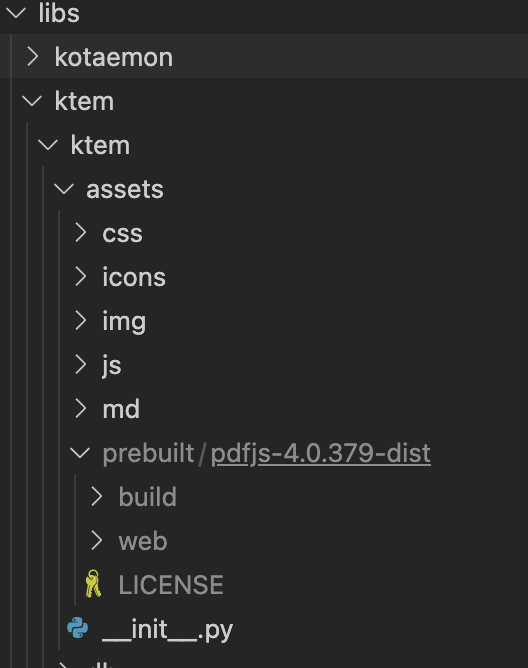
(Optional) To enable in-browser PDF_JS viewer, download PDF_JS_DIST then extract it to libs/ktem/ktem/assets/prebuilt.
Start the web server:
python app.py
The app will be automatically launched in your browser.
Default username and password are both admin. You can set up additional users directly through the UI.
Check the Resources tab and LLMs and Embeddings and ensure that your api_key value is set correctly from your .env file. If it is not set, you can set it there.
Setup GraphRAG
[!NOTE]
Official MS GraphRAG indexing only works with OpenAI or Ollama API.
We recommend most users to use NanoGraphRAG implementation for straightforward integration with Kotaemon.
Setup Nano GRAPHRAG
Install nano-GraphRAG: pip install nano-graphrag
nano-graphrag install might introduce version conflicts, see this issue
Launch Kotaemon with USE_LIGHTRAG=true environment variable.
Set your default LLM & Embedding models in Resources setting and it will be recognized automatically from LightRAG.
Setup MS GRAPHRAG
Non-Docker Installation: If you are not using Docker, install GraphRAG with the following command:
pip install "graphrag<=0.3.6" future
Setting Up API KEY: To use the GraphRAG retriever feature, ensure you set the GRAPHRAG_API_KEY environment variable. You can do this directly in your environment or by adding it to a .env file.
Using Local Models and Custom Settings: If you want to use GraphRAG with local models (like Ollama) or customize the default LLM and other configurations, set the USE_CUSTOMIZED_GRAPHRAG_SETTING environment variable to true. Then, adjust your settings in the settings.yaml.example file.
By default, all application data is stored in the ./ktem_app_data folder. You can back up or copy this folder to transfer your installation to a new machine.
For advanced users or specific use cases, you can customize these files:
flowsettings.py
.env
flowsettings.py
This file contains the configuration of your application. You can use the example
here as the starting point.
Notable settings
# setup your preferred document store (with full-text search capabilities)
KH_DOCSTORE=(Elasticsearch | LanceDB | SimpleFileDocumentStore)

# setup your preferred vectorstore (for vector-based search)
KH_VECTORSTORE=(ChromaDB | LanceDB | InMemory | Milvus | Qdrant)

# Enable / disable multimodal QA
KH_REASONINGS_USE_MULTIMODAL=True

# Setup your new reasoning pipeline or modify existing one.
KH_REASONINGS = [
    "ktem.reasoning.simple.FullQAPipeline",
    "ktem.reasoning.simple.FullDecomposeQAPipeline",
    "ktem.reasoning.react.ReactAgentPipeline",
    "ktem.reasoning.rewoo.RewooAgentPipeline",
]
.env
This file provides another way to configure your models and credentials.
Configure model via the .env file
Alternatively, you can configure the models via the .env file with the information needed to connect to the LLMs. This file is located in the folder of the application. If you don't see it, you can create one.
Currently, the following providers are supported:
OpenAI
In the .env file, set the OPENAI_API_KEY variable with your OpenAI API key in order
to enable access to OpenAI's models. There are other variables that can be modified,
please feel free to edit them to fit your case. Otherwise, the default parameter should
work for most people.
OPENAI_API_BASE=https://api.openai.com/v1
OPENAI_API_KEY=<your OpenAI API key here>
OPENAI_CHAT_MODEL=gpt-3.5-turbo
OPENAI_EMBEDDINGS_MODEL=text-embedding-ada-002
Azure OpenAI
For OpenAI models via Azure platform, you need to provide your Azure endpoint and API
key. You might also need to provide your developments' name for the chat model and the
embedding model depending on how you set up Azure development.
Set the model names on web UI and make it as default:
Using GGUF with llama-cpp-python
You can search and download a LLM to be ran locally from the Hugging Face Hub. Currently, these model formats are supported:
GGUF
You should choose a model whose size is less than your device's memory and should leave
about 2 GB. For example, if you have 16 GB of RAM in total, of which 12 GB is available,
then you should choose a model that takes up at most 10 GB of RAM. Bigger models tend to
give better generation but also take more processing time.
Here are some recommendations and their size in memory:
Add a new LlamaCpp model with the provided model name on the web UI.
Adding your own RAG pipeline
Custom Reasoning Pipeline
Check the default pipeline implementation in here. You can make quick adjustment to how the default QA pipeline work.
Add new .py implementation in libs/ktem/ktem/reasoning/ and later include it in flowssettings to enable it on the UI.
Custom Indexing Pipeline
Check sample implementation in libs/ktem/ktem/index/file/graph
(more instruction WIP).
Citation
Please cite this project as
@misc{kotaemon2024,
    title = {Kotaemon - An open-source RAG-based tool for chatting with any content.},
    author = {The Kotaemon Team},
    year = {2024},
    howpublished = {\url{https://github.com/Cinnamon/kotaemon}},
}
Star History
Contribution
Since our project is actively being developed, we greatly value your feedback and contributions. Please see our Contributing Guide to get started. Thank you to all our contributors!
kotaemon (Cinnamon/kotaemon)
Choose a tag and it will appear here. With no tags selected, all catalog projects are shown.
Searching Database…
Choose a tag and it will appear here. With no tags selected, all catalog projects are shown.









 Kotaemon 是一个开源的 RAG 工具,用来和自己的文档聊天:它提供一个简洁的网页界面,你可以针对自己的文件提问,既面向最终用户,也面向开发者。