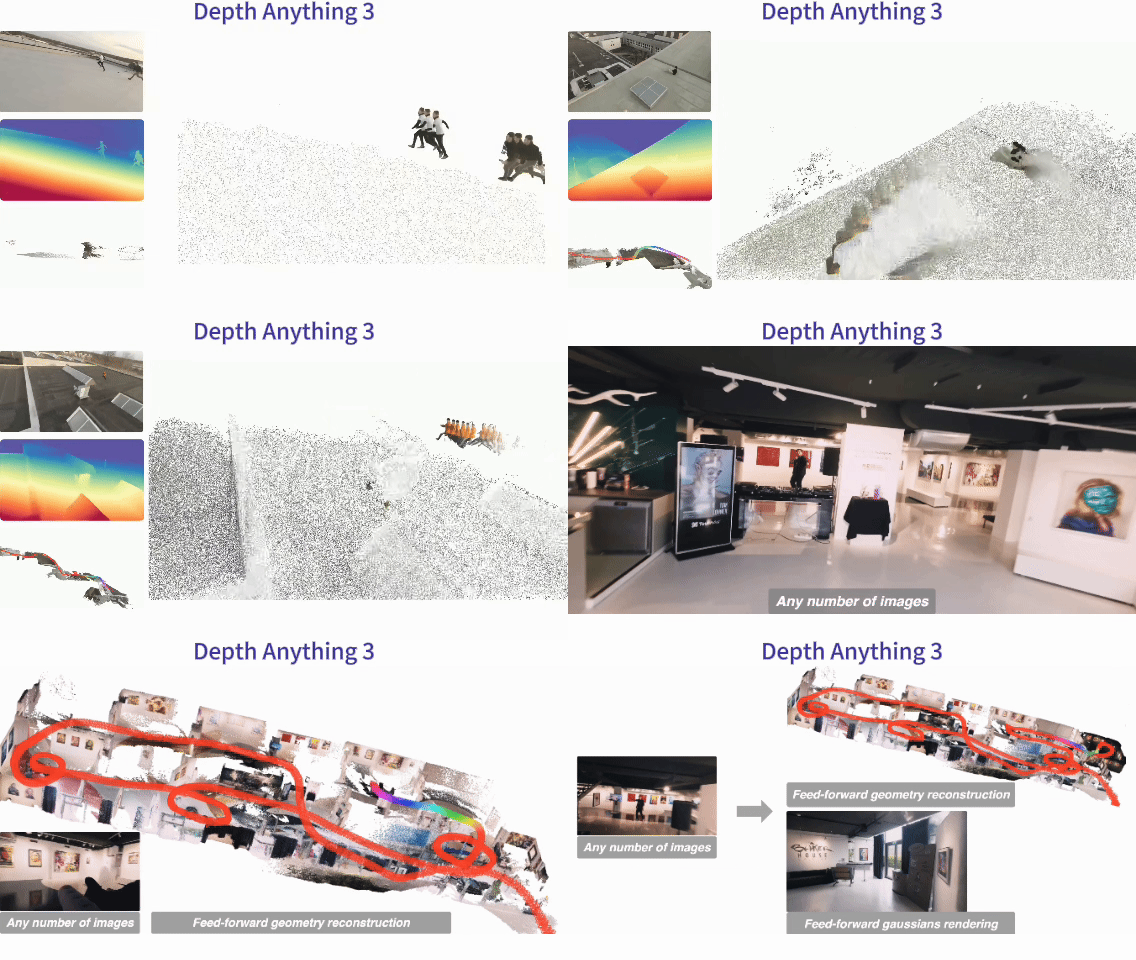
This work presents Depth Anything 3 (DA3), a model that predicts spatially consistent geometry from
arbitrary visual inputs, with or without known camera poses.
In pursuit of minimal modeling, DA3 yields two key insights:
- 💎 A single plain transformer (e.g., vanilla DINO encoder) is sufficient as a backbone without architectural specialization,
- ✨ A singular depth-ray representation obviates the need for complex multi-task learning.
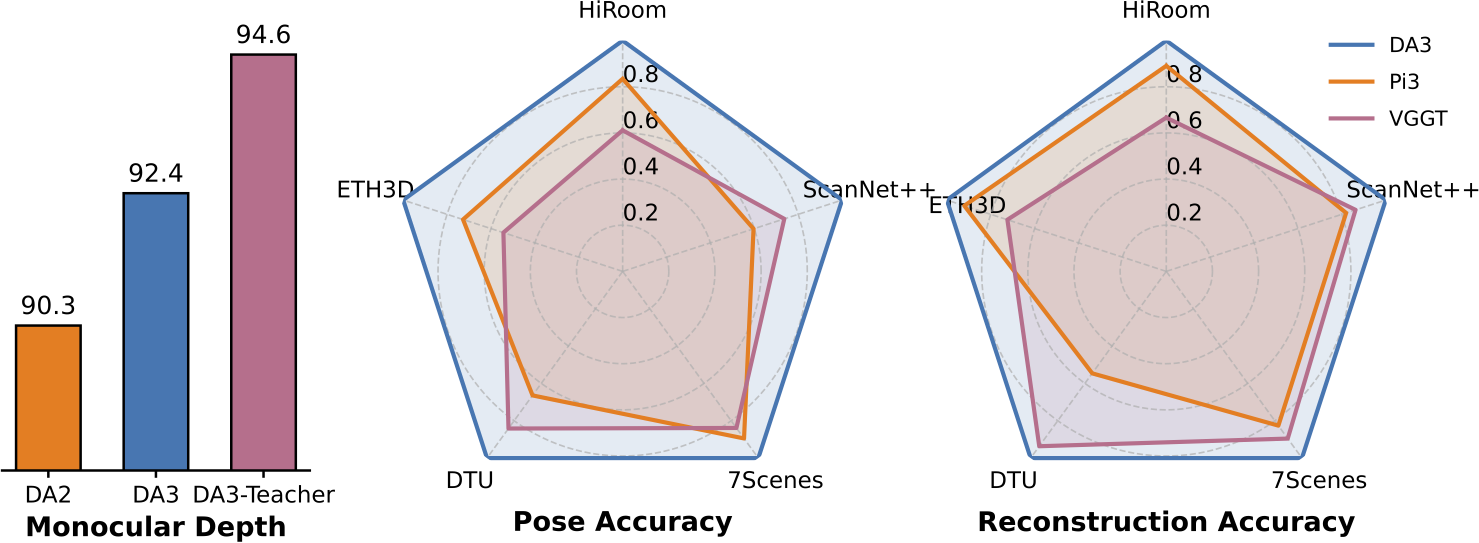
🏆 DA3 significantly outperforms
DA2 for monocular depth estimation,
and VGGT for multi-view depth estimation and pose estimation.
All models are trained exclusively on public academic datasets.
📰 News
- 11-12-2025: 🚀 New models and DA3-Streaming released! Handle ultra-long video sequence inference with less than 12GB GPU memory via sliding-window streaming inference. Special thanks to Kai Deng for his contribution to DA3-Streaming!
- 08-12-2025: 📊 Benchmark evaluation pipeline released! Evaluate pose estimation & 3D reconstruction on 5 datasets.
- 30-11-2025: Add
use_ray_pose and ref_view_strategy (reference view selection for multi-view inputs).
- 25-11-2025: Add Awesome DA3 Projects, a community-driven section featuring DA3-based applications.
- 14-11-2025: Paper, project page, code and models are all released.
✨ Highlights
🏆 Model Zoo
We release three series of models, each tailored for specific use cases in visual geometry.
🌟 DA3 Main Series (DA3-Giant, DA3-Large, DA3-Base, DA3-Small) These are our flagship foundation models, trained with a unified depth-ray representation. By varying the input configuration, a single model can perform a wide range of tasks:
- 🌊 Monocular Depth Estimation: Predicts a depth map from a single RGB image.
- 🌊 Multi-View Depth Estimation: Generates consistent depth maps from multiple images for high-quality fusion.
- 🎯 Pose-Conditioned Depth Estimation: Achieves superior depth consistency when camera poses are provided as input.
- 📷 Camera Pose Estimation: Estimates camera extrinsics and intrinsics from one or more images.
- 🟡 3D Gaussian Estimation: Directly predicts 3D Gaussians, enabling high-fidelity novel view synthesis.
📐 DA3 Metric Series (DA3Metric-Large) A specialized model fine-tuned for metric depth estimation in monocular settings, ideal for applications requiring real-world scale.
🔍 DA3 Monocular Series (DA3Mono-Large). A dedicated model for high-quality relative monocular depth estimation. Unlike disparity-based models (e.g., Depth Anything 2), it directly predicts depth, resulting in superior geometric accuracy.
🔗 Leveraging these available models, we developed a nested series (DA3Nested-Giant-Large). This series combines a any-view giant model with a metric model to reconstruct visual geometry at a real-world metric scale.
🛠️ Codebase Features
Our repository is designed to be a powerful and user-friendly toolkit for both practical application and future research.
- 🎨 Interactive Web UI & Gallery: Visualize model outputs and compare results with an easy-to-use Gradio-based web interface.
- ⚡ Flexible Command-Line Interface (CLI): Powerful and scriptable CLI for batch processing and integration into custom workflows.
- 💾 Multiple Export Formats: Save your results in various formats, including
glb, npz, depth images, ply, 3DGS videos, etc, to seamlessly connect with other tools.
- 🔧 Extensible and Modular Design: The codebase is structured to facilitate future research and the integration of new models or functionalities.
🚀 Quick Start
📦 Installation
pip install xformers torch\>=2 torchvision
pip install -e . # Basic
pip install --no-build-isolation git+https://github.com/nerfstudio-project/gsplat.git@0b4dddf04cb687367602c01196913cde6a743d70 # for gaussian head
pip install -e ".[app]" # Gradio, python>=3.10
pip install -e ".[all]" # ALL
For detailed model information, please refer to the Model Cards section below.
💻 Basic Usage
import glob, os, torch
from depth_anything_3.api import DepthAnything3
device = torch.device("cuda")
model = DepthAnything3.from_pretrained("depth-anything/DA3NESTED-GIANT-LARGE")
model = model.to(device=device)
example_path = "assets/examples/SOH"
images = sorted(glob.glob(os.path.join(example_path, "*.png")))
prediction = model.inference(
    images,
)
# prediction.processed_images : [N, H, W, 3] uint8   array
print(prediction.processed_images.shape)
# prediction.depth            : [N, H, W]    float32 array
print(prediction.depth.shape)
# prediction.conf             : [N, H, W]    float32 array
print(prediction.conf.shape)
# prediction.extrinsics       : [N, 3, 4]    float32 array # opencv w2c or colmap format
print(prediction.extrinsics.shape)
# prediction.intrinsics       : [N, 3, 3]    float32 array
print(prediction.intrinsics.shape)
export MODEL_DIR=depth-anything/DA3NESTED-GIANT-LARGE
# This can be a Hugging Face repository or a local directory
# If you encounter network issues, consider using the following mirror: export HF_ENDPOINT=https://hf-mirror.com
# Alternatively, you can download the model directly from Hugging Face
export GALLERY_DIR=workspace/gallery
mkdir -p $GALLERY_DIR

# CLI auto mode with backend reuse
da3 backend --model-dir ${MODEL_DIR} --gallery-dir ${GALLERY_DIR} # Cache model to gpu
da3 auto assets/examples/SOH \
    --export-format glb \
    --export-dir ${GALLERY_DIR}/TEST_BACKEND/SOH \
    --use-backend

# CLI video processing with feature visualization
da3 video assets/examples/robot_unitree.mp4 \
    --fps 15 \
    --use-backend \
    --export-dir ${GALLERY_DIR}/TEST_BACKEND/robo \
    --export-format glb-feat_vis \
    --feat-vis-fps 15 \
    --process-res-method lower_bound_resize \
    --export-feat "11,21,31"

# CLI auto mode without backend reuse
da3 auto assets/examples/SOH \
    --export-format glb \
    --export-dir ${GALLERY_DIR}/TEST_CLI/SOH \
    --model-dir ${MODEL_DIR}
The model architecture is defined in DepthAnything3Net, and specified with a Yaml config file located at src/depth_anything_3/configs. The input and output processing are handled by DepthAnything3. To customize the model architecture, simply create a new config file (e.g., path/to/new/config) as:
__object__:
  path: depth_anything_3.model.da3
  name: DepthAnything3Net
  args: as_params

net:
  __object__:
    path: depth_anything_3.model.dinov2.dinov2
    name: DinoV2
    args: as_params

  name: vitb
  out_layers: [5, 7, 9, 11]
  alt_start: 4
  qknorm_start: 4
  rope_start: 4
  cat_token: True

head:
  __object__:
    path: depth_anything_3.model.dualdpt
    name: DualDPT
    args: as_params

  dim_in: &head_dim_in 1536
  output_dim: 2
  features: &head_features 128
  out_channels: &head_out_channels [96, 192, 384, 768]
Then, the model can be created with the following code snippet.
from depth_anything_3.cfg import create_object, load_config

Model = create_object(load_config("path/to/new/config"))
📚 Useful Documentation
🗂️ Model Cards
Generally, you should observe that DA3-LARGE achieves comparable results to VGGT.
The Nested series uses an Any-view model to estimate pose and depth, and a monocular metric depth estimator for scaling.
⚠️ Models with the -1.1 suffix are retrained after fixing a training bug; prefer these refreshed checkpoints. The original DA3NESTED-GIANT-LARGE, DA3-GIANT, and DA3-LARGE remain available but are deprecated. You could expect much better performance for street scenes with the -1.1 models.
❓ FAQ
Monocular Metric Depth: To obtain metric depth in meters from DA3METRIC-LARGE, use metric_depth = focal * net_output / 300., where focal is the focal length in pixels (typically the average of fx and fy from the camera intrinsic matrix K). Note that the output from DA3NESTED-GIANT-LARGE is already in meters.
Ray Head (use_ray_pose): Our API and CLI support use_ray_pose arg, which means that the model will derive camera pose from ray head, which is generally slightly slower, but more accurate. Note that the default is False for faster inference speed.
AUC3 Results for DA3NESTED-GIANT-LARGE
| Model |
HiRoom |
ETH3D |
DTU |
7Scenes |
ScanNet++ |
ray_head |
84.4 |
52.6 |
93.9 |
29.5 |
89.4 |
cam_head |
80.3 |
48.4 |
94.1 |
28.5 |
85.0 |
Older GPUs without XFormers support: See Issue #11. Thanks to @S-Mahoney for the solution!
🏢 Awesome DA3 Projects
A community-curated list of Depth Anything 3 integrations across 3D tools, creative pipelines, robotics, and web/VR viewers, including but not limited to these. You are welcome to submit your DA3-based project via PR, and we will review and feature it if applicable.
DA3-blender: Blender addon for DA3-based 3D reconstruction from a set of images.
ComfyUI-DepthAnythingV3: ComfyUI nodes for Depth Anything 3, supporting single/multi-view and video-consistent depth with optional point‑cloud export.
DA3-ROS2-Wrapper: Real-time DA3 depth in ROS2 with multi-camera support.
DA3-ROS2-CPP-TensorRT: DA3 ROS2 C++ TensorRT Inference Node: a ROS2 node for DA3 depth estimation using TensorRT for real-time inference.
VideoDepthViewer3D: Streaming videos with DA3 metric depth to a Three.js/WebXR 3D viewer for VR/stereo playback.
🧑💻 Official Codebase Core Contributors and Maintainers

Bingyi Kang
|

Haotong Lin
|

Sili Chen
|

Jun Hao Liew
|

Donny Y. Chen
|

Kai Deng
|
📝 Citations
If you find Depth Anything 3 useful in your research or projects, please cite our work:
@article{depthanything3,
  title={Depth Anything 3: Recovering the visual space from any views},
  author={Haotong Lin and Sili Chen and Jun Hao Liew and Donny Y. Chen and Zhenyu Li and Guang Shi and Jiashi Feng and Bingyi Kang},
  journal={arXiv preprint arXiv:2511.10647},
  year={2025}
}




 Depth Anything 3(DA3)是字节跳动 Seed 推出的一个基础模型,可以从任意视觉输入中预测空间上保持一致的几何信息——深度、相机位姿,甚至 3D 高斯——无论是否已知相机位姿都可以。