




6.5K ·GitHub
What is this?
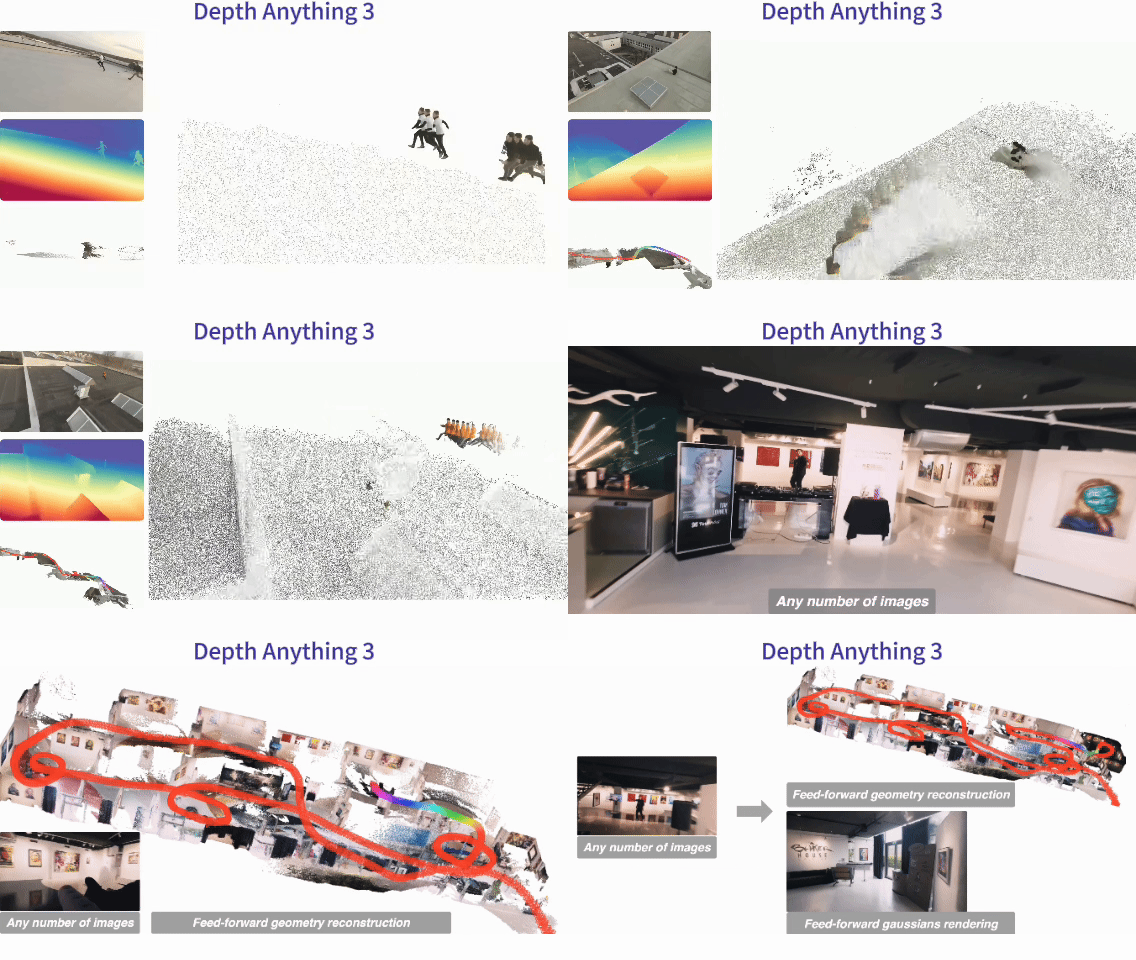
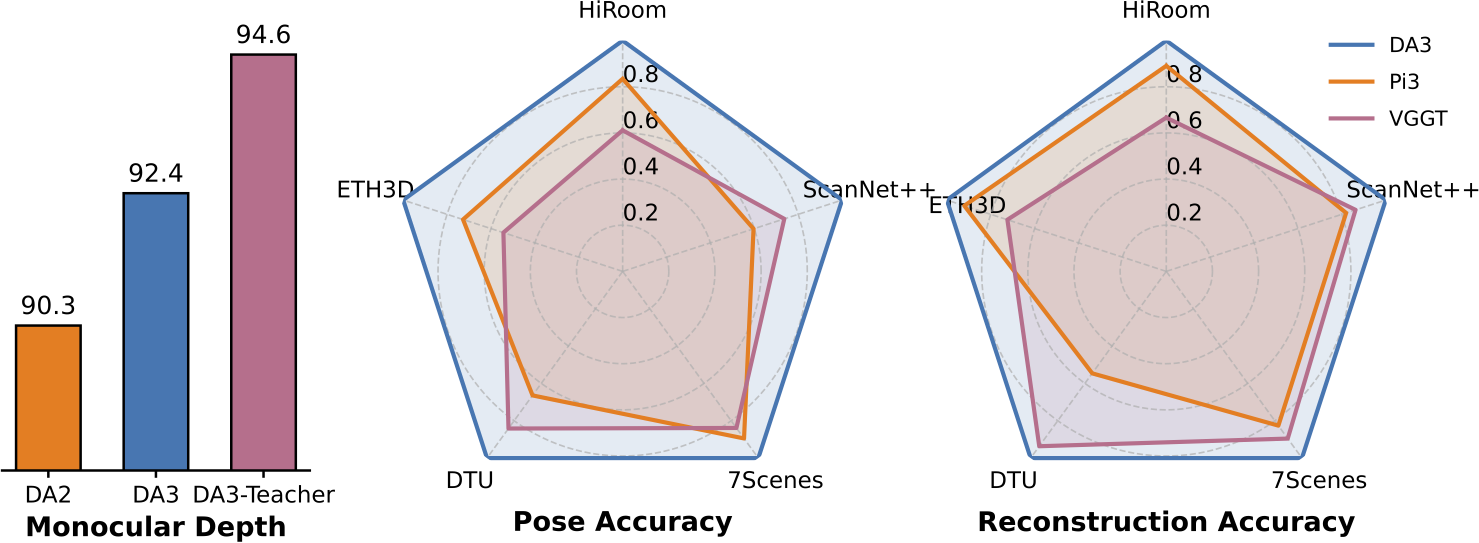
 Depth Anything 3 (DA3) is a foundation model from ByteDance Seed that predicts spatially consistent geometry — depth, camera poses, even 3D Gaussians — from arbitrary visual inputs, with or without known camera poses.
Depth Anything 3 (DA3) is a foundation model from ByteDance Seed that predicts spatially consistent geometry — depth, camera poses, even 3D Gaussians — from arbitrary visual inputs, with or without known camera poses.Is this a model I download, a Python library, or a ready-made app?Both, in one repo: pretrained checkpoints plus a Python toolkit that wraps them in a Gradio web UI, a scriptable CLI and a Python API. The architecture is defined in DepthAnything3Net and configured via Yaml files.
Both, in one repo: pretrained checkpoints plus a Python toolkit that wraps them in a Gradio web UI, a scriptable CLI and a Python API. The architecture is defined in DepthAnything3Net and configured via Yaml files.How do I get it running?It is a Python project: install the dependencies, download a checkpoint from the Model Zoo, then run it via the Gradio web UI for interactive use, the CLI for batch jobs, or the Python API.
It is a Python project: install the dependencies, download a checkpoint from the Model Zoo, then run it via the Gradio web UI for interactive use, the CLI for batch jobs, or the Python API.Any gotchas when grabbing the model weights?Yes: models with a -1.1 suffix were retrained after a training-bug fix and do better, especially on street scenes — prefer them; the original Giant, Large and Nested checkpoints are deprecated.
Yes: models with a -1.1 suffix were retrained after a training-bug fix and do better, especially on street scenes — prefer them; the original Giant, Large and Nested checkpoints are deprecated.Is it free to use for commercial projects?The code is Apache-2.0 and so are the smaller checkpoints (DA3-BASE, DA3-SMALL, DA3METRIC-LARGE, DA3MONO-LARGE), but the flagship GIANT, LARGE and NESTED weights are CC BY-NC 4.0 — non-commercial only.
The code is Apache-2.0 and so are the smaller checkpoints (DA3-BASE, DA3-SMALL, DA3METRIC-LARGE, DA3MONO-LARGE), but the flagship GIANT, LARGE and NESTED weights are CC BY-NC 4.0 — non-commercial only.Do I need a powerful GPU for this?You need a GPU, and model size is your lever — from DA3-Small (0.08B) up to Giant (1.15B). DA3-Streaming handles ultra-long video sequences on under 12GB of GPU memory via sliding-window inference.
You need a GPU, and model size is your lever — from DA3-Small (0.08B) up to Giant (1.15B). DA3-Streaming handles ultra-long video sequences on under 12GB of GPU memory via sliding-window inference.How do I get depth in real-world meters?Use DA3METRIC-LARGE and compute metricdepth = focal * netoutput / 300, where focal is the focal length in pixels (average of fx and fy from the intrinsic matrix K). The Nested series already outputs depth in meters.
Use DA3METRIC-LARGE and compute metricdepth = focal * netoutput / 300, where focal is the focal length in pixels (average of fx and fy from the intrinsic matrix K). The Nested series already outputs depth in meters.What does the useraypose flag change?It makes the model derive camera pose from the ray head instead — generally slightly slower but more accurate. The default is False for faster inference.
It makes the model derive camera pose from the ray head instead — generally slightly slower but more accurate. The default is False for faster inference.What data were the models trained on?All models are trained exclusively on public academic datasets, per the README.
All models are trained exclusively on public academic datasets, per the README.Does it plug into tools like Blender or ComfyUI?Yes — the community-curated Awesome DA3 list includes a Blender addon for reconstruction from image sets, ComfyUI nodes for single/multi-view and video-consistent depth, ROS2 wrappers for robotics, and a Three.js/WebXR video viewer.
Yes — the community-curated Awesome DA3 list includes a Blender addon for reconstruction from image sets, ComfyUI nodes for single/multi-view and video-consistent depth, ROS2 wrappers for robotics, and a Three.js/WebXR video viewer.What are similar projects?nerfstudio, vggt, lingbot-map, ml-sharp, vggt-omega, InsertAny3D, pointdit, ABot-Recon
nerfstudio, vggt, lingbot-map, ml-sharp, vggt-omega, InsertAny3D, pointdit, ABot-ReconWhich topics is it in?point-cloud, gaussian-splatting, vision-transformer, neural-rendering, pose-estimation, 3d-reconstruction, gradio, webui, transformer, inference, computer-vision, pytorch
point-cloud, gaussian-splatting, vision-transformer, neural-rendering, pose-estimation, 3d-reconstruction, gradio, webui, transformer, inference, computer-vision, pytorch